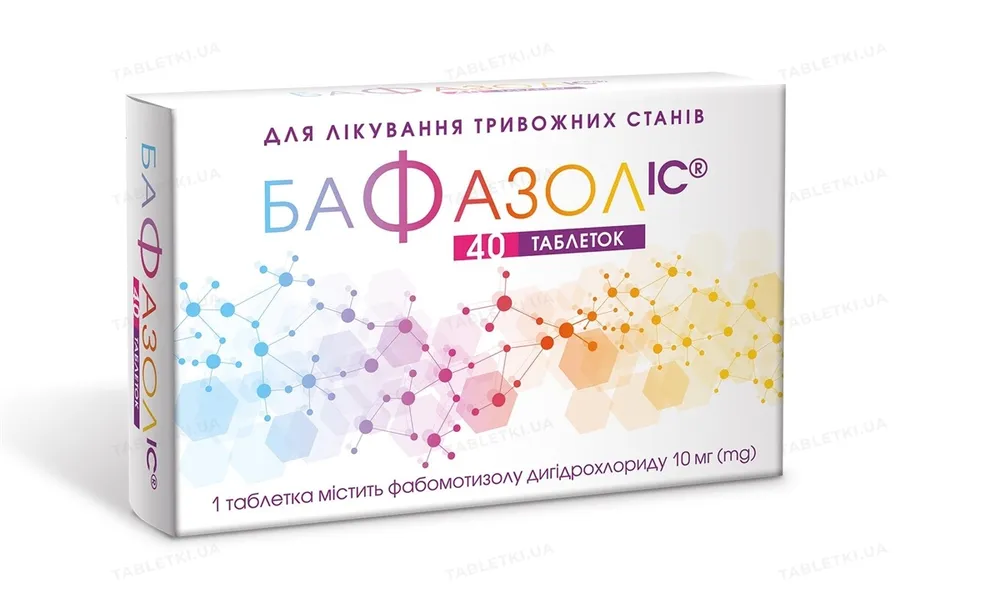
BAFAZOL IC®
UkraineThe drug is used to treat anxiety states, such as generalized anxiety disorders, neurasthenia, and adjustment disorders, as well as to treat sleep disturbances associated with anxiety, premenstrual syndrome, and to alleviate smoking cessation symptoms. It is also used in certain somatic diseases.
Frequently asked questions
How should Bafazol ic® be taken correctly?
The tablets should be taken orally after meals. The standard dose is 10 mg three times a day (a total of 30 mg per day). The course of treatment usually lasts from 2 to 4 weeks. Upon a doctor's recommendation, the dose can be increased to 60 mg per day, and the duration of administration can be extended up to 3 months.
What are the possible side effects of Bafazol ic®?
Allergic reactions are possible. Rarely, headaches may occur, which usually resolve on their own and do not require discontinuation of the drug.
Who should not take this drug?
The drug is contraindicated in children under 18 years of age, pregnant women, and breastfeeding women. It should also not be taken in case of individual intolerance to the components, galactose intolerance, lactase deficiency, or glucose-galactose malabsorption syndrome.
Does the drug affect the ability to drive a car?
No, the drug does not negatively affect the ability to drive a car or perform work that requires high concentration and rapid reaction time.
Does this agent cause addiction?
No, use of the drug does not lead to addiction, drug dependence, or withdrawal syndrome.
How does the drug interact with other substances?
The drug does not interact with ethanol. It may enhance the effects of carbamazepine (anticonvulsant effect) and diazepam (anxiolytic effect).
Instructions for use
INSTRUCTION FOR MEDICAL USE OF THE MEDICINAL PRODUCT BAFASOL IS®
Composition:
Active substance: fabomotizole;
1 tablet contains fabomotizole dihydrochloride 0.01 g (10 mg);
Excipients: potato starch, microcrystalline cellulose, StarLac® (lactose monohydrate, corn starch), talc, colloidal anhydrous silicon dioxide, magnesium stearate.
Pharmaceutical form. Tablets.
Main physicochemical properties: tablets of white or white with creamish shade, flat cylindrical shape with bevelled edge; slight color inhomogeneity is allowed; the trade mark of the manufacturer is imprinted on one side of the tablet, a score line is present on the other side.
Pharmacotherapeutic group.
Agents acting on the nervous system. Psycholeptics. Anxiolytics. Other anxiolytics. Fabomotizole. ATC code N05BX04.
Pharmacological Properties
Pharmacodynamics
Fabomotizole is a selective non-benzodiazepine anxiolytic.
By acting on σ1-receptors in brain neurons, fabomotizole stabilizes GABA/benzodiazepine receptors and restores their sensitivity to endogenous inhibitory mediators. Fabomotizole also enhances the bioenergetic potential of neurons and exerts a neuroprotective effect: it restores and protects nerve cells.
The action of fabomotizole is primarily achieved through a combination of anxiolytic (anti-anxiety) and mild stimulating (activating) effects. Fabomotizole reduces or eliminates feelings of anxiety (worry, apprehension, fear), irritability, tension (nervousness, tearfulness, restlessness, inability to relax, insomnia, fear), depressive mood, somatic manifestations of anxiety (muscular, sensory, cardiovascular, respiratory, gastrointestinal symptoms), vegetative disturbances (dry mouth, increased sweating, dizziness), and cognitive disorders (reduced concentration, memory impairment), including those occurring in stress-related disorders (adjustment disorders). The drug is particularly indicated for individuals with predominantly asthenic personality traits, such as anxious mistrust, uncertainty, increased vulnerability, emotional lability, and a tendency toward emotional-stress reactions.
The effect of the drug develops by the 5th to 7th day of treatment. Maximum effect is achieved by the end of the 4th week of treatment and persists for an average of 1–2 weeks after discontinuation.
The drug does not cause muscle weakness or drowsiness and does not negatively affect attention or memory. With its use, no habituation, drug dependence, or withdrawal syndrome develops.
Pharmacokinetics
Absorption
Fabomotizole is well and rapidly absorbed from the gastrointestinal tract after oral administration.
Maximum plasma concentration (Cmax) of fabomotizole is 0.130±0.073 μg/mL; time to reach maximum concentration (tmax) is 0.85±0.13 hours.
Metabolism
Fabomotizole undergoes the first-pass effect in the liver. The main metabolic pathways are hydroxylation of the aromatic ring of the benzimidazole cycle and oxidation of the morpholine fragment.
Distribution
Fabomotizole is intensively distributed into well-vascularized organs. It is characterized by rapid transfer from the central pool (blood plasma) to the peripheral compartment (highly vascularized organs and tissues).
Elimination
The elimination half-life of fabomotizole after oral administration is 0.82±0.54 hours. The short half-life is due to intensive biotransformation of fabomotizole and rapid distribution from blood plasma to organs and tissues. Fabomotizole is excreted mainly as metabolites, partially unchanged, in urine and feces.
It does not accumulate in the body during prolonged use.
Clinical characteristics.
Indications.
The medicinal product is indicated for use in adults for the treatment of anxiety disorders: generalized anxiety disorders, neurasthenia, adjustment disorders, and in patients with various somatic diseases (bronchial asthma, irritable bowel syndrome, systemic lupus erythematosus, ischemic heart disease, arterial hypertension, arrhythmias), as well as dermatological, oncological, and other conditions.
The medicinal product is used for the treatment of sleep disturbances associated with anxiety; neurocirculatory dystonia; premenstrual syndrome; alcohol withdrawal syndrome; and for alleviating withdrawal symptoms during smoking cessation.
Contraindications.
Hypersensitivity to any component of the medicinal product. Galactose intolerance, lactase deficiency, or glucose-galactose malabsorption syndrome. Pregnancy and breastfeeding. Pediatric use under 18 years of age.
Interaction with other medicinal products and other forms of interaction.
Fabomotizol does not interact with ethanol and does not affect the hypnotic action of thiopental. It enhances the anticonvulsant effect of carbamazepine. It causes an increase in the anxiolytic effect of diazepam.
Special precautions for use.
Patients with known intolerance to certain sugars should consult a physician before using the medicinal product.
Due to the content of lactose, the medicinal product should not be administered to patients with rare hereditary galactose intolerance, lactase deficiency, or glucose-galactose malabsorption syndrome.
Use during pregnancy or breastfeeding.
The use of the medicinal product during pregnancy is contraindicated.
Breastfeeding should be discontinued for the duration of treatment with the medicinal product.
Ability to affect reaction rate when driving or operating machinery.
The medicinal product does not negatively affect the ability to drive or operate machinery, or the ability to perform potentially hazardous activities requiring increased attention and psychomotor reaction speed.
Method of Administration and Dosage
Administer orally after meals.
The optimal single dose is 10 mg, and the daily dose is 30 mg, divided into 3 doses taken throughout the day. The duration of treatment is 2–4 weeks.
If necessary, upon physician's recommendation, the daily dose may be increased up to 60 mg and the treatment duration extended up to 3 months.
Children.
The use of the medicinal product in children under 18 years of age is contraindicated.
Overdose.
In cases of significant overdose and intoxication, a sedative effect and increased drowsiness may develop, without manifestations of myorelaxation.
Treatment. As emergency therapy, administer caffeine 20% solution in ampoules, 1 ml subcutaneously 2–3 times daily.
Adverse reactions.
Allergic reactions may occur.
Rarely – headache, which usually resolves spontaneously and does not require discontinuation of the medicinal product.
Reporting of suspected adverse reactions
Reporting of adverse reactions following registration of the medicinal product is of great importance. It enables ongoing monitoring of the benefit/risk balance of the medicinal product. Healthcare and pharmaceutical professionals, as well as patients or their legal representatives, should report all suspected adverse reactions and lack of efficacy via the Automated Information System for Pharmacovigilance at the following link: https://aisf.dec.gov.ua.
Shelf life. 2 years.
Storage conditions.
Store in the original packaging at a temperature not exceeding 25 °C.
Keep out of reach of children.
Packaging.
20 tablets in a blister; 2 or 3 blisters per carton.
Supply category. Over-the-counter (without prescription).
Manufacturer.
Limited liability company "INTERKHIM".
Manufacturer's address and location of its business activity.
40-A, 21st km, Starokyivska Road, Odesa, 65025, Ukraine.
The original data is available in the language of the country of manufacture.
Data source: State Register of Medicinal Products of Ukraine
Data last verified: August 13, 2026