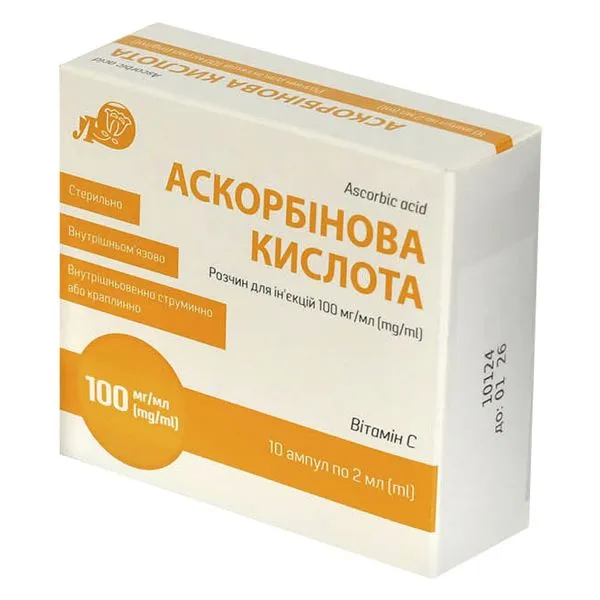
ASCORBIC ACID
UkraineThe drug is used for vitamin C deficiency (hypovitaminosis) and zinc deficiency. It is also prescribed for bleeding, hemorrhagic diathesis, infectious diseases, bone fractures, intoxications, during pregnancy, breastfeeding, and during heavy physical labor.
Frequently asked questions
How should Ascorbic acid be taken correctly?
The drug is administered intramuscularly (deep into the muscle) or intravenously (as a bolus or infusion). The dosage is selected individually. Adults and children aged 12 and older are usually prescribed 50–150 mg per day; in cases of poisoning, the dose may be higher. For children under 12, the dosage is calculated based on age and body weight.
Who should not use this drug?
Contraindications include hypersensitivity to the components, diabetes mellitus, tendency to thrombosis, urolithiasis, renal failure, hemochromatosis, thalassemia, leukemia, and certain types of anemia. It is also not recommended in progressive malignant diseases.
What side effects can Ascorbic acid cause?
Possible side effects include nausea, diarrhea, stomach cramps, headache, fatigue, and sleep disturbances. With prolonged use of high doses, kidney problems (stone formation), increased blood pressure, impaired sugar metabolism, or fluid retention in the body may occur. Very rarely, allergic reactions such as rash or anaphylactic shock may occur.
Can the drug be combined with other medicines or alcohol?
Ascorbic acid may interact with many drugs: it reduces the effect of anticoagulants (blood thinners), contraceptives, and certain antibiotics. Consuming alcohol while using high doses of the drug may cause a specific bodily reaction. It is also important to consider that the drug may change the composition of other medicines due to its chemical properties.
Does the drug affect pregnancy and breastfeeding?
The drug can be used, but it is important not to exceed the recommended doses. Intravenous administration of large doses poses a risk of pregnancy termination. During breastfeeding, large doses may pass into the milk; therefore, if high doses are necessary, it is recommended to discontinue breastfeeding.
Instructions for use
INSTRUCTIONS for medical use of the medicinal product ASCORBIC ACID (ASCORBIC ACID)
Composition:
Active ingredient: ascorbic acid;
1 ml of solution contains 50 mg or 100 mg of ascorbic acid;
Excipients: sodium hydrocarbonate, sodium metabisulphite (E 223), disodium edetate, water for injections.
Pharmaceutical form. Injection solution.
Main physico-chemical properties: 5 % solution – clear colorless or slightly yellowish liquid; 10 % solution – clear liquid ranging from colorless to yellowish.
Pharmacotherapeutic group. Simple ascorbic acid preparations. Ascorbic acid (vitamin C). ATC code A11G A01.
Pharmacological Properties.
Pharmacodynamics.
Ascorbic acid (vitamin C) is a water-soluble vitamin that supports optimal tissue metabolism. It actively participates in redox reactions, forming with dehydroascorbic acid a hydrogen proton transfer system, exhibits antioxidant properties, thereby ensuring the stability of cellular membranes. It is involved in the synthesis of the ground substance of vascular wall connective tissue, thus preventing the development of hemorrhagic diathesis. It is not synthesized in the human body. When ascorbic acid intake from food is insufficient, bleeding from the gums and mucous membranes develops. It participates in glucose metabolism, cholesterol catabolism, and synthesis of steroid hormones. During stress reactions, the content of ascorbic acid in the body, particularly in adrenal gland tissue, decreases significantly, confirming the involvement of ascorbic acid in adaptation responses. It is capable of exerting an anti-anemic effect due to its influence on iron metabolism. It reduces trivalent iron to divalent iron, which is then transported in the bloodstream.
Pharmacokinetics.
After parenteral administration, ascorbic acid readily penetrates into leukocytes and platelets, and then into all tissues; it accumulates mainly in organs with elevated metabolic activity, particularly in adrenal gland tissue. In tissues, it exists both in free form and as various compounds. It is excreted from the body in urine, both in unchanged form and as metabolites.
Alcohol consumption and smoking accelerate the breakdown of ascorbic acid (conversion into inactive metabolites), sharply reducing its body stores.
Clinical characteristics.
Indications.
Vitamin C deficiency; scurvy, hemorrhages (uterine, pulmonary, nasal, hepatic), hemorrhagic diatheses, bleeding as a symptom complex of radiation sickness, various intoxications and infectious diseases, nephropathy in pregnancy, Addisonian crisis, anticoagulant overdose, bone fractures and slowly healing wounds, various dystrophies, pregnancy and lactation, increased mental strain and heavy physical labor.
Contraindications.
Increased individual sensitivity to ascorbic acid or to any of the excipients; diabetes mellitus, increased blood coagulation, predisposition to thrombosis, thrombophlebitis, urolithiasis (including hyperoxaluria), renal insufficiency, progressive malignant diseases, hemochromatosis, thalassemia, polycythemia, leukemia, sideroblastic anemia, sickle cell anemia, glucose-6-phosphate dehydrogenase deficiency.
Interaction with other medicinal products and other forms of interaction.
Ascorbic acid increases blood concentrations of salicylates (increasing the risk of crystalluria), ethinylestradiol, benzylpenicillin, and tetracyclines, while decreasing blood levels of oral contraceptives. It increases the excretion of drugs with alkaline reactions (including alkaloids). In high doses, it enhances renal excretion of mexiletine.
Tetracyclines and acetylsalicylic acid enhance the urinary excretion of ascorbic acid.
Concomitant administration with salicylates and short-acting sulfonamides increases the risk of urinary stone formation.
High doses of ascorbic acid can reduce urine pH, thereby decreasing tubular reabsorption of concurrently administered amphetamines and tricyclic antidepressants.
It increases iron excretion in patients taking deferoxamine.
It reduces the anticoagulant effect of coumarin derivatives and heparin, as well as the efficacy of antibiotics.
It enhances detoxification and total clearance of ethanol.
It reduces the chronotropic effect of isoprenaline and the therapeutic effect of phenothiazine derivatives.
Concomitant use with barbiturates and primidone increases urinary excretion of ascorbic acid.
When ascorbic acid is used in high doses together with alcohol consumption, a disulfiram-like reaction may develop.
Special precautions for use
When high doses are administered, monitoring of renal function and blood pressure (due to stimulation by ascorbic acid of corticosteroid production) as well as pancreatic function (due to suppression of the islet apparatus) is required.
High-dose therapy is contraindicated in patients with a tendency to recurrent urolithiasis. In patients with renal insufficiency, adequate fluid intake (1.5–2 L per day) should be ensured to reduce the risk of crystalluria.
Administration of high doses of ascorbic acid may interfere with the results of certain laboratory tests: false-positive urine glucose test results, false-negative fecal occult blood test results, and decreased serum levels of lactate dehydrogenase and aminotransferases.
Patients with increased body iron content should receive ascorbic acid in minimal doses.
High doses of the drug should not be prescribed to patients on a low-sodium diet.
Administration of ascorbic acid to patients with rapidly proliferating and intensively metastasizing tumors may enhance these processes. In patients undergoing chemotherapy, the drug should not be administered earlier than 1–3 days after chemotherapy (depending on the half-life of the antineoplastic agent), due to lack of clinical data on possible interactions.
Use during pregnancy or breastfeeding
The minimal daily requirement for ascorbic acid during the second and third trimesters of pregnancy is approximately 60 mg. Ascorbic acid crosses the placental barrier. It should be noted that the fetus may adapt to high doses of ascorbic acid taken by the pregnant woman, and subsequently, scurvy may develop in the newborn as a withdrawal reaction. Therefore, the drug should not be administered in increased doses during pregnancy, except when the potential benefit to the mother outweighs the possible risk to the fetus.
The minimal daily requirement for ascorbic acid during breastfeeding is 80 mg. A mother's diet containing an adequate amount of ascorbic acid is sufficient to prevent deficiency in the infant. Ascorbic acid is excreted in breast milk. There is a theoretical risk to the infant when the mother takes high doses of ascorbic acid (during breastfeeding, exceeding the daily requirement for ascorbic acid is not recommended). If higher doses of the drug are necessary, breastfeeding should be discontinued.
Ability to affect reaction speed when driving or operating machinery
The drug, when used at recommended doses, does not impair the ability to drive or operate machinery.
Administration and Dosage
The drug is administered intravenously by bolus or infusion, and intramuscularly.
Intravenous bolus injection should be given over 1–3 minutes. For intravenous infusion, the single dose should be diluted in 50–100 mL of 0.9% sodium chloride solution and administered by slow intravenous infusion at a rate of 30–40 drops per minute.
Intramuscular injection should be administered deeply into the muscle.
Dosages are individually determined, depending on the nature and severity of the disease.
Adults and children aged 12 years and older: The usual daily dose is 50–150 mg. In cases of poisoning, the daily dose may be increased up to 500 mg. Maximum single dose – 200 mg; maximum daily dose – 1 g.
Children under 12 years of age: Intravenous administration at a daily dose of 5–7 mg/kg body weight as a 5% solution (0.5–2 mL). Usual daily doses for children are: under 6 months – 30 mg; 6–12 months – 35 mg; 1–3 years – 40 mg; 4–10 years – 45 mg; 11–12 years – 50 mg. Maximum daily dose – 100 mg.
Special patient groups: In patients with recurrent kidney stone formation, the daily dose of ascorbic acid should not exceed 100–200 mg. In patients with severe or end-stage renal insufficiency (patients on dialysis), the daily dose of ascorbic acid should not exceed 50–100 mg. In patients with glucose-6-phosphate dehydrogenase deficiency, the daily dose of ascorbic acid should not exceed 100–500 mg.
Children.
For administration to children, refer to the section "Administration and Dosage".
Overdose.
Large doses of ascorbic acid may cause gastrointestinal disturbances, including diarrhea, and may lead to hyperoxaluria and formation of oxalate calculi. Doses exceeding 600 mg daily may produce a diuretic effect.
When administered intravenously in high doses, there is a risk of threatened pregnancy termination.
Treatment: Discontinue the drug and provide symptomatic therapy.
Adverse Reactions
Ascorbic acid is generally well tolerated; however, the following adverse effects may occur.
Blood and lymphatic system disorders: with prolonged use in high doses – thrombocytosis, hyperprothrombinemia, thrombosis, erythrocytopenia, neutrophilic leukocytosis.
Nervous system disorders: headache, fatigue; with prolonged use in high doses – sleep disturbances, increased excitability of the central nervous system.
Gastrointestinal disorders: nausea, diarrhea, stomach cramps.
Renal and urinary disorders: hyperoxaluria; with prolonged use in high doses – damage to the glomerular apparatus of the kidneys, formation of calcium oxalate kidney stones.
Skin and subcutaneous tissue disorders: very rarely – skin rash, hyperemia, pruritus, erythema, urticaria, edema.
Metabolism and nutritional disorders: hypervitaminosis C; with prolonged use in high doses – suppression of the function of the islet apparatus of the pancreas (hyperglycemia, glucosuria) and glycogen synthesis, sodium and fluid retention, disturbances in zinc and copper metabolism.
Vascular disorders: decreased capillary permeability, impaired tissue trophism; with prolonged use in high doses – myocardial dystrophy, increased arterial pressure, development of microangiopathies.
General disorders: chills, increased body temperature.
Pregnancy: with intravenous administration in high doses – risk of pregnancy termination.
Immune system disorders: very rarely – anaphylactic shock.
Shelf life.
2 years.
Storage conditions.
Store in the original packaging at a temperature not exceeding 25 °C.
Keep out of reach of children.
Incompatibility.
Ascorbic acid has a high redox potential, which may alter the chemical composition of other drugs. Therefore, when considering the possibility of concomitant use with other medicinal products, their compatibility must be confirmed.
Packaging. 2 mL in ampoules. 10 ampoules per box with partitions; or 5 ampoules in a single-sided blister pack, 2 blisters per box; or 100 ampoules per box with partitions.
Prescription status.
By prescription only.
Manufacturer.
Private Joint-Stock Company "Lekhym-Kharkiv".
Manufacturer's location and address of business activity.
Ukraine, 61115, Kharkiv region, Kharkiv, Severin Pototskogo Street, 36.
Similar drugs
| Brand name | Dosage form | Active substance / Dosage | Manufacturer |
|---|---|---|---|
| ASCORBIC ACID | solution for injection |
|
JSC "Lubnipharm" |
| ASCORBIC ACID | solution for injection |
|
JSC "Lubnipharm" |
| ASCORBIC ACID | solution for injection |
|
PJSC "Lekhim - Kharkiv" |
| ASCORBIC ACID | solution for injection |
|
LLC "Research Plant "GNCLS" (quality control, batch release) |
| ASCORBIC ACID-DARNITSA | solution for injection |
|
PJSC «Pharmaceutical Company «Darnitsa» |
| ASCORBIC ACID-DARNITSA | solution for injection |
|
PJSC «Pharmaceutical Company «Darnitsa» |
| ASCORBIC ACID-ZDOROVYA | solution for injection |
|
LLC "Corporation "Zdorovya" |
| ASCORBIC ACID-ZDOROVYA | solution for injection |
|
LLC "Corporation "Zdorovya" |
The original data is available in the language of the country of manufacture.
Data source: State Register of Medicinal Products of Ukraine
Data last verified: August 13, 2026