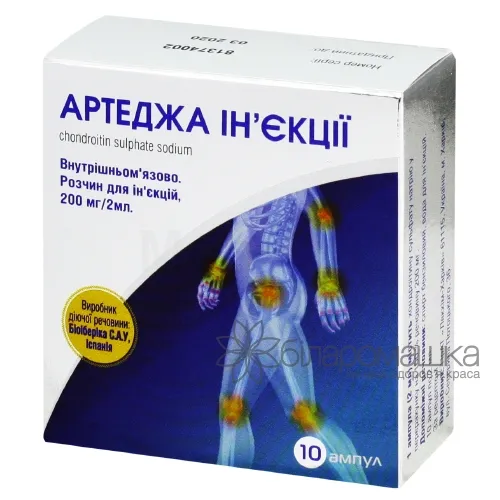
ARTEJJA® INJECTION
UkraineThe drug is used for degenerative-dystrophic diseases of the joints and spine (arthrosis, osteochondrosis, osteoarthritis), osteoporosis, periodontopathies, as well as to accelerate the recovery of bone tissue after fractures and joint surgeries.
Frequently asked questions
How should Artejja® injection be taken correctly?
For adults, the drug is administered intramuscularly at a dose of 1 ml every other day. If the drug is well tolerated, starting from the fourth injection, the dose may be increased to 2 ml. A standard course consists of 25 to 35 injections, and repeat courses are recommended after 6 months.
What are the possible side effects of Artejja® injection?
Possible allergic reactions (edema, anaphylactic shock), skin rash, itching, redness at the injection site, dizziness, swelling, and visual disturbances (keratopathy).
Who should not use this drug?
Contraindications include hypersensitivity to the components, tendency to bleeding, thrombophlebitis, renal insufficiency, severe liver disease, pregnancy, and breastfeeding.
Can the drug be combined with other medicines?
The drug may enhance the effect of anti-inflammatory and analgesic agents. When taken simultaneously with acetylsalicylic acid, anticoagulants, or antiplatelet agents, blood clotting must be monitored.
Does the drug affect the ability to drive a vehicle?
No, the use of the drug does not limit the ability to drive motor vehicles or operate complex machinery.
Instructions for use
INSTRUCTIONS FOR MEDICAL USE OF THE MEDICINAL PRODUCT ARTEJAD® INJECTIONS (ARTEDJAINJECTIONS)
Composition:
Active substance: chondroitin sulphate sodium;
1 ampoule (2 ml) contains 200 mg of sodium chondroitin sulphate, calculated as 100% substance;
Excipients: benzyl alcohol, water for injections.
Pharmaceutical form. Solution for injection.
Main physicochemical properties: clear, colorless liquid or slightly yellowish in tint, with a specific odor.
Pharmacotherapeutic group.
Medicinal products affecting the musculoskeletal system. Chondroitin sulphate.
ATC code M01AX25.
Pharmacological Properties.
Pharmacodynamics. The main active ingredients of the drug are sodium salts of chondroitin sulfate A and C. Chondroitin sulfate is a high-molecular-weight mucopolysaccharide. It is a key component of proteoglycans, which, together with collagen fibers, form the cartilage matrix.
The medicinal product inhibits the degeneration process and stimulates regeneration of cartilage tissue, exerting chondroprotective, anti-inflammatory, and analgesic effects. It replaces chondroitin sulfate in joint cartilage degraded by the pathological process. It suppresses the activity of enzymes causing degradation of articular cartilage: inhibits metalloproteinases, particularly leukocyte elastase. It reduces hyaluronidase activity. Partially blocks the release of free oxygen radicals; promotes inhibition of chemotaxis and antigenic determinants. Stimulates proteoglycan production by chondrocytes. Influences phosphorus-calcium metabolism in cartilage tissue. Helps restore mechanical and elastic integrity of the cartilage matrix. Anti-inflammatory and analgesic effects are achieved by reducing the release of inflammatory mediators and pain factors into the synovial fluid by synoviocytes and macrophages of the synovial membrane, as well as due to inhibition of leukotriene B and prostaglandin E secretion.
The use of the drug promotes restoration of the joint capsule and cartilage surfaces, prevents compression of connective tissue, acts as a lubricant for joint surfaces, normalizes production of joint fluid, improves joint mobility, contributes to reduction in pain intensity, and enhances quality of life.
The drug slows down bone tissue resorption and reduces calcium loss, while accelerating bone tissue regeneration processes.
Pharmacokinetics. After intramuscular administration, chondroitin sulfate penetrates into the synovial fluid. Maximum concentration in the synovial fluid is reached within 4–5 hours after injection. It is eliminated from the body within 24 hours. Elimination is primarily renal.
Clinical characteristics.
Indications. Degenerative-dystrophic joint and spinal diseases (primary osteoarthritis, intervertebral osteochondrosis, osteoarthrosis), osteoporosis, periodontopathies, fractures (to accelerate formation of bone callus). Treatment of post-surgical complications in joints.
Contraindications.
Hypersensitivity to any component of the drug, tendency to bleeding, thrombophlebitis, renal failure, hepatic insufficiency in the decompensated stage, pregnancy, breastfeeding.
Interaction with other medicinal products and other forms of interaction. When used concomitantly with glucocorticoids and nonsteroidal anti-inflammatory agents, chondroitin sulfate may reduce the need for these drugs, as well as for analgesics. A synergistic effect is observed when used simultaneously with glucosamine and other chondroprotective agents. Treatment efficacy is enhanced by enriching the diet with vitamins A and C, and salts of manganese, magnesium, copper, zinc, and selenium.
When used concomitantly with acetylsalicylic acid or other anticoagulants or antiplatelet agents, monitoring of blood coagulation is recommended.
Special precautions for use.
To achieve a stable clinical effect, at least 25 injections of the drug are required. The therapeutic effect persists for many months after completion of treatment. To prevent exacerbations, repeated treatment courses should be administered. Dose escalation under physician supervision is recommended for patients with excess body weight, gastric peptic ulcer, those concurrently using diuretics, and at the beginning of treatment when a faster clinical response is needed.
Treatment should be discontinued in case of allergic reactions or hemorrhages.
1 ml of the medicinal product contains 9 mg of benzyl alcohol; therefore, it should not be used in premature infants and newborns. Benzyl alcohol may cause toxic and allergic reactions in infants and children under 3 years of age.
Use with caution in patients with coagulation disorders; diabetes mellitus; individuals with increased body weight; patients on a low-salt diet; renal function impairment; and women planning pregnancy.
Use during pregnancy or breastfeeding. Do not use during pregnancy or breastfeeding.
Starting from the 20th week of pregnancy, the use of nonsteroidal anti-inflammatory drugs (NSAIDs) may cause oligohydramnios due to fetal renal dysfunction. This condition may occur soon after starting treatment and is usually reversible upon discontinuation of therapy. Additionally, there have been reports of arterial duct constriction following NSAID treatment in the second trimester of pregnancy, which in most cases resolved after stopping the treatment.
Ability to influence reaction rate when driving or operating machinery. There are no restrictions regarding driving or operating complex machinery during use of this medicinal product.
Method of administration and dosage.
Administer 1 ml of the drug intramuscularly every other day to adults. In case of good tolerance, increase the dose to 2 ml starting from the fourth injection. Treatment course consists of 25–35 injections. Repeat courses should be administered after 6 months.
Children. There is no experience with the use of the drug in children.
Overdose. There have been no reports of overdose symptoms associated with the use of this drug to date. It can be assumed that exceeding the daily dose may enhance the drug's adverse effects. Treatment is symptomatic.
Adverse reactions.
When using the drug in patients with increased hypersensitivity to the drug, the following reactions are possible:
Immune system disorders: allergic reactions, anaphylactic shock, angioneurotic edema;
Skin and subcutaneous tissue disorders: skin rashes, itching, erythema, urticaria, dermatitis, alopecia. At the injection site, redness and itching may occur;
Eye disorders: keratopathy;
Other: dizziness, peripheral edema.
Shelf life. 2 years.
Storage conditions. Store in the original packaging at a temperature not exceeding 25 °C, in a place inaccessible to children.
Incompatibility. No cases of incompatibility have been documented since the beginning of chondroitin sulfate use (1960); however, mixing solutions of high-molecular-weight polysaccharides (including chondroitin sulfate) with solutions of other medicinal products should be avoided.
Packaging. 2 ml in ampoules. 10 ampoules per pack or 5 ampoules per blister, 2 blisters per pack.
Prescription status. Prescription only.
Manufacturer. JSC "PHYTOPHARM"
Manufacturer's address and place of business.
17 Chumatska Street, Boryspil, Kyiv region, 08303, Ukraine.
Marketing authorization holder. Delta Medical Promotions AG
Address of the marketing authorization holder.
26 Oetenbachgasse, Zurich CH-8001, Switzerland / 26 Oetenbachgasse, Zurich CH-8001, Switzerland
Similar drugs
| Brand name | Dosage form | Active substance / Dosage | Manufacturer |
|---|---|---|---|
| ARTIDA | solution for injection |
|
HAUPT Pharma Livron |
| ARTIFLEX CHONDRO | solution for injection |
|
LLC "Corporation "Zdorovya" (all manufacturing stages, quality control, batch release) |
| ARTROX | solution for injection |
|
LLC Firm Novofarm-Biosyntez |
| CHONDROSAT | solution for injection |
|
FZ "STADA" LLC |
| HITART | solution for injection |
|
LLC Firm "Novofarm-Biosyntez" (full-cycle manufacturing) |
| STAUREM | solution for injection |
|
K.T. Rompharm Company S.R.L. (manufacturing, quality control testing (physical/chemical), primary packaging, batch release) |
The original data is available in the language of the country of manufacture.
Data source: State Register of Medicinal Products of Ukraine
Data last verified: August 13, 2026