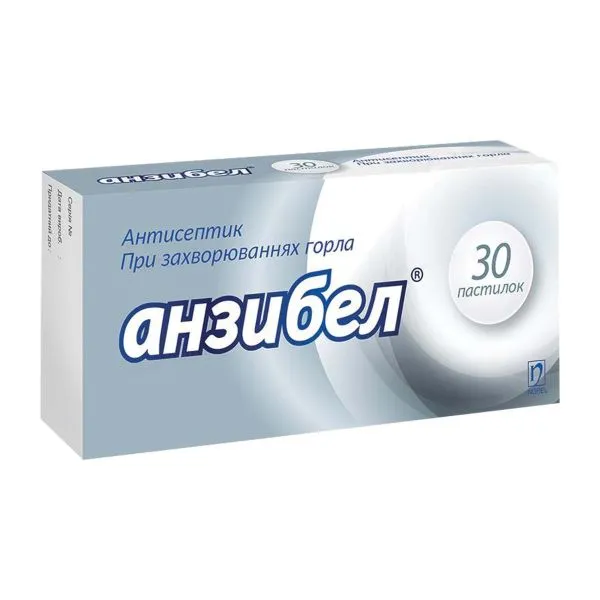
ANZIBEL®
UkraineThe drug is used for the local treatment of symptoms of infectious inflammatory diseases of the oral cavity and pharynx.
Frequently asked questions
How should Anzibel be taken correctly?
Adults and children aged 12 years and older should dissolve 1 lozenge every 2–3 hours. The maximum daily dose is 8 lozenges. It is recommended to take the drug after eating and brushing teeth. After dissolving, you should not rinse your mouth or drink large amounts of liquid for 2 hours.
Who should not use this drug?
Contraindications include hypersensitivity to the components of the drug or to other anesthetic agents, as well as phenylketonuria. The drug should not be used during pregnancy and breastfeeding. The drug is not recommended for children under 12 years of age.
What are the possible side effects of Anzibel?
Possible allergic reactions (itching, rash, urticaria), changes in taste, appearance of dental plaque or brown stains on tooth enamel and fillings. Irritation of the oral mucosa, diarrhea, edema, or increased blood pressure may also be observed with prolonged use.
Can the drug be combined with other medicines?
It must not be used together with other antiseptics or products containing iodine. Caution should also be exercised when taken simultaneously with sulfanilamides or cholinesterase inhibitors.
Does the drug affect driving a car?
No, the drug does not affect reaction speed when driving a vehicle.
Instructions for use
INSTRUCTIONS FOR MEDICAL USE OF THE MEDICINAL PRODUCT ANZIBEL®
Composition:
Chlorhexidine hydrochloride, benzocaine, enoxolone.
1 tablet contains: chlorhexidine hydrochloride 5 mg, benzocaine 4 mg, enoxolone 3 mg.
Excipients:
Tablets: sorbitol (E 420), potassium acesulfame, magnesium stearate.
Menthol-flavored tablets: sorbitol (E 420), potassium acesulfame, magnesium stearate, menthol flavoring agent.
Honey and lemon-flavored tablets: sorbitol (E 420), potassium acesulfame, magnesium stearate, lemon flavoring agent, honey flavoring agent.
Pharmaceutical form:
Tablets.
Main physical and chemical properties:
Round, biconvex tablets, white or almost white, smooth on one side and marked with the logo «ŋ» on the other;
Round, biconvex tablets, white or almost white, with a menthol odor, smooth on one side and marked with the logo «ŋ» on the other;
Round, biconvex tablets, white or almost white, with a lemon and honey odor, smooth on one side and marked with the logo «ŋ» on the other.
Pharmacotherapeutic group:
Preparations used in throat diseases. Antiseptics.
ATC code: R02A A20.
Pharmacological properties:
Pharmacodynamics:
Anzibel® is a combined antiseptic preparation intended for local application in the oropharyngeal area. The pharmacological effect is provided by the components of the formulation.
Chlorhexidine exerts bacteriostatic action at low concentrations and bactericidal action at high concentrations. The mechanism of action of chlorhexidine involves binding to the bacterial cell membrane, leading to disruption of its structure. It is active against staphylococci, streptococci, Candida albicans, Escherichia coli, and certain aerobic and anaerobic bacteria. Proteus, Pseudomonas, and Klebsiella spp. are weakly sensitive to chlorhexidine.
Benzocaine provides local anesthetic action in the presence of pronounced pain syndrome. It is used for the treatment of wounds of the oral mucosa or tongue.
Enoxolone has anti-inflammatory and analgesic properties, as well as pronounced antiviral activity against DNA- or RNA-containing viruses, including various strains of Herpes simplex and Herpes zoster viruses.
Clinical characteristics:
Indications:
Local treatment of symptoms in infectious inflammatory diseases of the oral cavity and pharynx.
Contraindications:
Hypersensitivity to any component of the drug or known hypersensitivity to other agents with anesthetic activity, including ester derivatives with anesthetic properties.
Phenylketonuria.
Interaction with other medicinal products and other types of interactions:
Do not use with other medicinal products containing antiseptics.
Concomitant use with iodine-containing preparations is not recommended.
Due to the presence of benzocaine, the drug interacts with cholinesterase inhibitors (inhibits the metabolism of local anesthetics, increasing the risk of systemic toxicity) and with sulfonamides (metabolites of benzocaine may inhibit the antibacterial activity of sulfonamides).
Concomitant use of enoxolone and hydrocortisone may potentiate the skin effects of the latter.
Interaction with diagnostic tests:
Interaction may occur with diagnostic tests for pancreatic function using bentiramid. Results are invalid because benzocaine is metabolized to arylamines and also increases the amount of para-aminobenzoic acid (PABA). It is recommended to discontinue treatment at least 3 days before the test.
Special precautions for use:
Do not exceed the recommended dose.
When using local anesthetics, including benzocaine, there is an increased risk of systemic toxicity in elderly patients, patients with acute illnesses, or debilitated patients.
With prolonged use or high doses of enoxolone in elderly patients, fluid retention, edema, and arterial hypertension may occur.
Patients with intolerance to ester-type local anesthetics (especially para-aminobenzoic acid (PABA) derivatives, parabens, or paraphenylenediamine (hair dyes)) may also exhibit intolerance to benzocaine.
The benefit-risk ratio should be evaluated in the following situations:
- Severe mucosal injuries (increased absorption of anesthetics).
- On surfaces filled with fillings or with uneven edges, irreversible staining may occur due to the action of chlorhexidine.
The drug contains benzocaine, which may cause a positive doping test result in athletes.
Anzibel® contains sorbitol and is not recommended for patients with hereditary fructose intolerance.
If a patient has intolerance to certain sugars, consult a physician before taking this medicinal product.
Anzibel® contains potassium acesulfame, which should be taken into account in patients with impaired or reduced kidney function or in patients on a potassium-controlled diet.
Since the drug contains potassium acesulfame, there is a risk of increased potassium levels in the stomach in patients with impaired potassium absorption. Elevated potassium levels may cause gastric irritation and diarrhea.
In patients with periodontitis, chlorhexidine may increase supragingival calculus formation. Adequate oral hygiene should be maintained using anti-calculus toothpaste to prevent calculus accumulation and tooth discoloration due to chlorhexidine.
Use during pregnancy or breastfeeding:
Anzibel® should not be used during pregnancy.
Enoxolone, when used in high doses exceeding 60 mg/day or with prolonged use, may promote fluid retention, edema, and arterial hypertension, which should be considered in pregnant women.
There are insufficient data on the use of chlorhexidine and benzocaine in pregnant women.
It is unknown whether the active components of the drug pass into breast milk; therefore, the drug should not be used during breastfeeding.
Ability to influence reaction rate when driving or operating machinery:
No effect.
Method of administration and dosage:
The drug should be administered into the oral cavity.
Tablets should be held in the mouth until completely dissolved.
Recommended doses for adults and children aged 12 years and older:
1 tablet every 2–3 hours (maximum daily dose – 8 tablets).
Should be used after meals and after tooth brushing.
It is recommended not to rinse the mouth or drink large amounts of liquid within 2 hours after sucking the tablets.
The duration of treatment depends on the course of the disease and usually lasts from 3 to 7 days. However, if symptoms persist or worsen within 2 days after starting treatment, a physician should be consulted.
Children:
The efficacy and safety of Anzibel® in children under 12 years of age have not been established; therefore, the drug should not be prescribed to this age group.
Overdose:
Overdose is unlikely.
In case of enoxolone overdose, hypermineralocorticoidism, sodium retention, potassium loss, edema, elevated blood pressure, and suppression of the aldosterone-renin-angiotensin system (RAAS) may occur.
In case of chlorhexidine overdose, especially in children, symptoms of alcohol intoxication (slurred speech, numbness, or unsteady gait) may occur.
Despite the low absorption of benzocaine, excessive intake may lead to systemic absorption, with symptoms such as blurred vision, diplopia, dizziness, seizures, tinnitus, excitement (CNS stimulation) changing to drowsiness (CNS depression), increased sweating, decreased blood pressure, slowed pulse, arrhythmia, and cardiovascular depression.
Treatment of chlorhexidine overdose is symptomatic. Treatment includes administration of oxygen or artificial respiration if necessary. Treatment of circulatory depression requires vasopressors and fluids.
Patients may develop methemoglobinemia (difficulty breathing, dizziness, weakness, fatigue, lethargy), in which case methylene blue should be administered.
Adverse reactions:
Immune system: allergic reactions, including nasal congestion.
Skin and subcutaneous tissue: itching, urticaria, skin rashes, contact dermatitis.
Cardiovascular system: with chronic use, edema and arterial hypertension may occur.
Gastrointestinal system: altered taste, dental plaque, discoloration/pigmentation of tooth enamel (brown stains), fillings and dental prostheses, parotitis, gastric mucosa irritation, diarrhea, tongue and oral mucosa pain, irritation or inflammation of the oral mucosa and tongue, as well as burning, itching, swelling, or redness of the mucosa in the mouth or around the mouth.
Shelf life:
3 years.
Storage conditions:
Store at a temperature not exceeding 25 °C in the original packaging. Keep out of reach of children.
Packaging:
10 tablets in a blister.
10 tablets in a blister; 1, 2, or 3 blisters per cardboard package.
Prescription status:
Over-the-counter.
Manufacturer:
NOBEL ILAC SANAYI VE TICARET A.S.
Address: Sancaclar Quarter, Eskisehir Yolu Akcakoca Street No: 299, 81100 Duzce, Turkey.
Similar drugs
The original data is available in the language of the country of manufacture.
Data source: State Register of Medicinal Products of Ukraine
Data last verified: August 13, 2026