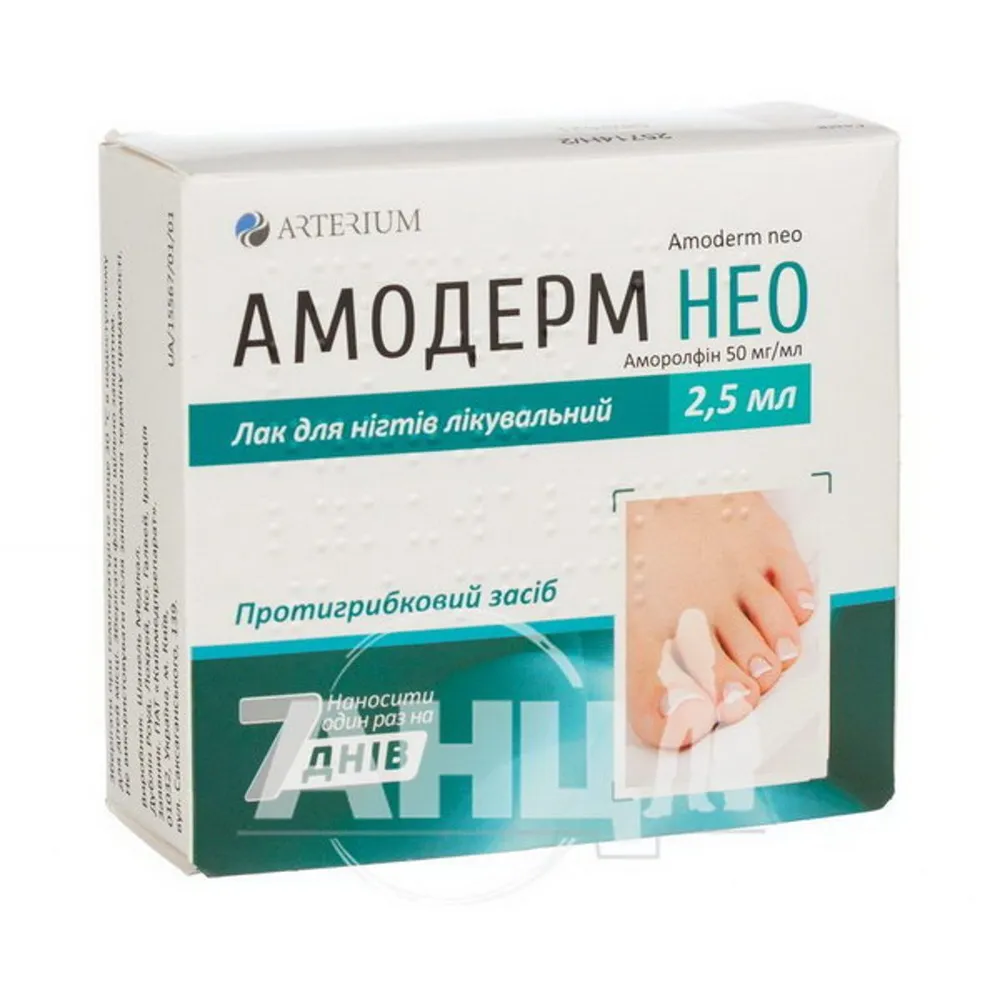
AMODERM NEO
UkraineThe drug is used to treat mild to moderate onychomycosis (nail fungus) caused by dermatophytes, yeasts, or molds, provided that the nail matrix is not affected.
Frequently asked questions
How should Amoderm neo lacquer be used correctly?
Before the first use, the affected nail surface must be thoroughly filed with a nail file, then cleaned and degreased with an alcohol solution or nail polish remover. Apply the lacquer to the entire surface of the affected nail using the included spatula and allow it to dry for 3-5 minutes. Repeat the procedure once or twice a week until the nail has completely regrown. Treatment usually lasts 6 months for hands and 9 months for feet.
Can cosmetic nail polish be applied over the therapeutic agent?
Cosmetic nail polish can be applied no earlier than 10 minutes after applying Amoderm neo. Before each new application of the therapeutic lacquer, any remaining cosmetic product must be removed.
Who should not use this drug?
The lacquer should not be used in case of hypersensitivity to the active substance or excipients. It is also not recommended for use in children under 18 years of age. Pregnant and breastfeeding women should not use the drug, except in cases of absolute necessity.
What are the possible side effects of Amoderm neo?
Allergic reactions are possible (itching, redness, contact dermatitis, blisters, or systemic allergic reaction). Changes in nail color, brittleness, or fragility may also rarely be observed.
Does this product interact with other medicines?
Currently, there is no data to suggest that the drug has clinically significant interactions with other medicinal products.
Instructions for use
INSTRUCTION FOR MEDICAL USE OF THE MEDICINAL PRODUCT AMODERM NEO (AMODERM NEO)
Composition:
Active substance: amorolfine;
1 ml contains: amorolfine hydrochloride equivalent to 50 mg of amorolfine;
Excipients: ammonium methacrylate copolymer (type A), triacetin,
n-butyl acetate, ethyl acetate, anhydrous ethanol.
Pharmaceutical form. Therapeutic nail lacquer.
Main physicochemical properties: transparent solution, colorless to light yellow.
Pharmacotherapeutic group.
Antifungal agents for dermatological use. Other topical antifungal agents. ATC code D01AE16.
Pharmacological properties.
Pharmacodynamics.
An antifungal agent for topical use. Amorolfine belongs to a new class of chemical compounds; its fungicidal action is based on altering the fungal cell membrane, primarily through affecting sterol biosynthesis. The content of ergosterol decreases, while atypical non-planar sterols accumulate simultaneously.
Amorolfine is a broad-spectrum antifungal agent. It is highly active (MIC < 2 mcg/mL) in vitro against:
- dermatophytes Trichophyton, Microsporum, Epidermophyton;
- yeasts Candida, Cryptococcus, Malassezia;
- molds Hendersonula, Alternaria, Scopulariopsis, Scytalidium, Aspergillus;
- fungi of the family Dematiaceae: Cladosporium, Fonsecaea, Wangiella;
- dimorphic fungi Coccidioides, Histoplasma, Sporothrix.
Bacteria, with the exception of actinomycetes, are insensitive to amorolfine.
Pharmacokinetics.
Amorolfine contained in the nail lacquer penetrates into the nail plate and diffuses through it, thereby being able to eradicate fungi located in the nail bed that are difficult to reach. Systemic absorption of the active substance after such application is very low; its plasma concentration remains below the detection limit, even after one year of use.
Clinical characteristics.
Indications.
Treatment of onychomycosis without matrix involvement (mild to moderate degree), caused by dermatophytes, yeasts, and mold fungi.
Contraindications.
Hypersensitivity to the active substance or to any of the excipients.
Interaction with other medicinal products and other forms of interaction.
Current available data do not indicate the presence of clinically significant interactions.
Special precautions for use.
The nail lacquer should not be applied to the skin around the nail. Avoid contact of the lacquer with eyes, ears, and mucous membranes.
The lacquer should be used with caution in patients with conditions that predispose them to nail damage (peripheral circulation disorders, diabetes mellitus, and immunosuppression), as well as in patients with nail dystrophy or severely damaged nails (when more than two-thirds of the nail plate is destroyed). In such cases, systemic treatment should be considered.
Do not use artificial nails during application of the lacquer.
When working with organic solvents, impermeable gloves should be worn to prevent dissolution of the lacquer. Cosmetic nail polish may be applied no sooner than 10 minutes after application of the medicinal lacquer. Before reapplying the medicinal lacquer, cosmetic nail polish must be carefully removed.
Systemic or local allergic reactions may occur after using this medicinal product. In such cases, discontinue use of the lacquer immediately and consult a physician. The product should be thoroughly removed using a nail polish remover. The medicinal product must not be used again.
Use during pregnancy or breastfeeding.
There is limited data on the use of amorolfine during pregnancy or breastfeeding. Post-marketing reports include only a small number of pregnant women who used topical amorolfine, so the potential risk is unknown. Animal studies have shown reproductive toxicity when the drug was administered at high oral doses.
It is unknown whether amorolfine passes into breast milk.
Amoderm Neo should not be used during pregnancy or breastfeeding, except in cases where it is clearly necessary.
Ability to influence reaction rate while driving or operating machinery. No effect.
Method of administration and dosage.
Apply Amoderm Neo nail lacquer to affected nails once or twice a week.
The lacquer should be applied, strictly following the recommendations:
| Contents: 10 applicators for lacquer application |
Contents:10 applicators for lacquer application, 30 cleansing wipes with isopropyl alcohol, 30 nail files in a cardboard box. |
|
|
|
|
|
|
|
|
||
|
||
|
||
|
||
Nail cosmetic varnish should not be applied earlier than 10 minutes after application of Amoderm Neo varnish. Treatment should be continued without interruption until complete nail renewal and full clinical and mycological healing of affected areas.
The duration of treatment is generally 6 months for fingernails and 9 months for toenails (this depends primarily on the severity of infection, its location, and the extent of nail involvement).
Special recommendations:
- Files used for filing infected nails should not be reused for filing healthy nails.
- Prior to each new application, if necessary, the affected nails should be filed and in all cases cleaned with a nail polish remover to remove residual varnish.
- When working with organic solvents (such as white spirit, thinners, etc.), impermeable gloves should be worn to protect nails coated with Amoderm Neo varnish.
Children.
Due to lack of data, the use of Amoderm Neo varnish in patients under 18 years of age is not recommended.
Overdose.
Isolated cases of adverse reactions may occur. Possible nail disorders such as nail discoloration and nail brittleness. Such reactions may also be associated with onychomycosis.
No systemic signs of overdose are expected following topical application of the varnish. In case of accidental oral ingestion, appropriate symptomatic treatment should be administered.
Adverse reactions.
| Organ system class |
Frequency |
Adverse reactions |
| Immune system disorders |
Frequency unknown (cannot be estimated from available data) |
Hypersensitivity (systemic allergic reaction)* |
| Skin and subcutaneous tissue disorders |
Uncommon |
Nail disorders, nail discoloration, brittle nails (onychoclasis), fragile nails (onychorrhexis) |
| Very rare |
Skin burning sensation |
|
| Frequency unknown (cannot be estimated from available data) |
Erythema, pruritus, contact dermatitis, urticaria, blisters |
* Adverse reactions reported since the product was marketed.
Shelf life. 3 years.
Storage conditions.
Store at a temperature not exceeding 30 ºC, in a place inaccessible to children.
Keep the bottle tightly closed.
Packaging.
2.5 ml in a bottle together with applicators for lacquer application in a cardboard box; 2.5 ml in a bottle together with nail files, cleansing wipes, and applicators for lacquer application in a cardboard box.
Availability category. Over-the-counter.
Manufacturer.
Chanel Medical Limited Company.
Manufacturer's address and place of business.
Dublin Road, Lochrea, H62 FH90, Ireland.
Marketing Authorization Holder.
PJSC "Kyivmedpreparat".
Address of the Marketing Authorization Holder.
139 Saksaganskogo Street, Kyiv, 01032, Ukraine.
Similar drugs
| Brand name | Dosage form | Active substance / Dosage | Manufacturer |
|---|---|---|---|
| AMOROLFINE-INTELI | nail polish, medicinal |
|
Chanel Medical Unlimited Company |
| FUNGOSEPT® | nail polish, medicinal |
|
Farmaklar (manufacturing in bulk, primary and secondary packaging, quality control) |
| LOCERYL | nail polish, medicinal |
|
GALDERMA LABORATORIES |
| ONIHELP | nail polish, medicinal |
|
Belupo, Medicines and Cosmetics, d.d. (quality control and batch release) |
The original data is available in the language of the country of manufacture.
Data source: State Register of Medicinal Products of Ukraine
Data last verified: August 13, 2026