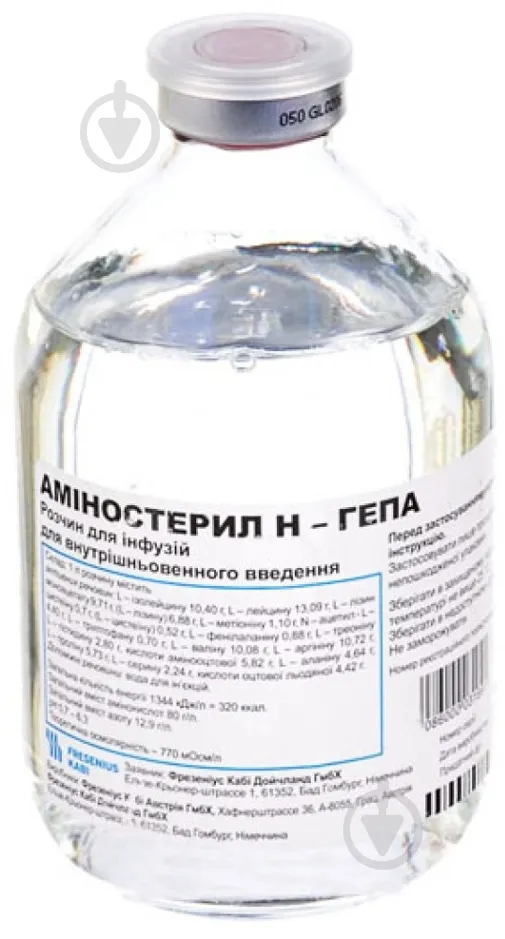
AMINOSTERIL N-HEPA
UkraineThe drug is used for the parenteral (intravenous) administration of amino acids in severe forms of hepatic insufficiency, with or without hepatic encephalopathy, if the patient cannot or is unable to receive nutrition via the mouth or intestines.
Frequently asked questions
How should Aminosteril n-hepa be taken correctly?
The drug is administered intravenously. The dosage is usually 1–1.25 ml per 1 kg of body weight per hour. The maximum daily dose is 1.5 g of amino acids per 1 kg of body weight. The drug should be used as part of comprehensive parenteral nutrition along with carbohydrates, fats, electrolytes, and vitamins.
What are the contraindications for use?
The drug must not be used in cases of amino acid metabolism disorders, metabolic acidosis, hypervolemia (excess fluid in the body), hyponatremia, hypokalemia, renal failure, decompensated heart failure, shock, hypoxia, as well as in cases of hypersensitivity to any component of the composition.
What are the possible side effects of Aminosteril n-hepa?
When administered through peripheral veins, thrombophlebitis is possible. Hypersensitivity reactions, injection site reactions, headache, chills, increased body temperature, nausea, and vomiting may also occur.
Can this drug be mixed with other agents?
It is not recommended to mix amino acid solutions with other drugs to avoid the risk of contamination or incompatibility. Carbohydrates, fat emulsions, electrolytes, or vitamins may only be added provided there is thorough control of sterility and compatibility.
Can the drug be used during pregnancy or breastfeeding?
No specific studies have been conducted, but clinical experience has not shown signs of danger. The drug may be used only when the expected benefit to the woman outweighs the potential risk to the fetus or child.
Instructions for use
INSTRUCTIONS FOR MEDICAL USE OF THE MEDICINAL PRODUCT AMINOSTERIL N-HEPA (AMINOSTERIL N-HEPA)
Composition:
1000 ml of solution contains
Active substances:
L-isoleucine 10.4 g
L-leucine 13.09 g
L-lysine monacetate 9.71 g
(L-lysine) 6.88 g
L-methionine 1.1 g
N-acetyl-L-cysteine 0.7 g
(L-cysteine) 0.52 g
L-phenylalanine 0.88 g
L-threonine 4.4 g
L-tryptophan 0.7 g
L-valine 10.08 g
L-arginine 10.72 g
L-histidine 2.8 g
aminoacetic acid 5.82 g
L-alanine 4.64 g
L-proline 5.73 g
L-serine 2.24 g
glacial acetic acid 4.42 g;
Excipient: water for injections.
Total amino acid content – 80 g/L.
Total nitrogen content – 12.9 g/L.
Pharmaceutical form. Infusion solution.
Main physicochemical properties: clear solution.
pH = 5.7 – 6.3. NaOH titer – 12 – 25 mmol/L. Theoretical osmolarity – 770 mosm/L.
Pharmacotherapeutic group. Solutions for parenteral nutrition.
ATC code B05BA01.
Pharmacological properties.
Pharmacodynamics.
Signs of liver failure in patients include:
- increased plasma ammonia concentration;
- severe amino acid imbalance in the blood, resulting in decreased concentrations of branched-chain amino acids (valine, leucine, isoleucine) and increased concentrations of aromatic amino acids (tyrosine, phenylalanine, tryptophan) and methionine;
- hypercatabolism.
The combination of these factors leads to cerebral changes, which primarily contribute to the development of hepatic encephalopathy and hepatic coma.
In the context of infusion therapy, normalization of these factors is supported by administration of amino acid solutions containing a high proportion of branched-chain amino acids and simultaneously a low proportion of aromatic amino acids and methionine.
Amino acids are components of proteins in ordinary food and are used for tissue protein synthesis, while any excess is directed toward various metabolic processes.
Studies have demonstrated the thermogenic effect of amino acid infusions.
Pharmacokinetics.
Aminosteryl N-Hepa, when administered intravenously as part of parenteral nutrition, has 100% bioavailability.
The formulation takes into account amino acid metabolism disturbances in severe liver failure. The content of methionine, phenylalanine, and tryptophan is reduced, yet sufficient to meet requirements, while the content of branched-chain amino acids (leucine, isoleucine, and valine) is significantly increased (42%) compared to solutions intended for patients with normal liver function.
Clinical characteristics.
Indications.
For parenteral administration of amino acids in severe forms of hepatic insufficiency with or without hepatic encephalopathy, when oral or enteral nutrition is impossible, insufficient, or contraindicated.
Contraindications.
Disorders of amino acid metabolism, metabolic acidosis, hypervolemia, hyponatremia, hypokalemia, renal failure, decompensated heart failure, shock, hypoxia, hypersensitivity to any component of the drug.
Interaction with other medicinal products and other types of interactions.
Currently, there are no data on interactions between Aminosteril N-Hepta and other medicinal products. Amino acid solutions should not be mixed with other drugs to avoid the risk of microbiological contamination and incompatibility.
If carbohydrates, fat emulsions, electrolytes, vitamins, or trace elements need to be added to Aminosteril N-Hepta to ensure complete parenteral nutrition, sterility, mixing quality, and compatibility must be carefully monitored.
Special precautions for use.
Use immediately after opening the vial.
Use only sterile equipment for administration of the solution.
For single use only.
Do not use after the expiry date.
Use only a clear, particle-free solution from undamaged packaging.
Any unused solution or mixture must be discarded.
Serum electrolyte levels, fluid balance, acid-base balance, blood glucose, serum protein, creatinine, and liver function biochemical parameters must be monitored.
Electrolytes and carbohydrates should be administered in a balanced manner, using parallel infusions if necessary.
Aminosteril N-Hepa has a specific composition; therefore, its use for indications other than those recommended may lead to amino acid imbalances and severe metabolic disturbances.
The choice between peripheral or central venous administration depends on the final osmolarity of the mixture. The generally accepted limit for peripheral infusions is approximately 800 mOsm/L, but this may vary depending on the patient's age, general condition, and characteristics of peripheral veins.
To minimize the risk of thrombophlebitis, infusion sites should be frequently monitored when peripheral veins are used.
Use during pregnancy or breastfeeding.
Specific safety studies of Aminosteril N-Hepa during pregnancy or breastfeeding have not been conducted. However, clinical experience compared to other amino acid solutions for parenteral nutrition has not shown any signs of risk to pregnant or breastfeeding women.
During pregnancy or breastfeeding, the drug should be used only if the expected benefit to the woman outweighs the potential risk to the fetus or infant.
Ability to affect reaction speed when driving or operating machinery.
Aminosteril N-Hepa does not affect the ability to drive or operate machinery.
Administration and Dosage
The medication should be used only for intravenous infusion.
Administer 1 – 1.25 mL per kg of body weight per hour, which corresponds to 0.08 – 0.1 g of amino acids per kg of body weight per hour.
Maximum infusion rate: 1.25 mL per kg of body weight per hour, equivalent to 0.1 g of amino acids per kg of body weight per hour.
Maximum daily dose: 1.5 g of amino acids per kg of body weight, which corresponds to 18.75 mL per kg of body weight or 1300 mL for a body weight of 70 kg.
The medication should be administered into a peripheral or central vein.
Aminosteril N-Hepta is used as part of parenteral nutrition in combination with an appropriate amount of energy supplements (carbohydrate solutions, lipid emulsions), electrolytes, vitamins, and trace elements.
For optimal administration, carbohydrate solutions and/or lipid emulsions should be given simultaneously.
Aminosteril N-Hepta should be administered as long as there is a need for parenteral nutrition and treatment.
Children
Data on the use of the medication in children are lacking.
Overdose
When the solution is administered according to recommendations, acute intoxication is unlikely.
Very rapid infusion into peripheral veins may cause thrombophlebitis (ensure proper osmolarity).
Depending on pre-existing conditions, possible adverse effects include worsening of liver function, nausea, vomiting, chills, and increased renal excretion of amino acids. If signs of overdose occur, the infusion rate should be reduced or the infusion discontinued.
Adverse Reactions.
Thrombophlebitis may occur when the drug is administered into peripheral veins. If the drug is administered correctly, no other reactions are observed.
Hypersensitivity reactions and reactions at the injection site may occur; headache, chills, fever, nausea, vomiting – which are typical for parenteral nutrition products in general, but not specific to this particular drug.
Shelf Life. 3 years.
Storage Conditions.
Store in the original packaging at a temperature not exceeding 25 °C. Do not freeze.
Keep out of the reach of children.
Incompatibility.
Amino acid solutions should not be mixed with other medicinal products to avoid the risk of microbiological contamination and incompatibility.
Mixing with other parenteral nutrition products is permissible if compatibility has been documented. See "Interaction with other medicinal products and other forms of interaction" and "Method of administration and dosage". Additional data on the medicinal product's compatibility may be provided by the manufacturer/marketing authorization holder upon request.
Packaging.
500 ml of solution in a glass bottle. 10 bottles per cardboard box.
Prescription Status.
Prescription only.
Manufacturer.
Fresenius Kabi Austria GmbH /
Fresenius Kabi Austria GmbH.
Manufacturer’s Address.
Hafnerstrasse 36, 8055 Graz, Austria /
Hafnerstrasse 36, 8055 Graz, Austria.
Marketing Authorization Holder.
Fresenius Kabi Deutschland GmbH /
Fresenius Kabi Deutschland GmbH.
Address of the Marketing Authorization Holder.
Else-Kroner-Strasse, 1, 61352 Bad Homburg, Germany /
Else-Kroner-Strasse, 1, 61352 Bad Homburg, Germany.
Similar drugs
| Brand name | Dosage form | Active substance / Dosage | Manufacturer |
|---|---|---|---|
| AMINOL® | solution for infusion |
|
Yuria-Pharm LLC |
| AMINOPLASMAL B.BRAUN 10 % E | solution for infusion |
|
B. Braun Melsungen AG (manufacturing, primary and secondary packaging, batch release, batch control) |
| AMINOPLASMAL® HEPA - 10 % | solution for infusion |
|
B. Braun Melsungen AG (manufacturing, primary and secondary packaging, batch release, quality control - physical/chemical testing, microbiological testing (excluding sterility testing)) |
| AMINOVEN 10 % | solution for infusion |
|
Fresenius Kabi Austria GmbH |
| AMINOVEN 15 % | solution for infusion |
|
Fresenius Kabi Austria GmbH |
| AMINOVEN INFANT 10 % | solution for infusion |
|
Fresenius Kabi Austria GmbH |
| NEPHROTEC | solution for infusion |
|
Fresenius Kabi Austria GmbH |
The original data is available in the language of the country of manufacture.
Data source: State Register of Medicinal Products of Ukraine
Data last verified: August 13, 2026