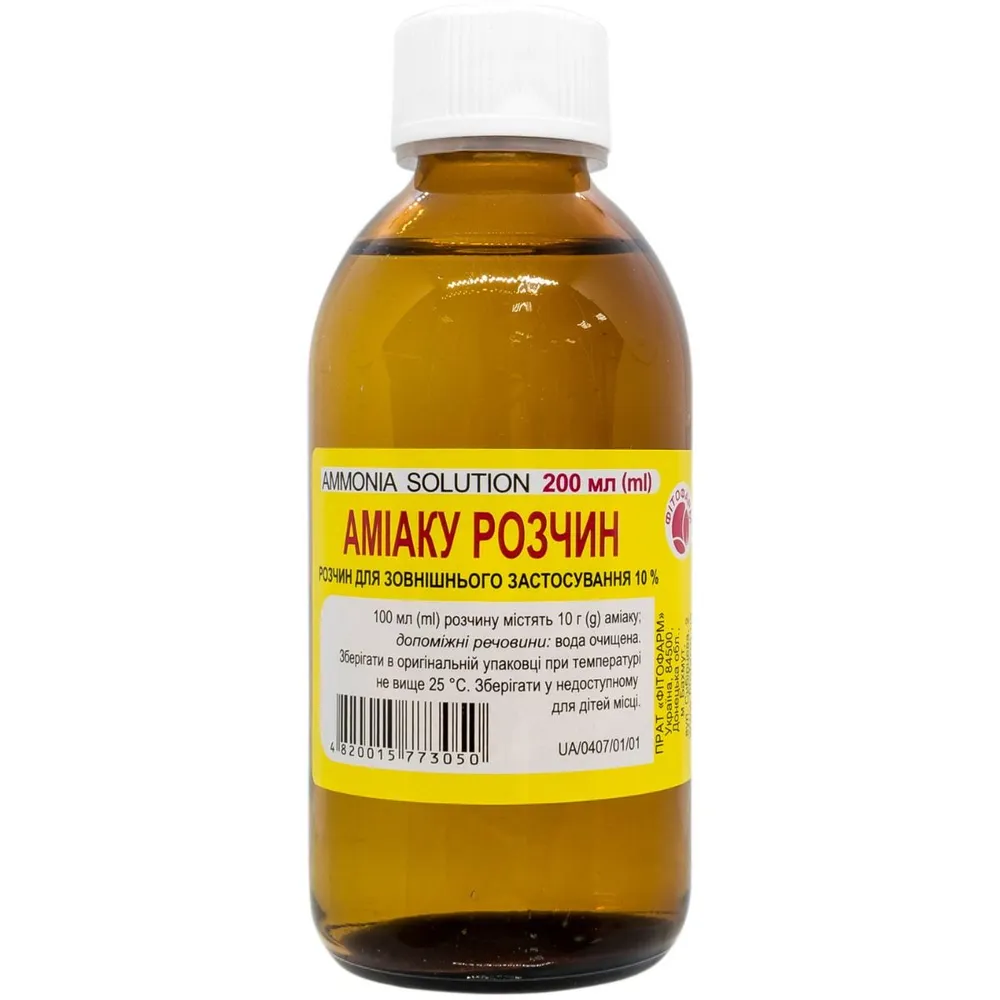
AMMONIA SOLUTION
UkraineThe drug is used as first aid for fainting, as well as for insect bites.
Frequently asked questions
How to correctly use Ammonia solution?
To assist with fainting, a moistened cotton or gauze piece is gently held to the nose for 0.5–1 second. For insect bites, the solution is applied to the skin as compresses for up to 30 seconds.
What are the possible side effects of Ammonia solution?
Inhalation of vapors may cause reflex respiratory arrest. Topical application to the skin may cause irritation, dermatitis, eczema, or allergic reactions.
Who should not use this drug?
The product should not be used by individuals with hypersensitivity to it, nor by children under 3 years of age. The solution may only be applied to the skin if it is intact and undamaged.
What to do if the drug gets into the eyes or is swallowed?
If it gets into the eyes, they must be rinsed with water for 15 minutes (in 10-minute intervals) or with a 3% boric acid solution. If the drug is swallowed, one should drink water, milk, fruit juice, or weak solutions of citric or acetic acid to neutralize the stomach contents.
Can the drug be used during pregnancy or breastfeeding?
This is only possible in cases where the expected benefit to the mother outweighs the potential risk to the child or fetus.
Instructions for use
INSTRUCTIONS FOR MEDICAL USE OF THE MEDICINAL PRODUCT AMIAKU SOLUTION
Composition:
Active substance: ammonia;
100 ml of solution contains 10 g of ammonia;
Excipient: purified water.
Pharmaceutical form. Solution for external use.
Main physico-chemical properties: clear, colorless, volatile, highly alkaline liquid with a pungent odor. The presence of slight opalescence and/or slight turbidity may occur during storage.
Pharmacotherapeutic group.
Agents affecting the respiratory system. ATC code R07A B.
Pharmacological properties.
Pharmacodynamics.
Ammonia solution belongs to medicinal agents that stimulate nerve endings.
The mechanism of action of ammonia upon inhalation involves reflex stimulation of the respiratory center via receptors in the upper respiratory tract – the endings of the trigeminal nerve.
When applied to the skin, it exerts an irritant and antimicrobial effect.
Pharmacokinetics.
The drug does not enter the bloodstream.
Clinical characteristics.
Indications. Fainting state, insect bites.
Contraindications. Hypersensitivity to the medicinal product.
Interaction with other medicinal products and other forms of interaction. Not established.
Special precautions for use.
Topical application is permitted only on intact skin.
In case of accidental exposure to the eye mucous membrane, rinse several times with water (for 15 minutes with a 10-minute interval) or with a 3% boric acid solution. Do not use oils or ointments. In case of exposure to the nose or pharynx, use a 0.5% citric acid solution or natural fruit juices. In case of accidental ingestion, drink water, fruit juice, or milk; preferably, a 0.5% citric acid solution or a 1% acetic acid solution until complete neutralization of gastric contents is achieved.
Do not violate the instructions for use of the medicinal product, as this may harm health.
Use during pregnancy or breastfeeding.
During pregnancy and breastfeeding, the use of this drug is possible only when the expected benefit to the mother outweighs the potential risk to the fetus or infant.
Ability to influence reaction rate while driving or operating machinery.
Does not affect.
Administration and dosage.
For stimulation of the respiratory center as an emergency aid: a small piece of gauze or cotton moistened with ammonia solution is carefully brought close to the nostrils for 0.5–1 second. For insect bites, the ammonia solution is applied externally as compresses (procedure duration – up to 30 seconds).
Children. The drug is not used in children under 3 years of age.
Overdose.
Exaggeration of adverse reaction manifestations.
Symptomatic therapy.
Side effects.
Inhalation of ammonia solution vapors may cause reflex respiratory arrest. With local application, irritation, dermatitis, eczema at the site of application, and allergic reactions are possible.
If any adverse events occur, consult a physician.
Shelf life. 2 years.
The product must not be used after the expiry date stated on the packaging.
Storage conditions. Store in the original packaging at a temperature not exceeding 25 °C.
Keep out of reach of children.
Packaging. 40 ml or 100 ml in glass bottles; 200 ml in glass bottles with tamper-evident closure; 40 ml, 100 ml, or 200 ml in polymer bottles with tamper-evident closure.
Pharmaceutical category. Over-the-counter (without prescription).
Manufacturer.
JSC "FITOPHARM"
Manufacturer's address and place of business.
2 Sybirtseva Street, Bakhmut, Donetsk region, 84500, Ukraine.
Marketing authorization holder.
LLC "FC "VIOLA"
Address of the marketing authorization holder.
68 Obiezna Road, city of Brovary, Brovary district, Kyiv region, 07400, Ukraine.
Similar drugs
| Brand name | Dosage form | Active substance / Dosage | Manufacturer |
|---|---|---|---|
| AMMONIA | solution, topical |
|
DKP "Pharmaceutical Factory" LLC |
| AMMONIA SOLUTION 10% | solution, topical |
|
PJSC Pharmaceutical Factory "Viola" |
The original data is available in the language of the country of manufacture.
Data source: State Register of Medicinal Products of Ukraine
Data last verified: August 13, 2026