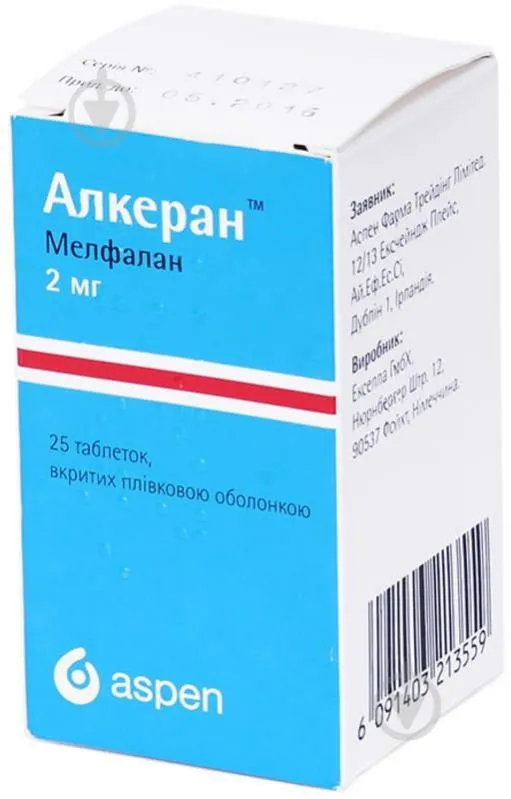
ALKERAN
UkraineThe drug is used for the treatment of multiple myeloma, late-stage ovarian adenocarcinoma, breast cancer, and polycythemia vera.
Frequently asked questions
How should Alkeran be taken correctly?
The drug is taken orally. Dosage and duration of the course depend on the disease and are prescribed by a physician. For example, in multiple myeloma, it is usually taken for 4 days with the cycle repeated every 6 weeks. It is important not to take the tablets immediately after a meal, as this may reduce the effectiveness of the treatment.
Who should not take this drug?
Contraindications include hypersensitivity to the active substance or excipients, as well as breastfeeding.
What are the possible side effects of Alkeran?
The most common side effects are bone marrow suppression (decreased levels of leukocytes, platelets, and erythrocytes), nausea, vomiting, diarrhea, alopecia (hair loss), and fever. There are also risks of thrombosis, especially when combined with other specific medications.
Can the drug be taken during pregnancy or when planning children?
Use during pregnancy is undesirable due to the risk of congenital defects in the child. Women undergoing treatment should use only progestogen-based contraceptive methods. Men are advised not to father children during therapy and for 6 months after it due to potential infertility.
How does the drug interact with other agents?
It is not recommended to administer live vaccines. When combined with certain drugs (e.g., lenalidomide or thalidomide), the risk of thrombosis and hematological toxicity increases. Caution should also be exercised when combining with cyclosporine after a bone marrow transplant.
Instructions for use
INSTRUCTIONS FOR MEDICAL USE OF THE MEDICINAL PRODUCT Alkeran™
Composition:
Active substance: melphalan;
1 film-coated tablet contains 2 mg of melphalan;
Excipients: microcrystalline cellulose, crospovidone, colloidal anhydrous silicon dioxide, magnesium stearate, Opadry White YS-1-18097-A (hypromellose, titanium dioxide (E 171), polyethylene glycol).
Pharmaceutical form. Film-coated tablets.
Main physicochemical properties: white to almost white, round, biconvex, film-coated tablets, engraved with "A" on one side and "GX EH3" on the other.
Pharmacotherapeutic group. Antineoplastic agents. Alkylating agents. Nitrogen mustard analogues. Melphalan. ATC code L01A A03.
Pharmacological Properties
Pharmacodynamics
Melphalan is a bifunctional alkylating antineoplastic agent with some immunosuppressive properties. The formation of carbon intermediates from each of its two bis-2-chloroethyl groups enables alkylation through covalent binding to the 7-nitrogen of guanine in DNA, resulting in cross-linking of the two strands of the DNA molecule, thereby disrupting cellular replication.
Pharmacokinetics
Absorption
The absorption of oral melphalan varies considerably in terms of time to first appearance of the drug in plasma and time to reach peak plasma concentration.
According to study data, the mean absolute bioavailability of melphalan ranges from 56% to 85%.
To avoid variability in absorption associated with myeloablative therapy, melphalan can be administered intravenously.
In a study involving 18 patients who received oral melphalan at doses of 0.2 to 0.25 mg/kg body weight, maximum plasma concentrations (ranging from 87 to 350 ng/mL) were achieved within 0.5–2 hours.
Administration of Alkeran** tablets immediately after food increases the time to peak plasma concentration and reduces the area under the concentration-time curve by 39–54%.
Distribution
Melphalan penetrates minimally across the blood-brain barrier. In several samples of cerebrospinal fluid, drug levels were below measurable limits. Low concentrations in cerebrospinal fluid (~10% of plasma levels) were observed in one clinical study in children treated with high-dose melphalan.
Elimination
In 13 patients treated with oral melphalan at a dose of 0.6 mg/kg body weight, the mean terminal elimination half-life of the drug in plasma was 90 ± 57 minutes. Eleven percent of the administered dose was excreted in urine within 24 hours. In 18 patients treated with oral melphalan at doses of 0.2–0.25 mg/kg body weight, the mean elimination half-life was 1.12 ± 0.15 hours.
Special Patient Groups
Renal Impairment
Melphalan clearance may be reduced in patients with renal impairment (see sections "Method of Administration and Dosage" and "Special Precautions").
Elderly Patients
There is no correlation between patient age and melphalan clearance or terminal elimination half-life (see section "Method of Administration and Dosage").
Clinical characteristics.
Indications.
- Multiple myeloma;
- advanced stages of ovarian adenocarcinoma;
- breast carcinoma: melphalan alone or in combination with other drugs has significant therapeutic effect in patients with advanced stages of breast cancer;
- true polycythemia.
Contraindications.
Hypersensitivity to the active substance or to any of the excipients.
Breastfeeding.
Interaction with other medicinal products and other forms of interaction.
Administration of vaccines containing live microorganisms is not recommended in immunocompromised patients (see section "Special precautions for use").
Intravenous administration of high doses of melphalan together with nalidixic acid may result in fatal outcome in children due to development of hemorrhagic enterocolitis.
When using a combination of busulfan and melphalan in children, it has been reported that administration of melphalan less than 24 hours after the last oral dose of busulfan may influence the development of toxicity.
Cases of renal dysfunction have been reported in patients after bone marrow transplantation who had previously received high-dose intravenous melphalan and subsequently received cyclosporine to prevent graft-versus-host reaction.
Special precautions for use.
Alkeran™ is a cytotoxic agent and should only be administered under the supervision of a physician experienced in the use of drugs of this class.
Immunization with vaccines containing live microorganisms may lead to infectious complications in immunocompromised patients; therefore, the use of such vaccines during treatment with Alkeran™ is not recommended.
Monitoring
Bone marrow suppression with leukopenia and thrombocytopenia is the principal adverse effect. The time to maximal myelosuppression may vary. Regular blood count monitoring is essential to prevent excessive myelosuppression and the risk of irreversible bone marrow aplasia.
Blood cell counts may continue to decline after discontinuation of treatment; therefore, treatment should be temporarily suspended at the first signs of excessive reduction in leukocyte or platelet counts.
Alkeran™ should be used with caution in patients who have recently undergone radiotherapy or chemotherapy, due to increased toxic effects on the bone marrow.
Venous thromboembolic events
Patients receiving melphalan in combination with lenalidomide and prednisone or thalidomide and prednisone or dexamethasone have an increased risk of deep vein thrombosis and pulmonary embolism (see section "Adverse reactions"). The risk is highest during the first 5 months of therapy, particularly in patients with additional risk factors for thrombosis (such as smoking, arterial hypertension, hyperlipidemia, and history of thrombosis). These patients require careful monitoring and measures to minimize all modifiable risk factors. Recommendations for thrombosis prophylaxis and dosing/anticoagulant therapy are provided in the section "Dosage and administration".
Patients and physicians should remain vigilant for symptoms of thromboembolism. Patients should be informed about the necessity to seek medical help if symptoms such as dyspnea, chest pain, or swelling of arms or legs occur. If any thromboembolic event occurs, treatment should be immediately discontinued and standard anticoagulant therapy initiated. After stabilization of the patient's condition under anticoagulant treatment and resolution of all thromboembolic complications, melphalan in combination with lenalidomide and prednisone or thalidomide and prednisone or dexamethasone may be resumed at the initial dose, depending on the benefit-risk assessment. The patient should continue anticoagulant therapy throughout the entire treatment course.
Neutropenia and thrombocytopenia
In elderly patients with newly diagnosed multiple myeloma receiving melphalan in combination with lenalidomide and prednisone or thalidomide and prednisone or dexamethasone, an increased frequency of hematological toxicity, particularly neutropenia and thrombocytopenia, has been observed. Patients and physicians should remain vigilant for symptoms of bleeding, including petechiae and epistaxis, especially in patients receiving these combination regimens (see section "Adverse reactions").
Mutagenicity
Melphalan has shown mutagenic properties in animals, and chromosomal aberrations have been observed in patients treated with Alkeran™. Melphalan has also demonstrated carcinogenic properties in animals, and the possibility of such an effect should be considered when planning long-term treatment.
Carcinogenicity
Acute myeloid leukemia (AML) and myelodysplastic syndromes (MDS)
Alkeran™, like other alkylating agents, has been reported to be leukemogenic, particularly in elderly patients after prolonged combined therapy and radiotherapy. Cases of acute leukemia have been reported after melphalan treatment for conditions such as amyloidosis, malignant melanoma, multiple myeloma, macroglobulinemia, cold agglutinin syndrome, and a significant increase in acute leukemia cases has been observed in patients with ovarian cancer.
In patients with ovarian cancer, significantly more cases of acute leukemia have been observed when treated with alkylating agents, including melphalan, compared to those not receiving such therapy.
Before initiating therapy, the potential therapeutic benefit of the drug should be weighed against the risk of developing leukemia (AML and MDS), particularly when considering melphalan in combination with thalidomide or lenalidomide and prednisone, as these combinations have been shown to increase the leukemogenic risk. Therefore, to ensure early detection of malignancy and initiate treatment if necessary, physicians should continuously monitor patients using standard methods before, during, and after therapy.
Contraception
Only progestogen-containing ovulation inhibitors (e.g., desogestrel) should be used. Due to the increased risk of venous thromboembolism in patients with multiple myeloma, the use of combined oral contraceptives is not recommended. If a patient is using combined oral contraceptives, she should be switched to one of the effective methods described above (only progestogen-containing ovulation inhibitors should be used). The risk of venous thromboembolism persists for 4–6 weeks after discontinuation of combined oral contraception.
Renal impairment
The clearance of Alkeran™ may be reduced in patients with renal impairment, who may also have bone marrow suppression due to uremia; therefore, dose reduction is necessary. Such patients require close monitoring.
At the beginning of Alkeran™ therapy in patients with myeloma and renal involvement, a transient increase in blood urea levels may occur.
Use during pregnancy or breastfeeding.
Pregnancy
There are no data on the use of melphalan in pregnant women. Animal studies have demonstrated reproductive toxicity. However, due to its mutagenic properties and structural similarity to known teratogenic agents, Alkeran™ may very likely cause congenital defects in children of patients treated with the drug.
Alkeran™ should not be used during pregnancy, especially during the first trimester, except when the physician considers it absolutely necessary. In each individual case, the potential risk to the fetus must be weighed against the expected benefit for the mother.
As with other cytostatic agents, both partners should use adequate contraceptive methods during Alkeran™ treatment.
Breastfeeding
Women receiving Alkeran™ treatment should not breastfeed (see section "Dosage and administration").
Fertility
Alkeran™ may cause suppression of ovarian function up to amenorrhea in a significant number of premenopausal women.
Animal studies have shown a negative effect of Alkeran™ on spermatogenesis. Alkeran™ may cause temporary or permanent sterility in men.
Men receiving melphalan treatment are advised not to father children during treatment and for 6 months thereafter and to seek counseling regarding sperm cryopreservation prior to treatment due to the possibility of irreversible infertility caused by melphalan therapy.
Ability to affect reaction speed when driving or operating machinery.
Not studied.
Dosage and Administration
Alkeran is a cytotoxic agent belonging to the alkylating compounds group and must be prescribed by a physician experienced in treating malignant diseases with this class of drugs.
Due to the myelosuppressive effect of Alkeran, blood counts should be monitored frequently, and the dose should be reduced or therapy discontinued if necessary.
The oral absorption of Alkeran is inconsistent. It may be necessary to gradually increase the dose until signs of myelosuppression appear in order to achieve therapeutic levels.
Thromboembolic Events
The use of melphalan in combination with lenalidomide and prednisone or thalidomide and prednisone or dexamethasone is associated with an increased risk of venous thromboembolism (mainly deep vein thrombosis and pulmonary embolism). Thrombosis prophylaxis should be performed for at least the first 5 months of treatment, especially in patients with additional risk factors for thrombosis. Decisions regarding antithrombotic prophylactic measures should be made after careful assessment of individual patient risk factors (see sections "Special Warnings and Precautions for Use" and "Adverse Reactions").
If a patient develops any thromboembolic events, treatment must be discontinued and standard anticoagulant therapy initiated. After stabilization of the patient's condition with anticoagulant therapy and correction of all thromboembolic complications, melphalan in combination with lenalidomide and prednisone or thalidomide and prednisone or dexamethasone may be resumed at the initial dose, depending on the benefit/risk assessment. The patient should continue anticoagulant therapy throughout the course of melphalan treatment.
Dosage
Multiple Myeloma
Alkeran is usually administered orally at a dose of 0.15 mg/kg body weight per day in divided doses over 4 days, with repeated cycles every 6 weeks. However, numerous treatment regimens exist, and detailed information should be consulted in the scientific literature.
Concomitant oral administration of Alkeran with prednisone may be more effective than Alkeran alone. This combination is usually administered intermittently (with treatment breaks between cycles).
It has been established that treatment duration exceeding 1 year does not lead to improved outcomes.
Ovarian Adenocarcinoma (advanced stages)
The typical treatment regimen is 0.2 mg/kg body weight per day orally in divided doses over 5 days. This cycle should be repeated every 4–8 weeks or after recovery of bone marrow function.
Breast Carcinoma
Alkeran should be administered orally at a dose of 0.15 mg/kg body weight or 6 mg/m² body surface area per day for 5 days, with this cycle repeated every 6 weeks. If signs of toxic effects on the bone marrow appear, the dose should be reduced.
Polycythemia Vera
For induction of remission, 6–10 mg daily for 5–7 days should be administered, followed by 2–4 mg daily until satisfactory disease control is achieved. For maintenance therapy, 2–6 mg once weekly is recommended. Due to the potential for severe myelosuppression with continuous use of Alkeran, it is essential to monitor peripheral blood parameters regularly during therapy and adjust the dose or introduce treatment breaks as necessary to ensure careful control of hematological parameters.
Children
Alkeran is very rarely used in children at standard doses; therefore, no general dosage recommendations are available.
Elderly Patients
Although Alkeran is frequently used at standard doses in elderly patients, there are no specific dosage recommendations for this age group. However, caution should be exercised if renal function is impaired.
Renal Impairment
The clearance of Alkeran, although variable, is reduced in renal impairment (see section "Special Warnings and Precautions for Use").
Current pharmacokinetic data do not provide clear recommendations for dose reduction when administering Alkeran tablets to patients with renal impairment; however, it is advisable to reduce the initial dose to assess tolerability.
Children.
Alkeran is very rarely used in children at standard doses; therefore, no general dosage recommendations are available.
Overdose
Symptoms
The most common early symptoms of acute Alkeran tablet overdose are gastrointestinal disturbances, including nausea, vomiting, and diarrhea. The principal manifestation of toxicity is bone marrow suppression, leading to leukopenia, thrombocytopenia, and anemia.
Treatment
General supportive measures should be implemented, including appropriate blood and platelet transfusions. If necessary, the patient should be hospitalized and prescribed anti-infective agents and hematopoietic growth factors.
There is no specific antidote. Blood tests must be closely monitored for at least 4 weeks after overdose until signs of recovery appear.
Adverse Reactions
Current clinical data sufficient to determine the frequency of adverse reactions to this medicinal product are lacking. The frequency and severity of adverse reactions vary depending on the dose of the drug, the indication, and the combination of drugs used with Alkeran™.
The following classification is used to describe the frequency of adverse reactions: very common ≥ 1/10, common ≥ 1/100 to < 1/10, uncommon ≥ 1/1,000 to < 1/100, rare ≥ 1/10,000 to < 1/1,000, very rare < 1/10,000, frequency not known (cannot be estimated from the available data).
Benign and malignant neoplasms, unspecified (including cysts and polyps): frequency not known — secondary acute myeloid leukemia and myelodysplastic syndrome (see section "Special precautions for use").
Blood and lymphatic system disorders: very common — bone marrow suppression leading to leukopenia, thrombocytopenia, neutropenia, and anemia (increased incidence of hematological toxicity, particularly neutropenia and thrombocytopenia, was observed in elderly patients with newly diagnosed multiple myeloma receiving melphalan in combination with lenalidomide and prednisone or thalidomide and prednisone or dexamethasone (see section "Special precautions for use"); rare — hemolytic anemia.
Immune system disorders: rare — hypersensitivity (see skin and subcutaneous tissue disorders) — allergic reactions to melphalan, including urticaria, edema, skin rash, pruritus, and anaphylactic shock, occur uncommonly, primarily following intravenous administration; isolated cases of cardiac arrest associated with allergic reactions.
Respiratory, thoracic and mediastinal disorders: rare — interstitial lung disease and pulmonary fibrosis (including fatal cases).
Gastrointestinal disorders: very common — nausea, vomiting, and diarrhea; stomatitis at high doses; rare — stomatitis at usual doses.
Gastrointestinal disturbances such as nausea and vomiting occur in approximately 30% of patients taking standard oral doses of Alkeran™.
Hepatobiliary disorders: rare — liver disorders ranging from abnormalities in liver function tests to clinical manifestations of hepatitis and jaundice.
Skin and subcutaneous tissue disorders: very common — alopecia at high doses; common — alopecia at usual doses; rare — maculopapular rash and pruritus (see immune system disorders).
Renal and urinary disorders: common — transient increase in blood urea nitrogen levels during early stages of melphalan therapy has been observed in patients with myeloma and renal involvement.
Vascular disorders: frequency not known — deep vein thrombosis and pulmonary embolism have been clinically significant adverse reactions associated with the use of melphalan in combination with thalidomide and prednisone or dexamethasone, and to a lesser extent with melphalan in combination with lenalidomide and prednisone (see sections "Dosage and administration" and "Special precautions for use").
Reproductive system and breast disorders: frequency not known — azoospermia, amenorrhea.
General disorders: very common — fever.
Reporting of suspected adverse reactions
Reporting suspected adverse reactions after marketing authorization is important. It allows continued monitoring of the benefit-risk balance of the medicinal product. Healthcare professionals are encouraged to report suspected adverse reactions via the national reporting system.
Shelf life. 3 years.
Storage conditions.
Store at 2 to 8 °C in a place inaccessible to children.
Packaging. 25 tablets in a bottle. One bottle in a cardboard box.
Prescription status. Prescription only.
Manufacturer.
Excella GmbH & Co. KG.
Manufacturer's address.
Nürnberger Str. 12, 90537 Feucht, Germany.
Marketing Authorization Holder. Aspen Pharma Trading Limited.
Address of Marketing Authorization Holder.
3016 Lake Drive, Citywest Business Campus, Dublin 24, Ireland.
The original data is available in the language of the country of manufacture.
Data source: State Register of Medicinal Products of Ukraine
Data last verified: August 13, 2026