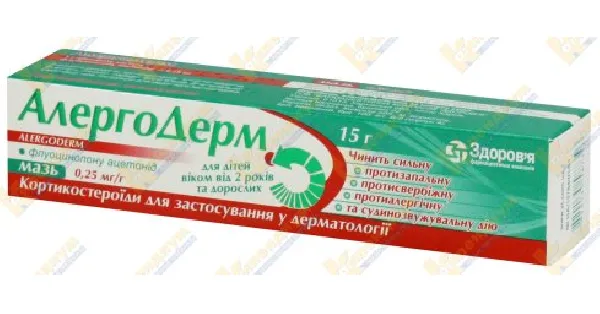
ALLERGODERM
UkraineThe drug is used for the short-term treatment of acute and severe non-infectious skin diseases accompanied by itching or skin thickening. This may include seborrheic, atopic, or allergic contact dermatitis, psoriasis, lichen planus, erythema nodosum, and other conditions.
Frequently asked questions
How should Allergoderm be applied correctly?
The ointment should be applied in a thin layer to the affected area of the skin 1–2 times daily. Before each new application, any residue of the previous ointment must be washed off with a soap solution or an antiseptic. It is not recommended to use the drug under a dressing (occlusion), except in cases of psoriasis.
What are the restrictions regarding the duration of Allergoderm use?
The ointment must not be used continuously for more than 2 weeks. If you are applying the drug to the face, the duration of treatment should not exceed 1 week.
Who should not use this drug?
Contraindicated in cases of bacterial, viral, and fungal skin infections, herpes, chickenpox, syphilis, skin tuberculosis, as well as in the presence of wounds, ulcers, skin neoplasms, or diaper dermatitis. The drug is prohibited during pregnancy and breastfeeding.
What are the possible side effects?
Possible local reactions include: burning, itching, irritation, skin dryness, skin atrophy, or the appearance of acne-like eruptions. Prolonged or excessive use may lead to systemic problems: edema, increased blood pressure, disturbances in blood sugar levels, and decreased immunity. Vision changes are also possible (blurring, risk of developing cataracts or glaucoma if applied to areas around the eyes).
Can the ointment be combined with other medicines?
The drug can be used together with antimicrobial agents. However, concomitant use with other hormonal (glucocorticosteroids) or anti-inflammatory (non-steroidal) agents may increase the risk of side effects. The ointment should not be applied simultaneously with other topical agents.
Can the drug be used in children?
The drug is not prescribed to children under 2 years of age. For children aged 2 and older, use is possible only under medical supervision, no more than once daily, on a small area of skin, and not on the face.
Instructions for use
INSTRUCTIONS FOR MEDICAL USE OF THE MEDICINAL PRODUCT ALE R G O D E R M (ALERGODERM)
Composition:
Active substance: fluocinolone acetonide;
1 g of the preparation contains fluocinolone acetonide 0.25 mg;
Excipients: propylene glycol, anhydrous citric acid, lanolin, white soft paraffin.
Pharmaceutical form. Ointment.
Main physico-chemical properties: white or almost white, semitransparent, greasy soft mass; a slight specific odor is permissible.
Pharmacotherapeutic group.
Corticosteroids for dermatological use. ATC code D07A C04.
Pharmacological properties.
Pharmacodynamics.
Fluocinolone acetonide is a potent synthetic glucocorticoid for topical use. When applied as an ointment at a concentration of 0.25 mg/g, it exerts a strong anti-inflammatory, antipruritic, antiallergic, and vasoconstrictive effect. It possesses lipophilic properties and is readily absorbed through the skin. Even after application of 2 g of the ointment, production of adrenocorticotropic hormone (ACTH) by the pituitary gland may be reduced due to suppression of the "adrenal glands–pituitary" system.
Pharmacokinetics.
Fluocinolone acetonide readily penetrates the stratum corneum of the skin, where it gradually accumulates and can still be detected even 15 days after application. It is not biotransformed in the skin. After systemic absorption, it is mainly biotransformed in the liver. It is excreted in the urine and, to a lesser extent, in bile, primarily as a conjugate with glucuronic acid, as well as in small amounts unchanged.
Absorption of fluocinolone acetonide through the skin is enhanced when applied to sensitive skin areas such as skin folds and face, as well as to skin with damaged epidermis or inflammatory processes. The use of an occlusive dressing increases skin temperature and moisture, which also leads to enhanced absorption of fluocinolone acetonide. In addition, absorption is increased with frequent application of the drug and over large skin areas. Skin absorption is higher in adolescents than in adult patients.
Clinical characteristics.
Indications.
Short-term treatment of acute and severe non-infectious inflammatory skin diseases (without exudation) accompanied by persistent pruritus or hyperkeratosis: seborrheic dermatitis, atopic dermatitis, nodular urticaria (papular urticaria), allergic contact dermatitis, erythema multiforme, lupus vulgaris, psoriasis, lichen planus.
Contraindications.
Skin manifestations of syphilis, cutaneous tuberculosis, pyoderma, varicella, herpes, actinomycosis, blastomycosis, sporotrichosis, diaper dermatitis, anogenital pruritus, nevus; atheroma, hemangioma, xanthoma, skin neoplasms, wounds and ulcerative skin lesions, wounds at application sites, numerous psoriatic plaques, trophic ulcers associated with varicose vein enlargement, erosive-ulcerative lesions of the gastrointestinal tract.
The ointment should not be used in bacterial, viral, and fungal skin infections, common and rosacea acne, perioral dermatitis (dermatitis perioralis), after prophylactic vaccinations, or in cases of confirmed hypersensitivity to fluocinolone acetonide or to other glucocorticosteroids and other components of the medicinal product.
Interaction with other medicinal products and other forms of interaction.
The drug can be used in combination with antimicrobial agents of local and systemic action. Concurrent use with systemic glucocorticosteroids increases the efficacy of the drug, but also increases the likelihood of adverse effects. Concurrent use of the drug with nonsteroidal anti-inflammatory agents increases the risk of developing systemic and local adverse effects. It may enhance the effects of antihypertensive, diuretic, antiarrhythmic drugs, and potassium preparations. Diuretic drugs (except potassium-sparing ones) increase the risk of developing hypokalemia. Vaccination against smallpox and other types of immunization should not be performed during treatment with the drug (especially during prolonged use on large skin areas) due to the possible absence of an adequate immunological response in the form of production of specific antibodies.
The drug may enhance the action of immunosuppressive agents and reduce the effect of immunostimulatory drugs.
Special precautions for use.
Treatment should be carried out under medical supervision.
Before each repeated application, any residue from the previous application should be washed off with soapy water or an antiseptic solution. Loose-fitting clothing is recommended during treatment. Do not apply to the skin of the mammary glands.
Do not use simultaneously with other topical medicinal products.
Prolonged use requires periodic monitoring of adrenal gland function by measuring cortisol levels in blood and urine following ACTH stimulation.
The ointment should be used with special caution in patients with psoriasis, since topical application of glucocorticoids to psoriatic lesions may lead to the spread of the pathological process or relapse due to the development of tolerance, as well as to the risk of generalized pustular psoriasis and systemic toxicity caused by skin dysfunction.
Do not use the medicinal product for longer than 2 weeks without interruption. Prolonged application over large skin areas increases the frequency of adverse effects and the possibility of developing edema, arterial hypertension, hyperglycemia, and reduced body resistance.
With topical application of the drug, suppression of ACTH production by the pituitary gland may occur due to inhibition of the "adrenal glands–pituitary" system, decreased blood cortisol levels, and development of iatrogenic Cushing's syndrome, which resolves after discontinuation of the drug.
If infection develops at the site of ointment application, appropriate antibacterial or antifungal treatment should be initiated. If infection symptoms do not resolve, the drug should be discontinued during the infection treatment period.
Avoid applying the drug to the eyelids or skin around the eyes in patients with closed-angle or open-angle glaucoma, as well as in patients with cataracts, due to possible worsening of disease symptoms.
Topical and systemic corticosteroids may cause visual disturbances. If symptoms such as blurred vision or other visual impairments occur, patients should consult an ophthalmologist to evaluate possible causes, including cataract, glaucoma, or rare conditions such as central serous choroidopathy, which has been reported with systemic and topical corticosteroid use.
Avoid contact of the drug with the eyes. If skin irritation occurs at the application site, discontinue use.
Use on the facial skin and in the axillary area only when strictly necessary, as increased absorption and a high risk of adverse reactions (e.g., telangiectasias, dermatitis perioralis) may occur even after short-term use.
Use with caution in patients with subcutaneous tissue atrophy, particularly in elderly individuals.
Since the medicinal product contains propylene glycol, it may cause skin irritation upon application.
Since the medicinal product contains lanolin, it may cause local reactions (e.g., contact dermatitis).
Use during pregnancy or breastfeeding.
The medicinal product is contraindicated during pregnancy. Breastfeeding should be discontinued during treatment with this drug.
Ability to affect reaction speed when driving or operating machinery.
The medicinal product does not impair mental or motor performance, or the ability to drive vehicles or operate other machinery.
Dosage and Administration.
The product is intended for topical use. Apply the ointment as a thin layer to the affected skin area 1–2 times daily.
Do not use the ointment under occlusive dressings. In psoriasis, a closed dressing may be used, which should be changed daily.
Treatment should not be continued continuously for longer than 2 weeks. Do not use on facial skin for more than 1 week. During one week, no more than 15 g of ointment (1 tube) is recommended.
Use with caution and under medical supervision in children aged 2 years and older; such use should be limited to once daily and on a small skin area only; do not apply to the facial skin.
Children.
The product is not recommended for children under 2 years of age.
Overdose .
With prolonged application over large skin areas, symptoms of overdose may occur, manifested by an increase in adverse reactions, including burning sensation at the application site, glucosuria, edema, arterial hypertension, and decreased resistance to infections. Pruritus, hyperglycemia, and Cushing's syndrome are possible. Treatment is symptomatic, with gradual discontinuation of the drug.
Side effects.
Skin and subcutaneous tissue disorders.
Acneiform lesions, steroid-induced purpura, epidermal growth suppression, burning, itching, irritation, rash, subcutaneous tissue atrophy, dry skin, hypertrichosis or alopecia, depigmentation or hyperpigmentation of the skin, skin atrophy and impaired skin integrity, telangiectasias, furunculosis, atrophic striae, secondary infections, local skin reactions (including perioral, contact, allergic dermatitis). In individual cases: urticaria or maculopapular rash, or exacerbation of existing skin lesions.
Eye disorders.
When applied topically to the skin of the eyelids, cataract or glaucoma may occasionally develop. Possible visual disturbances.
Systemic disorders.
Use of the ointment under occlusive dressing, due to increased absorption, may lead to pronounced systemic effects, manifested as edema, arterial hypertension, decreased resistance to infections.
Systemic side effects.
Secondary immunodeficiency (exacerbation of chronic infectious diseases, generalization of infection, development of opportunistic infections), gastritis, steroid-induced gastric ulcer, hyperglycemia, glucosuria, delayed wound healing, adrenal cortex insufficiency, growth and developmental retardation in children, Cushing's syndrome.
Immune system disorders.
Allergic reactions or hypersensitivity reactions may occur.
Shelf life. 2 years.
Storage conditions. Store in the original packaging at a temperature not exceeding 25 °C.
Keep out of reach of children.
Packaging. 15 g of the drug in a tube, in a cardboard box.
Prescription status. Prescription only.
Manufacturer. LIMITED LIABILITY COMPANY "CORPORATION "ZDOROVIYA".
Manufacturer's address and place of business.
Ukraine, 61013, Kharkiv region, city of Kharkiv, Shevchenka Street, 22.
(all stages of manufacturing, quality control, batch release)
Ukraine, 08301, Kyiv region, city of Boryspil, Shevchenka Street, 100, letter B-II (building 4).
(all stages of manufacturing, batch release)
Similar drugs
| Brand name | Dosage form | Active substance / Dosage | Manufacturer |
|---|---|---|---|
| FLUCINAR® | ointment |
|
Yelfa Plant LLC |
| SINAPHLAN | ointment |
|
FZ "STADA" LLC |
| SINAPHLAN OINTMENT | ointment |
|
DKP "Pharmaceutical Factory" LLC |
| SINAPHLAN-VIOLA | ointment |
|
PJSC "Fitofarm" |
| SINAPHLAN-ZDOROVYA | ointment |
|
LLC "Corporation "Zdorovya" (all manufacturing stages, quality control, batch release) |
The original data is available in the language of the country of manufacture.
Data source: State Register of Medicinal Products of Ukraine
Data last verified: August 13, 2026