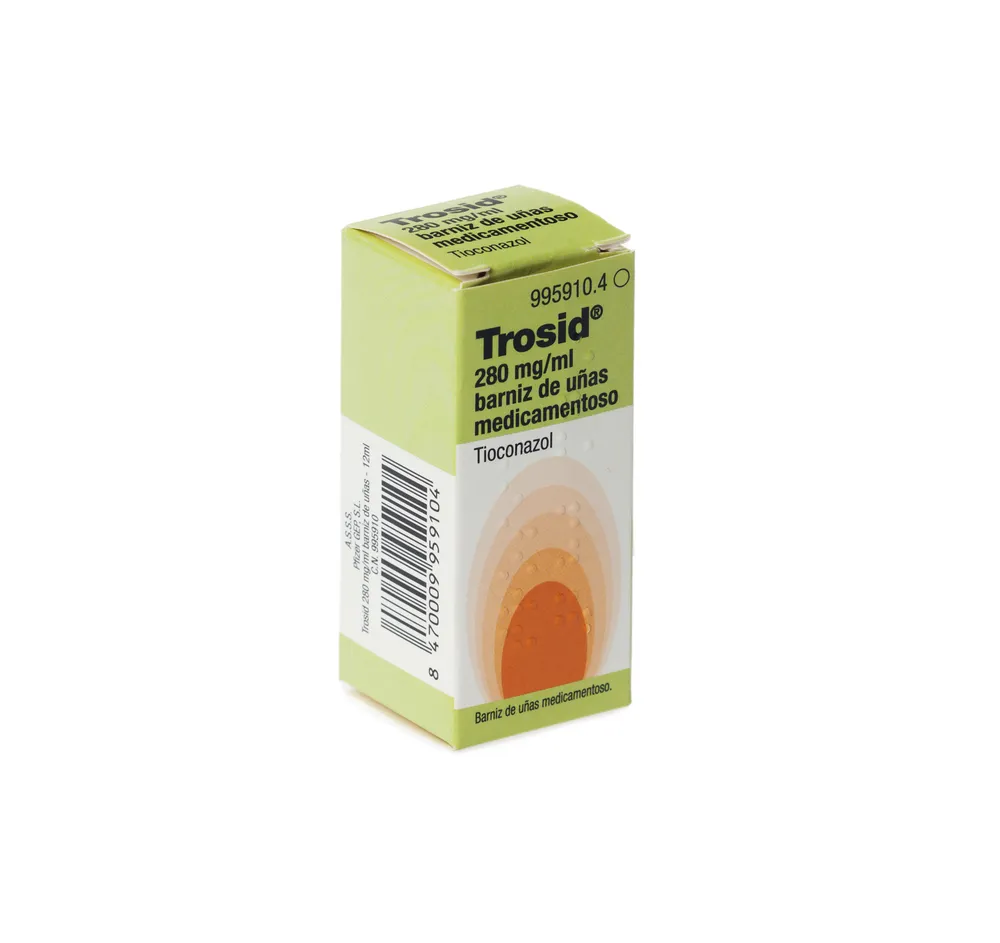
TROSID 280 MG/ML MEDICATED NAIL LACQUER
SpainIt is used for the treatment of nail infections caused by fungi (dermatophytes and Candida).
Frequently asked questions
How should I apply Trosid?
It should be applied twice a day (every 12 hours) to the entire affected nail and the surrounding area, using the applicator brush provided in the package.
When should I not use this medication?
It should not be used if you are allergic to tioconazole, other imidazoles, or any of its components. Contact with the eyes must also be avoided.
How long does the treatment last?
The duration varies depending on the patient and the type of fungus, but it usually lasts about 6 months and may be extended up to 12 months. You should not interrupt treatment before your doctor instructs you to do so, even if you notice improvement.
What side effects can Trosid have?
The most frequent effects are symptoms of local irritation. Other effects may include swelling of the extremities, redness or swelling of the skin, itching, dry skin, peeling, pain, or changes in nail color.
Can I take it if I am pregnant or breastfeeding?
If you are pregnant or breastfeeding, you must consult your doctor. During pregnancy, it should only be used if the doctor considers that the benefit justifies the risk. During breastfeeding, it is recommended to temporarily interrupt breastfeeding while using this medication.
Does it interact with other medications?
No interactions with other medications have been described, but it is recommended to inform your doctor if you are using any other drug.
What should I do if a child accidentally ingests it?
You must immediately go to a healthcare center to treat possible gastrointestinal irritation or central nervous system involvement.
Instructions for use
Package leaflet: Information for the user
Introduction
Package leaflet: information for the user
Trosid 280 mg/ml medicated nail lacquer
Tioconazole
Read the entire leaflet carefully before you start using this medicine, because it contains important information for you.
- Keep this leaflet, as you may need to read it again.
- If you have any questions, ask your doctor, pharmacist or nurse.
- This medicine has been prescribed for you only, and you should not give it to other people even if they have the same symptoms as you, because it may harm them.
- If you experience any adverse effects, consult your doctor, pharmacist or nurse, even if these are effects not listed in this leaflet.
Leaflet contents:
-
What Trosid is and what it is used for
-
What you need to know before using Trosid
-
How to use Trosid
-
Possible side effects
-
How to store Trosid
-
Contents of the pack and other information
1. What Trosid is and what it is used for
Trosid contains tioconazole. It belongs to a group of medicines called antifungals, which are used to treat various infections caused by fungi. Trosid works by eliminating or inhibiting the growth of the fungi responsible for these infections.
Trosid is indicated for the topical treatment of nail infections caused by susceptible fungi (dermatophytes and Candida).
2. What you need to know before using Trosid
Do not use Trosid
- if you are allergic to tioconazole, to other imidazoles, or to any of the other components of this medicine (listed in section 6).
Warnings and precautions
Consult your doctor or pharmacist before starting to use this medicine.
This medicine should be applied only to the affected nails using the brush provided. Avoid contact with the eyes.
Children
Due to the type of components in this medicine, it should be used with caution in young children who have a tendency to suck their fingers and nails.
Use of Trosid with other medicines
Inform your doctor or pharmacist if you are using, have recently used, or might need to use any other medicines.
No interactions with other medicines have been reported.
Pregnancy and breastfeeding
If you are pregnant or breastfeeding, think you might be pregnant, or plan to become pregnant, consult your doctor or pharmacist before using this medicine.
Although systemic absorption has been shown to be negligible after topical application to the skin, there are insufficient data on the use of tioconazole in pregnant women. Therefore, tioconazole should be used during pregnancy only if your doctor considers that the potential benefit justifies the potential risk to the fetus.
It is unknown whether this drug is excreted in human milk, but since many drugs are excreted in breast milk, temporary interruption of breastfeeding is recommended while using tioconazole.
Driving and using machines
The effects on the ability to drive and use machines are unknown.
3. How to use Trosid
Follow exactly the administration instructions for this medicine as given by your doctor or pharmacist. If in doubt, consult your doctor or pharmacist again.
Trosid is applied twice daily (every 12 hours) to the entire affected nail and surrounding area, using the brush applicator provided in the package.
The duration of treatment required to achieve healing varies for each patient, depending on the causative microorganism and the location of the infection. Your doctor will indicate the duration of treatment with Trosid. Do not stop treatment before your doctor tells you to do so, even if your symptoms have improved.
Generally, the treatment duration is approximately 6 months, although in some patients it may be extended up to 12 months.
If you use more Trosid than you should
Overdose is unlikely to occur with topical application of tioconazole, as its systemic absorption is negligible. No cases of poisoning have been reported at the recommended dose and route of administration. If the solution is accidentally ingested, seek immediate medical attention at a healthcare facility, where possible gastrointestinal irritation and/or central nervous system depression will be treated, and appropriate gastric lavage will be considered.
In case of overdose or accidental ingestion, contact your doctor or pharmacist immediately, or call the Toxicology Information Service at telephone: 91 562 04 20, indicating the medicine and the amount ingested.
If you forget to use Trosid
If you forget to apply a dose, do so as soon as you remember.
If you interrupt treatment with Trosid
Do not interrupt treatment with Trosid without consulting your doctor, even if you notice improvement.
If you have any further questions about the use of this medicine, ask your doctor, pharmacist, or nurse.
4. Possible adverse effects
Like all medicines, Trosid can cause adverse effects, although not everyone experiences them.
Thioconazole is well tolerated after topical application. The most common adverse effects are symptoms of local irritation (including local allergic reactions), which usually occur during the first week of treatment and are mild and transient. Systemic allergic reactions are uncommon.
However, if any hypersensitivity reaction occurs during use, discontinue treatment and consult your doctor.
The adverse effects, listed according to their frequency of occurrence, are:
- Common (may affect more than 1 in 100 patients): swelling of the extremities.
- Uncommon (may affect more than 1 in 1,000 patients): swelling and/or redness of the skin (dermatitis, rash).
- Frequency not known: abnormal sensation of tingling or burning (paresthesia), swelling and/or redness of the skin with blisters (bullous eruption), contact dermatitis, dry skin, nail disorder (including nail discoloration, inflammation around the nail, and nail pain), itching, skin irritation, peeling (exfoliation) of the skin, pain, allergic reaction, and urticaria (itchy, raised, red welts).
Reporting of adverse effects
If you experience any type of adverse effect, consult your doctor or pharmacist, even if it is a possible adverse effect not listed in this leaflet. You can also report them directly through the Spanish Pharmacovigilance System for Human Medicines: https://www.notificaram.es. By reporting adverse effects, you can help provide more information on the safety of this medicine.
5. Storage of Trosid
Do not store above 30°C.
Keep this medicine out of the sight and reach of children.
Do not use this medicine after the expiry date stated on the packaging after EXP. The expiry date is the last day of the month indicated.
Medicines should not be disposed of via wastewater or household waste. Dispose of unused medicines and their containers at the SIGRE Point at your pharmacy. If you have any doubts, ask your pharmacist how to dispose of medicines and containers you no longer need. This will help protect the environment.
6. Contents of the pack and other information
Composition of Trosid
- The active substance is tioconazole. Each ml of solution contains 280 mg of tioconazole.
- The other components are: undecylenic acid and ethyl acetate.
Nature and contents of the container
Trosid is supplied in amber glass bottles containing 12 ml of yellow or very pale yellow solution with a characteristic odour. The bottles are equipped with a brush applicator.
Marketing Authorisation Holder and Manufacturer
Marketing Authorisation Holder: Pfizer, S.L. Avda. de Europa, 20-B. Parque Empresarial La Moraleja. 28108, Alcobendas (Madrid). Spain
Manufacturer: Farmasierra Manufacturing, SL. Ctra. Irún, Km 26,200. 28709, San Sebastián de los Reyes. Madrid. Spain
The latest revision of this leaflet was in April 2017.
Detailed and up-to-date information on this medicine is available on the website of the Spanish Agency for Medicines and Health Products (AEMPS) http://www.aemps.gob.es/
The original data is available in the language of the country of manufacture.
Data source: Online Medicines Information Centre (CIMA) — AEMPS
Data last verified: September 21, 2026