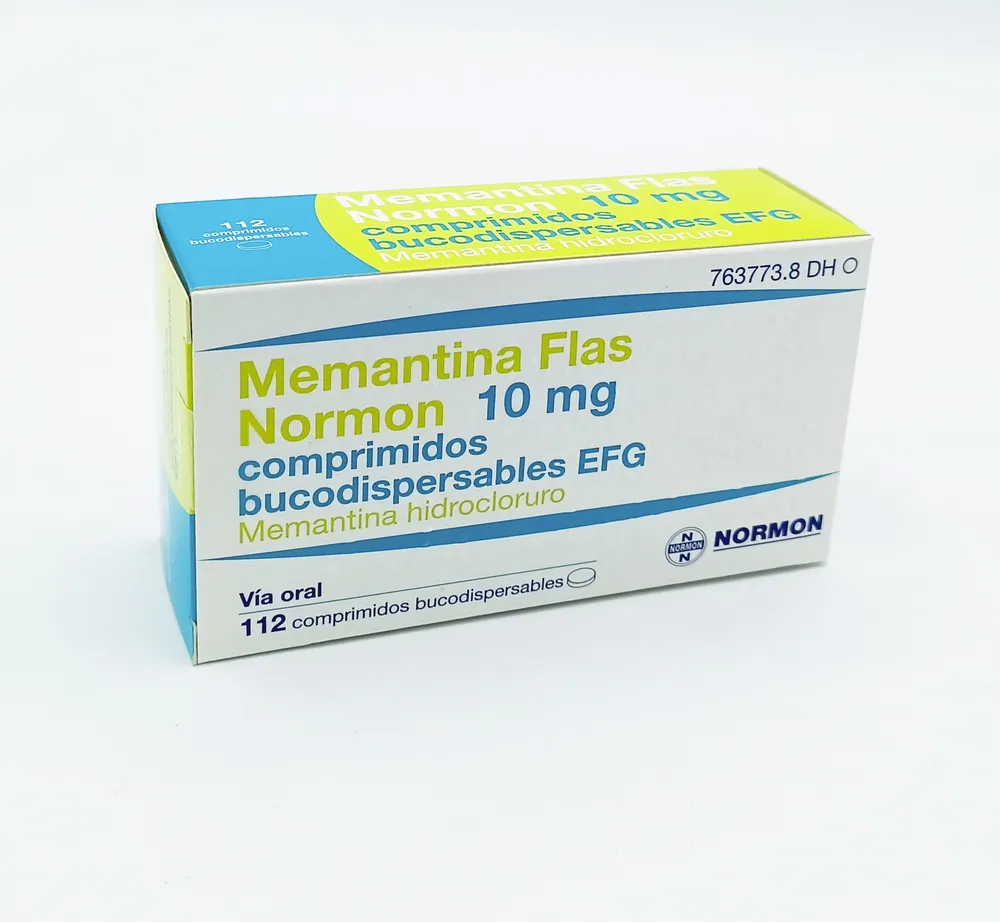
MEMANTINA FLAS COMBIX 10 MG ORODISPERSIBLE TABLETS EFG
SpainIt is used for the treatment of patients with moderate to severe Alzheimer's disease, helping to improve nerve signal transmission and memory.
Frequently asked questions
How should I take Memantina Flas Combix?
It should be taken once daily by mouth. The tablets are placed on the tongue and allowed to dissolve before swallowing, with or without water, and with or without food. The dose is gradually increased during the first four weeks until reaching 20 mg daily.
When should I not take this medication?
Do not take it if you are allergic to memantine hydrochloride or any of its components. Its use is also not recommended in pregnant women, breastfeeding women, or children or adolescents under 18 years of age.
What side effects can Memantina Flas Combix cause?
Common side effects include headache, sleepiness, constipation, vertigo, impaired balance, difficulty breathing, and high blood pressure. Other less common effects may include fatigue, confusion, hallucinations, vomiting, or heart failure. In very rare cases, seizures may occur.
Are there interactions with other medications?
Yes. You must inform your doctor if you are taking other drugs, especially amantadine, ketamine, dextromethorphan, or medications for Parkinson's, anticonvulsants, oral anticoagulants, among others, as the dose may need adjustment.
What precautions should I take if I have other health problems?
You should consult your doctor if you have a history of seizures, heart problems (such as myocardial infarction or uncontrolled hypertension), renal failure, renal tubular acidosis, or severe urinary tract infections.
What should I do if I forget a dose?
If you forget to take it, wait and take the next dose at the usual time. Do not take a double dose to make up for the one you forgot.
Instructions for use
Table of contents
- Introduction
- 1. What Memantina Flas Combix is and what it is used for
- 2. What you need to know before taking Memantina Flas Combix
- 3. How to take Memantina Flas Combix
- Memantina Flas Combix tablets cannot be split. For memantina Flas Combix doses that are not available, the patient should use another medicine containing memantina for which the required dose is available.
- 4. Possible adverse effects
- 5. Storage of Memantina Flas Combix
- 6. Contents of the pack and other information
Patient Information Leaflet
Introduction
Patient Information Leaflet
Memantina Flas Combix 10 mg orodispersible tablets EFG
memantine hydrochloride
Read the entire leaflet carefully before you start taking this medicine, because it contains important information for you.
- Keep this leaflet as you may need to read it again.
- If you have any questions, ask your doctor or pharmacist.
- This medicine has been prescribed for you only; do not give it to other people, even if they have the same symptoms as you, because it could harm them.
- If you experience any adverse effects, consult your doctor or pharmacist, even if they are effects not listed in this leaflet. See section 4.
Leaflet Contents:
- What Memantina Flas Combix is and what it is used for
- What you need to know before taking Memantina Flas Combix
- How to take Memantina Flas Combix
- Possible side effects
- How to store Memantina Flas Combix
- Contents of the pack and other information
1. What Memantina Flas Combix is and what it is used for
Memantina Flas Combix contains the active substance memantina hydrochloride. It belongs to a group of medicines known as anti-dementia drugs.
Memory loss in Alzheimer's disease is due to disturbances in brain signaling. The brain contains receptors known as N-methyl-D-aspartate (NMDA) receptors, which are involved in the transmission of nerve signals important for learning and memory. Memantina belongs to a group of medicines called NMDA receptor antagonists. Memantina acts on these receptors, improving nerve signal transmission and memory.
Memantina is used in the treatment of patients with moderate to severe Alzheimer's disease.
2. What you need to know before taking Memantina Flas Combix
Do not take Memantina Flas Combix
- if you are allergic to memantine hydrochloride or to any of the other ingredients of this medicine (listed in section 6).
Warnings and precautions
Talk to your doctor or pharmacist before taking this medicine:
- if you have a history of epileptic seizures
- if you have recently had a myocardial infarction (heart attack), if you have congestive heart disease, or if you have uncontrolled hypertension (high blood pressure).
In the above situations, treatment must be carefully monitored and your doctor should regularly re-evaluate the clinical benefit of memantine.
If you have renal impairment (kidney problems), your doctor must closely monitor your kidney function and, if necessary, adjust the dose of memantine.
If you have renal tubular acidosis (RTA, excess acid-producing substances in the blood due to kidney dysfunction (kidney problems)) or severe urinary tract infections, your doctor may need to adjust the dose of the medicine.
The use of memantine should be avoided together with other medicines such as amantadine (used to treat Parkinson’s disease), ketamine (a drug generally used as an anaesthetic), dextromethorphan (a cough medicine), and other NMDA antagonists.
Children and adolescents
The use of memantine is not recommended in children and adolescents under 18 years of age.
Other medicines and Memantina Flas Combix
Tell your doctor or pharmacist if you are taking, have recently taken, or might need to take any other medicines.
Specifically, the administration of memantine may cause changes in the effects of the following medicines, so your doctor may need to adjust the dose:
- amantadine, ketamine, dextromethorphan,
- dantrolene, baclofen,
- cimetidine, ranitidine, procainamide, quinidine, quinine, nicotine,
- hydrochlorothiazide (or any combination containing hydrochlorothiazide),
- anticholinergics (substances generally used to treat movement disorders or intestinal spasms),
- anticonvulsants (substances used to prevent and stop seizures),
- barbiturates (substances generally used to induce sleep),
- dopaminergic agonists (substances such as L-dopa, bromocriptine),
- neuroleptics (substances used in the treatment of mental illnesses),
- oral anticoagulants.
If you are admitted to hospital, inform your doctor that you are taking memantine.
Taking Memantina Flas Combix with food and drinks
You should inform your doctor if you have recently changed or intend to substantially change your diet (for example, from a normal diet to a strict vegetarian diet), as your doctor may need to adjust the dose of the medicine.
Pregnancy and breastfeeding
If you are pregnant or breastfeeding, think you may be pregnant, or are planning to become pregnant, consult your doctor or pharmacist before using this medicine.
Pregnancy
The use of memantine is not recommended in pregnant women.
Breastfeeding
Women taking memantine should discontinue breastfeeding.
Driving and using machines
Your doctor will advise you whether your condition allows you to drive and use machines safely.
Furthermore, memantine may affect your reaction ability, so driving or operating machinery may be inappropriate.
Memantina Flas Combix contains sodium
This medicine contains less than 1 mmol of sodium (23 mg) per orodispersible tablet; i.e., essentially “sodium-free”.
Memantina Flas Combix contains Allura Red AC
May cause allergic-type reactions.
3. How to take Memantina Flas Combix
Follow exactly the instructions for administering this medicine given by your doctor. If in doubt, consult your doctor or pharmacist again.
The recommended dose of memantine in adult and elderly patients is 20 mg administered once daily. To reduce the risk of adverse effects, this dose is reached gradually according to the following daily treatment schedule:
Week 1 | Take 5 mg once daily |
Week 2 | Take 10 mg (one 10 mg tablet) once daily |
Week 3 | Take 15 mg once daily |
Week 4 and onwards | Take 20 mg (two 10 mg tablets or one 20 mg tablet) once daily |
The usual starting dose is one 5 mg tablet once daily during the first week. This is increased to one 10 mg tablet daily during the second week, and to 15 mg once daily during the third week. From the fourth week onward, the usual dose is two 10 mg tablets or one 20 mg tablet administered once daily.
Memantina Flas Combix tablets cannot be split. For memantina Flas Combix doses that are not available, the patient should use another medicine containing memantina for which the required dose is available.
Dosage for patients with renal impairment
If you have kidney problems, your doctor will decide the appropriate dose for your condition. In this case, your doctor should periodically monitor your kidney function.
Administration
Memantina must be administered orally once daily. To get the maximum benefit from your medication, you should take it every day at the same time. The tablets should be placed on the tongue and allowed to dissolve before swallowing, with or without water, according to patient preference. The tablets may be taken with or without food.
Duration of treatment
Continue taking memantina for as long as it is beneficial for you. Your doctor should periodically evaluate the effects of your treatment.
Instructions for use
Memantina orodispersible tablets are fragile and therefore should be handled with care.
Do not handle the tablets with wet hands, as they may disintegrate.
- Hold the blister pack at the edges and separate one tablet compartment from the rest by gently breaking it along the surrounding perforations.
- Gently peel back the backing of the compartment.
Place the tablet on your tongue. It will dissolve directly in the mouth and can therefore be swallowed without water.
If you take more Memantina Flas Combix than you should
- In general, taking an excessive amount of memantina should not cause you harm. However, you may experience an increase in the symptoms described in section 4, “Possible side effects”.
- If you take an overdose of memantina, contact your doctor or seek medical advice, as you may require medical attention.
In case of overdose or accidental ingestion, contact your doctor or pharmacist immediately or call the Toxicology Information Service at telephone number 91 562 04 20, indicating the medication and the amount taken.
If you forget to take Memantina Flas Combix
- If you realize you have forgotten to take your dose of memantina, wait and take the next dose at the usual time.
- Do not take a double dose to make up for the missed dose.
If you have any further questions about the use of this medicine, ask your doctor or pharmacist.
4. Possible adverse effects
Like all medicines, this medicine may cause adverse effects, although not everyone experiences them.
In general, adverse effects are classified as mild to moderate.
Frequent (may affect up to 1 in 10 people):
- Headache, drowsiness, constipation, elevated liver function tests, dizziness, loss of balance, difficulty breathing, high blood pressure, and hypersensitivity to the medicine.
Uncommon (may affect up to 1 in 100 people):
- Fatigue, fungal infections, confusion, hallucinations, vomiting, unsteadiness in gait, heart failure, and formation of blood clots in the venous system (venous thrombosis/venous thromboembolism).
Very rare (may affect up to 1 in 10,000 people):
- Seizures.
Frequency not known (frequency cannot be estimated from the available data):
- Inflammation of the pancreas, inflammation of the liver (hepatitis), and psychotic reactions.
Alzheimer's disease has been associated with depression, suicidal ideation, and suicide. These events have been reported in patients treated with memantine.
Reporting of adverse effects
If you experience any type of adverse effect, consult your doctor or pharmacist, even if it is a possible adverse effect not listed in this leaflet. You may also report them directly via the Spanish Pharmacovigilance System for Human Medicines: www.notificaram.es. By reporting adverse effects, you can help provide more information on the safety of this medicine.
5. Storage of Memantina Flas Combix
Keep this medicine out of the sight and reach of children.
Do not use this medicine after the expiry date stated on the packaging and on the blister after EXP. The expiry date refers to the last day of the month indicated.
This medicine does not require any special storage conditions.
Medicines must not be disposed of via wastewater or household waste. Dispose of unused medicines and their containers at the SIGRE collection point at your pharmacy. If you are unsure, ask your pharmacist how to dispose of medicines and containers you no longer need. This will help protect the environment.
6. Contents of the pack and other information
Composition of Memantina Flas Combix
- The active substance is memantine hydrochloride. Each orodispersible tablet contains 10 mg of memantine hydrochloride, equivalent to 8.31 mg of memantine.
- The other components are: microcrystalline cellulose, mannitol (E421), sodium croscarmellose, sucralose, peppermint flavoring, magnesium stearate, anhydrous colloidal silica, and Allura Red (E129).
Appearance of the product and contents of the pack
Memantina Flas Combix orodispersible tablets are pale pink to mottled pink in colour, round-shaped, flat, with bevelled edges, engraved with "M10" on one side and smooth on the other. The tablet diameter is approximately 9 mm.
Memantina Flas Combix is available in blisters containing 112 orodispersible tablets.
Marketing Authorization Holder
Laboratorios Combix, S.L.U.
C/ Badajoz 2. Edificio 2.
28223 Pozuelo de Alarcón (Madrid)
Spain
Manufacturer
Zydus France
ZAC Les Hautes Patures
Parc d'activités des Peupliers
25 Rue des Peupliers
92000 Nanterre
France
or
Centre Spécialités Pharmaceutiques
ZAC des Suzots
35 rue de la Chapelle
63450 Saint Amant Tallende
France
or
Netpharmalab Consulting Services S.L.
Carretera de Fuencarral 22
28108 Alcobendas, Madrid
Spain
or
Laboratori Fundacio DAU
C/De la letra C, 12-14,
Polígono Industrial de la Zona Franca,
08040 Barcelona,
Spain
or
Flavine Pharma France
3 Voie d’Allemagne
13127 Vitrolles
France
Date of the most recent revision of this leaflet: February 2024
Detailed information on this medicine is available on the website of the Spanish Agency of Medicines and Health Products (AEMPS) (http://www.aemps.gob.es/)
Similar drugs
The original data is available in the language of the country of manufacture.
Data source: Online Medicines Information Centre (CIMA) — AEMPS
Data last verified: September 21, 2026