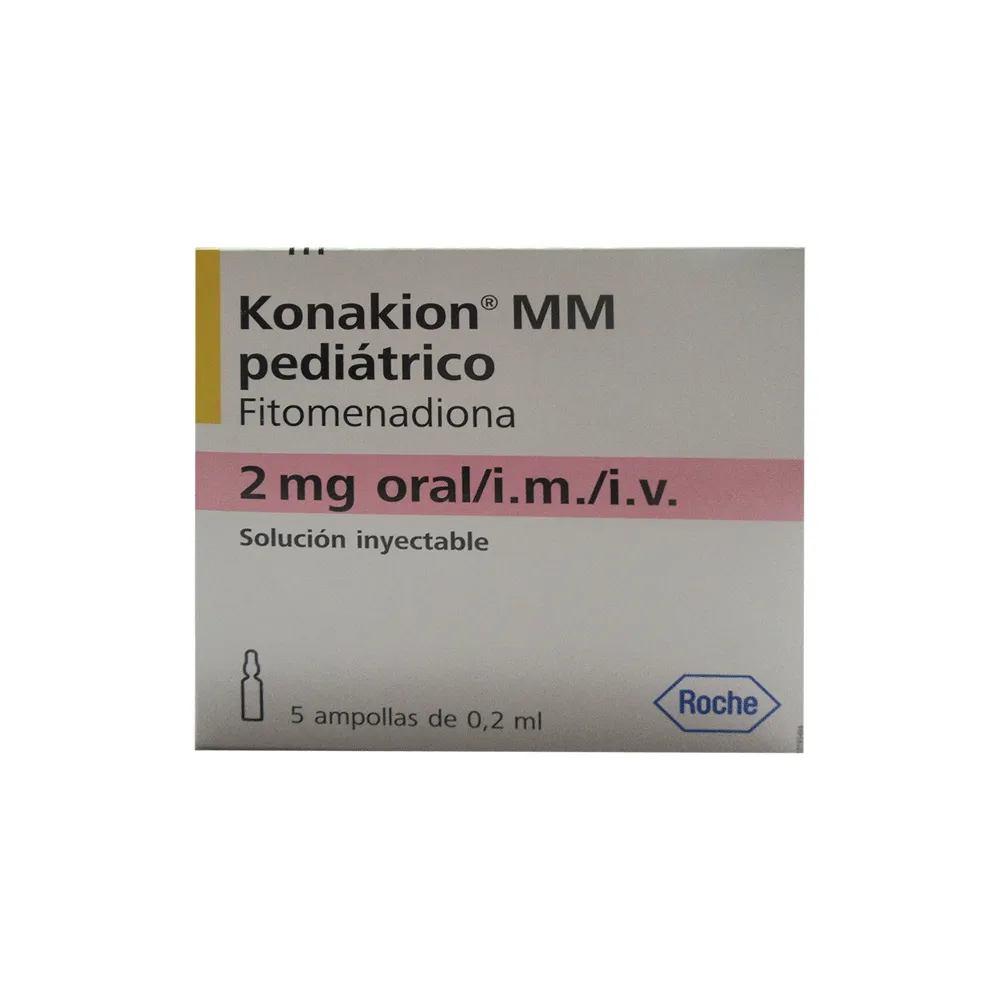
KONAKION 2 MG/0.2 ML PEDIATRIC ORAL SOLUTION/INJECTION SOLUTION
SpainIt is used for the prevention and treatment of vitamin K deficiency bleeding in newborns, which is bleeding caused by a lack of vitamin K1.
Frequently asked questions
When should this medicine not be used?
It should not be used if the child is allergic to phytonadione or any of the other components of the product.
How should Konakion 2mg/0.2ml pediatric be administered?
Administration must strictly follow the doctor's instructions and can be performed orally, or via intramuscular or intravenous injection. The dose and method of administration depend on whether the baby is premature, their weight, and the reason for treatment.
What happens if more than the indicated dose is taken?
An overdose may cause yellowing of the skin (jaundice), increased bilirubin in the blood, abdominal pain, constipation, soft stools, malaise, agitation, skin rashes, or changes in liver enzymes. In case of doubt, consult a doctor immediately.
Can it interact with other medicines?
Yes, inform the doctor if the child is using or has used other medicines. Konakion may interact with epilepsy medications and with coumarin-type anticoagulants (such as warfarin or acenocoumarol).
What side effects can Konakion 2mg/0.2ml pediatric have?
In rare cases, it may cause allergic reactions following injection or irritation at the injection site (pain, swelling, or tenderness). If you notice facial redness or difficulty breathing, contact a doctor immediately.
What precautions should be taken with premature babies?
In premature infants weighing less than 2.5 kg, caution should be exercised with injections due to the risk of a serious neurological complication called kernicterus.
Instructions for use
Table of contents
- Introduction
- 1. What Konakion 2 mg/0.2 ml paediatric is and what it is used for
- 2. What you need to know before starting to use Konakion 2 mg/0.2 ml pediatric
- 3. How to use Konakion 2 mg/0.2 ml paediatric
- 4. Possible adverse effects
- 5. Storage of Konakion 2 mg/0.2 ml pediatric
- 6. Contents of the pack and other information
Package leaflet: Information for the user
Introduction
Package leaflet: information for the user
Konakion 2 mg/0.2 ml paediatric oral solution/injectable solution
Phytomenadione
Read all of this leaflet carefully before you start using this medicine, because it contains important information for you.
- Keep this leaflet, as you may need to read it again. If you have any questions, ask your doctor or pharmacist.
- This medicine has been prescribed for you only, and you should not give it to other people, even if they have the same symptoms as you, because it may harm them.
- If you experience any adverse effects, consult your doctor or pharmacist, even if these adverse effects are not listed in this leaflet. See section 4.
Contents of the leaflet
- What Konakion 2 mg/0.2 ml paediatric is and what it is used for
- What you need to know before using Konakion 2 mg/0.2 ml paediatric
- How to use Konakion 2 mg/0.2 ml paediatric
- Possible adverse effects
- How to store Konakion 2 mg/0.2 ml paediatric
- Contents of the pack and other information
1. What Konakion 2 mg/0.2 ml paediatric is and what it is used for
Konakion paediatric contains as the active substance phytomenadione, which is vitamin K1, involved in the blood clotting mechanism. A deficiency of vitamin K1 leads to an increased tendency to bleed; it is used for the treatment and prevention of bleeding (haemorrhages).
Konakion paediatric is indicated for: prevention and treatment of haemorrhagic disease of the newborn (bleeding due to vitamin K deficiency).
2. What you need to know before starting to use Konakion 2 mg/0.2 ml pediatric
Do not use Konakion pediatric
If the child is allergic to phytomenadione or to any of the other components of this medicine (listed in section 6).
Warnings and precautions
Consult your doctor before starting to use Konakion 2 mg/0.2 ml pediatric.
- Caution is required when administering the medicine by parenteral route (injectable), as it may be associated with a potential risk of kernicterus (a serious neurological complication due to increased levels of bilirubin in the blood) in premature infants weighing less than 2.5 kg.
- If the ampoules have not been properly stored, they may appear cloudy or show phase separation. In such a case, the ampoule must be discarded.
Use of Konakion 2 mg/0.2 ml pediatric with other medicines
Inform your doctor or pharmacist if your child is taking, has recently taken, or might need to take any other medicines, including those obtained without a prescription. This is very important, as using several medicines at the same time may increase or decrease their effects.
The following medicines may interact with Konakion:
- Anticoagulants of the coumarin type (medicines that prevent thrombus formation), such as warfarin or acenocumarol.
- Medicines for epilepsy
Pregnancy, breastfeeding and fertility
Not applicable.
Driving and using machines
Not applicable.
Konakion 2 mg/0.2 ml pediatric contains sodium hydroxide
This medicine contains less than 23 mg (1 mmol) of sodium per ampoule, and is therefore considered essentially "sodium-free".
3. How to use Konakion 2 mg/0.2 ml paediatric
Follow exactly the instructions given by your doctor for administering this medicine. If in doubt, consult your doctor or pharmacist again. Administration can be oral or by intramuscular or intravenous injection.
How to administer the dose of Konakion paediatric depends on the intended use and whether the infant is premature.
Prevention of haemorrhagic disease of the newborn
Healthy full-term or near full-term newborns (with normal gestation duration)
The medicine may be administered in either of the following ways:
- A single intramuscular injection of 1 mg (half the contents of one ampoule) at birth or shortly afterwards, or
- An initial oral dose of 2 mg (one ampoule) at birth or shortly afterwards, followed by a second oral dose of 2 mg given 4–7 days later and a third oral dose of 2 mg one month after birth. In infants fed exclusively with formula milk (bottle-fed), the third oral dose may not be necessary.
Additional oral doses:
- Infants receiving oral vitamin K who are breastfed may require additional oral doses of vitamin K.
- Bottle-fed infants who have received the two oral doses of vitamin K may not require further vitamin K doses, as it is included in the formula milk.
Premature newborns weighing 2.5 kg or more, or full-term newborns at special risk of haemorrhage (e.g., birth asphyxia, obstructive jaundice, etc.)
- These infants will receive an intramuscular or intravenous injection of 1 mg of Konakion at birth or shortly afterwards.
- If the risk of haemorrhage persists, additional injections may be administered.
Premature newborns weighing less than 2.5 kg
Intramuscular and intravenous doses must not exceed 0.4 mg/kg of the infant's body weight (equivalent to 0.04 ml/kg) in premature infants weighing less than 2.5 kg (see "Warnings and precautions" in section 2). The amount and frequency of additional doses will be adjusted according to the child's coagulation status.
Dosing information table for premature newborns at birth
Child's weight | Vitamin K dose at birth | Injection volume |
1 kg | 0.4 mg | 0.04 ml |
1.5 kg | 0.6 mg | 0.06 ml |
2 kg | 0.8 mg | 0.08 ml |
2.5 kg | 1 mg | 0.1 ml |
Greater than 2.5 kg | 1 mg | 0.1 ml |
Treatment of hemorrhagic disease of the newborn
- These babies will receive an intravenous injection of 1 mg (half the content of one ampoule) at birth or shortly thereafter.
- If the risk of bleeding persists, additional injections may be administered. Some babies may also require a blood transfusion.
Instructions for the correct administration of Konakion 2 mg/0.2 ml pediatric
The solution must be clear and transparent at the time of use.
Oral administration: Use the dispenser provided in the package. Break the neck of the ampoule and insert the dispenser vertically. Draw the solution from the ampoule by filling the dispenser up to the mark indicated on it. Administer the contents directly into the child's mouth.
Parenteral (injectable) administration: Konakion pediatric must not be diluted or mixed with other parenteral medications, but it may be injected into the bottom of an infusion set.
If you use more Konakion 2 mg/0.2 ml pediatric than you should
Symptoms that may occur in case of overdose include: jaundice (yellowing of the skin), hyperbilirubinemia (increased blood bilirubin concentration), elevated levels of GOT and GGT (liver enzymes), abdominal pain, constipation, soft stools, malaise, restlessness, and skin rashes.
In case of overdose or accidental ingestion, consult your doctor or pharmacist immediately, go to a medical center, or call the Toxicology Information Service at telephone number 91 562 04 20, indicating the medication and the amount administered.
4. Possible adverse effects
Like all medicines, this medicine can cause adverse effects, although not everyone will experience them.
Rare adverse effects (may affect up to 1 in 1,000 people):
Allergic reactions (anaphylactoid) have been reported following injectable administration of Konakion pediatric.
Local irritation (pain, swelling, tenderness) at the injection site may also occur following injectable administration.
If you notice anything unusual in the child, such as facial redness or difficulty breathing, contact your doctor immediately.
Reporting of adverse effects
If you experience any type of adverse effect, consult your doctor or pharmacist, even if it is a possible adverse effect not listed in this leaflet. You may also report them directly via the Spanish Pharmacovigilance System for Human Medicines: www.notificaRAM.es.
By reporting adverse effects, you can help provide more information on the safety of this medicine.
5. Storage of Konakion 2 mg/0.2 ml pediatric
Store below 25°C.
Keep the ampoules in the outer packaging to protect them from light.
Keep this medicine out of the sight and reach of children. Do not use this medicine after the expiry date stated on the packaging after EXP. The expiry date is the last day of the month indicated.
Do not use this medicine if you notice that the solution is cloudy or shows phase separation.
For stability reasons, any unused contents from opened ampoules must not be used and should be discarded.
Medicines should not be disposed of via wastewater or household waste. Dispose of containers and unused medicines at the SIGRE Point at your pharmacy. If you are in doubt, ask your pharmacist how to dispose of containers and medicines you no longer need. This will help protect the environment.
6. Contents of the pack and other information
Composition of Konakion 2 mg/0.2 ml paediatric
-
The active substance is phytomenadione (vitamin K1). Each 0.2 ml ampoule contains 2 mg of phytomenadione.
-
The other components are glycocholic acid, sodium hydroxide, lecithin, 25% hydrochloric acid, and water for injections.
Appearance of the product and contents of the pack
Konakion paediatric is an oral and injectable solution contained in amber glass ampoules.
Each pack contains 5 ampoules of 0.2 ml and 5 dispensers for oral administration.
Other presentations:
Konakion 10 mg/ml oral solution/injectable solution (for adults).
Marketing Authorisation Holder and Manufacturer
Marketing Authorisation Holder
CHEPLAPHARM Arzneimittel GmbH
Ziegelhof 24
17489 Greifswald
Germany
Local representative
Laboratorios Rubió, S.A.
C/ Industria, 29 - Pol. Ind. Comte de Sert
08755 Castellbisbal (Barcelona)
Spain
Manufacturer
CHEPLAPHARM Arzneimittel GmbH
Ziegelhof 23-24
17489 Greifswald
Germany
Date of the most recent review of this leaflet: December 2015.
Detailed and up-to-date information on this medicine is available on the website of the Spanish Agency for Medicines and Health Products (AEMPS) http://www.aemps.es/
Similar drugs
| Brand name | Dosage form | Active substance / Dosage | Manufacturer |
|---|---|---|---|
| KONAKION 10 MG/ML ORAL SOLUTION/INJECTION SOLUTION | solution, oral and injectable |
|
Cheplapharm Arzneimittel Gmbh |
The original data is available in the language of the country of manufacture.
Data source: Online Medicines Information Centre (CIMA) — AEMPS
Data last verified: September 21, 2026