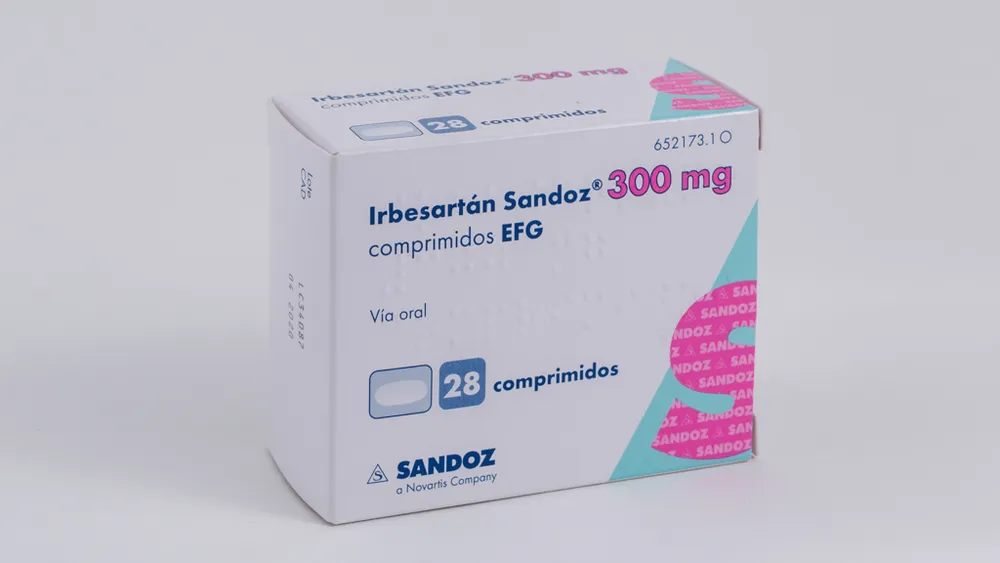
IRBESARTAN SANDOZ 300 MG TABLETS EFG
SpainIrbesartan Sandoz is used in adults to treat high blood pressure (hypertension) and to protect the kidney in people with high blood pressure and type 2 diabetes who show signs of impaired kidney function.
Frequently asked questions
How should I take Irbesartan Sandoz?
It should be taken orally, swallowing the tablets with sufficient liquid, such as a glass of water. It can be taken with or without food, and it is recommended to try to take it at the same time every day.
What is the usual dose for high blood pressure?
The normal dose is 150 mg once daily, although depending on the patient's response, the doctor may increase it to 300 mg once daily.
When should I not take this medicine?
You should not take it if you are allergic to the active ingredient or any of its components, if you are more than 3 months pregnant, or if you have diabetes or renal failure and are being treated with aliskiren for blood pressure.
What side effects can Irbesartan Sandoz cause?
Common side effects include dizziness, nausea, vomiting, and fatigue. Other effects may include diarrhea, indigestion, cough, muscle or joint pain, and changes in blood potassium levels. In rare cases, it may cause intestinal swelling or skin allergic reactions.
Can I take other medicines while using this treatment?
You must inform your doctor if you are taking angiotensin-converting enzyme (ACE) inhibitors, aliskiren, potassium supplements, lithium-containing medicines, repaglinide, or non-steroidal anti-inflammatory drugs, as they may interact with the treatment.
What should I do if I forget a dose?
If you forget a dose, simply take the next one when it is due. You must not take a double dose to make up for the one you forgot.
Is it safe during pregnancy or breastfeeding?
Its use is not recommended at the beginning of pregnancy and is prohibited from the third month of gestation due to the risk of serious harm to the baby. Its use is also not recommended during breastfeeding; consult your doctor.
Instructions for use
Package leaflet: Information for the user
Introduction
Package leaflet: information for the patient
Irbesartán Sandoz 300 mg tablets EFG
Read the entire leaflet carefully before you start taking this medicine, as it contains important information for you.
- Keep this leaflet, as you may need to read it again.
- If you have any questions, consult your doctor or pharmacist.
- This medicine has been prescribed for you only and must not be given to other people, even if they have the same symptoms as you, because it could harm them.
- If you experience any adverse effects, consult your doctor or pharmacist, even if they are adverse effects not listed in this leaflet. See section 4.
Leaflet contents
- What Irbesartán Sandoz is and what it is used for
- What you need to know before taking Irbesartán Sandoz
- How to take Irbesartán Sandoz
- Possible side effects
- How to store Irbesartán Sandoz
- Contents of the pack and other information
1. What is Irbesartan Sandoz and what is it used for?
Irbesartan belongs to a group of medicines known as angiotensin-II receptor antagonists. Angiotensin-II is a substance produced in the body that binds to receptors, causing blood vessels to constrict. This leads to an increase in blood pressure. Irbesartan prevents angiotensin-II from binding to these receptors, relaxing the blood vessels and thereby reducing blood pressure. Irbesartan slows down the decline in kidney function in patients with high blood pressure and type 2 diabetes.
Irbesartan Sandoz is used in adult patients:
-
to treat high blood pressure (essential hypertension),
-
to protect the kidneys in patients with high blood pressure, type 2 diabetes, and clinical evidence of impaired kidney function.
2. What you need to know before taking Irbesartán Sandoz
Do not take Irbesartán Sandoz:
- if you are allergic to the active substance or to any of the other ingredients of this medicine (listed in section 6),
- if you are more than 3 months pregnant. (In any case, it is better to avoid taking this medicine also during early pregnancy – see Pregnancy section),
- if you have diabetes or renal failure and are being treated with a blood pressure-lowering medicine containing aliskiren.
Warnings and precautions
Talk to your doctor before starting to take irbesartan and if any of the following apply to you:
- if you have excessive vomiting or diarrhoea,
- if you have kidney problems,
- if you have heart problems,
- if you are taking irbesartan for diabetic kidney disease. In this case, your doctor may carry out regular blood tests, especially to measure potassium levels if kidney function is impaired,
- if you have low blood sugar levels (symptoms may include sweating, weakness, hunger, dizziness, trembling, headache, flushing or paleness, numbness, rapid and strong heartbeat), especially if you are being treated for diabetes,
- if you are going to have surgery (surgical intervention) or will be given anaesthetics,
- if you are taking any of the following medicines used to treat high blood pressure (hypertension):
- an angiotensin-converting enzyme inhibitor (ACE inhibitor) (e.g. enalapril, lisinopril, ramipril), particularly if you have kidney problems related to diabetes,
- aliskiren.
Your doctor may monitor your kidney function, blood pressure, and blood electrolyte levels (e.g. potassium) at regular intervals.
See also the information under the heading “Do not take Irbesartán Sandoz”.
If you are pregnant, think you might be pregnant, or plan to become pregnant, you must inform your doctor. Use of irbesartan is not recommended during the first trimester of pregnancy (first 3 months), and in no case should it be administered from the third month of pregnancy onwards, as it may cause serious harm to your baby.
Consult your doctor if you experience abdominal pain, nausea, vomiting, or diarrhoea after taking irbesartan. Your doctor will decide whether to continue treatment. Do not stop taking irbesartan on your own.
Children and adolescents
This medicine must not be used in children and adolescents, as safety and efficacy have not yet been fully established.
Other medicines and Irbesartán Sandoz
Tell your doctor or pharmacist if you are taking, have recently taken, or might need to take any other medicines.
Your doctor may need to adjust your dose and/or take other precautions:
If you are taking an angiotensin-converting enzyme inhibitor (ACE inhibitor) or aliskiren (see also information under the headings “Do not take Irbesartán Sandoz” and “Warnings and precautions”).
You may need to have blood tests if you are taking:
- potassium supplements,
- salt substitutes containing potassium,
- potassium-sparing medicines (such as certain diuretics),
- medicines containing lithium,
- repaglinide (a medicine used to reduce blood sugar levels).
If you are using a type of painkiller known as non-steroidal anti-inflammatory drugs (NSAIDs), the effect of irbesartan may be reduced.
Taking Irbesartán Sandoz with food and drink
Irbesartán Sandoz can be taken with or without food.
The tablets should be swallowed with water.
Pregnancy and breast-feeding
Pregnancy
If you are pregnant or breast-feeding, think you might be pregnant, or plan to become pregnant, consult your doctor or pharmacist before using this medicine. Generally, your doctor will advise you to stop taking irbesartan before becoming pregnant or as soon as pregnancy is confirmed, and will recommend an alternative antihypertensive medicine. Use of irbesartan is not recommended during early pregnancy and must not be used from the third month of pregnancy onwards, as it may cause serious harm to your baby when administered from that time.
Breast-feeding
Inform your doctor if you are planning to start or are currently breast-feeding, as irbesartan is not recommended for women during this period. Your doctor may decide to prescribe a different treatment if you wish to breast-feed, especially if the baby is a newborn or premature.
Driving and using machines
No studies on the effects on the ability to drive and use machines have been performed.
It is unlikely that irbesartan will affect your ability to drive or use machines. However, during treatment for hypertension, dizziness or fatigue may occasionally occur. If you experience these symptoms, talk to your doctor before driving or using machines.
Irbesartán Sandoz contains lactose and hydrogenated castor oil
This medicine contains lactose. If your doctor has informed you that you have an intolerance to certain sugars, consult him before taking this medicine.
This medicine may cause stomach discomfort and diarrhoea because it contains hydrogenated castor oil.
3. How to take Irbesartán Sandoz
Follow exactly the instructions for use of this medicine as given by your doctor or pharmacist. If in doubt, consult your doctor or pharmacist again.
Method of administration:
Irbesartán Sandoz is administered orally. The tablets should be swallowed with a sufficient amount of liquid (e.g., a glass of water). Irbesartán Sandoz can be taken with or without food. You should try to take your daily dose at the same time each day. It is important that you continue taking this medicine until your doctor advises you otherwise.
Patients with high blood pressure
The usual dose is 150 mg once daily. Subsequently, depending on the blood pressure response, this dose may be increased to 300 mg once daily.
Patients with high blood pressure and type 2 diabetes with kidney impairment
In patients with high blood pressure and type 2 diabetes, the recommended maintenance dose for the treatment of associated kidney impairment is 300 mg once daily.
Your doctor may recommend a lower dose, especially at the beginning of treatment, in certain patients, such as patients on hemodialysis or patients over 75 years of age.
The maximum blood pressure-lowering effect should be achieved within 4–6 weeks after starting treatment.
Use in children and adolescents
Irbesartán Sandoz must not be given to children under 18 years of age. If a child swallows several tablets, contact your doctor immediately.
If you take more Irbesartán Sandoz than you should
If you accidentally take too many tablets, or if a child swallows several, contact your doctor or pharmacist immediately.
In case of overdose or accidental ingestion, consult your doctor or pharmacist immediately or call the Toxicology Information Service, telephone: 91 562 04 20, indicating the medicine and the amount ingested.
If you forget to take Irbesartán Sandoz
If you accidentally miss a dose, simply take your next dose at the usual time. Do not take a double dose to make up for missed doses.
If you have any further questions about the use of this medicine, ask your doctor or pharmacist.
4. Possible adverse effects
Like all medicines, this medicine can cause adverse effects, although not everyone will experience them.
However, some effects may be serious and may require medical attention.
As with similar medicines, rare cases of skin allergic reactions (rash, urticaria) as well as localized swelling of the face, lips and/or tongue have been reported in patients treated with irbesartan. If you think you may be experiencing a reaction of this type or have difficulty breathing, stop taking irbesartan and go immediately to a medical facility.
The adverse effects listed below are grouped according to their frequency as follows:
Very common: may affect more than 1 in 10 patients.
Common: may affect up to 1 in 10 patients.
Uncommon: may affect up to 1 in 100 patients.
Rare: may affect up to 1 in 1000 patients.
Adverse effects reported in clinical trials conducted in patients treated with irbesartan were:
-
Very common (may affect more than 1 in 10 patients): if you have high blood pressure and type 2 diabetes with kidney impairment, blood tests may show increased levels of potassium.
-
Common (may affect up to 1 in 10 patients): dizziness, nausea/vomiting, fatigue, and blood tests may show elevated levels of an enzyme that measures muscle and heart function (creatine kinase enzyme). In patients with high blood pressure and type 2 diabetes with kidney impairment, dizziness (especially when standing up), low blood pressure (especially when standing up), muscle or joint pain, and decreased levels of a protein present in red blood cells (haemoglobin).
-
Uncommon (may affect up to 1 in 100 patients): tachycardia, skin redness, cough, diarrhoea, indigestion/heartburn, sexual dysfunction (impairment of sexual function), and chest pain.
-
Rare (may affect up to 1 in 1000 patients): intestinal angioedema; swelling in the intestine presenting symptoms such as abdominal pain, nausea, vomiting and diarrhoea.
Since the marketing of irbesartan, some adverse effects have been reported. Adverse effects reported with unknown frequency are: sensation of spinning (vertigo), headache, taste disturbance, tinnitus, muscle cramps, muscle and joint pain, reduction in the number of red blood cells (anaemia - symptoms may include tiredness, headaches, shortness of breath on exertion, dizziness and pallor), reduction in the number of platelets, abnormal liver function, increased blood potassium levels, kidney function impairment, inflammation of small blood vessels, mainly in the skin (a condition known as leukocytoclastic vasculitis), severe allergic reactions (anaphylactic shock), and low blood sugar levels.
Infrequent cases of jaundice (yellowing of the skin and/or whites of the eyes) have also been observed.
Reporting of adverse effects
If you experience any adverse effect, consult your doctor or pharmacist, even if it is a possible adverse effect not listed in this leaflet. You may also report them directly via the Spanish Pharmacovigilance System for Human Medicines: https://www.notificaram.es. By reporting adverse effects, you can help provide more information on the safety of this medicine.
5. Storage of Irbesartan Sandoz
Keep this medicine out of the sight and reach of children.
No special storage conditions are required. Store in the original packaging to protect from light.
Do not use this medicine after the expiry date stated on the container after “CAD/EXP”. The expiry date refers to the last day of the month indicated.
Medicines should not be disposed of via wastewater or household waste. Dispose of unused containers and medicines at the SIGRE collection point at your pharmacy. If you have any doubts, ask your pharmacist how to dispose of containers and unused medicines. This will help protect the environment.
6. Contents of the pack and other information
If you would like more information about your condition or your treatment, you should consult your doctor or pharmacist.
Composition of Irbesartan Sandoz 300 mg tablets EFG
- The active substance is irbesartan. Each tablet contains 300 mg of irbesartan.
- The other components are: povidone K90 (E1201), magnesium stearate, microcrystalline cellulose (E460), monohydrate lactose, sodium croscarmellose, colloidal anhydrous silica, hydrogenated castor oil, and corn starch.
Appearance of the product and pack size
Irbesartan Sandoz 300 mg tablets are white, oblong, biconvex, and scored tablets. The tablet can be divided into equal doses.
Each pack contains 28 tablets.
Marketing Authorization Holder and Manufacturer
Marketing Authorization Holder:
Sandoz Farmacéutica S.A.
Centro Empresarial Parque Norte
Edificio Roble
C/ Serrano Galvache, 56
28033 Madrid
Spain
Manufacturer:
Laboratorios Liconsa, S.A.
Avd. Miralcampo, nº 7
Polígono Industrial Miralcampo
19200 Azuqueca de Henares (Guadalajara)
Spain
Date of the most recent review of this leaflet: February 2025
Detailed and up-to-date information on this medicinal product is available on the website of the Spanish Agency of Medicines and Health Products (AEMPS) http://www.aemps.gob.es/
Similar drugs
| Brand name | Dosage form | Active substance / Dosage | Manufacturer |
|---|---|---|---|
| IRBESARTAN AUROVITAS 150 MG TABLETS EFG | tablets |
|
Aurovitas Spain, S.A.U. |
| IRBESARTAN AUROVITAS 300 MG TABLETS EFG | tablets |
|
Aurovitas Spain, S.A.U. |
| IRBESARTAN AUROVITAS 75 MG TABLETS EFG | tablets |
|
Aurovitas Spain, S.A.U. |
| IRBESARTAN CINFA 150 MG TABLETS EFG | tablets |
|
Laboratorios Cinfa S.A. |
| IRBESARTAN CINFA 300 MG TABLETS EFG | tablets |
|
Laboratorios Cinfa S.A. |
| IRBESARTAN CINFA 75 MG TABLETS EFG | tablets |
|
Laboratorios Cinfa S.A. |
| IRBESARTAN NORMON 150 MG TABLETS EFG | tablets |
|
Laboratorios Normon S.A. |
| IRBESARTAN NORMON 300 MG TABLETS EFG | tablets |
|
Laboratorios Normon S.A. |
| IRBESARTAN NORMON 75 MG TABLETS EFG | tablets |
|
Laboratorios Normon S.A. |
| IRBESARTAN PENSA 150 MG TABLETS EFG | tablets |
|
Towa Pharmaceutical S.A. |
| IRBESARTAN PENSA 300 MG TABLETS EFG | tablets |
|
Towa Pharmaceutical S.A. |
| IRBESARTAN PENSA 75 MG TABLETS EFG | tablets |
|
Towa Pharmaceutical S.A. |
The original data is available in the language of the country of manufacture.
Data source: Online Medicines Information Centre (CIMA) — AEMPS
Data last verified: September 21, 2026