GELASPAN 40 MG/ML SOLUTION FOR INFUSION
SpainIt is used to replace blood and body fluids lost following surgery, an accident, or a burn. It is also used to prevent low blood pressure during spinal or epidural anesthesia, or due to severe blood loss during surgery, and to replenish circulating blood volume in extracorporeal circulation systems.
Frequently asked questions
How should Gelaspan be administered?
The medication is administered by a doctor via an intravenous route (drip into a vein). The dose and administration time depend on the amount of fluid lost and the patient's condition.
Who should not use this medication?
It should not be used if you are allergic to gelatin, red meat (mammalian meat) or its by-products, or to the alpha-Gal allergen. It should also not be used if blood volume is too high, if there is excess water in the body, if you have acute congestive heart failure, or abnormally high potassium levels in the blood.
What side effects can Gelaspan cause?
It may cause allergic reactions (difficulty breathing, nausea, dizziness, or swelling of the face and neck), a decrease in red blood cells and proteins, increased tendency to bleed, accelerated heartbeat, low blood pressure, fever, or chills. Nausea, vomiting, or dizziness may also occur due to decreased oxygen in the blood.
Are there interactions with other medications?
The doctor must be informed if you are taking medications that retain sodium (such as spironolactone, corticosteroids, or anti-inflammatories like diclofenac), as this could cause swelling in the extremities. You should also inform the doctor if you are taking medications that cause potassium loss.
What precautions should be taken during treatment with Gelaspan?
The doctor will monitor blood composition and may adjust the dose to prevent fluid overload, especially in people with heart, lung, or kidney problems. In children, its use is reserved only for cases that the doctor deems absolutely necessary.
Instructions for use
Patient Information Leaflet
Introduction
Patient Information Leaflet
Gelaspan 40 mg/ml solution for infusion
Read the entire package leaflet carefully before you start using this medicine, as it contains important information for you.
|
Package leaflet:
- What Gelaspan is and what it is used for
- What you need to know before using Gelaspan
- How to use Gelaspan
- Possible side effects
- How to store Gelaspan
Contents of the pack and other information
1. What Gelaspan is and what it is used for
Gelaspan is one of the so-called plasma volume expanders. This means that it replaces fluid lost from the blood vessels.
Gelaspan is used for:
- Replacing blood and body fluids that have been lost, for example, after surgery, an accident, or a burn. It may be combined with blood transfusions if necessary.
- Preventing low blood pressure (hypotension) that may occur during spinal or epidural anesthesia, or due to severe and imminent blood loss in a surgical setting.
Restoring the volume of circulating blood during procedures involving, for example, extracorporeal circulation, using other perfusion fluids.
2. What you need to know before using Gelaspan
Do not use Gelaspan
- if you are allergic to gelatin or to any of the other components of this medicine (listed in section 6)
- if you are allergic to an allergen called “galactose-α-1,3-galactose (alpha-Gal)” or to red meat (mammalian meat) and offal
- if your circulating blood volume is too high
- if you have too much water in your body
- if you have certain types of heart failure (acute congestive heart failure)
- if you have abnormally high potassium levels in your blood.
Warnings and precautions
Talk to your doctor, pharmacist, or nurse before starting to use Gelaspan.
Inform your doctor
-
if you suffer from an allergic condition such as asthma, as you may be at increased risk of experiencing an allergic reaction
-
in these cases, Gelaspan must not be administered due to possible cross-reactions:
-
if you know you are allergic to red meat (mammalian meat) or offal
-
if you have tested positive for antibodies (IgE) against the allergen alpha-Gal
Your doctor will exercise particular caution if you have
- heart problems
- high blood pressure
- fluid in your lungs
- severe kidney problems.
Administering large amounts of fluid by intravenous infusion may worsen your condition.
Your doctor will also act with caution
- if you have severely elevated levels of sodium or chloride in your blood
- if you retain water and salt, which may be associated with tissue swelling
- if you have high potassium levels in your blood or if you are taking or receiving medications that cause potassium retention
- if your blood coagulation is severely impaired
- if you are elderly
While you are receiving Gelaspan, your blood composition will be monitored. If necessary, your doctor may administer other medications such as electrolytes and fluids.
Children:
There is limited experience with the use of Gelaspan in children. Your doctor will administer this medicine to children only when absolutely necessary.
Laboratory test results:
Your doctor may take blood or urine samples before administering Gelaspan. This is because some laboratory test results may be affected after receiving this medicine and thus may not be reliable.
Other medicines and Gelaspan
Inform your doctor or pharmacist if you are taking or using, or have recently taken or used any other medicines, including those obtained without a prescription.
In particular, your doctor should know if you are taking or receiving medications that cause sodium retention (e.g., spironolactone, triamterene, amiloride; ACE inhibitors such as captopril or enalapril, corticosteroids such as cortisone, or non-steroidal anti-inflammatory drugs such as diclofenac). Concomitant administration with this medicine could cause swelling of the arms, hands, legs, and feet (edema). Additionally, inform your doctor if you are taking medications that cause potassium loss, such as diuretics.
Pregnancy and breastfeeding
If you are pregnant or breastfeeding, think you may be pregnant, or are planning to become pregnant, consult your doctor or pharmacist before taking any medicine.
Pregnancy:
If you are pregnant, inform your doctor. Due to the possibility of allergic reactions, use of this medicine should be avoided during pregnancy. However, your doctor may administer this medicine in emergency situations.
Breastfeeding:
If you are breastfeeding, inform your doctor. There is limited information available on whether this medicine is excreted in breast milk. Your doctor will decide whether to discontinue breastfeeding or discontinue treatment with this medicine, taking into account the benefit of breastfeeding for the child and the benefit of treatment for you.
Fertility:
There are no data available on the effect of this medicine on human or animal fertility. However, due to the nature of its components, it is considered unlikely to affect fertility.
Driving and using machines
This medicine does not affect the ability to drive or operate machinery.
3. How to use Gelaspan
Your doctor will administer Gelaspan only if they consider that other products known as crystalloids are not sufficient on their own.
Your doctor will carefully adjust the dose of Gelaspan to prevent fluid overload. This is particularly important if you have problems with your lungs, heart, or circulation.
Posology
Gelaspan is administered intravenously, i.e., as a slow infusion.
Adults
The volume and duration of administration will depend on the amount of blood or fluid you have lost and on your clinical condition.
Your doctor will perform tests (e.g., for blood pressure and blood parameters) during treatment and will adjust the dose of Gelaspan according to your needs. If necessary, you may also receive blood or packed red blood cells.
Use in children
There is limited experience with the use of this medicine in children. The doctor will administer this medicine only if they consider it essential for the child's recovery. In such cases, the clinical condition will be taken into account, and treatment will be monitored with particular care.
If you have received more Gelaspan than you should
An overdose of Gelaspan may cause an excessively high blood volume (hypervolemia) and fluid overload, which may affect heart and lung function.
If an overdose occurs, your doctor will administer the necessary treatment.
If you have any further questions about the use of this medicine, ask your doctor or pharmacist.
4. Possible adverse effects
Like all medicines, Gelaspan may cause adverse effects, although not everyone experiences them.
All plasma substitutes carry a slight risk of allergic reactions, usually mild or moderate, but in very rare cases they can also be severe. These reactions are believed to occur more frequently in patients with known allergic disorders, such as asthma. For this reason, you will be closely monitored by a healthcare professional, especially at the beginning of the infusion.
The following adverse effects may be serious. If any of the following adverse effects occur, consult a doctor immediately:
Rare (may affect up to 1 in 1,000 people):
Allergic reactions (anaphylactic/anaphylactoid) including, for example, difficulty breathing, wheezing, nausea, vomiting, dizziness, sweating, tightness in the chest or throat, stomach pain, swelling of the neck and face.
If an allergic reaction occurs, the infusion will be stopped immediately and you will be given the necessary treatment (see also section 2 "What you need to know before using Gelaspan", especially regarding allergies involving allergens called galactose-α-1,3-galactose (alpha-Gal), red meat, and offal).
Other adverse effects include:
Very common (may affect up to 1 in 10 people):
- decrease in red blood cells and blood proteins
Common (may affect up to 1 in 100 people):
- your blood may not clot as well as before, and you may notice that you bleed more easily
Very rare (may affect up to 1 in 10,000 people):
- increased heart rate
- low blood pressure
- fever, chills
Frequency not known (cannot be estimated from available data):
- nausea, vomiting, stomach pain
- decreased oxygen in the blood, which may make you feel dizzy
Other adverse effects in children
There are no data regarding differences in adverse effects in children.
Reporting of adverse effects
If you experience any type of adverse effect, consult your doctor or pharmacist, even if it is a possible adverse effect not listed in this leaflet. You can also report them directly through the Spanish Pharmacovigilance System for Human Medicinal Products: www.notificaRAM.es. By reporting adverse effects, you can help provide more information on the safety of this medicine.
5. Storage of Gelaspan
Keep this medicine out of the sight and reach of children.
Do not use Gelaspan after the expiry date stated on the label and on the carton. The expiry date is the last day of the month indicated.
Do not store above 25 °C. Do not freeze.
Do not use Gelaspan if you observe:
- cloudiness or discoloration of the solution
- leakage from the container.
Previously opened or partially used Gelaspan must be discarded. Partially used vials or bags must not be reconnected.
6. Contents of the container and other information
Composition of Gelaspan
Active substances:
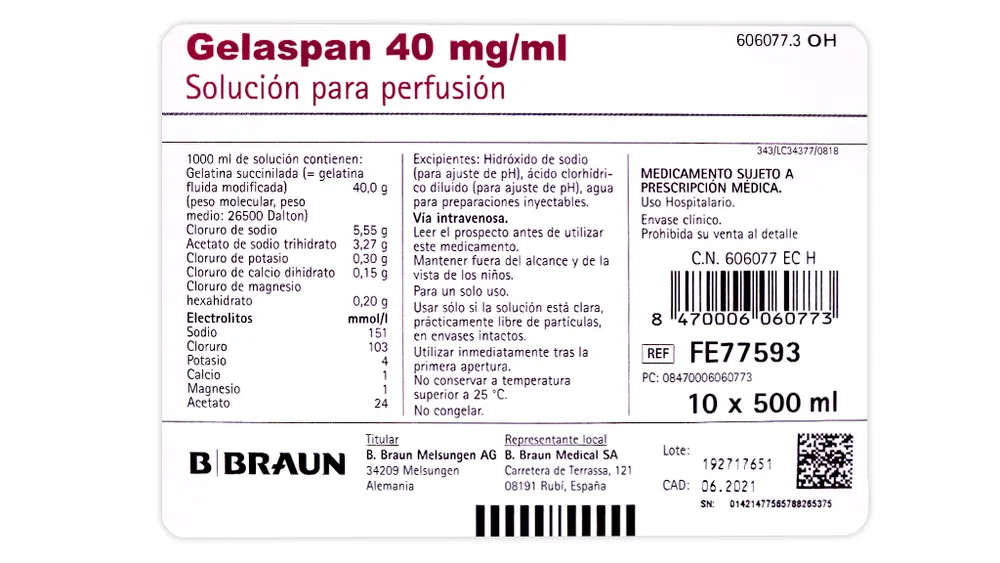
1,000 ml of solution contain:
Hydrolyzed succinylated gelatin (modified fluid) 40.0 g
Sodium chloride 5.55 g
Sodium acetate trihydrate 3.27 g
Potassium chloride 0.30 g
Calcium chloride dihydrate 0.15 g
Magnesium chloride hexahydrate 0.20 g
Electrolyte concentration:
Sodium 151 mmol/l
Chloride 103 mmol/l
Potassium 4 mmol/l
Calcium 1 mmol/l
Magnesium 1 mmol/l
Acetate 24 mmol/l
Other components:
Water for injections, diluted hydrochloric acid (for pH adjustment), and sodium hydroxide (for pH adjustment).
Appearance of the product and contents of the container
Gelaspan is an intravenous infusion solution (administered by intravenous drip).
It is a sterile, clear, colourless or slightly yellowish solution.
Gelaspan is available in:
- Low-density polyethylene flasks "Ecoflac plus", containing 500 ml, available in packs of 10 x 500 ml
- Plastic bags "Ecobag" (non-PVC), sealed with rubber stoppers, containing 500 ml, available in packs of 20 x 500 ml.
Only certain pack sizes may be marketed.
Marketing Authorization Holder, Manufacturer and Local Representative
Marketing Authorization Holder and Manufacturer
- Braun Melsungen AG
Carl-Braun-Straße 1
34212 Melsungen, Germany
Postal address:
34209 Melsungen, Germany
Telephone: +49/5661/71-0
Fax: +49/5661/71-4567
Manufacturer responsible for batch release in the UK
- Braun Medical Limited
Brookdale Road
Thorncliffe Park Estate
Chapeltown
Sheffield
S35 2PW
United Kingdom
Manufacturer responsible for batch release in ES and PT
- Braun Medical S.A.
Carretera de Terrassa, 121
08191 Rubí (Barcelona)
Spain
For further information regarding this medicinal product, please contact the local representative of the Marketing Authorization Holder:
- Braun Medical, S.A.
Ctra. Terrassa, 121
08191 Rubí (Spain)
This medicinal product has been authorized in the Member States of the European Economic Area and in the United Kingdom (Northern Ireland) under the following names:
Member State | Medicinal Product Name |
Austria | Gelofusin Iso 40 mg/ml Infusionslösung |
Belgium | Isogelo oplossing voor infusie, solution pour perfusion, Infusionslösung |
Bulgaria | Gelofusine Balance 4% solution for Infusion |
Czech Republic | Gelaspan 4% |
Denmark | Gelaspan |
Estonia | Gelaspan infusioonilahus 4% |
France | Gelaspan, solution for perfusion |
Germany | Gelafundin ISO 40 mg/ml Infusionslösung |
Greece | Gelaspan solution for Infusion 4% |
Hungary | Gelaspan 4% oldatos infúzió |
Ireland | Gelaspan Solution for Infusion |
Italy | Gelaspan |
Latvia | Gelaspan 4% Solution for Infusion |
Lithuania | Gelaspan 4% infuzinis tirpalas |
Luxembourg | Gelafundin ISO 40 mg/ml Infusionslösung |
Malta | Gelaspan 4% Solution for Infusion |
Netherlands | Gelaspan, oplossing voor infusie |
Norway | Gelaspan |
Poland | Gelaspan |
Portugal | Gelaspan |
Romania | Gelaspan 40 mg/ml solutie perfuzabila |
Slovakia | Gelaspan 4% |
Slovenia | Gelaspan 40 mg/ml raztopina za infundiranje |
Spain | Gelaspan 40 mg/ml solution for perfusion |
Sweden | Gelaspan |
United Kingdom (Northern Ireland) | Gelaspan solution for infusion |
Date of the latest review of this summary: April 2023
Detailed information on this medicine is available on the website of the Spanish Agency for Medicinal Products and Medical Devices: http://www.aemps.gob.es/
This information is intended for healthcare professionals only:
Precautions for use
Gelaspan must not be infused through the same infusion line as blood, blood components, or blood derivatives (red blood cell concentrates, plasma, and plasma fractions).
During the replacement of severe blood loss with large-volume infusions of Gelaspan, hematocrit and electrolyte levels should be monitored. Hematocrit should not fall below 25%. In elderly or severely ill patients, hematocrit should not fall below 30%.
The dilution effect on coagulation factors should also be considered in these situations, especially in patients with pre-existing hemostatic disorders.
Since the product does not replace lost plasma proteins, plasma protein concentrations should be monitored.
In serious acute situations, Gelaspan may be rapidly infused using pressure infusion (500 ml can be administered within 5–10 minutes) until signs of hypovolemia are relieved.
Prior to rapid infusion, Gelaspan may be warmed to a maximum temperature of 37°C.
In the case of pressure infusion, which may be necessary in life-threatening emergencies, all air must be removed from the container and infusion set before administration to avoid the risk of air embolism, which could otherwise be associated with the infusion.
Influence on laboratory tests
Blood laboratory tests (blood group and irregular antibodies) are possible after Gelaspan infusions. However, it is recommended to collect blood samples before Gelaspan infusion to avoid ambiguous interpretation of test results.
Gelaspan may interfere with the following clinical chemistry tests, leading to falsely elevated values:
- Erythrocyte sedimentation rate
- Urine specific gravity
- Non-specific protein assays, e.g., the Biuret method.
Incompatibilities
In the absence of compatibility studies, this medicinal product must not be mixed with other medicinal products.
The original data is available in the language of the country of manufacture.
Data source: Online Medicines Information Centre (CIMA) — AEMPS
Data last verified: September 21, 2026