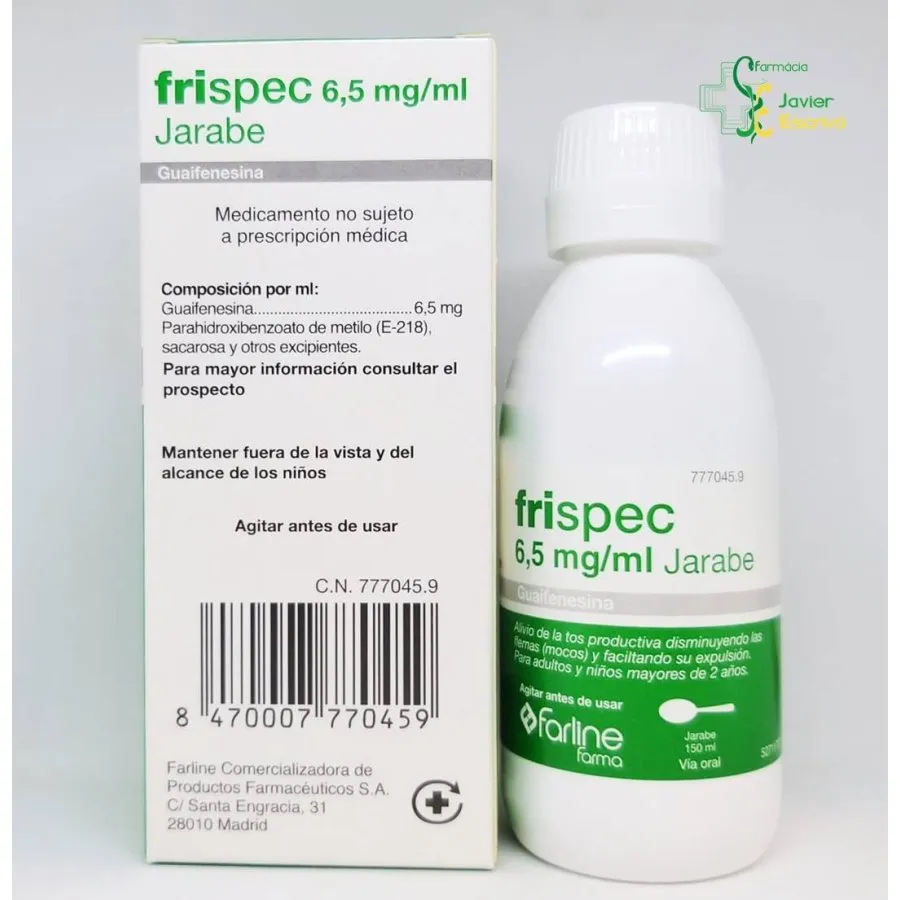
FRISPEC 6.5 MG/ML SYRUP
SpainIt is used to relieve productive cough (cough with phlegm), helping to reduce mucus and facilitating its expulsion.
Frequently asked questions
Who can take this medication?
It is indicated for adults, adolescents, and children over 2 years of age.
When should FRISPEC not be taken?
It should not be taken if you are allergic to guaifenesin or any of its components, nor in children under 2 years of age.
How should I take the syrup?
It should be taken orally, shaking the bottle before use and measuring the dose with the included spoon. It can be taken alone or mixed with water, but it is necessary to drink a glass of water after each dose.
What is the recommended dose for adults and children?
For adults and adolescents over 12 years of age, the dose is 30 ml every 4 hours if necessary. For children aged 6 to 12 years, it is 15 ml every 4 hours, and for children aged 2 to 5 years, it is 7.5 ml every 4 hours, always under medical supervision.
What side effects can FRISPEC cause?
It may cause nausea, vomiting, diarrhea, stomach discomfort, headache, and dizziness. If allergic reactions such as itching or skin rashes appear, you must stop taking it and consult a doctor immediately.
Can I take other medications at the same time?
It is not recommended to take this medication along with other cough products (antitussives or cough suppressants). It is important to inform your doctor if you are taking any other medication.
Are there warnings regarding alcohol or food consumption?
The medication can be taken with or without food, but you should not consume alcohol while undergoing treatment. If you suffer from diabetes, please note that it contains sucrose.
What should I do if symptoms do not improve?
You should consult a doctor if the cough worsens or if there is no improvement after 7 days of treatment.
Instructions for use
Package leaflet: Information for the user
Introduction
PACKAGE LEAFLET: Information for the user
frispec 6.5 mg/ml Syrup
Guaifenesin
Read the entire leaflet carefully before you start taking this medicine, as it contains important information for you.
Follow exactly the administration instructions of the medicine contained in this leaflet or as indicated by your doctor or pharmacist.
- Keep this leaflet, as you may need to read it again.
- If you need advice or more information, consult your pharmacist.
- If you experience any adverse reactions, consult your doctor or pharmacist, even if they are adverse reactions not listed in this leaflet.
- You should consult a doctor if your condition worsens or if you do not improve after 7 days of treatment.
Contents of the leaflet:
- What frispec is and what it is used for
- What you need to know before taking frispec
- How to take frispec
- Possible side effects
- How to store frispec
- Contents of the pack and other information
1. What frispec is and what it is used for
Guaifenesin, the active ingredient in this medicine, belongs to a group of medicines called expectorants.
It is indicated for the relief of productive cough by reducing phlegm (mucus) and facilitating its expulsion.
For adults and children over 2 years of age.
You should consult a doctor if symptoms worsen or do not improve after 7 days of treatment.
2. What you need to know before starting to take frispec
Do not take frispec:
- If you are allergic to guaifenesin or to any of the other ingredients of this medicine (listed in section 6)
- Children under 2 years of age must not take this medicine.
Warnings and precautions:
Consult your doctor, pharmacist, or nurse before taking Frispec if:
- You have had a cough for more than 7 days, or if your cough is recurrent or accompanied by fever, rash, or persistent headache
- You have a persistent cough that may be due to asthma
- You have a cough with a large amount of mucus (phlegm)
- You have severe liver or kidney problems
Interference with laboratory tests
If you are due to have a urine test, it is important to inform your doctor or nurse that you are taking or have recently taken this medicine, as it may alter some test results.
Children
Children under 2 years of age must not take this medicine because it is contraindicated.
Taking frispec with other medicines:
Inform your doctor or pharmacist if you are taking, have recently taken, or might need to take any other medicines.
It is not recommended to take this medicine together with other cough medicines (antitussives or cough suppressants).
Taking frispec with food, drinks and alcohol:
You may take this medicine with or without food.
Do not drink alcohol while being treated with this medicine.
Pregnancy and breastfeeding
If you are pregnant or breastfeeding, think you may be pregnant, or are planning to become pregnant, consult your doctor or pharmacist before using this medicine.
This medicine should not be used during pregnancy unless prescribed by your doctor.
Do not take this medicine while breastfeeding unless prescribed by your doctor.
Driving and using machines:
If you experience dizziness during treatment with this medicine, do not drive or operate machinery.
frispec contains sucrose, methyl parahydroxybenzoate, glycerol, sodium benzoate and sodium
This medicine contains sucrose. If your doctor has informed you of an intolerance to certain sugars, consult with him before taking this medicine.
Patients with diabetes mellitus should be aware that this medicine contains 9.75 g of sucrose per 15 ml.
It may cause allergic reactions (possibly delayed) because it contains methyl parahydroxybenzoate (E-218).
This medicine may cause headache, stomach discomfort, and diarrhoea because it contains glycerol.
This medicine contains 0.1 g of benzoic acid salt per volume unit equivalent to 0.1 g/volume weight.
This medicine contains less than 1 mmol of sodium (23 mg) per volume unit; hence, it is essentially “sodium-free”.
3. How to take frispec
Follow exactly the instructions for use provided in this leaflet or those given by your doctor, pharmacist, or nurse. If in doubt, consult your doctor, pharmacist, or nurse.
The recommended dose is:
Adults and adolescents over 12 years: take 30 ml (195 mg) every 4 hours if necessary.
Over 65 years: same dose as for adults.
Patients with renal/hepatic disease: must consult their doctor.
Use in children
Children aged 6 to 12 years: take 15 ml (97.5 mg) every 4 hours if necessary.
Children aged 2 to 5 years: take under medical supervision 7.5 ml (48.75 mg) every 4 hours if necessary.
Children under 2 years: contraindicated.
Method of administration
This medicine is taken orally.
Shake the bottle before use. Measure the dose with the spoon provided in the package.
The syrup may be taken alone or mixed with water. Drink a glass of water after each dose.
Consult a doctor if symptoms worsen or do not improve after 7 days of treatment.
If you take more frispec than you should:
If you take more medicine than you should, you may experience stomach discomfort, nausea, diarrhoea, and drowsiness.
Prolonged use and high doses of this medicine may lead to urinary stones.
In case of overdose or accidental ingestion, consult a doctor, go to a medical centre, or call the Toxicology Information Service (telephone: 91 562 04 20), stating the medicine and the amount ingested.
4. Possible adverse effects
Like all medicines, frispec may produce adverse effects, although not everyone experiences them.
The following may occur: nausea, vomiting, diarrhoea, stomach discomfort, headache, and dizziness.
If you experience any of the following adverse effects, stop taking this medicine and consult your doctor immediately:
- Allergic reactions including skin rashes (which may be severe, with the appearance of blisters, erosion, and peeling of the skin) and itching.
Reporting of adverse effects:
If you experience any type of adverse effect, talk to your doctor, pharmacist, or nurse, even if it is a possible adverse effect not listed in this leaflet. You can also report them directly through the Spanish Pharmacovigilance System for Human Medicines: https://www.notificaram.es. By reporting adverse effects, you can help provide more information on the safety of this medicine.
5. Storage of frispec
Keep this medicine out of the sight and reach of children.
Do not use this medicine after the expiry date stated on the packaging after EXP. The expiry date is the last day of the month indicated.
No special storage conditions are required.
Medicines must not be disposed of via wastewater or household waste. Dispose of unused medicines and their containers at the SIGRE collection point at your pharmacy. If you are in doubt, ask your pharmacist how to dispose of medicines and containers you no longer need. This will help protect the environment.
6. Contents of the pack and other information
Composition of frispec:
- The active substance is guaifenesin. Each ml of syrup contains 6.5 mg of guaifenesin.
- The other components (excipients) are methyl parahydroxybenzoate (E-218), anise flavour, pine flavour, sodium benzoate (E-211), sucrose, glycerol (E-422), sodium saccharin and purified water.
Appearance of the product and contents of the pack
Clear oral solution with an aniseed odour. frispec is supplied in a bottle containing 150 ml.
Marketing Authorisation Holder
Farline Comercializadora de Productos Farmacéuticos, S.A.
C/ Santa Engracia, 31
28010 – Madrid (Spain)
Manufacturer
ALCALÁ FARMA, S.L.
Avenida de Madrid 82,
Alcalá de Henares, 28802, Spain
Date of the most recent review of this leaflet: September 2022
Detailed and up-to-date information on this medicine is available on the website of the Spanish Agency for Medicines and Health Products (AEMPS) http://www.aemps.gob.es/
The original data is available in the language of the country of manufacture.
Data source: Online Medicines Information Centre (CIMA) — AEMPS
Data last verified: September 21, 2026