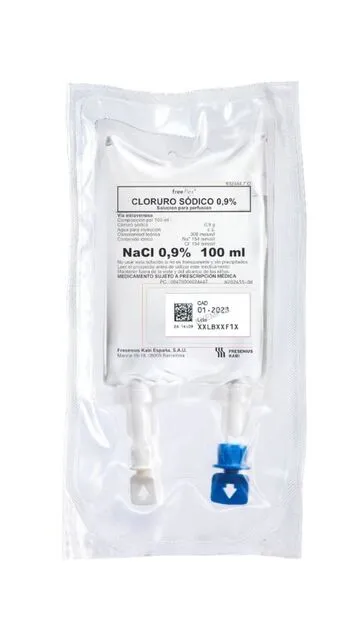
FREEFLEX SODIUM CHLORIDE 0.9%
SpainIt is used to provide water, sodium, and chloride to the bloodstream, to help rebalance ions, and to treat extracellular dehydration and hypovolemia.
Frequently asked questions
How should this medication be taken?
It is administered via intravenous infusion following the exact instructions of a doctor or pharmacist. The dose will be adjusted according to the patient's weight and level of dehydration.
When should Freeflex Sodium Chloride 0.9% not be used?
It should not be used if you are allergic to its components or if you suffer from acidosis, hyperchloremia, hypokalemia, renal or cardiac insufficiency, hypernatremia, hyperhydration, edema, hypertension, hepatic insufficiency, or if you are undergoing prolonged treatment with corticosteroids or ACTH.
What side effects can Freeflex Sodium Chloride 0.9% have?
No adverse effects have been described; however, if an excessive dose is administered, it could cause arterial hypertension, acute edema, hyponatremia with dehydration of internal organs, and hyperchloremic acidosis.
Does it interact with other medications?
No interactions with other preparations have been observed.
What should I do if a higher dose than indicated is administered?
In case of overdose, you should consult the Toxicological Information Service by calling (91) 562 04 20.
Instructions for use
Table of contents
- Introduction
- 1. What Freeflex Sodium Chloride 0.9% is and what it is used for
- 2. What you need to know before starting to use Freeflex Sodium Chloride 0.9%
- 3. How to use Freeflex Sodium Chloride 0.9%
- 4. Possible adverse effects
- 5. Storage of Freeflex Sodium Chloride 0.9%
- 6. Contents of the container and other information
Package leaflet: Information for the user
Introduction
Package leaflet: information for the user
Freeflex Sodium Chloride 0.9%
sodium chloride
Read the entire leaflet carefully before you start using this medicine, because it contains important information for you.
- Keep this leaflet, as you may need to read it again.
- If you have any questions, ask your doctor, pharmacist or nurse.
- This medicine has been prescribed for you only, and you should not give it to other people, even if they have the same symptoms as you, because it may harm them.
- If you experience any adverse effects, consult your doctor, pharmacist or nurse, even if they are adverse effects not listed in this leaflet. See section 4.
Contents of the leaflet
- What Freeflex Sodium Chloride 0.9% is and what it is used for
- What you need to know before using Freeflex Sodium Chloride 0.9%
- How to use Freeflex Sodium Chloride 0.9%
- Possible side effects
- How to store Freeflex Sodium Chloride 0.9%
- Contents of the pack and other information
1. What Freeflex Sodium Chloride 0.9% is and what it is used for
Freeflex Sodium Chloride 0.9% is an intravenous infusion solution supplied in 50 ml, 100 ml, 250 ml, 500 ml, and 1000 ml freeflex® bags with overpouch, intended for intravascular administration of water, sodium, and chlorides.
It is indicated for:
- Correction of ionic imbalance by supplying chlorides and sodium
- Extracellular dehydration
- Hypovolemia
2. What you need to know before starting to use Freeflex Sodium Chloride 0.9%
Do not use Freeflex Sodium Chloride 0.9%
If you are allergic to the active substance or to any of the other components of this medicine (listed in section 6).
If you suffer from acidosis, hyperchloremia, hypokalemia, renal and/or cardiac insufficiency, hypernatremia, hyperhydration, generalized edema, hypertension, hepatic insufficiency, or if you are undergoing prolonged treatment with corticosteroids or ACTH.
Warnings and precautions
Consult your doctor, pharmacist, or nurse before starting to use Freeflex Sodium Chloride 0.9%.
Other medicines and Freeflex Sodium Chloride 0.9%
No interactions with other medicinal products have been observed.
Pregnancy and breastfeeding
If you are pregnant or breastfeeding, think you may be pregnant, or are planning to become pregnant, consult your doctor or pharmacist before using this medicine.
Studies have not been conducted in this population group. Given the characteristics of the product, the benefit-risk ratio will be assessed.
3. How to use Freeflex Sodium Chloride 0.9%
Follow exactly the instructions for use of this medicine as indicated by your doctor or pharmacist. If in doubt, consult your doctor or pharmacist again.
The recommended dose should be adjusted according to the patient's weight and degree of dehydration.
If you use more Freeflex Sodium Chloride 0.9% than you should
Due to the nature of its components, intoxications have not been reported.
Excessive doses may lead to hypernatremia with dehydration of internal organs and hyperchloremic acidosis.
Arterial hypertension. Acute edema.
In case of overdose or accidental ingestion, contact the Toxicology Information Service. Telephone (91) 562 04 20.
4. Possible adverse effects
Like all medicines, this medicine can produce adverse effects, although not everyone will experience them.
No adverse effects have been reported. However, if any adverse reaction attributable to taking the medicine occurs, consult your doctor or pharmacist.
Reporting of adverse effects
If you experience any type of adverse effect, consult your doctor or pharmacist, even if it is a possible adverse effect not listed in this leaflet. You may also report them directly via the Spanish Pharmacovigilance System for Human Medicines website: www.notificaRAM.es. By reporting adverse effects, you can help provide more information on the safety of this medicine.
5. Storage of Freeflex Sodium Chloride 0.9%
Keep this medicine out of the sight and reach of children.
Do not use this medicine after the expiry date which is stated on the packaging after EXP. The expiry date is the last day of the month indicated.
6. Contents of the container and other information
Composition of Freeflex Sodium Chloride 0.9%
- The active substance is sodium chloride. Each 100 ml of solution contains 0.9 g of sodium chloride.
- The only excipient is water for injections.
Electrolytic composition | mmol/l | meq/l |
Sodium ion | 154 | 154 |
Chloride ion | 154 | 154 |
Theoretical osmolarity: 308 mosmol/l
Appearance of the product and contents of the pack
Intravenous infusion solution in freeflex® bags of 50 ml, 100 ml, 250 ml, 500 ml and 1000 ml, with overpouch.
Marketing Authorization Holder and Manufacturer
Marketing Authorization Holder:
Fresenius Kabi España, S.A.U.
C/ Marina 16-18,
08005-Barcelona
Manufacturer:
Fresenius Kabi Deutschland GmbH
Werk Friedberg Freseniusstraße 1
D-61169 Friedberg
Germany
Fresenius Kabi France, S.A.
6, Rue du Rempart, B.P. 611
(Louviers) F-27400 France
HP Halden Pharma AS
Svinesundsveien 80
1788 Halden
Norway
Fresenius Kabi India PVT. LTD.
A-3 MIDC, Ranjangaon Ganpati, ‘tal. Shirur
412220 Maharashtra
India
Date of latest revision of this package leaflet: March 2023
Detailed and up-to-date information on this medicinal product is available on the website of the Spanish Agency of Medicines and Health Products (AEMPS) http://www.aemps.es
This information is intended for healthcare professionals only:
INSTRUCTIONS FOR CORRECT ADMINISTRATION OF THE PREPARATION
Visual inspection
- Do not remove the freeflex® from its overpouch until immediately before use.
- Check composition, batch number and expiration date.
- Inspect the entire set to verify the integrity of the primary packaging. Do not use if the container is not intact.
Removal of the overpouch
Some freeflex® bags have an overpouch for protection during storage. The overpouch, with a “peel” opening system, can be removed as follows:
- Locate the tabs at the end where the ports of the bag are located.
- Separate the two halves of the overpouch, leaving the bag on a clean surface.
Preparation for administration
freeflex® bags are designed for air-free administration. If an administration set with air venting must be used, ensure that it remains closed at all times.
- Squeeze the freeflex® to ensure there are no leaks and examine the solution for visible particles or precipitates. DO NOT ADMINISTER IF THE SOLUTION IS NOT CLEAR AND/OR THE CONTAINER IS NOT INTACT.
- Using an aseptic technique, prepare the infusion set with the flow regulator closed.
- Identify the administration port (blue), arrow-shaped, indicating the outlet from the bag.
- Remove the protective plug from the administration port of the freeflex® by firmly holding the lower fins with one hand and breaking off the arrow-shaped plug with a sustained twisting motion.
- Hold the base of the administration port, placing fingers behind the protector, and firmly push the spike of the administration set into the port. A slight resistance should be felt as the port membrane is punctured. To prevent leakage, insert the spike fully into the administration port.
- Hang the bag on the infusion stand and prime the administration set according to the manufacturer's instructions. Perform venipuncture and immediately connect the administration set to the intravenous cannula. Adjust the flow regulator to achieve the desired drip rate.
- freeflex® bags are calibrated to indicate the approximate infused volume. The scale should be read by stretching the bag and reading the volume at the upper surface of the liquid. For more accurate measurement of fluid volume, an administration set with a drip chamber should be used.
For adding medication
freeflex® bags have a separate medication addition port with a self-sealing plug. Since the port is protected by a hermetically sealed protective plug, disinfection of the medication addition site is not required before first use.
Additions using syringes
- Identify the medication addition port (white), arrow-shaped, indicating an inflow into the bag.
- Using an aseptic technique, prepare a syringe with the medication using a 20–22 G needle.
- Remove the protective plug from the medication addition port of the bag by firmly holding the lower fins with one hand and breaking off the arrow-shaped plug with a sustained twisting motion.
- Hold the medication addition port, placing fingers behind the protector, and fully insert the needle so that it penetrates both the outer plug and the inner membrane. Its rigid construction prevents the needle from penetrating the sides of the port.
- Inject the medication and withdraw the needle. To prevent aerosol formation, a sterile swab should be held around the plug.
Recommended maximum addition volumes are as follows:
| freeflex® bag size (ml) | Maximum recommended addition (ml) | |-------------------------|-------------------------------------| | 50 | 50 | | 100 | 50 | | 250 | 100 | | 500 | 150 | | 1000 | 250 |
NOTE: Additives may be incompatible; therefore, expert advice should be sought before adding medication to freeflex®. If the physician decides to add medication, an aseptic technique must be used. It is recommended that medication be added only under the supervision of a pharmacist. Do not store solutions to which medication has been added.
- Shake and squeeze the freeflex® to ensure complete mixing of the medication. With dense medications such as potassium chloride, it is advisable to squeeze both ports while the bag is in vertical position and invert the bag several times.
- If necessary, a protective plug may be placed over the medication addition port to prevent further additions.
Additions using reconstitution devices
- Identify the medication addition port (white), arrow-shaped, indicating an inflow into the bag.
- Remove the protective plug from the medication addition port of the bag by firmly holding the lower fins with one hand and breaking off the arrow-shaped plug with a sustained twisting motion.
- Using an aseptic technique, remove the reconstitution device from its packaging and push the narrow end onto the medication addition port so that the port fins align with the slots of the reconstitution device. Stop when the upper surface of the fins reaches the first stop in the slot. In this position, the tip of the reconstitution device needle is located between the outer plug and the inner membrane, preventing fluid from escaping the freeflex®.
- Using an aseptic technique, prepare the medication vial and connect it to the open end of the reconstitution device.
- Connect the medication to the intravenous solution by rotating the reconstitution device so that the port fins align with the inner slot, and push the vial and reconstitution device until the upper surface of the fins reaches the second stop.
- With the vial inverted, squeeze and release the freeflex® several times to transfer solution into the medication vial. Shake to dissolve the medication. Note: If the medication is a liquid, step 6 may be omitted.
- Invert the freeflex® so that the vial is above the bag, and transfer the medication into the bag by squeezing and releasing the bag several times, allowing sterile air to push the liquid out of the vial.
- If the solubility of the medication is low, steps 6 and 7 may need to be repeated.
- Once transfer is complete, remove the reconstitution device from the freeflex® and safely dispose of the vial and reconstitution device. The reconstitution device is designed for single use only and must not be used for subsequent additions to this or any other freeflex®.
NOTE: Additives may be incompatible; therefore, expert advice should be sought before adding medication to freeflex®. If the physician decides to add medication, an aseptic technique must be used. It is recommended that medication be added only under the supervision of a pharmacist. Do not store solutions to which medication has been added.
- Shake and squeeze the freeflex® to ensure complete mixing of the medication. With dense medications such as potassium chloride, it is advisable to squeeze both ports while the bag is in vertical position and invert the bag several times.
- If necessary, a protective plug may be placed over the medication addition port to prevent further additions.
Warnings:
- Do not vent
- Do not administer if the solution is not clear and the freeflex® is not intact
- If adverse reactions occur, discontinue infusion
- It is recommended that infusion sets be changed at least once every 24 hours
Similar drugs
| Brand name | Dosage form | Active substance / Dosage | Manufacturer |
|---|---|---|---|
| KABIPAC SODIUM CHLORIDE 9 MG/ML SOLUTION FOR INFUSION | solution for infusion |
|
Fresenius Kabi Espana, S.A.U. |
| SODIUM CHLORIDE 0.9% SOLUTION FOR INFUSION B. BRAUN | solution for infusion |
|
B Braun Medical S.A. |
| SODIUM CHLORIDE 0.9% SOLUTION FOR INFUSION VIAFLO | solution for infusion |
|
Baxter S.L. |
| SODIUM CHLORIDE 0.9% VANTIVE (CLEAR-FLEX) SOLUTION FOR INFUSION | solution for infusion |
|
Vantive Health S.L. |
| SODIUM CHLORIDE 9 MG/ML SOLUTION FOR INFUSION BAXTER | solution for infusion |
|
Baxter S.L. |
| SODIUM CHLORIDE MEIN 0.9% SOLUTION FOR INFUSION | solution for infusion |
|
Fresenius Kabi Espana, S.A.U. |
| SUERO FISIOLOGICO VITULIA 0.9% SOLUTION FOR INFUSION | solution for infusion |
|
Laboratorios Ern S.A. |
| VIAFLO SODIUM CHLORIDE 0.9% AND POTASSIUM CHLORIDE 0.3% SOLUTION FOR INFUSION | solution for infusion |
|
Baxter S.L. |
The original data is available in the language of the country of manufacture.
Data source: Online Medicines Information Centre (CIMA) — AEMPS
Data last verified: September 21, 2026