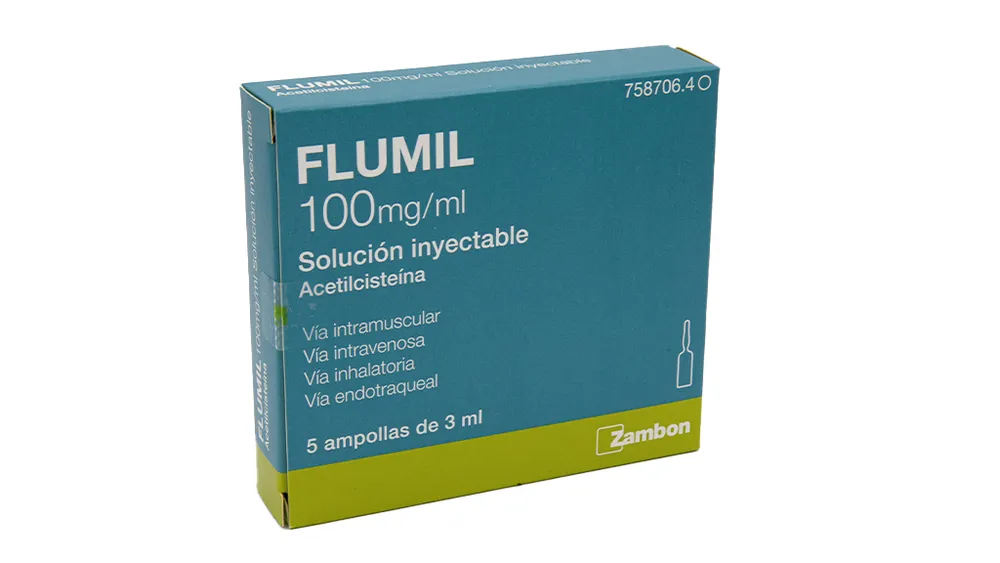
FLUMIL 100 MG/ML SOLUTION FOR INJECTION
SpainIt is used to facilitate the elimination of excess mucus and phlegm in adults and children aged 2 years and older presenting with respiratory processes involving heavy secretion, such as bronchitis, COPD, emphysema, or pulmonary complications.
Frequently asked questions
How should I take Flumil 100 mg/ml?
The dose and method of administration depend on the route indicated by your doctor (inhalation, endotracheobronchial route, intramuscular or intravenous injection) and the patient's age. You must strictly follow the instructions of your healthcare professional.
When should this medication not be used?
It should not be used if you are allergic to acetylcysteine or any of its components, nor in children under 2 years of age. Its use is also not recommended during pregnancy or breastfeeding.
What side effects can Flumil 100 mg/ml cause?
It may cause allergic reactions, difficulty breathing (bronchospasm), nausea, vomiting, hives, itching, or facial swelling. In very rare cases, severe skin reactions may occur.
What precautions should I take if I have asthma?
If you suffer from asthma or a serious respiratory disease, you must consult your doctor before use, as it may cause breathing difficulties. Asthmatic patients should be under close medical supervision during treatment.
Can I take other medications while using this product?
You must inform your doctor if you are taking other drugs. It should not be combined with cough medicines (antitussives) or those that decrease secretions, as they could cause mucus to accumulate. The use of nitroglycerin requires blood pressure monitoring, and carbamazepine may increase the risk of seizures.
What should I do if I notice a strange smell in the medication?
The possible sulfurous odor (similar to rotten eggs) is characteristic of the active ingredient and does not mean that the product has been altered.
Instructions for use
Package leaflet: Information for the user
Introduction
Package leaflet: information for the patient
Flumil 100 mg/ml solution for injection
Acetylcysteine
Read all of this leaflet carefully before you start using this medicine because it contains important information for you.
-
Keep this leaflet as you may need to read it again.
-
If you have any questions, ask your doctor or pharmacist.
-
This medicine has been prescribed for you only and must not be given to other people, even if they have the same symptoms as you, because it could harm them.
- If you experience any adverse effects, consult your doctor or pharmacist, even if they are adverse effects not listed in this leaflet. See section 4.
Contents of this leaflet
- What Flumil 100 mg/ml is and what it is used for
- What you need to know before using Flumil 100 mg/ml
- How to use Flumil 100 mg/ml
- Possible side effects
- Storage of Flumil 100 mg/ml
- Contents of the pack and other information
1. What Flumil 100 mg/ml is and what it is used for
Flumil 100 mg/ml contains the active substance N-acetylcysteine, which belongs to a group of medicines called mucolytics that reduce the viscosity of mucus, liquefying it and facilitating its removal from the respiratory tract.
Flumil 100 mg/ml is indicated to help eliminate excess mucus and phlegm in adults and children from 2 years of age, in respiratory conditions associated with bronchial hypersecretion such as: acute and chronic bronchitis, chronic obstructive pulmonary disease (COPD), emphysema, pulmonary complications of cystic fibrosis, facilitation of procedures in anesthesia during bronchoscopies, bronchographies and bronchoaspiration, bronchiectasis, obstructive and infectious complications due to tracheotomy, and bronchopulmonary complications following surgical intervention.
2. What you need to know before using Flumil 100 mg/ml
Do not use Flumil 100 mg/ml:
- If you are allergic to the active substance or to any of the other ingredients of this medicine (listed in section 6).
- Do not administer to children under 2 years of age.
Warnings and precautions
Talk to your doctor or pharmacist before starting to use Flumil 100 mg/ml.
If you have asthma or suffer from a serious respiratory disease, you should consult your doctor before taking this medicine, as it may cause breathing difficulties (bronchospasm).
Patients with bronchial asthma must be closely monitored during treatment. If bronchospasm occurs, acetylcysteine must be discontinued immediately and appropriate treatment initiated. This bronchoconstrictor effect can be prevented by prior administration of a bronchodilator.
The possible sulfur-like odor (resembling rotten eggs) of the medicine is characteristic of the active substance and does not indicate that its properties have been altered.
Caution is advised when using this product in patients with peptic ulcer or a history thereof, particularly when administered concomitantly with other medicines known to have an irritating effect on the gastric mucosa.
During the first days of treatment, you may notice an increase in mucus and phlegm, which will gradually decrease over the course of treatment. If you find you are unable to effectively expectorate, postural drainage and bronchial aspiration should be performed.
Intravenous administration must be carried out under strict medical supervision. Adverse reactions are more likely to occur following intravenous infusion if the drug is administered too rapidly or in excessive amounts. Therefore, it is recommended to strictly follow the instructions provided in section 3. How to use Flumil 100 mg/ml.
Acetylcysteine is incompatible with rubber and certain metals, especially iron, nickel, and copper. Contact with materials containing these substances should be avoided.
Caution is advised during long-term treatment in patients with histamine intolerance.
Children and adolescents
The same precautions and warnings apply to children and adolescents.
It is contraindicated in children under 2 years of age.
Other medicines and Flumil 100 mg/ml
Inform your doctor or pharmacist if you are taking, have recently taken, or might need to take any other medicines.
If simultaneous treatment with nitroglycerin is required, monitor for the development of hypotension (low blood pressure), which may be severe and may cause headache.
Concomitant use of carbamazepine, a medicine used to treat epileptic seizures, may increase the risk of seizures.
Do not administer concurrently with antitussive (cough-suppressant) medicines or with those that reduce bronchial secretions (such as antihistamines and anticholinergics), as this could lead to accumulation of bronchial secretions.
Separate administration from antibiotics is recommended.
Dissolving Flumil 100 mg/ml with other medicines is not recommended.
Use of Flumil 100 mg/ml with food and drinks
Taking food and drinks does not affect the effectiveness of this medicine.
Pregnancy, breastfeeding, and fertility
If you are pregnant or breastfeeding, think you may be pregnant, or are planning to become pregnant, consult your doctor or pharmacist before using this medicine.
Acetylcysteine crosses the placenta. Therefore, the use of acetylcysteine during pregnancy is not recommended.
It is unknown whether acetylcysteine and its metabolites are excreted in human milk. Use during breastfeeding should be avoided.
There are no data available on the effect of acetylcysteine on fertility in humans. Animal studies do not indicate harmful effects with regard to human fertility at the recommended doses.
Driving and using machines
There is no evidence of effects on the ability to drive or operate machinery.
Flumil 100 mg/ml contains sodium
This medicine contains 43 mg of sodium (a main component of table salt) per 3 ml ampoule. This is equivalent to 2.15% of the maximum daily intake of sodium recommended for an adult.
Interference with diagnostic tests
Acetylcysteine may interfere with the colorimetric assay method for salicylate determination.
Acetylcysteine may interfere with urine ketone testing.
3. How to use Flumil 100 mg/ml
Follow exactly the instructions given by your doctor or pharmacist for administering this medicine. If in doubt, consult your doctor or pharmacist again.
The recommended dose is:
Local administration
Nebulization inhalation:
Adults and children from 12 years of age: one 300 mg vial once or twice daily for 5 to 10 days.
Children between 2 and 12 years of age: up to one 300 mg vial once or twice daily for 5 to 10 days in cooperative children.
Endotracheobronchial route:
Adults and children from 12 years of age: one 300 mg vial (60 drops) once or twice daily for 5 to 10 days.
Children between 2 and 12 years of age: up to one 300 mg vial (60 drops) once or twice daily for 5 to 10 days.
Parenteral administration
Flumil 100 mg/ml may be administered in bronchial conditions when local route treatment is impossible or difficult, or when the physician prefers systemic administration (due to lack of patient cooperation, enforced bed rest, closed-circuit respiration, etc.).
Intramuscular route:
Adults and children from 12 years of age: one 300 mg vial once or twice daily administered by deep injection.
Children between 2 and 12 years of age: 150 mg (half a 3 ml vial) once or twice daily administered by deep injection.
Intravenous route:
Intravenous administration of acetylcysteine must be performed under strict medical supervision.
The medicine should be administered by slow infusion in saline solution or 5% glucose solution.
Adults and children from 12 years of age: one 300 mg vial once or twice daily.
Children between 2 and 12 years of age: 150 mg (half a 3 ml vial) once or twice daily.
Opening the vial:
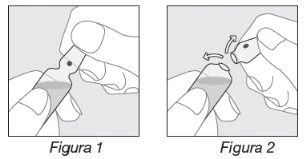
- Hold the vial as shown in Figure 1;
- Place your thumb on the colored spot and press backward as shown in Figure 2.
Duration of treatment
The duration of treatment should be determined according to the clinical course. The average duration is 5–10 days. The high general and local tolerability of Flumil 100 mg/ml allows prolonged treatment in certain cases.
If you use more Flumil 100 mg/ml than you should
If you have used more Flumil 100 mg/ml than recommended, you may experience symptoms similar to those described in section 4. Possible adverse effects, but more intense. In case of overdose or accidental massive administration, consult your doctor or pharmacist immediately or call the Toxicology Information Service at telephone number 91 562 04 20, indicating the medicine and the amount used.
If you have any further questions about the use of this medicine, ask your doctor or pharmacist.
4. Possible adverse effects
Like all medicines, this medicine can cause adverse effects, although not everyone experiences them.
The following adverse effects may occur, although their frequency cannot be established from the available information:
Local use:
Allergic reactions (hypersensitivity), bronchial constriction and difficulty breathing (bronchospasm), increased nasal discharge (rhinorrhea), mouth ulcers (stomatitis), vomiting, nausea, urticaria, rash or itching.
Parenteral use:
Allergic reactions (hypersensitivity) of varying degrees, potentially leading to anaphylactic shock, increased heart rate (tachycardia), bronchial constriction and difficulty breathing (bronchospasm, dyspnea), vomiting, nausea, facial swelling (angioedema), urticaria, flushing, rash, itching, facial edema, decreased blood pressure, reduced blood coagulation (increased prothrombin time, decreased platelet aggregation).
In very rare cases, severe skin reactions (Stevens-Johnson syndrome and Lyell syndrome) may occur, although in most cases at least one other drug suspected of triggering the syndrome could also be identified.
If any skin or mucous membrane changes occur, administration of acetylcysteine must be stopped immediately. The specialist physician will determine the appropriate treatment.
Reporting of adverse effects
If you experience any type of adverse effect, consult your doctor, pharmacist, or nurse, even if it is a possible adverse effect not listed in this leaflet. You may also report them directly via the Spanish Pharmacovigilance System for Human Medicinal Products: https://www.notificaram.es. By reporting adverse effects, you can help provide more information on the safety of this medicine.
5. Storage of Flumil 100 mg/ml
Keep this medicine out of the sight and reach of children.
No special storage conditions are required when kept in the original packaging.
Do not use this medicine after the expiry date stated on the packaging after the abbreviation EXP. The expiry date refers to the last day of the month indicated.
Local administration
It is recommended to open the ampoule immediately before use. Opened ampoules may only be used for local administration and must be stored in a refrigerator for a maximum of 24 hours.
Parenteral administration
Use immediately after opening. If not used immediately, the storage times and conditions during use are the responsibility of the user.
The solution, once diluted for use (in 5% glucose solution or 0.9% sodium chloride solution), remains stable for 24 hours at 25°C.
Discard after use.
Medicines must not be disposed of via wastewater or household waste. Unused medicines and their containers should be taken to the SIGRE point at your pharmacy. If in doubt, ask your pharmacist how to dispose of unused medicines and containers. This will help protect the environment.
6. Contents of the pack and other information
Composition of Flumil 100 mg/ml
The active substance is acetylcysteine. Each 3 ml ampoule contains 300 mg of acetylcysteine.
The other components (excipients) are: disodium edetate, sodium hydroxide (E524) (for pH adjustment), and water for injections.
Appearance of the product and contents of the container
Amber glass ampoules with a break point, containing 3 ml of a clear, colourless solution.
Each pack contains 5 ampoules.
Marketing Authorization Holder and Manufacturer
Zambon S.A.U.
Maresme, 5. Pol. Can Bernades-Subirà
08130 Sta. Perpètua de Mogoda (Barcelona)
Spain
Manufacturer
Zambon S.p.A.
Via della Chimica, 9
36100 Vicenza
Italy
or
Biologici Italia Laboratories S.r.l.
Via Filippo Serpero, 2
20060 Masate (MI)
Italy
Date of the most recent revision of this package leaflet: May 2025
Detailed information on this medicine is available on the website of the Spanish Agency for Medicines and Health Products (AEMPS) http://www.aemps.gob.es/.
Similar drugs
| Brand name | Dosage form | Active substance / Dosage | Manufacturer |
|---|---|---|---|
| ACETYLCYSTEINE KERN PHARMA 100 MG/ML SOLUTION FOR INJECTION EFG | solution for injection |
|
Kern Pharma S.L. |
The original data is available in the language of the country of manufacture.
Data source: Online Medicines Information Centre (CIMA) — AEMPS
Data last verified: September 21, 2026