COLIROFTA TROPICAMIDE 10 MG/ML EYE DROPS SOLUTION
SpainIt is used to perform eye examinations, such as measuring refractive errors (myopia, hyperopia, astigmatism, and presbyopia) or to examine the fundus of the eye, by dilating the pupil and rapidly paralyzing the focusing ability.
Frequently asked questions
When should I not use COLIROFTA TROPICAMIDE?
It should not be used if you are allergic to tropicamide or any of its components, or if you have or believe you may have narrow-angle glaucoma. It is also not recommended during pregnancy or breastfeeding.
How should COLIROFTA TROPICAMIDE be applied?
Follow your doctor's instructions. Generally, 1 or 2 drops are instilled into the eye to be examined, and this may be repeated after 5 minutes. To prevent the medication from entering the rest of the body, gently press the tear duct (next to the nose) for 2 minutes with your eyes closed.
What side effects can COLIROFTA TROPICAMIDE cause?
It may cause blurred vision, light sensitivity, pain, ocular irritation or redness, as well as dizziness, headache, nausea, or rashes. In children, changes in behavior or psychotic reactions may occur.
Can I wear contact lenses with this eye drop?
Contact lenses should be removed before using the medication and you should wait 15 minutes before putting them back in, as one component may alter the color of soft lenses.
What should I do if I am taking other medications?
Inform your doctor if you are using amantadine, antihistamines, antipsychotics, or antidepressants.
What precautions should I take when driving?
Because it may cause blurred vision and light sensitivity, you should not drive or operate machinery until your vision is clear.
How should I store the bottle?
Store it at a temperature not exceeding 25ºC and out of the reach of children. The bottle must be discarded 4 weeks after being opened for the first time.
Instructions for use
Package leaflet: Information for the user
Introduction
Package leaflet: information for the user
COLIROFTA TROPICAMIDE 10 mg/ml eye drops solution
Read the entire leaflet carefully before you start using this medicine, because it contains important information for you.
- Keep this leaflet, as you may need to read it again.
- If you have any questions, ask your doctor or pharmacist.
- This medicine has been prescribed for you only, and you should not give it to others, even if they have the same symptoms as you, because it could harm them.
- If you experience any adverse effects, consult your doctor or pharmacist, even if they are effects not listed in this leaflet. See section 4.
Leaflet contents
- What COLIROFTA TROPICAMIDE is and what it is used for
- What you need to know before using COLIROFTA TROPICAMIDE
- How to use COLIROFTA TROPICAMIDE
- Possible side effects
- How to store COLIROFTA TROPICAMIDE
- Contents of the pack and other information
1. What COLIROFTA TROPICAMIDE is and what it is used for
This medicine is an eye drop containing an active substance (tropicamide) which is an anticholinergic drug that dilates the pupil (has a mydriatic effect) and paralyzes the eye's focusing ability (cycloplegic effect).
It is generally used under the supervision of a healthcare professional for refraction examination (to measure focusing errors of the eye and detect refractive defects such as myopia, hyperopia, astigmatism, and presbyopia) and for fundus examination when a rapid-onset, short-acting mydriatic and/or cycloplegic effect is required.
2. What you need to know before using COLIROFTA TROPICAMIDE
Do not use COLIROFTA TROPICAMIDE
- If you are allergic to tropicamide or to any of the other ingredients of this medicine (listed in section 6).
- If you have or suspect you may have narrow-angle glaucoma.
Warnings and precautions
Talk to your doctor or pharmacist before using Colirofta Tropicamide.
-
Use this medicine only in your eye(s).
-
Consult your doctor. Use of this medicine may cause:
- Increased eye pressure. Eye pressure should be monitored before starting treatment, especially in elderly patients.
-
Changes in behavior (particularly in infants and children).
Children
- This medicine should be used with great caution in children in general.
- This medicine is not recommended in newborns and infants (especially in premature infants and low-birth-weight infants) due to the risk of serious adverse reactions.
For this reason, it should also be used with extreme caution in children with Down syndrome, spastic paralysis, or brain injury. Consult your doctor for information about serious adverse reactions that may occur with the use of this medicine. See also section “How to use COLIROFTA TROPICAMIDE”.
- Prevent children from getting the eye drops in their mouth. Wash your hands and the child’s hands immediately after administration.
Other medicines and COLIROFTA TROPICAMIDE
Tell your doctor or pharmacist if you are taking, have recently taken, or might need to take any other medicines.
In particular, inform your doctor if you are taking:
- Amantadine (used in Parkinson’s disease and for influenza)
- Antihistamines (antiallergic medicines)
- Antipsychotics (for mental illnesses)
- Antidepressants (for depression)
Pregnancy, breastfeeding and fertility
Consult your doctor before using any medicine.
If you are pregnant or breastfeeding, think you may be pregnant, or are planning to become pregnant, consult your doctor or pharmacist before using this medicine.
This medicine is not recommended during pregnancy or breastfeeding.
Driving and using machines
This medicine may cause drowsiness, blurred vision, and light sensitivity. Do not drive or operate machinery or tools until your vision is clear.
COLIROFTA TROPICAMIDE contains benzalkonium chloride
This medicine contains 0.0035 mg of benzalkonium chloride per drop, equivalent to 0.1 mg/ml.
Benzalkonium chloride may be absorbed by soft contact lenses, altering their color. Remove contact lenses before using this medicine and wait 15 minutes before reinserting them.
Benzalkonium chloride may cause ocular irritation, especially if you have dry eye or other corneal diseases (the transparent layer at the front of the eye). Consult your doctor if you experience a foreign body sensation, stinging, or eye pain after using this medicine.
3. How to use COLIROFTA TROPICAMIDA
Follow exactly the instructions for administration of this medicine as given by your doctor or pharmacist. If in doubt, consult your doctor or pharmacist again.
However, this medicine is usually administered under the supervision of a healthcare professional.
- To limit the amount of medicine that enters the bloodstream after eye drop administration, keep your eyes closed while gently pressing on the tear duct with a finger for at least 2 minutes (figure 4).
Recommended dose:
Adults and elderly patients:
Instill 1 or 2 drops into the eye to be examined. Repeat after 5 minutes. If the examination is not performed within 20–30 minutes, administer 1 additional drop to prolong the effect.
Use caution when administering this medicine to elderly patients and in cases of increased intraocular pressure.
Use in children:
Use caution when administering this medicine to children (see section 2).
However, this medicine is not recommended for newborns and infants (especially premature infants and low-birth-weight infants) due to the risk of serious adverse reactions. See also the sections “Warnings and precautions”, “If you use more COLIROFTA TROPICAMIDA than you should”, and “Possible side effects”.
Instructions for use:
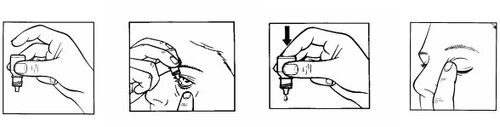
- 2 3 4
- Wash your hands.
- Take the bottle.
- After opening the bottle for the first time, remove the loose plastic seal ring if present.
- Hold the bottle upside down between your fingers (figure 1).
- Tilt your head backward. Gently pull down the eyelid to create a pouch between the eyelid and the eye, into which the drop should fall (figure 2).
- Bring the tip of the bottle close to the eye. A mirror may be helpful.
- Do not touch the eye, eyelid, nearby areas, or any other surface with the dropper tip. The drops could become contaminated.
- Gently squeeze the base of the bottle so that one drop falls at a time (figure 3).
- After using these eye drops, press with your finger on the inner corner of the eye near the nose for 2 minutes. This helps prevent the medicine from passing into the rest of the body (figure 4).
- If drops are to be administered into both eyes, repeat all the previous steps for the other eye.
- Close the bottle tightly immediately after use.
If a drop misses the eye, try again.
If you are using other ophthalmic medicines, wait at least 5 minutes between administering this medicine and the other ophthalmic products. Ophthalmic ointments should be administered last.
If you use more COLIROFTA TROPICAMIDA than you should
You can remove it by rinsing the eyes with lukewarm water. Do not administer additional drops until instructed to do so.
Symptoms of ocular overdose may include: redness and dryness of the skin (rash may occur in children), blurred vision, rapid and irregular pulse, fever, abdominal distension in infants, seizures, hallucinations, or loss of coordination. Any severe reaction due to tropicamide starts rapidly and is of short duration. It is recommended to immediately administer an intravenous injection of an alpha-adrenergic blocker, for example 5 to 10 mg of phentolamine mesylate, followed by a beta-blocker such as propranolol at a dose of 2.5 mg.
In case of severe overdose or accidental ingestion, contact your doctor or pharmacist immediately or call the Toxicology Information Service at 91 562 04 20, indicating the medicine and the amount used, as serious adverse reactions may occur (especially in children).
If you forget to use COLIROFTA TROPICAMIDA
Do not use a double dose to make up for missed doses.
Use a single dose as soon as you remember, and then continue with your next scheduled dose. However, if it is almost time for your next dose, do not take the missed dose and continue with your regular dosing schedule.
If you have any further questions about the use of this medicine, ask your doctor or pharmacist.
4. Possible adverse effects
Like all medicines, this medicine can cause adverse effects, although not everyone will experience them.
The following adverse effects have been observed with the use of this medicine:
Adverse effects of unknown frequency (cannot be estimated from available data)
-
Effects on the eye: blurred vision, light sensitivity, increased pupil size (prolonged effect of the medication), eye pain, eye irritation, eye redness.
-
General effects: dizziness, headache, fainting, low blood pressure, nausea, rash.
Additional adverse effects in children
Psychotic reactions (abnormal perception and thinking) and behavioural disorders have been reported with this type of medicine, especially in children. See also section “Warnings and precautions”.
Reporting of adverse effects
If you experience any type of adverse effect, consult your doctor or pharmacist, even if it is a possible adverse effect not listed in this leaflet. You may also report them directly through the Spanish Pharmacovigilance System for Human Medicines: https://www.notificaRAM.es . By reporting adverse effects, you can help provide more information on the safety of this medicine.
5. Storage of COLIROFTA TROPICAMIDE
Keep this medicine out of the sight and reach of children.
Do not store above 25°C.
Do not use this medicine after the expiry date stated on the bottle and carton after "EXP". The expiry date refers to the last day of the month indicated.
To prevent infections, discard the bottle 4 weeks after first opening.
Record the date you opened the bottle in the space provided for this purpose on the carton.
Medicines must not be disposed of via wastewater or household waste. Dispose of unused medicines and their packaging at the SIGRE Point at your pharmacy. If in doubt, ask your pharmacist how to properly dispose of unused medicines and packaging. This will help protect the environment.
6. Contents of the pack and other information
Composition of COLIROFTA TROPICAMIDE
- The active substance is tropicamide. One ml of solution contains 10 mg of tropicamide.
- The other components are benzalkonium chloride, concentrated hydrochloric acid (to adjust pH), disodium edetate, sodium chloride, and purified water.
Appearance of the medicine and contents of the pack
Colirofta Tropicamide is a liquid (clear and colourless) supplied in a box containing a dropper container (plastic bottle with dropper dispenser) with a cap. Each container holds 5 ml of eye drops.
Marketing Authorization Holder
Alcon Healthcare S.A.
World Trade Center Almeda Park
Plaça de la Pau s/n, Building 6, 3rd Floor
08940 - Cornellà de Llobregat (Barcelona)
Spain
Manufacturer
Alcon Laboratories Belgium
Lichterveld 3
2870 Puurs-Sint-Amands
Belgium
Date of the most recent review of this leaflet: November 2017.
Detailed information on this medicine is available on the website of the Spanish Agency of Medicines and Health Products (AEMPS) http://www.aemps.gob.es/
Similar drugs
| Brand name | Dosage form | Active substance / Dosage | Manufacturer |
|---|---|---|---|
| MINIMS TROPICAMIDE 10 MG/ML EYE DROPS SOLUTION IN SINGLE-DOSE CONTAINER | solution, ophthalmic |
|
Bausch + Lomb Ireland Limited |
The original data is available in the language of the country of manufacture.
Data source: Online Medicines Information Centre (CIMA) — AEMPS
Data last verified: September 21, 2026