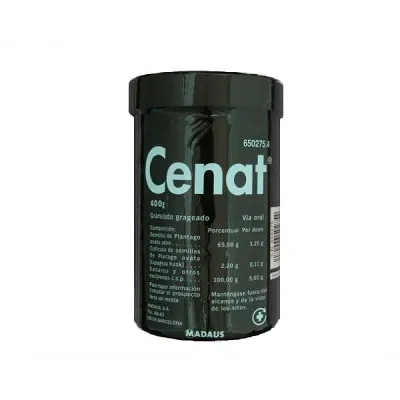
CENAT GRANULES
SpainIt is used to treat chronic constipation, situations involving alternating diarrhea and constipation (such as in irritable bowel syndrome), to regulate bowel movements in people with a colostomy, to treat functional diarrhea, and as an aid in conditions such as hemorrhoids or anal fissures to facilitate evacuation. It also serves to supplement daily fiber intake.
Frequently asked questions
How should I take Cenat?
Adults and children over 12 years of age should take 2 dessert spoons at night after dinner, with the possibility of adding one additional dessert spoon in the morning if necessary. Children aged 6 to 12 years should take half of the adult dose. The granules should be swallowed without chewing with a full glass of liquid, and hydration of 1 to 2 liters of water per day must be maintained.
When should I not take this medication?
Do not take it if you are allergic to Plantago ovata or any of its components, if you have intestinal obstruction or narrowing of the digestive tract, or if you present with nausea, vomiting, or abdominal symptoms of unknown origin.
What side effects can Cenat cause?
Side effects are usually mild and transient, such as gas (flatulence) or a feeling of fullness. In exceptional cases, there may be abdominal bloating or even obstruction of the intestine, throat, or esophagus if not taken with sufficient water. Allergic reactions may also occur.
Can I take other medications with Cenat?
Cenat may delay the absorption of other drugs; therefore, it should be taken half an hour or one hour before or after taking anticoagulants, digitalis-containing medications, lithium, vitamins (such as B12), calcium, magnesium, iron, or zinc. It should not be combined with anti-diarrheal drugs or products that inhibit intestinal motility due to the risk of obstruction.
What should I do if I take a dose greater than the indicated amount?
If you take more than the recommended dose, you must consult your doctor or pharmacist, as it could cause abdominal discomfort, gas, or even intestinal obstruction.
What should I do if symptoms do not improve?
If symptoms worsen or persist after 7 days, you must consult a doctor.
Instructions for use
Package leaflet: Information for the user
Introduction
Package leaflet: information for the user
CENAT Granules
Plantago ovata seeds / Plantago ovata seed husks
(Ispaghula husk)
Read the entire leaflet carefully because it contains important information for you.
This medicine can be purchased without a prescription. However, to achieve the best results, it must be used correctly.
- Keep this leaflet, as you may need to read it again.
- If you need advice or further information, consult your pharmacist.
- If symptoms worsen or persist beyond 7 days, you should consult your doctor.
- If you consider any of the side effects you experience to be severe, or if you notice any side effects not listed in this leaflet, inform your doctor or pharmacist.
Leaflet contents
- What Cenat is and what it is used for
- What you need to know before taking Cenat
- How to take Cenat
- Possible side effects
- How to store Cenat
- Contents of the pack and other information
1. What Cenat is and what it is used for
Cenat belongs to a group of medicines called bulk-forming laxatives. These medicines work by promoting water absorption into the intestinal bolus, forming a gel that increases the volume and softens the stool.
Cenat is used for:
- Chronic habitual constipation, or constipation resulting from bed rest after surgical procedures, for example following rectal or anal surgery, as well as constipation due to changes in diet, travel, or prolonged treatment with harsh laxatives.
- Conditions characterized by alternating episodes of diarrhea and constipation (irritable bowel syndrome, diverticulosis). Regulation of bowel movements in patients with an artificial anus (colostomy).
- Symptomatic treatment of functional diarrhea and as an additional measure in cases of Crohn's disease.
- Proctological (rectal) conditions such as hemorrhoids, anal fissures (or abscesses), in which it reduces pain during defecation and facilitates the passage of stools by increasing their water content.
- Supplementing the daily intake of dietary fiber when intake is insufficient (weight-loss diets and certain metabolic disorders).
2. What you need to know before starting to take Cenat
Do not take Cenat
-
If you are hypersensitive (allergic) to Plantago ovata or Ispaghula husk, or to any of the other components of the medicine.
-
If you experience nausea, vomiting, or other abdominal symptoms of unknown diagnosis.
-
If you have intestinal obstruction or have been diagnosed with stenosis (narrowing) of the digestive tract.
Take special care with Cenat
- Consult your doctor if you have difficulty breathing or swallowing.
- Maintain adequate hydration by drinking 1-2 liters of water per day during treatment with Cenat.
Use of other medicines
Inform your doctor or pharmacist if you are using or have recently used any other medicines, including those obtained without a prescription.
Since Cenat may delay the absorption of certain medicines, Cenat should be taken half an hour to one hour before or after administering other medicines such as: coumarin derivatives (oral anticoagulants), digitalis-based medicines, lithium, and vitamins such as B12, calcium, magnesium, iron, or zinc.
Due to the risk of intestinal obstruction, do not take Cenat if you are taking antidiarrheal drugs or products that inhibit intestinal motility (diphenoxylate, loperamide, opioids).
Use of Cenat with food and drinks
As a general rule, Cenat should be administered after meals.
In the case of using Cenat as a complementary treatment for obesity, it may be helpful to take it before main meals.
Pregnancy and breastfeeding
Consult your doctor or pharmacist before using any medicine.
Driving and operating machinery
Effects of this medicine on the ability to drive and operate machinery are not expected.
Important information about some of the components of Cenat
This medicine contains sucrose. If your doctor has diagnosed you with an intolerance to certain sugars, consult him before taking this medicine.
3. How to take Cenat
Follow exactly the instructions for the administration of Cenat as indicated by your doctor. Consult your doctor or pharmacist if you have any doubts.
Remember to take your medication.
Cenat is administered orally.
Considering the safety of dietary fiber administration, treatment limitations are not considered to exist.
Take the granules without chewing and with a sufficient amount of liquid (a full glass) to avoid blockage of the throat.
Drink 1 to 2 liters of water daily during treatment with Cenat.
If symptoms worsen or persist after 7 days, you must consult your doctor.
If you feel that the effect of Cenat is too strong or too weak, inform your doctor or pharmacist.
Adults and children over 12 years old
Take 2 dessertspoons of granules (10 g of granules) at night after dinner. If necessary, you may take an additional teaspoon in the morning (which would amount to a total of 15 g of granules daily).
In case of diarrhea, take an initial dose of two teaspoons three times a day (30 g of granules/day) for 2 or 3 days, then reduce the dose to one heaping teaspoon three times a day (15 g/day).
Try to ensure that the last daily dose of Cenat is taken after dinner, but not immediately before going to bed, and take it while in an upright position.
As complementary treatment for obesity, take Cenat half an hour before main meals to induce a feeling of satiety.
Children from 6 to 12 years old
Administer half the doses indicated for adults and children over 12 years old.
If you take more Cenat than you should
If you have taken more Cenat than you should, consult your doctor or pharmacist.
Overdose of Plantago ovata may cause abdominal discomfort and flatulence, and could even lead to intestinal obstruction.
In case of overdose or accidental ingestion, contact the Toxicology Information Service at telephone number 915 62 04 20, indicating the medication and the amount ingested.
If you forget to take Cenat
Do not take a double dose to make up for missed doses.
4. Possible adverse effects
Like all medicines, Cenat may produce adverse effects, although not everyone will experience them.
The adverse effects of this medicine are generally mild and transient. At the beginning of treatment and depending on the dose, some discomforts such as flatulence and a sensation of fullness may occur, which disappear within a few days without the need to discontinue the medication.
In some cases, abdominal distension may occur, and very rarely isolated cases of intestinal, throat or oesophageal obstruction may appear, especially if the granules are taken without sufficient water.
Occasionally, allergic hypersensitivity reactions to Plantago ovata may occur, primarily due to inhalation of the powder, with isolated cases of anaphylactic reactions being possible. Due to Cenat's granular formulation, this problem is highly unlikely.
If you consider any of the adverse effects you experience to be severe, or if you notice any adverse effects not listed in this leaflet, inform your doctor or pharmacist.
5. Storage of Cenat
Keep in the original packaging. Keep the container tightly closed. Keep out of the reach and sight of children.
Expiry
Do not use Cenat after the expiry date (Exp.) stated on the container. The expiry date refers to the last day of the month indicated. Medicines should not be disposed of via wastewater drains or household waste. Ask your pharmacist how to dispose of medicines and containers you no longer need. This will help protect the environment.
6. Contents of the pack and other information
Composition of Cenat granules
- The active substances are Seeds of Plantago ovata, Seed husks of Plantago ovata (Ispaghula Husk).
- The other components are: Carum carvi essential oil; Salvia officinalis essential oil; Menta piperita essential oil; Arabic gum; Talc; Yellow iron oxide (E-172); Red iron oxide (E-172); Titanium dioxide (E-171); Solid paraffin; Liquid paraffin; Sucrose.
Appearance of the product and contents of the pack
Cenat is available in bottles containing 250 or 400 g of oral granules.
Marketing Authorization Holder and Manufacturer
Marketing Authorization Holder
Cooper Consumer Health B.V.
Verrijn Stuartweg 60,
1112 AX Diemen,
The Netherlands
Manufacturer
MADAUS GMBH
Lütticher Strasse, 5
(Troisdorf) – 53842
Germany
Further information on this medicinal product is available from the local representative of the Marketing Authorization Holder:
Vemedia Pharma Hispania, S.A.
C/ Aragón, 182, 5th floor
08011 Barcelona
Spain
Date of the most recent revision of this leaflet: September 2022.
Similar drugs
| Brand name | Dosage form | Active substance / Dosage | Manufacturer |
|---|---|---|---|
| AGIOLAX GRANULES | granules |
|
Cooper Consumer Health B.V. |
The original data is available in the language of the country of manufacture.
Data source: Online Medicines Information Centre (CIMA) — AEMPS
Data last verified: September 21, 2026