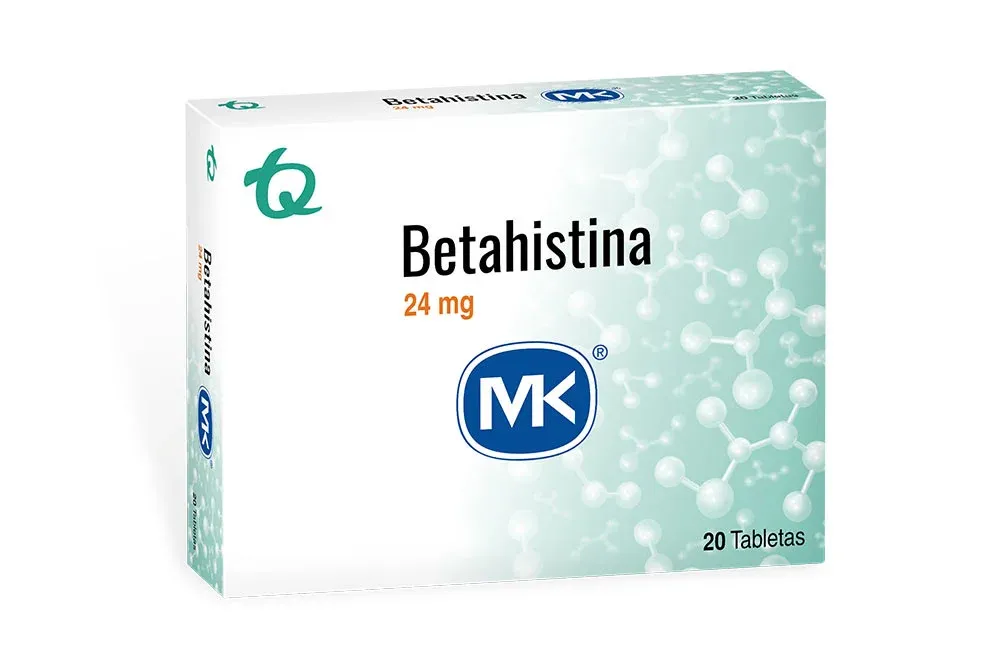
BETAHISTINE TARBIS 24 MG TABLETS EFG
SpainIt is used to treat vertigo, tinnitus (ringing in the ears), and hearing loss related to Ménière's disease.
Frequently asked questions
When should I not take this medication?
You should not take it if you are allergic to any of its components or if you have high blood pressure due to an adrenal tumor (pheochromocytoma).
How should I take Betahistina Tarbis?
The tablet should be swallowed with water. It is recommended to take it preferably with meals. The initial dose is usually 8 to 16 mg three times a day, and the maintenance dose is usually between 24 and 48 mg per day, according to your doctor's instructions.
What should I inform my doctor about before starting treatment?
You must inform your doctor if you have a stomach ulcer, asthma, if you are pregnant, breastfeeding, or planning to become pregnant. You should also communicate if you are taking other medications, especially antihistamines or drugs for depression or Parkinson's (MAO inhibitors).
What side effects can Betahistina Tarbis cause?
Common effects include nausea, indigestion, and headache. Itching, skin rash, hives, and mild stomach discomfort such as vomiting or bloating have also been reported. If you experience swelling of the face, lips, tongue, or neck, or have difficulty breathing, you must discontinue treatment and see a doctor immediately.
Can I drive or use machines while taking this medication?
The medication does not usually affect this ability, but the condition you are treating (vertigo or dizziness) could affect your ability to drive or use tools.
What should I do if I forget a dose or if I take too much?
If you forget a dose, wait until the next one and do not attempt to compensate for the missed dose. If you take too much, you must speak with a doctor or go to a hospital immediately.
Instructions for use
Patient Information Leaflet
Introduction
Patient Information Leaflet
Betahistina Tarbis 24 mg tablets EFG
Betahistine dihydrochloride
Read the entire leaflet carefully before you start taking this medicine, as it contains important information for you.
- Keep this leaflet, as you may need to read it again.
- If you have any questions, ask your doctor, pharmacist or nurse.
- This medicine has been prescribed for you only, and you should not give it to other people, even if they have the same symptoms as you, because it may harm them.
- If you experience any adverse effects, consult your doctor or pharmacist, even if they are adverse effects not listed in this leaflet. See section 4.
Leaflet Contents
- What Betahistina Tarbis is and what it is used for
- What you need to know before taking Betahistina Tarbis
- How to take Betahistina Tarbis
- Possible adverse effects
- How to store Betahistina Tarbis
- Contents of the pack and other information
1. What Betahistina Tarbis is and what it is used for
Betahistina Tarbis contains betahistina. This medicine is known as a "histamine analogue".
Betahistina is indicated for the treatment of vertigo, tinnitus, and hearing loss associated with Ménière's syndrome.
This medicine works by improving blood flow in the inner ear. This reduces the buildup of pressure.
2. What you need to know before taking Betahistina Tarbis
Do not take Betahistina Tarbis
- If you are allergic to the active substance or to any of the other ingredients of this medicine (listed in section 6).
- If you have high blood pressure due to an adrenal gland tumor (pheochromocytoma).
If you are in any of the situations above, do not take this medicine and consult your doctor.
Warnings and precautions
Talk to your doctor or pharmacist before starting betahistine:
- If you have a stomach ulcer
- If you have asthma
- If you are pregnant or planning to become pregnant
- If you are breastfeeding
If any of the above apply to you, consult your doctor or pharmacist before starting betahistina.
Your doctor will tell you whether it is safe for you to start taking this medicine.
Your doctor may also want to monitor your asthma while you are taking betahistine.
Other medicines and Betahistina Tarbis:
Tell your doctor or pharmacist if you are using, have recently used, or might need to use any other medicines, including herbal medicines and those obtained without a prescription.
In particular, inform your doctor or pharmacist if you are taking any of the following medicines:
- Antihistamines: these may (in theory) reduce the effect of betahistine. In addition, betahistine may also reduce the effect of antihistamines.
- Monoamine oxidase inhibitors (MAO inhibitors) – medicines used to treat depression or Parkinson’s disease. These may increase exposure to betahistine.
Use of Betahistina Tarbis with food, drinks and alcohol
You may take this medicine with or without food.
Pregnancy, breastfeeding and fertility
If you are pregnant or breastfeeding, think you may be pregnant, or are planning to become pregnant, consult your doctor or pharmacist before using this medicine.
Do not take betahistine tablets during pregnancy unless your doctor decides it is absolutely necessary. Ask your doctor for advice.
Do not breastfeed while taking betahistine tablets unless your doctor tells you to do so. It is unknown whether betahistine passes into breast milk.
Driving and using machines
Betahistina is unlikely to affect your ability to drive or use machines or tools.
However, bear in mind that the condition for which you are being treated with betahistine (vertigo, tinnitus and hearing loss associated with Ménière’s syndrome) may cause dizziness or nausea, thus affecting your ability to drive and use machines.
3. How to take Betahistina Tarbis
Follow exactly the administration instructions for this medicine given by your doctor or pharmacist. If in doubt, consult your doctor or pharmacist again.
How to take Betahistina Tarbis
- Swallow your tablet with water.
- Preferably, take the tablet with a meal.
How much Betahistina Tarbis to take
Always follow your doctor's instructions, as your doctor may adjust your dose.
Initially, 8 to 16 mg three times daily, preferably with meals.
Maintenance doses are generally in the range of 24 to 48 mg per day.
Continue taking your tablets. They may take some time to start working.
Betahistina is not recommended for individuals under 18 years of age.
If you interrupt treatment with Betahistina Tarbis
Keep taking the tablets until your doctor tells you otherwise.
Even when you start feeling better, your doctor may want you to continue taking the tablets for some time to ensure the medicine has fully worked.
If you take more Betahistina Tarbis than you should
If you or someone else takes too much betahistine (overdose), speak to a doctor or go to a hospital immediately. Take the medicine with you.
In case of overdose or accidental ingestion, contact your doctor or pharmacist immediately or call the Toxicology Information Service (telephone 91 562 04 20), indicating the medicine and the amount ingested.
If you forget to take Betahistina Tarbis
If you forget to take a dose, wait until the next one. Do not try to make up for the missed dose.
If you have any other questions about the use of this medicine, ask your doctor or pharmacist.
4. Possible adverse effects
Like all medicines, this medicine can cause adverse effects, although not everyone will experience them.
The following serious adverse effects may occur during treatment with Betahistina Tarbis:
Allergic reactions such as:
- Swelling of the face, lips, tongue, or throat. This may cause difficulty breathing.
- Red rash, inflamed itchy skin.
If you experience any of these adverse reactions, you must stop treatment immediately and speak to your doctor.
Common (may affect up to 1 in 10 people):
- Nausea
- Indigestion
- Headache
Other adverse effects reported with the use of betahistine
Itching, skin rash, urticaria, mild gastric discomfort such as vomiting, stomach pain, and bloating. Taking betahistine with food may help reduce stomach problems.
Reporting of adverse effects
If you experience any type of adverse effect, consult your doctor or pharmacist, even if it is a possible adverse effect not listed in this leaflet. You may also report them directly via the Spanish Pharmacovigilance System for Human Medicinal Products website: www.notificaRAM.es.
By reporting adverse effects, you can help provide more information on the safety of this medicine.
5. Storage of Betahistina Tarbis
Keep this medicine out of the sight and reach of children.
This medicine does not require any special storage conditions.
Do not use this medicine after the expiry date stated on the blister and on the outer packaging after "EXP". The expiry date refers to the last day of the month indicated.
Medicines must not be disposed of via wastewater or household waste. Unused containers and medicines should be returned to the SIGRE collection point at your pharmacy. If you have any doubts, ask your pharmacist how to dispose of containers and medicines you no longer need. This will help protect the environment.
6. Contents of the pack and other information
Composition of Betahistina Tarbis
The active substance is betahistina dihydrochloride.
Each tablet contains 24 mg betahistina dihydrochloride equivalent to 15.63 mg of betahistina.
The other components are:
Microcrystalline cellulose (E460), mannitol (E421), colloidal anhydrous silica (E551), citric acid (E330), talc (E553b).
Appearance of the product and contents of the pack
Tablet.
Betahistina Tarbis 24 mg tablets EFG
White to off-white, scored, round, biconvex tablets, engraved with "24 / B" on one side and smooth on the other (diameter 10 mm and thickness 4.40 mm).
The score line is intended only to facilitate breaking the tablet for ease of swallowing and not to divide it into equal doses.
Betahistina Tarbis tablets are available in blister packs containing 30, 60, 84, 90 and 120 tablets.
Only some pack sizes may be marketed.
Marketing Authorization Holder and Manufacturer
Marketing Authorization Holder
Tarbis Farma S.L.
Gran Vía Carlos III, 94
08028 Barcelona
Spain
Manufacturer
Amarox Pharma B.V.
Rouboslaan 32
Voorschoten, 2252TR
The Netherlands
This medicinal product is authorized in the European Economic Area member states under the following names:
The Netherlands: Betahistine Amarox 24 mg tabletten
Spain: Betahistina Tarbis 24 mg tablets EFG
Date of the most recent review of this leaflet: January 2022
Detailed and up-to-date information on this medicinal product is available on the website of the Spanish Agency of Medicines and Health Products (AEMPS) http://www.aemps.gob.es/
Similar drugs
| Brand name | Dosage form | Active substance / Dosage | Manufacturer |
|---|---|---|---|
| BETAHISTAMINE NORMON 24 MG TABLETS | tablets |
|
Laboratorios Normon S.A. |
| BETAHISTIDINE QUALIGEN 16 MG TABLETS EFG | tablets |
|
Neuraxpharm Spain S.L.U. |
| BETAHISTINE AUROVITAS 16 MG TABLETS EFG | tablets |
|
Aurovitas Spain, S.A.U. |
| BETAHISTINE AUROVITAS 8 MG TABLETS EFG | tablets |
|
Aurovitas Spain, S.A.U. |
| BETAHISTINE CINFA 16 MG TABLETS EFG | tablets |
|
Laboratorios Cinfa S.A. |
| BETAHISTINE CINFA 8 MG TABLETS EFG | tablets |
|
Laboratorios Cinfa S.A. |
| BETAHISTINE NORMON 16 MG TABLETS EFG | tablets |
|
Laboratorios Normon S.A. |
| BETAHISTINE NORMON 8 MG TABLETS EFG | tablets |
|
Laboratorios Normon S.A. |
| BETAHISTINE QUALIGEN 8 MG TABLETS EFG | tablets |
|
Neuraxpharm Spain S.L.U. |
| BETAHISTINE STADA 16 MG TABLETS EFG | tablets |
|
Laboratorio Stada S.L. |
| BETAHISTINE STADA 24 MG TABLETS EFG | tablets |
|
Laboratorio Stada S.L. |
| BETAHISTINE STADA 8 MG TABLETS EFG | tablets |
|
Laboratorio Stada S.L. |
The original data is available in the language of the country of manufacture.
Data source: Online Medicines Information Centre (CIMA) — AEMPS
Data last verified: September 21, 2026