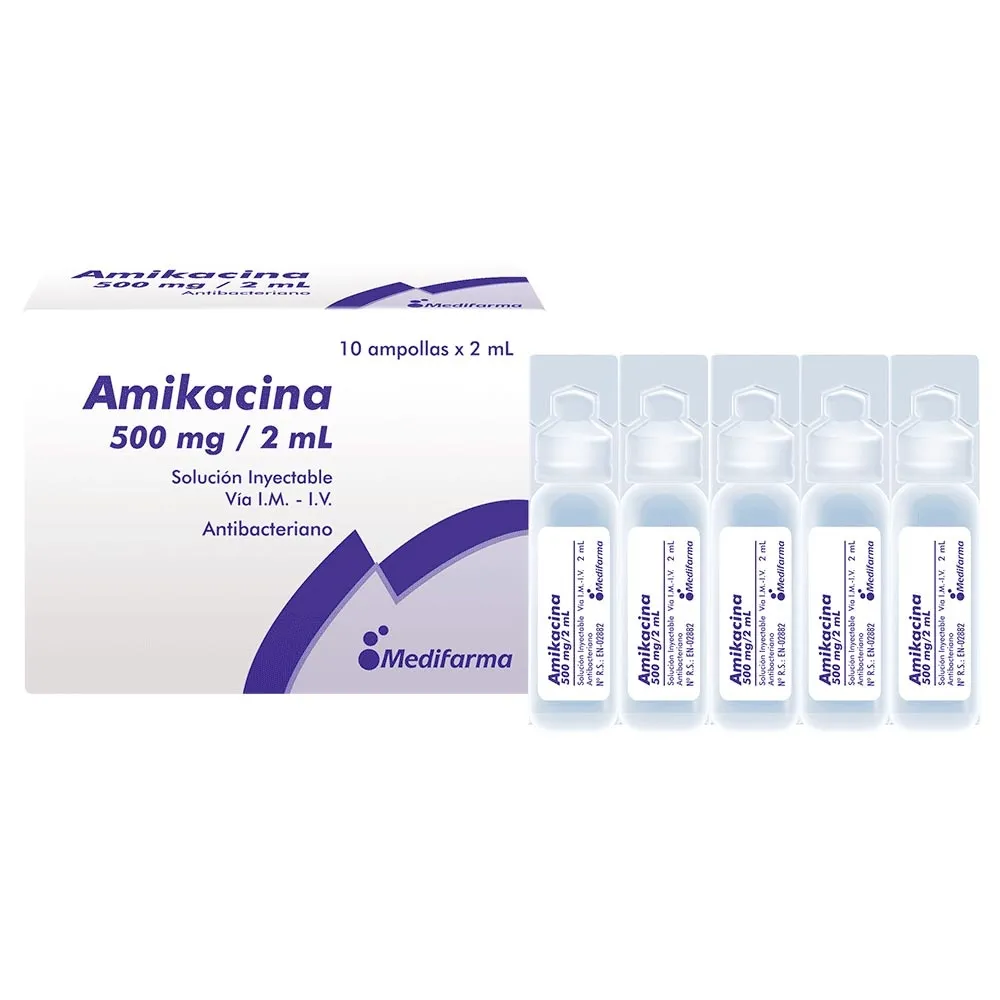
AMIKACIN BRAUN 500 MG/2ML SOLUTION FOR INJECTION
SpainIt is used for the short-term treatment of serious infections caused by sensitive microorganisms, such as blood infections (sepsis), serious lower respiratory tract infections, central nervous system infections (including meningitis), abdominal infections (such as peritonitis), skin, bone, and soft tissue infections (including burns), complicated urinary tract infections, and post-surgical infections.
Frequently asked questions
How should I take Amicacina Braun 500 mg/2ml?
This medication must be administered via direct intramuscular injection. The dose and duration of treatment will be determined by your doctor based on your age, weight, severity of the infection, and kidney function.
When should I not use this medication?
Do not use it if you are allergic to amikacin or other antibiotics in the aminoglycoside group, if you suffer from myasthenia gravis, or if it must be administered alongside other products that are toxic to the ear or kidney, such as certain potent diuretics.
What side effects can Amicacina Braun 500 mg/2ml cause?
Very common side effects include renal toxicity (changes in blood nitrogen and creatinine levels, presence of red or white blood cells in the urine), hearing problems (hearing loss, vertigo, tinnitus), and nervous system problems (acute muscle paralysis, apnea, numbness, or seizures). Uncommon side effects may also occur, such as nausea, vomiting, skin rashes, or pain at the injection site.
Can I take other medications while using this antibiotic?
You must inform your doctor if you are taking other medications, as the administration of Amicacina Braun 500 mg/2ml alongside other aminoglycoside antibiotics, potent diuretics, certain anesthetics, medications for myasthenia gravis, or some analgesics may require dosage adjustments or discontinuation of treatment.
What health precautions should I take during treatment?
It is important to inform your doctor if you have kidney function problems, muscular disorders (such as Parkinson's or myasthenia gravis), or if you have a family history of genetic diseases or hearing loss caused by antibiotics. Your doctor will monitor your hearing, balance, and kidney function during treatment.
Instructions for use
Table of contents
- Introduction
- 1. What Amicacina Braun 500 mg/2ml is and what it is used for
- 2. What you need to know before using Amikacin Braun 500 mg/2ml
- **Driving and use of machines:**
- 3. How to use Amikacin Braun 500 mg/2 ml
- **If you use more Amikacin Braun 500 mg/2ml than you should:**
- 4. Possible adverse effects
- 5. Storage of Amikacin Braun 500 mg/2ml.
- 6. Package Contents and Additional Information
Patient Information Leaflet
Introduction
Patient Information Leaflet
Amikacin Braun 500 mg/2ml solution for injection
Read the entire leaflet carefully before you start using this medicine
|
Package leaflet contents:
- What Amikacin Braun 500 mg/2ml is and what it is used for
- What you need to know before using Amikacin Braun 500 mg/2ml
- How to use Amikacin Braun 500 mg/2ml
- Possible side effects
- Storage of Amikacin Braun 500 mg/2ml
- Contents of the pack and other information
1. What Amicacina Braun 500 mg/2ml is and what it is used for
Amicacina Braun 500 mg/2ml is an aqueous solution of amikacin, a bactericidal antibiotic belonging to the aminoglycoside group.
Antibiotics are used to treat bacterial infections and are not effective against viral infections such as influenza or the common cold.
It is important that you follow your doctor's instructions regarding dosage, frequency, and duration of treatment.
Do not store or reuse this medicine. If you have any antibiotic left over after completing treatment, return it to the pharmacy for proper disposal. Medicines must not be disposed of via wastewater or household waste.
It is used for the short-term treatment of serious infections caused by susceptible microorganisms. It is mainly used in the following cases:
- blood infection, known as sepsis
- severe infections of the lower respiratory tract
- infections of the central nervous system (including meningitis)
- intra-abdominal infections, including peritonitis
- skin, bone, and soft tissue infections (including burns)
- complicated and recurrent urinary tract infections
- infections following surgical procedures
2. What you need to know before using Amikacin Braun 500 mg/2ml
Do not use Amikacin Braun 500 mg/2ml:
- If you are allergic to amikacin or other aminoglycoside antibiotics,
- If you have myasthenia gravis,
- It should not be administered with other products that are ototoxic or nephrotoxic, or with potent diuretics.
Warnings and precautions:
Talk to your doctor, pharmacist, or nurse before starting treatment with Amikacin Braun 500 mg/2ml.
Inform your doctor of any allergies or medical conditions you currently have or have had, especially:
- If you are allergic to amikacin or other aminoglycoside antibiotics,
- If your kidneys do not function properly, as this may increase the risk of toxicity,
- If you have muscle disorders such as myasthenia gravis or Parkinson's disease, as muscle weakness may worsen,
- If you are taking diuretics that may be ototoxic,
- If you develop symptoms of ototoxicity such as dizziness, vertigo, tinnitus (ringing sensation), buzzing in the ears, or hearing loss, or symptoms of nephrotoxicity,
- If you develop severe diarrhea,
- It is possible that your infection will not respond to amikacin if it did not respond to other aminoglycosides, and you may have an allergic reaction if you are already allergic to another aminoglycoside,
- If you or members of your family have a mitochondrial mutation disease (a genetic disorder) or hearing loss due to antibiotics, you are advised to inform your doctor or pharmacist before taking an aminoglycoside; certain mitochondrial mutations may increase your risk of hearing loss with this medicine. Your doctor may recommend genetic testing before administering Amikacin Braun 500 mg/2ml,
- Amikacin may alter laboratory test values for certain substances such as: blood urea nitrogen, transaminases, alkaline phosphatase, bilirubin, creatinine, lactate dehydrogenase, sodium, potassium, magnesium, and calcium.
To reduce the risk of ototoxic and nephrotoxic nerve damage, your doctor will be especially careful in evaluating the following:
- Monitoring of hearing, balance, and kidney function before, during, and after treatment.
- Strict dosing according to kidney function.
- If you have impaired renal function, total dosage will take into account any additional antibiotics administered directly at the site of infection.
- Monitoring of serum amikacin concentrations during treatment, if the specifics of your case require it.
- If you already have auditory nerve damage (impaired hearing or balance function), or if treatment is long-term, additional monitoring of balance and hearing function is required.
- Whenever possible, amikacin treatment should not exceed 10–14 days (typically 7–10 days).
- A sufficient interval of 7–14 days should elapse between individual courses of amikacin and other closely related antibiotics.
- Avoid administering other substances with potential harmful effects on the auditory nerve or kidneys in combination with amikacin. If this is unavoidable, especially careful monitoring of kidney function is required.
- Body fluid levels and urine output should remain within normal ranges.
Children
This medicine should be administered with caution and only if no alternative exists in premature infants and newborns due to their incomplete renal development.
Other medicines and Amikacin Braun 500 mg/2ml
Inform your doctor or pharmacist if you are currently using, or have recently used, any other medicines, including those obtained without a prescription.
The administration of Amikacin Braun 500 mg/2ml together with the following medicines may require dose adjustments or discontinuation of treatment:
- Other aminoglycoside antibiotics (gentamicin, tobramycin…) or capreomycin.
- Amphotericin, vancomycin, immunosuppressive agents, cytotoxic agents (cell-toxic such as cyclosporine or cisplatin), cephalosporins (cephalothin), or potent diuretics.
- Inhaled halogenated hydrocarbon anesthetics, massive transfusions of citrated blood, and neuromuscular blockers.
- Antihistamines, buclizine, cyclizine, loxapine, meclizine, phenothiazines, thioxanthenes, or trimethobenzamide.
- Antimyasthenics (medicines used to treat myasthenia gravis – muscle weakness).
- Indomethacin.
- Malathion.
- Polypeptide antibiotics (colistin, polymyxin).
- Opioid analgesics.
- Beta-lactam antibiotics (penicillin).
- Intravenous indomethacin in children.
Pregnancy and breastfeeding:
If you are pregnant or breastfeeding, think you may be pregnant, or are planning to become pregnant, consult your doctor or pharmacist before using this medicine.
Treatment during pregnancy is not recommended, although your doctor will assess whether its use is justified. If the medicine is used during pregnancy, or if the patient becomes pregnant during treatment, she should be informed of the potential risks.
There are no data available on excretion in breast milk, but as a general rule, breastfeeding should not be performed while the mother is undergoing treatment.
Driving and use of machines:
There is no evidence of effects on the ability to drive vehicles or operate machinery. However, this ability may be impaired if adverse reactions such as dizziness, vertigo, and lethargy occur.
Amikacin Braun 500 mg/2ml contains sodium metabisulfite (E-223), methylparaben (E-218), and propylparaben (E-216).
This medicine may cause severe allergic reactions and bronchospasm (sudden sensation of suffocation) because it contains sodium metabisulfite (E-223).
It may cause allergic reactions (possibly delayed) and, exceptionally, bronchospasm (sudden sensation of suffocation) because it contains methylparaben (E-218) and propylparaben (E-216).
This medicine contains less than 23 mg of sodium (1 mmol) per 2 ml vial; hence, it is essentially "sodium-free".
3. How to use Amikacin Braun 500 mg/2 ml
Follow exactly the administration instructions for this medicine provided in this leaflet or as directed by your doctor, pharmacist, or nurse. If in doubt, consult your doctor, pharmacist, or nurse.
Your doctor will determine how long your treatment should last. Do not stop the treatment prematurely.
Your doctor will decide the most appropriate dose for you, based on your age, body weight, general condition, severity of infection, and kidney function. Renal function should be monitored throughout treatment.
Peak concentrations (30–90 minutes after injection) exceeding 35 micrograms/mL and trough concentrations (just before the next dose) exceeding 10 micrograms/mL should be avoided.
If renal function is normal, the recommended dose for adults is 15–20 mg/kg/day, given either as a single daily dose or divided into 2 or 3 equal doses administered at equally spaced intervals.
Use in children
Adolescents (12 to less than 18 years) and children (2 to 11 years):
The recommended dosage is the same as for adults.
Term newborns aged 2 weeks or older and infants (28 days to 23 months):
The recommended dose in children older than 2 weeks is 7.5 mg/kg every 12 hours or 5 mg/kg every 8 hours.
Term newborns under 2 weeks of age (0 to 13 days):
An initial loading dose of 10 mg/kg should be administered, followed by 7.5 mg/kg every 12 hours.
Premature infants:
The recommended dose is 7.5 mg/kg every 12 hours.
Amikacin Braun 500 mg/2 ml may not be suitable for adjusting dosage in all cases. Other presentations of intravenous infusion solution may be used in such situations.
If the patient has impaired renal function, the doctor will monitor carefully and, if necessary, adjust the dose or extend the dosing intervals.
Amikacin Braun 500 mg/2 ml must be administered by intramuscular injection.
If you use more Amikacin Braun 500 mg/2ml than you should:
In case of overdose or accidental ingestion, immediately consult your doctor or pharmacist, or contact the Toxicology Information Service at telephone number 91 562 04 20, specifying the medication and the amount ingested. It is recommended to bring the medicine's packaging and leaflet to the healthcare professional.
If a toxic reaction due to high dosage or accumulation occurs—especially to be considered in patients with severe renal impairment—peritoneal dialysis or hemodialysis may enhance the elimination of the antibiotic.
If a hypersensitivity reaction occurs, administration will be discontinued and the patient will be given appropriate specific treatment according to the nature and severity of the reaction (antihistamines, corticosteroids, adrenaline...).
If you have any further questions about the use of this product, ask your doctor or pharmacist.
4. Possible adverse effects
Like all medicines, Amikacin Braun 500 mg can cause adverse effects, although not everyone will experience them.
The following is a list of adverse reactions categorized by affected systems and listed in decreasing order of frequency according to the following criteria:
Very common (> 1/10), common (>1/100, < 1/10), uncommon (>1/1000, <1/100), rare (>1/10000, < 1/1000) and very rare (<1/10000)
Renal and urinary disorders: | very common: renal toxicity: increased blood urea nitrogen and non-protein nitrogen, increased serum creatinine, albuminuria, presence of red and white blood cells in urine… |
Ear and labyrinth disorders: | very common: neurotoxicity and ototoxicity: hearing loss, vertigo, cochlear damage including high-frequency hearing loss. |
Nervous system disorders: | very common: neurotoxicity and neuromuscular blockade: acute muscle paralysis and apnea (cessation of breathing), numbness, tingling, muscle spasms, and seizures. |
Skin and subcutaneous tissue disorders: | uncommon: skin rash, redness, and increased temperature at the injection site. |
Gastrointestinal disorders: | uncommon: nausea, vomiting. |
Musculoskeletal and connective tissue disorders: | uncommon: paresthesia (a sensation of numbness, tingling, or burning in the skin), arthralgia (joint pain). |
General disorders and administration site conditions: | uncommon: pain at the injection site. |
Blood and lymphatic system disorders: | rare: eosinophilia, anemia (low red blood cell concentration). |
Cardiac disorders: | rare: hypotension (low blood pressure); hypomagnesemia (low magnesium levels). |
Reporting suspected adverse reactions
It is important to report suspected adverse reactions to the medicinal product following its authorization. This enables continued monitoring of the benefit-risk balance of the medicinal product. Healthcare professionals are encouraged to report any suspected adverse reactions via the Spanish Pharmacovigilance System for Human Medicinal Products: www.notificaRAM.es
5. Storage of Amikacin Braun 500 mg/2ml.
Keep out of sight and reach of children.
Store in a cool place and in the original packaging to protect from light.
Do not use Amikacin Braun 500 mg/2ml after the expiry date stated on the container. The expiry date refers to the last day of the month indicated.
The contents of the vials must be used immediately after opening. After opening, discard any unused portion of the solution.
Medicines should not be disposed of via wastewater or household waste. Ask your pharmacist how to dispose of medicines and packaging that you no longer need. This will help protect the environment.
6. Package Contents and Additional Information
Composition of Amicacina Braun 500 mg/2ml
The active substance in Amicacina Braun 500 mg/2ml is amikacin sulfate.
Each vial contains 500 mg of amikacin base.
The other components are: methylparaben (E-218), propylparaben (E-216), sodium metabisulfite (E-223), edetate disodium, and water for injections.
Appearance of the Product and Contents of the Package
It is presented in packages containing 1 and 50 glass vials of 2 ml.
Marketing Authorization Holder and Manufacturer
- Braun Medical, S.A.
Ctra. de Terrassa, 121
08191-Rubí (Barcelona)
Spain
Date of latest revision of this package leaflet: June 2023
Detailed information on this medicine is available on the website of the Spanish Agency of Medicines and Health Products (AEMPS) (http://www.aemps.gob.es/).
This information is intended exclusively for physicians or healthcare professionals:
Renal function and function of the auditory nerve must be carefully monitored in patients with renal impairment when the drug is used for prolonged periods or administered at doses exceeding the recommended doses, as disorders of the eighth cranial nerve and renal function have been reported. The appearance of signs of nephrotoxicity or ototoxicity will determine dosage adjustment or discontinuation of treatment, depending on the case.
Plasma levels of amikacin should be monitored, and dosage adjusted to avoid prolonged levels above 35 micrograms/ml. Urine should be examined for increased protein excretion, presence of cells or casts, and decreased density.
Ototoxicity in children has not been well established.
If superinfections caused by resistant microorganisms occur, treatment must be discontinued and appropriate therapy initiated.
Patients should be well hydrated during treatment.
Dosage
Patients with normal renal function may receive a single daily dose, provided that peak concentrations do not exceed 35 mg/ml. The usual duration of treatment is 7 to 10 days.
In difficult and complicated infections, a longer treatment period may be necessary. In such cases, renal, cochlear (auditory), and vestibular functions should be closely monitored.
The recommended dose for adults, adolescents, and children over 2 years of age is 15–20 mg/kg/day as a single daily dose or divided into two or three equal doses administered at equivalent intervals (i.e., for a dose of 15 mg/kg/day, administer 7.5 mg/kg every 12 hours or 5 mg/kg every 8 hours).
Total daily dose must not exceed 1.5 g/day.
Pediatric Population
Term newborns aged 2 weeks or older and infants (28 days to 23 months):
The recommended dose in children over 2 weeks of age is 7.5 mg/kg every 12 hours or 5 mg/kg every 8 hours.
Term newborns under 2 weeks (0 to 13 days):
An initial loading dose of 10 mg/kg should be administered, followed by 7.5 mg/kg every 12 hours.
Preterm infants:
The recommended dose is 7.5 mg/kg every 12 hours.
Amicacina Braun 500 mg/2ml may not be suitable for adjusting dosage in all cases. Other presentations of intravenous infusion solution are available for use in such situations.
Special Populations
Renal Impairment
In patients with renal impairment, as measured by a creatinine clearance < 50 ml/min, single-dose administration of amikacin is not recommended, as these patients would have prolonged exposure to elevated trough concentrations.
Dosage may be adjusted either by extending the dosing interval or by administering reduced doses.
Dosage adjustment based on serum creatinine values:
- Extension of dosing interval, using normal dose:
The extended dosing interval (in hours) for a normal dose (7.5 mg/kg every 12 hours) can be calculated by multiplying the serum creatinine value by 9. For example, if the serum creatinine level is 2 mg/100 ml, the recommended dosing regimen would be 7.5 mg/kg every 18 hours.
- Dose modification, maintaining the dosing frequency:
Initially, administer the standard loading dose of 7.5 mg/kg. To determine the maintenance dose to be administered every 12 hours, the dose should be reduced in proportion to the reduction in creatinine clearance:
Maintenance dose (every 12 h):

Obese Patients
Dosage should be adjusted according to body weight and renal function. In obese patients, the initial dose should be calculated using ideal body weight plus 40% of excess weight.
Burn Patients and Patients with Severe Infections
These patients may require higher doses or administration every 4 to 6 hours, as the drug's half-life is shorter in such cases.
Method of Administration
Direct intramuscular route.
Monitoring Recommendations:
For correct dosage calculation, the following should be considered:
- The patient's weight before treatment.
- Renal function status, determined by measuring serum creatinine concentration or creatinine clearance. Renal function should be monitored throughout treatment.
Whenever possible, serum concentrations of amikacin should be measured to ensure adequate levels. It is recommended to intermittently monitor peak and trough serum concentrations during treatment. Peak concentrations (measured 30–90 minutes after injection) should not exceed 35 µg/ml, and trough concentrations (measured just before the next dose) should not exceed 10 µg/ml.
Aminoglycosides must be administered separately, regardless of the route of administration, and must not be physically premixed with other drugs.
MEDICINAL PRODUCT SUBJECT TO MEDICAL PRESCRIPTION
HOSPITAL USE
Similar drugs
| Brand name | Dosage form | Active substance / Dosage | Manufacturer |
|---|---|---|---|
| AMIKACIN NORMON 500 MG/2 ML SOLUTION FOR INJECTION AND INFUSION EFG | solution for injection |
|
Laboratorios Normon S.A. |
The original data is available in the language of the country of manufacture.
Data source: Online Medicines Information Centre (CIMA) — AEMPS
Data last verified: September 21, 2026