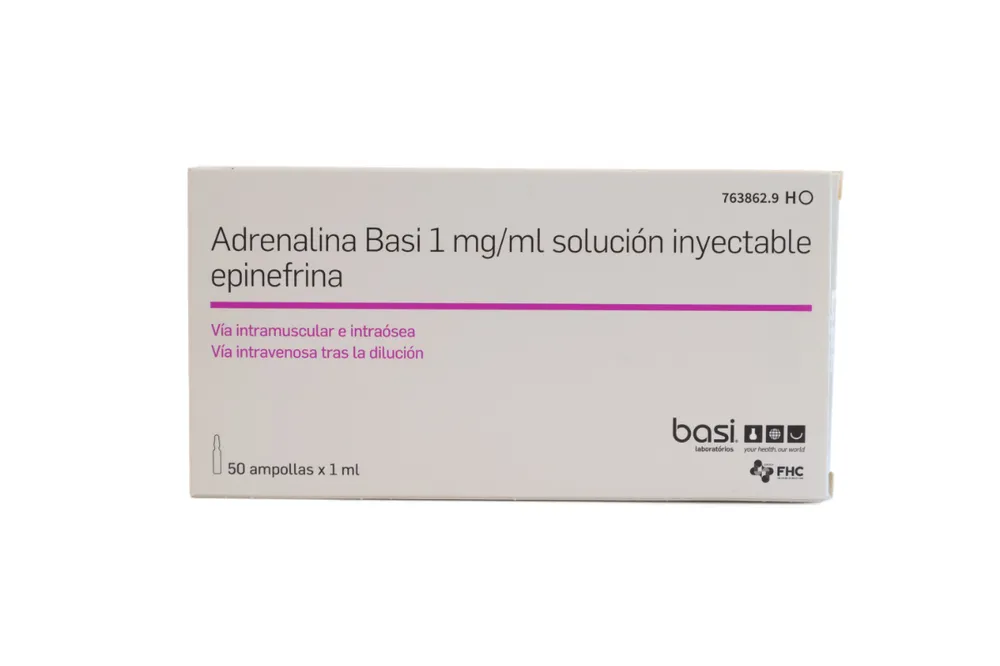
ADRENALINE BASI 1 MG/ML SOLUTION FOR INJECTION
SpainIt is used in life-threatening emergency situations, such as severe allergic reactions or cardiac arrest.
Frequently asked questions
When should I not use this medication?
It should not be used if you are allergic to adrenaline or any of its components.
What precautions should I take before being administered Adrenalina Basi?
You must inform your doctor if you have heart problems, brain problems, hyperthyroidism, diabetes, glaucoma, adrenal or prostatic tumors, kidney disease, hypertension, atherosclerosis, or if you have low potassium or high calcium levels. You should also notify them if you are in shock, have lost a lot of blood, or are going to undergo surgery under general anesthesia.
How is the medication administered?
Administration must be performed by a healthcare professional via injection into a muscle, a bone, or a vein (the latter requires prior dilution).
Can it interact with other drugs?
Yes, many medications can alter its effects, including antidepressants, Parkinson's medications, heart medications, diuretics, anesthetics, blood pressure medications, insulin, asthma treatments, corticosteroids, antihistamines, and cough or cold remedies.
What are the possible side effects of Adrenalina Basi?
It may cause effects such as headache, dizziness, anxiety, tremors, insomnia, confusion, changes in heart rhythm (palpitations or tachycardia), hypertension, difficulty breathing, nausea, vomiting, increased blood sugar, or sweating. In cases of repeated injections, there may be tissue damage at the injection site.
What should I do if I suspect an overdose?
Signs of overdose may include restlessness, confusion, paleness, a very fast, very slow, or irregular heart rate, and cardiac arrest. You must consult a doctor immediately.
Instructions for use
Package leaflet: Information for the user
Introduction
Package leaflet: information for the user
Adrenalina Basi 1 mg/ml solution for injection
epinephrine
Read the entire leaflet carefully before this medicine is administered to you, because it contains important information for you.
-
Keep this leaflet, as you may need to read it again.
-
If you have any questions, ask your doctor, pharmacist or nurse.
-
This medicine has been prescribed for you only, and you should not give it to other people, even if they have the same symptoms as you, because it could harm them.
- If you experience any adverse effects, consult your doctor, pharmacist or nurse, even if they are adverse effects not listed in this leaflet. See section 4.
Leaflet contents
-
What Adrenalina Basi is and what it is used for
-
What you need to know before Adrenalina Basi is administered
-
How Adrenalina Basi is administered
-
Possible side effects
- Storage of Adrenalina Basi
-
Contents of the pack and other information
1. What Adrenalina Basi is and what it is used for
Adrenaline belongs to a class of medicines called adrenergics and dopaminergics.
Adrenalina Basi is used in potentially life-threatening emergencies such as severe allergic reactions or cardiac arrest.
2. What you need to know before Adrenalina Basi is administered to you
Do not use Adrenalina Basi
- if you are allergic to adrenaline or to any of the other components of this medicine (listed in section 6).
Warnings and precautions
Talk to your doctor, pharmacist, or nurse before Adrenalina Basi is administered if:
- you are elderly;
- you have heart problems, especially if they affect your heart rate or if you experience chest pain;
- you have brain disorders (e.g., stroke, brain damage, or blood vessel disease);
- you have hyperthyroidism, diabetes, or glaucoma (high pressure in the eye);
- you have a phaeochromocytoma (a tumor of the adrenal gland);
- you have low blood potassium levels or high calcium levels;
- you have a tumor of the prostate gland or kidney disease;
- you are in shock or have lost a significant amount of blood;
- you are about to undergo surgery with general anesthesia;
- you have high blood pressure;
- you have atherosclerosis, which is narrowing and hardening of the blood vessels (your doctor will advise you).
Discuss with your doctor if any of these situations apply to you before receiving this medicine.
Other medicines and Adrenalina Basi
Inform your doctor or pharmacist if you are taking, have recently taken, or might need to take any other medicines.
A large number of medicines may interact with Adrenalina Basi, which could significantly alter its effects. These medicines include:
- monoamine oxidase inhibitors (MAOIs) such as moclobemide, or tricyclic antidepressants such as imipramine, amitriptyline, both used for depression;
- catechol-O-methyl transferase (COMT) inhibitors such as entacapone, tolcapone, opicapone, used to treat symptoms of Parkinson's disease;
- cardiac glycosides such as digoxin, used for heart failure;
- guanethidine, used for rapid control of blood pressure;
- diuretics such as hydrochlorothiazide, furosemide;
- inhaled general anesthetics such as halothane;
- medicines to increase or decrease blood pressure, including beta-blockers such as propranolol, atenolol, bisoprolol, phentolamine;
- antidiabetic medicines such as insulin or oral hypoglycemics (e.g., glipizide);
- aminophylline and theophylline (medicines used to treat asthma);
- corticosteroids (medicines used to treat inflammatory conditions of the body such as asthma or arthritis);
- antihistamines (e.g., diphenhydramine), used to treat allergies;
- medicines used to treat mental illness such as chlorpromazine, periciazine, or flufenazine;
- medicines used to treat hypothyroidism;
- oxytocin (used to induce labor at term and to control bleeding after childbirth);
- any cough or cold remedies (sympathomimetics).
If you are already taking any of these medicines, talk to your doctor before receiving Adrenalina Basi.
Pregnancy and breastfeeding
If you are pregnant or breastfeeding, think you may be pregnant, or are planning to become pregnant, consult your doctor or pharmacist before using this medicine.
Adrenalina Basi should not be used during pregnancy and childbirth.
Adrenaline is excreted in breast milk. If you are breastfeeding, talk to your doctor before receiving Adrenalina Basi.
Adrenaline should only be used during pregnancy and breastfeeding if your doctor considers it essential.
Driving and use of machines
This is unlikely to be relevant, as you will not be feeling well enough to drive or operate machinery.
Consult your doctor before considering such activities.
Adrenalina Basi contains sodium metabisulfite and sodium chloride
Sodium metabisulfite (a preservative) may rarely cause severe hypersensitivity reactions and bronchospasm.
This medicine contains less than 1 mmol of sodium (23 mg) per ampoule; i.e., essentially "sodium-free".
Adrenalina Basi may be diluted in 0.9% sodium chloride, 5% glucose, or 5% glucose in 0.9% sodium chloride. This should be taken into account in patients on a low-sodium diet.
3. How Adrenalina Basi is administered
Adrenaline can be injected into a muscle (intramuscularly) or into a bone (intraosseously). It must be diluted before intravenous injection.
Adrenaline injection should not be used in areas such as the fingers of the hands or feet, ears, nose, or penis, as blood supply to these areas may become insufficient.
Adrenalina Basi will be administered by a trained healthcare professional. Your doctor will decide the most appropriate dose and route of administration for your specific case, depending on your age and physical condition.
If you think you have been given more Adrenalina Basi than you should have
This is unlikely, as the injection will be administered by a doctor or nurse.
Possible signs of overdose include restlessness, confusion, pallor, abnormally fast resting heart rate (tachycardia), slow heart rate (bradycardia), irregular heart rate (cardiac arrhythmias), and cardiac arrest.
Talk to your doctor if you experience any adverse effects, so that appropriate treatment can be given. If you have already left the medical facility, contact your nearest hospital, doctor, or pharmacist.
If you have any further questions about the use of this medicine, ask your doctor, pharmacist, or nurse.
4. Possible adverse effects
Like all medicines, this medicine can cause adverse effects, although not everyone experiences them.
The following adverse effects have also been reported (frequency unknown):
- headache, dizziness;
- feeling of anxiety, fear, or restlessness;
- tremor;
- insomnia, confusion, irritability;
- changes in mood or behaviour;
- dry mouth or excessive saliva production;
- weakness or sweating;
- changes in heart rate and rhythm;
- palpitations (fast or irregular heartbeat), tachycardia (abnormally rapid resting heart rate), angina (chest pain of variable intensity);
- high blood pressure;
- coldness in arms or legs;
- breathing difficulty;
- reduced appetite, nausea, or vomiting;
- repeated injections may damage tissue at the injection site and may also cause damage to limbs, kidneys, and liver;
- difficulty in passing urine, urinary retention;
- metabolic acidosis may occur (an imbalance in certain components of the blood);
- increased tremors and rigidity in patients with a condition known as parkinsonism;
- cerebral haemorrhage;
- paralysis of one side of the body;
- increased blood sugar levels;
- decreased potassium levels in the blood;
- pulmonary oedema.
Reporting of adverse effects
If you experience any adverse effect, consult your doctor, pharmacist, or nurse, even if it is a possible adverse effect not listed in this leaflet. You can also report them directly via the Spanish Pharmacovigilance System for Human Medicinal Products: www.notificaRAM.es. By reporting adverse effects, you can help provide more information on the safety of this medicine.
5. Storage of Adrenaline Basi
Keep this medicine out of the sight and reach of children.
Do not use this medicine after the expiry date stated on the packaging and on the label of the ampoule after EXP. The expiry date refers to the last day of the month indicated.
Store below 25 °C. Keep the ampoules in the outer packaging to protect them from light.
For single use only. If only part of an ampoule is used, the remaining solution must be discarded.
Do not remove the ampoule from the carton until ready for use.
After dilution, the ready-to-use solution should be administered as soon as possible.
Only use solutions that are clear, free from particles or precipitates.
Medicines must not be disposed of via wastewater or household waste. Ask your pharmacist how to dispose of medicines and packaging you no longer need. This will help protect the environment.
6. Package Contents and Additional Information
Composition of Adrenalina Basi
- The active substance is epinephrine (adrenaline) in the form of epinephrine tartrate (adrenaline tartrate). Each 1 ml of this injectable solution contains 1 mg of epinephrine (adrenaline) as adrenaline tartrate.
- The other components (excipients) are sodium chloride, sodium metabisulfite (E223), and water for injectable preparations.
Appearance of the Product and Contents of the Container
Adrenalina Basi is a clear, sterile injectable solution in 1 ml amber glass type I ampoules.
Adrenalina Basi is available in packages containing 10 and 50 ampoules.
Marketing Authorization Holder and Manufacturer
Marketing Authorization Holder
Laboratórios Basi – Indústria Farmacêutica, S.A.
Parque Industrial Manuel Lourenço Ferreira, Lote 15
3450-232 Mortágua
Portugal
Tel.: +351 231 920 250 | Fax: +351 231 921 055
E-mail: [email protected]
Manufacturer
Laboratórios Basi - Indústria Farmacêutica, S.A.
Parque Industrial Manuel Lourenço Ferreira, Lotes 8, 15, 16
3450-232 Mortágua
Portugal
Further information on this medicinal product is available upon request to the local representative of the marketing authorization holder:
Local Representative
Laphysan, S.A.U.
Calle Anabel Segura 11,
Albatros Business Park, Building A, 4th Floor, Door D,
28108 Alcobendas (Madrid), Spain
This medicinal product is authorized in the Member States of the European Economic Area (EEA) under the following names:
Portugal: Adrenalina Basi
Spain: Adrenalina Basi 1 mg/ml solution for injection
Date of the most recent review of this summary: July 2023
Detailed and up-to-date information on this medicinal product is available on the website of the Spanish Agency of Medicines and Medical Devices (AEMPS): (http://www.aemps.gob.es/)
<------------------------------------------------------------------------------------------------------------------------>
Preparation and Handling:
Only clear solutions free from particles or precipitates should be used.
Repeated local administration may cause necrosis at injection sites.
The preferred site for intramuscular injection is the anterolateral aspect of the middle third of the thigh. Intramuscular injections of Adrenalina Basi into the gluteal region should be avoided due to the risk of tissue necrosis.
Incompatibilities:
Do not mix Adrenalina Basi with other medicinal products unless compatibility is known.
For intravenous administration, Adrenalina Basi must be diluted to a 0.1 mg/ml solution (a 1:10 dilution of the ampoule content) using 0.9% sodium chloride, 5% glucose, or 5% glucose in 0.9% sodium chloride.
Dosage and Administration:
This medicine should be administered by a trained healthcare professional.
Adrenalina Basi is intended for intravenous, intraosseous, intramuscular, or subcutaneous administration.
For intravenous use, it must be diluted first.
Acute Anaphylaxis
The intramuscular (IM) route is the preferred route for most patients requiring adrenaline for the treatment of acute anaphylaxis.
Patients should be monitored as soon as possible (pulse, blood pressure, ECG, pulse oximetry) to assess response to adrenaline.
The preferred site for IM injection is the anterolateral aspect of the middle third of the thigh.
The needle used for injection must be sufficiently long to ensure that adrenaline is delivered into the muscle.
The subcutaneous route is not recommended for adrenaline in the treatment of anaphylactic reactions, as it is less effective.
Adults
The usual dose is 0.5 mg (0.5 ml of adrenaline 1 mg/ml (1:1,000)). If necessary, this dose may be repeated several times at 5-minute intervals depending on blood pressure, pulse, and respiratory function.
Elderly Patients:
There are no specific dosage regimens for adrenaline injection in elderly patients. However, adrenaline should be used with great caution in these patients, who may be more susceptible to the cardiovascular adverse effects of adrenaline.
Paediatric Population
The following doses of Adrenalina 1 mg/ml (1:1,000) solution for injection are recommended:
Age | Dosage |
Over 12 years | 0.5 mg (0.5 ml of solution) |
6 – 12 years | 0.3 mg (0.3 ml of solution) |
6 months – 6 years | 0.15 mg (0.15 ml of solution) |
Less than 6 months | 0.01 mg/kg (0.01 ml/kg of solution) |
If necessary, these doses may be repeated several times at intervals of 5–15 minutes depending on blood pressure, pulse, and respiratory function.
A small-volume syringe should be used.
Cardiopulmonary resuscitation
Adults
1 mg of adrenaline intravenously or intraosseously, repeated every 3–5 minutes until return of spontaneous circulation. If administered through a peripheral line, it should be followed by a flush of at least 20 ml of fluid.
Paediatric population
The recommended intravenous or intraosseous dose of adrenaline in children is 10 micrograms/kg. Depending on body weight, this dose may need to be administered using a 0.1 mg/ml solution (i.e., a 1:10 ml dilution of the ampoule content). Subsequent doses of adrenaline may be given every 3–5 minutes. The maximum single dose is 1 mg.
Method of administration
Adrenaline 1 mg/ml (1:1,000) injectable solution may be administered by IM, IV, and IO routes.
The dose should be titrated in 50 microgram boluses according to response. This dose can only be administered using a 0.1 mg/ml solution (i.e., a 1:10 ml dilution of the ampoule content). For instructions on dilution of the medicinal product prior to administration, see section 6.6. Undiluted adrenaline solution 1 mg/ml must not be administered intravenously.
If repeated doses of adrenaline are required, an intravenous adrenaline infusion with dose adjustment according to response, under continuous haemodynamic monitoring, is recommended.
Similar drugs
| Brand name | Dosage form | Active substance / Dosage | Manufacturer |
|---|---|---|---|
| ADRENALINE B. BRAUN 1 MG/ML SOLUTION FOR INJECTION | solution for injection |
|
B Braun Medical S.A. |
| ADRENALINE BRADEX 1 MG/ML SOLUTION FOR INJECTION | solution for injection |
|
Bradex S.A. |
| ADRENALINE ETHYPHARM 1 MG/ML SOLUTION FOR INJECTION | solution for injection |
|
Ethypharm |
| ANAPEN 0.30 MG/0.3 ML SOLUTION FOR INJECTION IN PRE-FILLED SYRINGE | solution for injection |
|
Bioprojet Pharma |
The original data is available in the language of the country of manufacture.
Data source: Online Medicines Information Centre (CIMA) — AEMPS
Data last verified: September 21, 2026