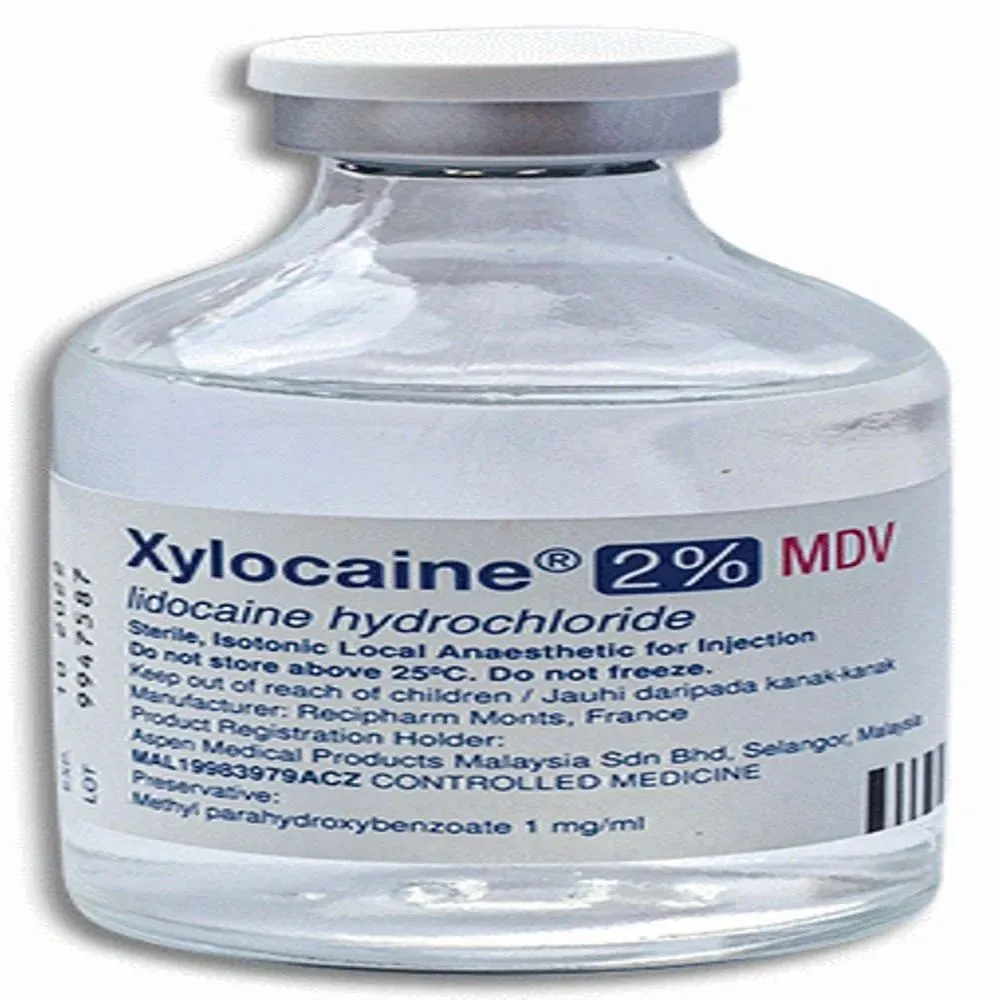
XYLOCAINE 2%
PolandThe medicinal product is intended for adults and adolescents over 12 years of age for use in infiltration anesthesia, peripheral nerve blocks, as well as epidural and caudal anesthesia.
Frequently asked questions
How should Xylocaine 2% be administered?
The medicinal product is administered by a physician in a hospital setting. The dose is determined by a specialist depending on the type of anesthesia and the patient's general health status.
When should this medicine not be used?
It must not be used if there is a hypersensitivity to lidocaine, other amide-type local anesthetics, or the ingredients of the medicinal product (e.g., paraben). Use is also contraindicated in individuals with very low blood pressure (e.g., cardiogenic or hypovolemic shock) and in certain types of anesthesia, such as intrathecal, intraventricular, or retrobulbar administration.
What are the possible side effects of Xylocaine 2%?
Nausea and a significant drop in blood pressure may occur very frequently. More frequently, the following may occur: slowed heart rate, hypertension, dizziness, convulsions, vomiting, and sensory disturbances. Less frequently, allergic reactions (facial swelling, difficulty breathing), nerve damage, double vision, or cardiac arrhythmias may occur.
Can the medicine be combined with other medicines?
The physician must be informed about all medicines being taken, especially other local anesthetics, antiarrhythmic drugs (e.g., amiodarone), drugs for gastric diseases (e.g., cimetidine), and beta-blockers.
Should caution be exercised during pregnancy or breastfeeding?
Women who are pregnant or breastfeeding should consult a physician before using the medicinal product. Lidocaine crosses the placenta to the fetus and is excreted into breast milk.
What are the symptoms of overdose?
The first signs may be dizziness, numbness around the mouth or tongue, and sensitivity to sounds. Serious symptoms include blurred vision and muscle tremors, and in severe cases, convulsions, loss of consciousness, or respiratory arrest.
Instructions for use
Package leaflet: Information for the user
Xylocaine 2%, 20 mg/ml, solution for injection
Lidocaini hydrochloridum
Please read all of this leaflet carefully before using this medicine, because it contains
important information for the patient.
- Keep this leaflet, as you may need to read it again.
- If you have any further questions, please consult your doctor or nurse.
- If the patient experiences any adverse reactions, including any possible adverse reactions not listed in this leaflet, inform the doctor or nurse immediately. See section 4.
Contents of the leaflet
- What Xylocaine 2% is and what it is used for
- Important information before using Xylocaine 2%
- How to use Xylocaine 2%
- Possible side effects
- How to store Xylocaine 2%
- Contents of the pack and other information
1. What Xylocaine 2% is and what it is used for
Xylocaine 2% contains lidocaine hydrochloride as the active substance, which belongs to a group of medicines known as amide-type local anaesthetics.
Xylocaine 2% is indicated for use in adults and adolescents over 12 years of age for:
- infiltration anaesthesia,
- peripheral nerve blocks, such as brachial plexus block, intercostal block,
- central blocks including epidural and caudal anaesthesia.
For children aged 1 to 12 years, it is recommended to use another medicinal product – an injection solution with a lower concentration of lidocaine hydrochloride.
2. Important information before using Xylocaine 2%
When not to use Xylocaine 2%:
- if the patient is allergic to lidocaine hydrochloride, other local anaesthetics of the amide group, or any of the other ingredients of this medicine (listed in section 6),
- if the patient is allergic to methyl and/or propyl parahydroxybenzoate [methyl and/or propyl paraben] or to their metabolite, para-aminobenzoic acid (PABA),
- if for any reason local anaesthesia is contraindicated, for epidural anaesthesia in patients with very low arterial blood pressure, e.g. in cardiogenic (originating from the heart) or hypovolemic (caused by a significant reduction in circulating blood volume) shock, for intrathecal, intraventricular, intraocular or retrobulbar administration.
Warnings and precautions
Before starting treatment with Xylocaine 2%, discuss the following with your doctor or nurse:
- if the patient has experienced a hypersensitivity reaction (allergy) during or after anaesthesia, or if the patient has been diagnosed with allergy to local anaesthetics,
- if the patient is breastfeeding,
- if the patient has severe liver disease or reduced hepatic blood flow,
- if the patient has impaired kidney function,
- if the patient has heart function disorders (e.g. partial or complete conduction block in the heart muscle),
- if the patient has circulatory system disorders,
- if the patient has pleural effusion (fluid in the chest cavity),
- if the patient has blood infection (septicaemia),
- if the patient is taking antiarrhythmic drugs, such as amiodarone,
- if the patient has acute porphyria.
Rarely, certain types of anaesthesia may lead to nerve damage, sometimes resulting in permanent damage. Some types of eye injections may very rarely cause transient blindness or prolonged eye muscle disorders.
Children and adolescents
Xylocaine 2% is indicated for use in adolescents above 12 years of age.
For children aged 1 to 12 years, it is recommended to use another medicine – an injection solution with a lower concentration of lidocaine hydrochloride.
Xylocaine 2% and other medicines
Inform your doctor about all medicines currently taken or recently taken, as well as any medicines planned for use, including those available without a prescription.
You should also inform your doctor about any disturbing reactions that occurred after using other medicines.
In particular, inform your doctor if the patient is taking any of the following medicines:
- other local anaesthetics,
- medicines used to treat irregular heartbeat (e.g. amiodarone, mexiletine),
- medicines used to treat stomach and duodenal disorders (e.g. cimetidine),
- beta-blockers (medicines used to treat high blood pressure and hyperthyroidism).
Xylocaine 2% with food and drink
Not applicable.
Pregnancy and breastfeeding
If the patient is pregnant or breastfeeding, suspects she may be pregnant, or is planning to have a child, she should consult a doctor before using this medicine.
Lidocaine crosses the placenta and may reach fetal tissues.
Lidocaine passes into human milk, but in such small amounts that its effect on the breastfed infant is unlikely when administered at recommended doses.
Driving and operating machinery
Depending on the dose, local anaesthetics may have a slight effect on mental functions and may also affect motor functions and coordination.
Xylocaine 2% contains methyl parahydroxybenzoate (E 218) and sodium
This medicine may cause allergic reactions (including delayed-type reactions) and, very rarely, bronchospasm. This medicine must not be used for intrathecal, intraventricular, intraocular or retrobulbar anaesthesia.
The medicine contains 124.5 mg of sodium (main component of table salt) per vial (50 ml). This corresponds to 6.23% of the maximum recommended daily dietary intake of sodium for adults.
3. How to use Xylocaine 2%
Xylocaine 2% is administered by a physician in a hospital setting.
The physician will determine the appropriate dose of Xylocaine 2% depending on the type of anesthesia and the patient's general condition.
Use of Xylocaine 2% in elderly patients
The dose of Xylocaine 2% should be reduced in elderly patients.
Use of a higher than recommended dose of Xylocaine 2%
Severe adverse effects resulting from overdose are extremely rare and require specialist management. The physician is appropriately trained and has the necessary equipment available for such situations.
The first signs indicating overdose are: dizziness, numbness around the mouth, tongue numbness, and auditory hypersensitivity. You should immediately inform the doctor if such symptoms occur. Blurred vision and muscle twitching are serious signs.
In case of severe overdose or intravascular administration, seizures, loss of consciousness, and respiratory arrest may occur.
Prompt discontinuation of the drug upon the appearance of the first symptoms of overdose reduces the risk of severe adverse effects.
Discontinuation of Xylocaine 2%
If you have any further doubts regarding the use of this medicine, consult your doctor or nurse.
4. Possible adverse reactions
Like all medicines, this medicine can cause adverse reactions, although not everyone experiences them.
Adverse reactions directly caused by the medicine are sometimes difficult to distinguish from
the physiological effects of nerve block (e.g. drop in blood pressure, bradycardia),
the direct effect of needle insertion (e.g. nerve damage), or represent an indirect consequence of the puncture
(e.g. subdural hematoma).
Severe allergic reactions (rare, occurring no more frequently than in 1 out of 1000 patients):
If a severe allergic reaction occurs, you must immediately inform your doctor.
Symptoms may include sudden onset of:
- swelling of the face, lips, tongue or throat. This may cause difficulty swallowing
- severe or sudden swelling of the hands, feet or ankles
- difficulty breathing
- intense itching of the skin (with a raised rash)
- very low blood pressure, which may lead to fainting or collapse
Other possible adverse reactions:
Very common (may occur in more than 1 out of 10 treated patients)
- nausea
- significant decrease in blood pressure (hypotension)
Common (may occur in no more than 1 out of 10 treated patients)
- significant slowing of heart rate (bradycardia)
- significant increase in blood pressure (hypertension)
- paresthesia (sensory disturbances)
- dizziness
- seizures
- vomiting
Uncommon (may occur in no more than 1 out of 100 treated patients)
- symptoms of central nervous system toxicity (seizures, numbness around the mouth, tongue numbness, auditory hypersensitivity, visual disturbances, loss of consciousness, muscle twitching, dizziness, tinnitus, speech disturbances)
Rare (may occur in no more than 1 out of 1000 treated patients)
- neuropathy, i.e. nerve disease causing tingling, numbness or muscle weakness in the innervated muscle
- peripheral nerve damage
- meningitis
- double vision
- circulatory arrest
- cardiac arrhythmias
- respiratory depression
Reporting of adverse reactions
If any adverse symptoms occur, including any adverse reactions not listed
in this leaflet, you should inform your doctor, pharmacist, or nurse. Adverse reactions can be reported directly to the Department of Monitoring Adverse Drug Reactions at the Office for Registration of Medicinal Products, Medical Devices
and Biocidal Products
Al. Jerozolimskie 181C
02-222 Warsaw
Phone: +48 22 49 21 301
Fax: +48 22 49 21 309
Website: https://smz.ezdrowie.gov.pl
Adverse reactions may also be reported to the marketing authorization holder.
Reporting adverse reactions helps to provide more information on the safety of the medicine.
5. How to store Xylocaine 2%
Keep the medicine out of the sight and reach of children.
Do not use this medicine after the expiry date stated on the carton after: "Expiry date (EXP)" and on the vial after: "EXP". The expiry date refers to the last day of the stated month.
Period of use after first opening of the vial: 3 days (72 hours).
Do not store above 25°C.
Do not leave needles or any metallic objects in the opened vial. This may lead to release of metal ions, which could cause swelling at the injection site.
Medicines must not be disposed of via the sewage system or household waste. Ask your pharmacist how to dispose of medicines no longer required. Such measures will help protect the environment.
6. Contents of the pack and other information
What Xylocaine 2% contains
- The active substance is lidocaine. 1 ml of Xylocaine 2% contains 20 mg of lidocaine hydrochloride. Each 50 ml vial contains 1000 mg of lidocaine hydrochloride.
- The other ingredients are: sodium chloride, methyl parahydroxybenzoate (E 218), sodium hydroxide 2 mol/l and (or) hydrochloric acid 2 mol/l to adjust pH between 5.0 and 7.0, and purified water.
What Xylocaine 2% looks like and contents of the pack
Xylocaine 2% is a clear, colourless solution for injection.
It is supplied in vials made of colourless glass, packed in a cardboard box.
Pack size: 5 vials of 50 ml.
Marketing Authorisation Holder
Aspen Pharma Trading Limited
3016 Lake Drive
Citywest Business Campus
Dublin 24, Ireland
tel: +48 22 104 21 00
Manufacturer
Astrea Monts
18 Rue de Montbazon
Monts, 37260
France
Other sources of information
Detailed information on this medicinal product is available on the website of the Office for Registration of Medicinal Products, Medical Devices and Biocidal Products https://www.urpl.gov.pl
Similar drugs
| Brand name | Dosage form | Active substance / Dosage | Manufacturer |
|---|---|---|---|
| BUPIVACAINE HYDROCHLORIDE WZF 0,5% | solution for injection |
|
Polpharma Pharmaceutical Works S.A. |
| LIDOCAINE 1% FRESENIUS KABI | solution for injection |
|
Labesfal Laboratorios Almiro S.A. |
| LIDOCAINE 2% | solution for injection |
|
B. Braun Melsungen AG |
| LIDOCAINE 2% FRESENIUS KABI | solution for injection |
|
Labesfal Laboratorios Almiro S.A. |
| LIDOCAINE ACCORD | solution for injection |
|
Accord Healthcare B.V. Accord Healthcare Polska Sp. z o.o. |
| LIDOCAINE ACCORD | solution for injection |
|
Accord Healthcare B.V. Accord Healthcare Polska Sp. z o.o. |
| LIDOCAINE GRINDEKS | solution for injection |
|
Grindex AS |
| LIDOCAINE HYDROCHLORIDE NORIDEM | solution for injection |
|
DEMO S.A. Pharmaceutical Industry |
| LIDOCAINE HYDROCHLORIDE NORIDEM | solution for injection |
|
Demo S.A. |
| LYDAGRIKS | solution for injection |
|
AS Grindeks |
| LYDAGRIKS | solution for injection |
|
AS Grindeks |
| XYLODONT 2% | solution for injection |
|
Cosmo S.p.A. |
The original data is available in the language of the country of manufacture.
Data source: Register of Medicinal Products of Poland (URPL)
Data last verified: September 01, 2026