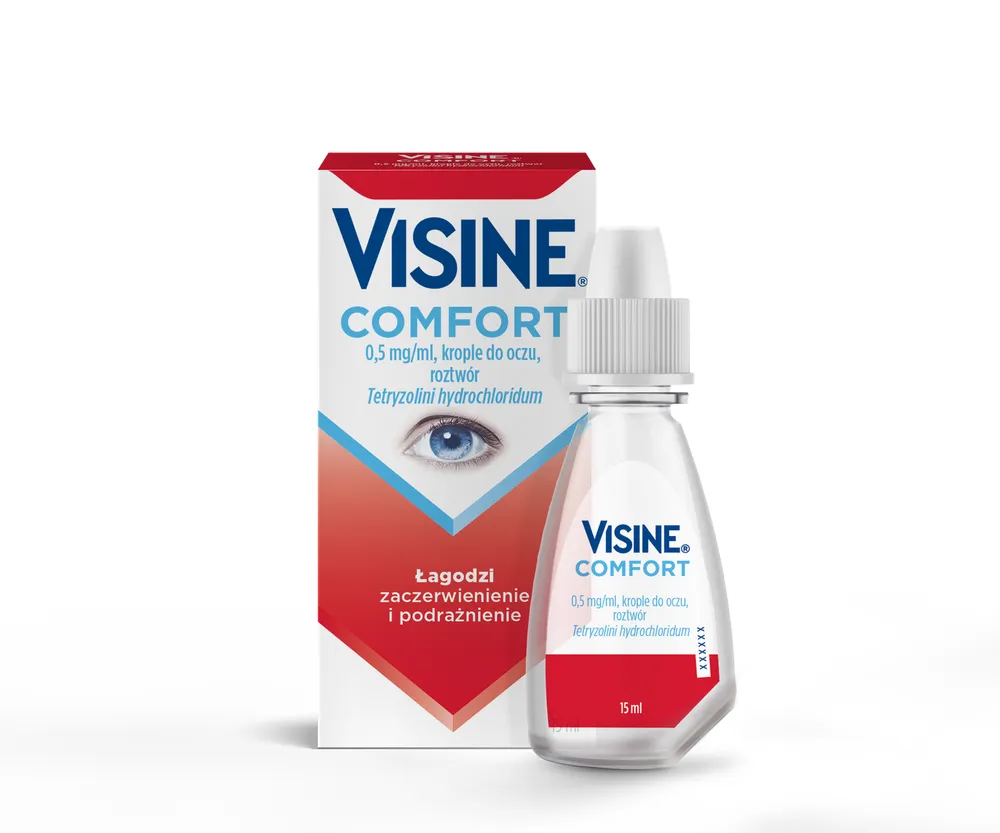
VISINE COMFORT
PolandThe medicine is used for the relief of eye redness caused by minor, non-infectious irritations, such as smoke, dust, wind, chlorinated water, light, or allergies.
Frequently asked questions
How to use Visine Comfort?
Adults, adolescents, and children over 6 years of age should instill 1 or 2 drops into the affected eye(s) 2 to 3 times daily. Children aged 2 to 6 years may use the medicine only after consulting a doctor (the recommended dose is 1 drop 2-3 times daily). The medicine should not be used for more than 3–5 consecutive days.
When should you not use this medicine?
Do not use the preparation if you are allergic to any of the ingredients, have narrow-angle glaucoma, or in children under 2 years of age.
What side effects can Visine Comfort cause?
Common side effects may include eye irritation (pain, stinging, burning), decreased visual acuity, a sensation of burning, or dryness of the mucous membranes. Less commonly, pupil dilation may occur, and very rarely, tearing or conjunctival dryness may occur with prolonged use.
Can contact lenses be worn while using the medicine?
Lenses should be removed before instilling the medicine and should only be reinserted after 15 minutes have passed.
Which medicines should be used with caution when using this preparation?
Avoid simultaneous use with antidepressants (monoamine oxidase inhibitors and tricyclic antidepressants), as this may increase blood pressure. It must not be combined with other medicines containing tetryzoline hydrochloride.
When should you stop use and consult a doctor?
Discontinue use if there is no improvement after 2 days, if redness worsens, if eye pain occurs, if vision changes occur (e.g., double vision, spots), or if loss of vision occurs.
Instructions for use
Patient Information Leaflet
Visine Comfort, 0,5 mg/ml, eye drops, solution
Tetryzolini hydrochloridum
Please read the entire leaflet carefully before using the medicine, as it contains
important information for the patient.
This medicine should always be used exactly as described in this patient leaflet or as directed by a
physician or pharmacist.
- Keep this leaflet for future reference.
- If advice or further information is needed, consult a pharmacist.
- If the patient experiences any adverse reactions, including any adverse reactions not listed in this leaflet, inform a physician or pharmacist. See section 4.
- If there is no improvement after 2 days, or if the patient feels worse, consult a physician.
Table of Contents
- What Visine Comfort is and what it is used for
- Important information before using Visine Comfort
- How to use Visine Comfort
- Possible side effects
- How to store Visine Comfort
- Contents of the pack and other information
1. What Visine Comfort is and what it is used for
Visine Comfort contains tetryzoline hydrochloride as the active substance. It belongs to a group of
medicines used in ophthalmology to reduce eye redness.
Visine Comfort is used for the temporary relief of eye redness caused by minor, non-infectious
irritations due to, for example, smoke, dust, wind, chlorinated water, light, or allergies, in adults,
adolescents, and children aged 2 years and older (see section 2). In children aged 2 years and above but under 6 years of age, Visine Comfort should only be used after consultation with a healthcare professional.
2. Important information before using Visine Comfort
When not to use this medicine:
- if the patient is allergic to tetryzoline hydrochloride or any of the other ingredients of this medicine (listed in section 6),
- if the patient has narrow-angle glaucoma,
- in children under 2 years of age.
Warnings and precautions
Before starting to use Visine Comfort, consult a doctor if the patient has any of the following conditions. It may still be possible to use Visine Comfort, but the patient should first discuss it with a doctor if they have:
- severe cardiovascular diseases (e.g. coronary heart disease, hypertension, pheochromocytoma),
- mild benign prostatic hyperplasia,
- metabolic disorders (e.g. hyperthyroidism, diabetes, disorders of red blood pigment formation),
- atrophic rhinitis (chronic inflammation in the front part of the nose),
- dry eye syndrome (dryness of the conjunctiva and cornea),
- glaucoma (an eye disease in which the optic nerve connecting the eye to the brain becomes damaged).
If there is no improvement within 48 hours, or if redness or irritation persists or worsens, or if changes in vision or eye pain occur, discontinue use and consult a doctor. Irritation or redness due to infection, presence of a foreign body in the eye, or chemical injury to the cornea also require medical consultation. If headache, vision loss, visual disturbances (e.g. appearance of moving spots or double vision), severe acute or unilateral eye redness, or pain upon exposure to light occur, discontinue use and consult a doctor immediately, as these may indicate a serious eye condition for which this product will not be effective.
Care should be taken not to use a higher dose than recommended or to use the medicine for too long (i.e. longer than 3–5 consecutive days), as this may lead to increased eye redness or nasal symptoms.
Transient pupil dilation may occur during treatment with this medicine.
Instructions for contact lens wearers
In general, contact lenses should not be worn during eye diseases. If the patient wears contact lenses, they should be removed before applying the medicine and reinserted only 15 minutes after instillation.
Children
Children under 12 years of age should use this medicine only with the help of an adult.
Children aged over 2 years to below 6 years
Visine Comfort should be used only after consultation with a healthcare professional.
Children under 2 years of age
Do not use in children under 2 years of age.
Visine Comfort and other medicines
Before using this medicine, tell your doctor or pharmacist about all medicines the patient is currently taking or has recently taken, as well as any medicines the patient plans to take, especially other ophthalmic medicines.
Concomitant use of antidepressants known as monoamine oxidase inhibitors or tricyclic antidepressants should be avoided with Visine Comfort, as this may lead to increased blood pressure.
Do not use with other Visine products and/or medicines containing tetryzoline hydrochloride.
Pregnancy, breastfeeding and fertility
Adequate and well-controlled studies on the use of tetryzoline in pregnant or breastfeeding women have not been conducted. If the patient is pregnant or breastfeeding, suspects she may be pregnant, or is planning to become pregnant, she should consult a doctor or pharmacist before using this medicine.
Driving and using machines
After using Visine Comfort, pupil dilation and blurred vision may occur. In such cases, the patient should not drive or operate machinery until vision returns to normal.
Visine Comfort contains phosphates.
The medicine contains 7.5 µg of phosphates per drop. In patients with severe damage to the transparent front part of the eye (cornea), phosphates may very rarely cause corneal clouding due to calcium accumulation during treatment.
3. How to use Visine Comfort
This medicine should always be used exactly as described in this patient information leaflet or as directed by your doctor or pharmacist. If in doubt, consult your doctor or pharmacist.
Children from 6 years, adolescents and adults
Unless otherwise advised by a doctor, instill 1 or 2 drops into the affected eye(s) 2 to 3 times daily. Contact lenses should be removed beforehand (see “Instructions for contact lens wearers”).
Children over 2 years to below 6 years
Visine Comfort should only be used in children aged 2–6 years after consultation with a healthcare professional. If not otherwise indicated, the recommended dose is 1 drop into the affected eye(s) 2 to 3 times daily.
Children under 2 years
Do not use in children under 2 years of age.
Method of administration
Visine Comfort is for ophthalmic use only.
- Before first use, remove the protective cap along the perforation on the neck of the bottle.
- To open the child-resistant cap, press down and turn it counterclockwise.
- After opening the cap, turn the bottle upside down. Tilt the head slightly backward. Gently squeeze the bottle to instill 1 or 2 drops into the conjunctival sac. To avoid contamination, the tip of the bottle should not touch any surface other than the cap. Never touch the eye with the tip of the bottle.
- After instillation, blink gently for several seconds to help distribute the drops evenly.
- Close the cap by turning it clockwise until tight. Never touch the tip of the bottle. Store the bottle in a closed state between uses.
Duration of treatment
Visine Comfort should be used for the shortest duration necessary to relieve symptoms, not longer than 5 consecutive days. Exercise caution with repeated use, as prolonged use (even with short breaks of several days) or excessive use may lead to chronic swelling and/or atrophy of the conjunctiva.
Continuous use may cause rebound redness of the eye. If symptoms do not improve within 2 days, if redness increases or persists, discontinue use and consult your doctor.
Use of a higher than recommended dose of Visine Comfort
When used in the eye, overdose symptoms are unlikely. However, accidental ingestion may lead to serious adverse reactions or poisoning, especially in children.
These serious adverse reactions may include, among others, cardiovascular instability, drowsiness, coma, hypothermia (decreased body temperature), bradycardia (slower heart rate), hypotension (low blood pressure) or arterial hypertension (high blood pressure), shock-like state, apnea, circulatory disturbances, vomiting, salivation, and other systemic effects such as miosis (pupil constriction), lethargy, dryness of mucous membranes, unusual chest pain, increased eye redness, and nasal mucosa redness.
In case of accidental ingestion or suspected accidental ingestion by a child, contact a doctor or pharmacist immediately.
Missed dose of Visine Comfort
Do not use a double dose to make up for a missed dose.
4. Possible adverse effects
Like all medicines, this medicine can cause adverse effects, although they do not occur in everyone.
Rarely (occurring no more frequently than in 1 out of 1,000 people):
- pupil dilation
Very rarely (occurring no more frequently than in 1 out of 10,000 people):
- dryness of the conjunctiva with closure of the lacrimal puncta after prolonged use of tetrahydrozoline
- excessive tearing after prolonged use of tetrahydrozoline
Frequently (occurring no more frequently than in 1 out of 10 people):
- eye irritation (pain, stinging, burning)
- blurred vision
- rebound hyperemia
- mucosal burning sensation
- dryness of mucous membranes
Frequency not known (cannot be estimated from available data):
- increased lacrimation
- eye or periocular burning, redness, irritation, swelling, pain, itching
Reporting of adverse effects
If any adverse effects occur, including any adverse effects not listed in this leaflet, inform your doctor or pharmacist. Adverse effects can be reported directly to the Department of Monitoring Adverse Drug Reactions of the Office for Registration of Medicinal Products, Medical Devices and Biocidal Products: Al. Jerozolimskie 181C, 02-222 Warsaw, phone: 22 49-21-301, fax: 22 49-21-309, website: https://smz.ezdrowie.gov.pl
Adverse effects can also be reported to the marketing authorization holder.
Reporting adverse effects helps to provide more information on the safety of the medicine.
5. How to store Visine Comfort
Keep the medicine out of the sight and reach of children.
Do not use this medicine after the expiry date stated on the label and carton. The expiry date refers to the last day of the stated month.
Store below 30°C.
Discard the medicine 6 weeks after first opening the bottle.
Do not use this medicine if the solution changes colour or becomes cloudy.
Medicines should not be disposed of via wastewater or household waste. Ask your pharmacist how to dispose of medicines no longer required. This will help protect the environment.
6. Contents of the package and other information
What Visine Comfort contains
- Active substance: 1 ml of eye drops contains 0.5 mg of tetrahydrozoline hydrochloride.
- Other ingredients: glycerol, hypromellose, macrogol 400, boric acid, disodium phosphate, sodium citrate, potassium chloride, magnesium chloride hexahydrate, sodium (S)-lactate solution, glycine, ascorbic acid, dextrose monohydrate, poliquaternium 42 solution, purified water.
What Visine Comfort looks like and contents of the pack
Visine Comfort is a clear, colourless or slightly yellow solution for ocular use, free from solid particles.
Visine Comfort is available in 15 ml bottles made of LDPE with an LDPE dropper and a child-resistant closure made of PP/HDPE.
Outer packaging: cardboard box.
Marketing Authorisation Holder and Manufacturer
Marketing Authorisation Holder:
McNeil Healthcare (Ireland) Limited
Block 5, High Street, Tallaght
Dublin 24
Ireland
Manufacturers:
Janssen Pharmaceutica N.V.
Turnhoutseweg 30
B-2340 Beerse
Belgium
Kenvue Germany GmbH
Johnson & Johnson Platz 2
41470 Neuss
Germany
This medicinal product is authorised in the European Economic Area member states under the following trade names:
Germany Visine Yxin Hydro
Bulgaria Visine Novo
Croatia Visiklear
Cyprus Vispring Advance
Czech Republic Visine Rapid
Estonia Visine
Greece Vispring Advance
Hungary Visine Rapid
Latvia Visine
Lithuania Visine
Poland Visine Comfort
Portugal Visine
Romania Visine Novo
Slovakia Visine Rapid
Slovenia Visiklear
Spain Vispring
Similar drugs
| Brand name | Dosage form | Active substance / Dosage | Manufacturer |
|---|---|---|---|
| STARAZOLIN FREE | drops, ophthalmic solution |
|
Jadran-Galenski Laboratorij d.d. |
| STARAZOLIN REDFREE | drops, ophthalmic solution |
|
Jadran-Galenski Laboratorij d.d. |
| VISINE CLASSIC | drops, ophthalmic solution |
|
Johnson & Johnson Hellas Consumer AE |
The original data is available in the language of the country of manufacture.
Data source: Register of Medicinal Products of Poland (URPL)
Data last verified: September 01, 2026