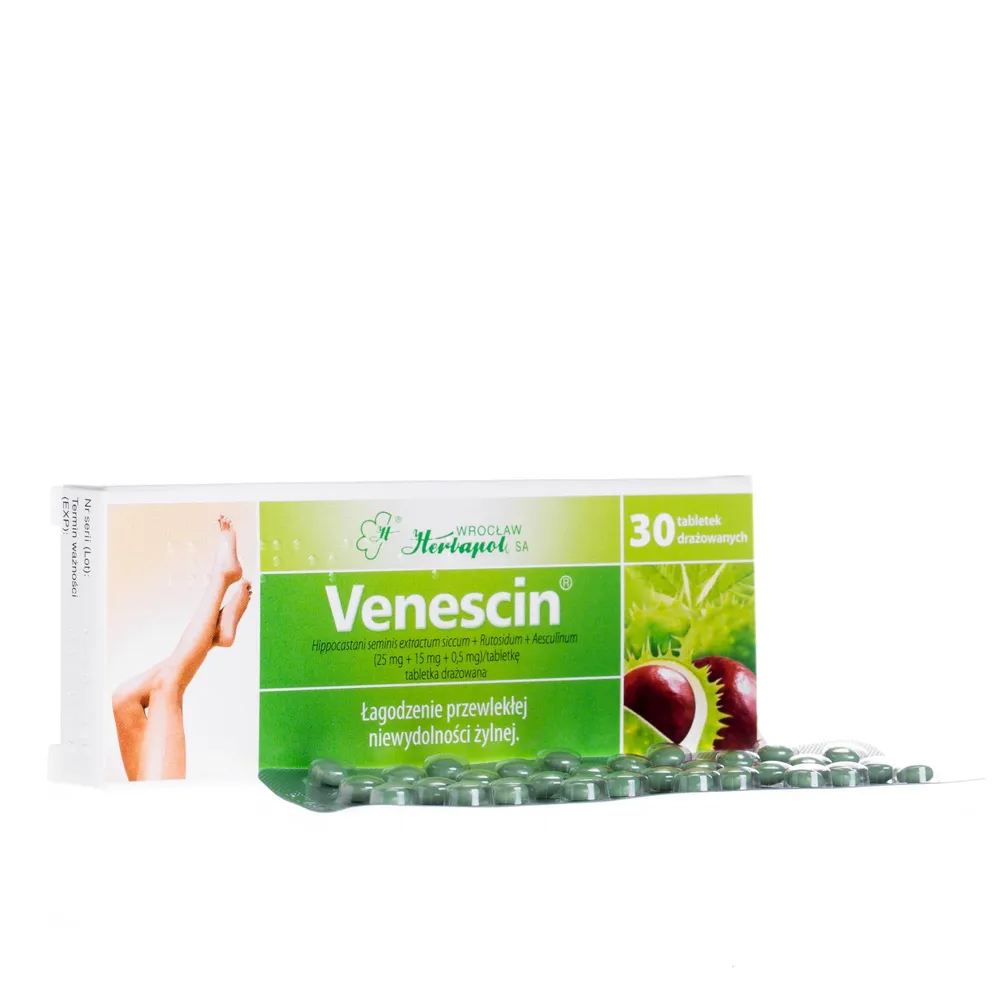
VENESIN
PolandThe medicine is used to relieve the symptoms of chronic venous insufficiency.
Frequently asked questions
How should Venescin be used?
Adults should take 2 film-coated tablets 3 times daily by mouth. Do not take a double dose to make up for a missed dose.
When should you not take this medicine?
Do not use this medicine if you are allergic to the active substances or any of the other ingredients (e.g., gum arabic) and during the first trimester of pregnancy. It should also not be used in children and adolescents under 18 years of age.
Can the medicine be used during pregnancy or breastfeeding?
It must not be used during the first trimester of pregnancy. During the remainder of pregnancy and during breastfeeding, the preparation may be used only if a doctor considers that the benefit to the mother outweighs the risk to the fetus.
What are the possible side effects?
Gastrointestinal problems, such as nausea or abdominal pain, may occur rarely. In such cases, treatment should be discontinued and a doctor should be consulted.
Should caution be exercised when taking other medicines?
Yes, you should inform your doctor or pharmacist about all medicines you are currently taking or have taken recently, as well as any medicines you plan to take.
What should I do if I do not feel any improvement after 21 days?
If symptoms do not subside, no improvement occurs, or you feel worse after 21 days, you should contact a doctor.
Instructions for use
Package leaflet: Information for the patient
VENESCIN
Hippocastani seminis extractum siccum + Rutosidum trihydricum + Aesculinum
(25 mg + 15 mg + 0.5 mg) per tablet, film-coated tablets
Please read all of this leaflet carefully before taking this medicine because it contains
important information for you.
This medicine should always be taken exactly as described in this patient leaflet or as directed by
your doctor or pharmacist.
- Keep this leaflet so that you can read it again if necessary.
- If you need advice or further information, please consult your pharmacist. If you experience any adverse reactions, including any possible adverse reactions not listed in this leaflet, inform your doctor or pharmacist. See section 4.
- If symptoms worsen, do not improve, or if you feel worse after 21 days, you should contact your doctor.
Contents of the leaflet
- What Venescin is and what it is used for
- Important information before taking Venescin
- How to take Venescin
- Possible side effects
- How to store Venescin
- Contents of the pack and other information
1. What Venescin is and what it is used for
Venescin is a medicinal product containing dry extract of horse chestnut seed, rutosid trihydrate, and aesculin. It is believed that the use of this product increases venous tone and reduces permeability while increasing the mechanical resistance of capillaries.
The medicine is used to relieve symptoms of chronic venous insufficiency.
If there is no improvement after 21 days or if you feel worse, consult your doctor.
2. Important information before taking Venescin
When not to take Venescin
- if you are allergic to the active substances or to any of the other ingredients of this medicine (listed in section 6), e.g. acacia gum,
- during the first trimester of pregnancy.
Warnings and precautions
Each film-coated tablet of Venescin contains 34.49 mg of sucrose.
If you have previously been diagnosed with intolerance to certain sugars, you should consult your doctor before taking this medicine.
Children and adolescents
Do not use this medicine in children and adolescents under 18 years of age.
Venescin with other medicines
Tell your doctor or pharmacist if you are taking, have recently taken, or plan to take any other medicines.
Use of Venescin in children
This medicine should not be used in children.
Pregnancy, breastfeeding and fertility
Do not use during the first trimester of pregnancy. Due to lack of studies confirming safety during the remainder of pregnancy and during breastfeeding, the product should be used only if, in the opinion of the doctor, the benefit to the mother outweighs the potential risk to the fetus.
The effect on fertility is unknown.
Driving and operating machinery
No adverse effect of Venescin on the ability to drive or operate machinery has been observed.
3. How to use Venescin
This medicine should always be used exactly as described in this patient leaflet or as directed by a doctor or pharmacist. If in doubt, consult a doctor or pharmacist.
Oral use.
Adults
2 film-coated tablets three times daily.
Children and adolescents
Do not use this medicine in children and adolescents under 18 years of age.
Use of a higher than recommended dose of Venescin
Symptoms of overdose are unknown.
Missed dose of Venescin
Do not take a double dose to make up for a missed dose.
4. Possible adverse effects
Like all medicines, this product may cause adverse effects, although not everyone experiences them.
The adverse effects of this medicine are listed according to MedDRA system organ class and frequency of occurrence:
rare – adverse effects may occur in 1 to 10 out of 10,000 patients using the medicine.
When using the medicinal product Venescin, the following may occur:
- Gastrointestinal disorders (nausea, abdominal pain) – rare. If adverse symptoms occur, treatment should be discontinued and if symptoms persist, medical advice should be sought.
Reporting of adverse effects
If any adverse effects occur, including any not listed in this leaflet, inform your doctor or pharmacist. Adverse effects can be reported directly to the Department of Monitoring Adverse Drug Reactions of the Office for Registration of Medicinal Products, Medical Devices and Biocidal Products, Al. Jerozolimskie 181 C, 02-222 Warsaw, phone: +48 22 49-21-301, fax: +48 22 49-21-309, e-mail: [email protected]. Adverse effects can also be reported to the marketing authorization holder. Reporting adverse effects helps to improve the safety information regarding this medicine.
5. How to store Venescin
Keep the medicine at a temperature not exceeding 25°C, in a place out of sight and reach of children.
Do not use this medicine after the expiry date stated on the blister or carton.
The expiry date refers to the last day of the specified month.
Medicines must not be disposed of via wastewater or household waste. Ask your pharmacist how to dispose of medicines no longer required. This will help protect the environment.
6. Contents of the packaging and other information
What Venescin contains
The active substances in the medicine are:
Dry extract of horse chestnut seeds (Hippocastani seminis extractum siccum) (5.5-8:1),
containing on average 22% triterpene saponins, expressed as anhydrous escin – 25 mg;
extraction solvent: ethanol 70% (V/V),
Rutoside trihydrate (Rutosidum trihydricum) – 15 mg,
Aesculin (Aesculinum (6-glucoside of 6,7-dihydrocoumarin)) – 0.5 mg.
Excipients: potato starch, magnesium stearate, rosin, castor oil, gum arabic, talc, sucrose, indigotine (E 132), quinoline yellow (E 104).
What Venescin looks like and contents of the pack
Al/PVC foil blister in a cardboard box with patient information leaflet. The blister contains 30 coated tablets.
Marketing authorization holder and manufacturer
Wrocławskie Zakłady Zielarskie „Herbapol” S.A.
50-951 Wrocław, ul. Św. Mikołaja 65/68
Tel: +48 71 33 57 225
Fax: +48 71 37 24 740
E-mail: [email protected]
For further information about this medicine, please contact the marketing authorization holder at tel. 71 321 86 04 ext. 123
Similar drugs
| Brand name | Dosage form | Active substance / Dosage | Manufacturer |
|---|---|---|---|
| VENESICIN FORTE | tablets, coated |
|
Wroclaw Herbal Works "Herbapol" S.A. |
The original data is available in the language of the country of manufacture.
Data source: Register of Medicinal Products of Poland (URPL)
Data last verified: September 01, 2026