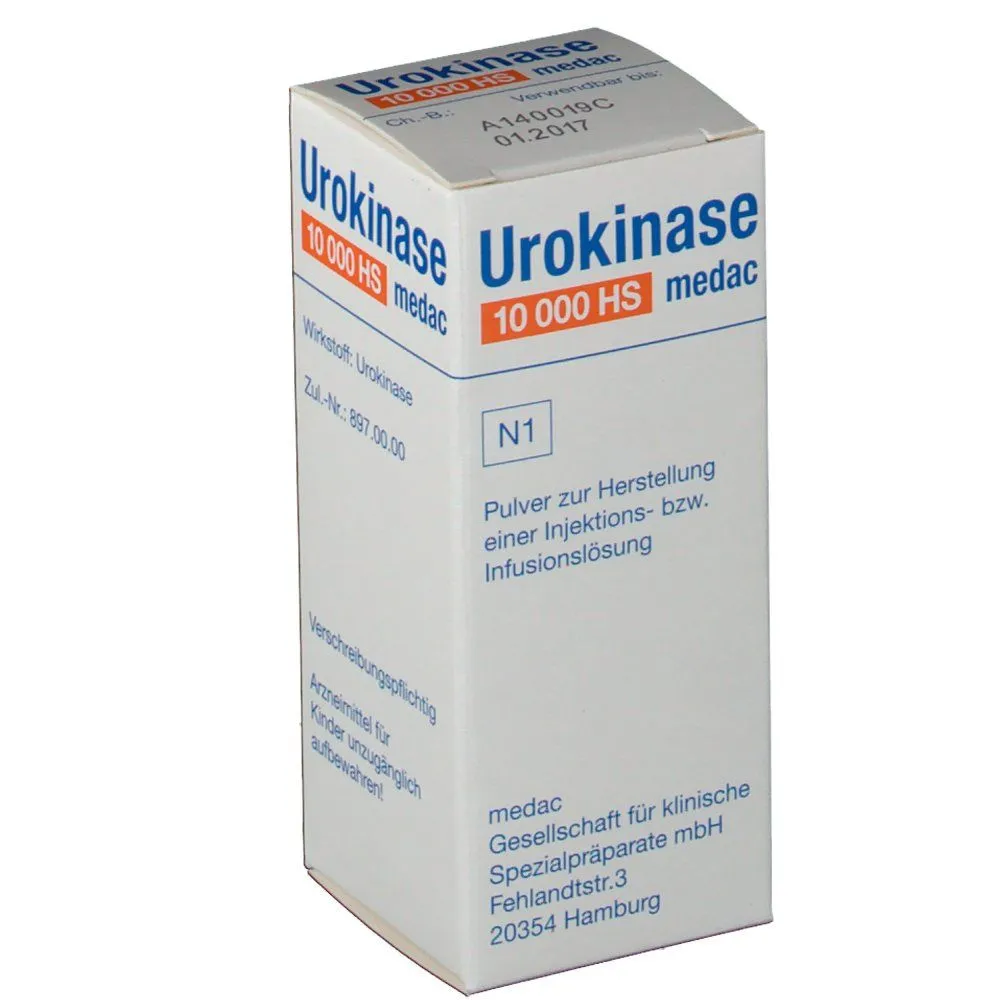
UROKINASE MEDAC
PolandThe medicine helps to dissolve blood clots located in the lungs, deep veins, peripheral arteries, as well as in central venous catheters and arteriovenous fistulas for hemodialysis.
Frequently asked questions
How should Urokinase medac be administered?
The medicine is administered by a doctor or nurse via intravenous injection, directly into an artery, or into a catheter, depending on the purpose of the treatment. It must never be injected into muscles or subcutaneously.
When should you not use this medicine?
It must not be used if there is bleeding, vascular malformations, a tumor with a risk of bleeding, blood clotting problems, or if you are taking anticoagulants. Contraindications also include severe uncontrolled hypertension, pancreatitis, pericarditis, recent stroke (within the last 2 months), or recent major surgery.
Can this medicine be used with other preparations?
You should inform your doctor about all medicines you are taking, especially if you are using heparin, aspirin, non-steroidal anti-inflammatory drugs (NSAIDs), dextrans, or contrast media.
What are the possible side effects of Urokinase medac?
The most common side effects may include bleeding (e.g., from the injection site, nose, gums, or blood in the urine) and changes in blood test results. Other possible symptoms include fever, chills, nausea, vomiting, back pain, or breathing problems. Any spontaneous bleeding and symptoms of an allergic reaction, such as facial swelling, rash, or chest tightness, should be reported to a doctor immediately.
Can the medicine be used during pregnancy or breastfeeding?
The medicine should not be used during pregnancy or immediately after childbirth unless clearly necessary. Breastfeeding should be avoided during therapy, as it is unknown whether the active substance passes into breast milk.
Is the medicine safe for children?
The medicine can be used in children to clear venous catheters; however, its use in children to dissolve clots in peripheral arteries is not recommended due to limited experience.
Instructions for use
Package leaflet: Information for the user
Urokinase medac, 10,000 IU, powder for solution for injection or infusion
Urokinase medac, 50,000 IU, powder for solution for injection or infusion
Urokinase medac, 100,000 IU, powder for solution for injection or infusion
Urokinase medac, 250,000 IU, powder for solution for injection or infusion
Urokinase medac, 500,000 IU, powder for solution for injection or infusion
Urokinasum
Please read this leaflet carefully before using this medicine because it contains important information for you.
- Keep this leaflet. You may need to read it again.
- If you have any further questions, ask your doctor or pharmacist.
- This medicine has been prescribed for a specific individual. Do not pass it on to others. It may harm them, even if their symptoms are the same.
- If you experience any side effects, including any not listed in this leaflet, tell your doctor or pharmacist. See section 4.
Leaflet contents:
- What Urokinase medac is and what it is used for
- Important information before using Urokinase medac
- How to use Urokinase medac
- Possible side effects
- How to store Urokinase medac
- Contents of the pack and other information
1. What Urokinase medac is and what it is used for
The name of the medicine is Urokinase medac. The active substance is urokinase, which helps dissolve blood clots in:
- lungs
- deep veins
- peripheral arteries (e.g. in the legs)
- central venous catheters (catheters placed in large veins in the neck, chest, or groin) and arteriovenous dialysis fistulas (surgically created connections between an artery and a vein used for blood filtration during dialysis)
2. Important information before using Urokinase medac
Urokinase medac is administered by a doctor or nurse experienced in this type of therapy.
The patient will not be asked to self-administer the medication.
When not to use Urokinase medac
- if the patient is allergic to urokinase or any of the other ingredients of this medicine (listed in section 6)
- if the patient is currently experiencing bleeding
- if the patient has vascular malformations
- if the patient has a tumor with a risk of bleeding
- if the patient has blood clotting disorders or is taking anticoagulant (blood-thinning) medicines
- if the patient has severe uncontrolled hypertension
- if the patient has pancreatitis, pericarditis, or any other acute infection
- if the patient has had a stroke within the last 2 months
- if the patient has recently undergone a major surgical procedure or procedures such as lumbar puncture
Warnings and precautions
Exercise particular caution when using Urokinase medac
- if the patient has recently experienced gastrointestinal bleeding
- if the patient has recently undergone surgery other than cardiac or neurosurgical procedures, recent childbirth, or puncture of non-compressible vessels
- if the patient has cystic lung diseases
- if the patient has urinary tract diseases that may lead to bleeding (e.g. urinary catheter placement)
- if the patient has heart problems, particularly mitral valve disease, or arrhythmias such as atrial fibrillation
- if the patient has severe liver or kidney disease
- if the patient is pregnant
- if the patient has severe vascular disease, particularly cerebral
- if the patient is elderly, especially over 75 years of age
In such circumstances, the doctor will decide whether to administer Urokinase medac to the patient.
During treatment with Urokinase medac, the doctor will exercise special caution if blood tests, intramuscular injections, or any other medical procedures associated with a high risk of bleeding (such as arterial procedures) are being performed on the patient.
Children
There is very limited experience with the use of urokinase for dissolving blood clots in peripheral arteries (e.g. in the legs) in children. Therefore, urokinase should not be used in such cases.
Urokinase medac and other medicines
Inform your doctor or pharmacist about all medicines currently used or recently used, including those obtained without a prescription, and especially if the patient is taking any of the following medicines:
- heparin, dipyridamole, and other anticoagulants or agents affecting coagulation
- acetylsalicylic acid (aspirin)
- non-steroidal anti-inflammatory drugs (NSAIDs)
- dextrans
- contrast agents
Pregnancy and breastfeeding
If the patient is pregnant or breastfeeding, suspects she may be pregnant, or is planning to have a child, she should consult her doctor or pharmacist before using this medicine.
Urokinase medac should not be used during pregnancy or immediately after delivery unless clearly necessary.
It is unknown whether urokinase passes into breast milk. For this reason, breastfeeding should be avoided during treatment with Urokinase medac.
Driving and operating machinery
The use of Urokinase medac has no relevant influence on the ability to drive or operate machinery.
3. How to use Urokinase medac
This medicine should always be used exactly as prescribed by the doctor. The doctor will determine the dose and duration of treatment with Urokinase medac depending on the indication. Urokinase medac must never be injected into muscle or under the skin.
- If the patient has blood clots in the lungs or deep veins, Urokinase medac should be administered intravenously (usually into an arm vein) over several hours for up to 3 days. After dissolution of the clots, the patient may begin anticoagulant (blood-thinning) therapy to prevent recurrence.
- If the patient has arterial clots, Urokinase medac should be administered directly into the artery until the clot dissolves.
- If a central venous catheter is blocked by a clot, Urokinase medac should be injected directly into the catheter and left in place for one hour before removing the fluids. This procedure may be repeated multiple times if necessary.
- If an arteriovenous fistula for hemodialysis is blocked by a clot, Urokinase medac should be infused into both branches of the fistula. This procedure may be repeated multiple times if necessary.
Use in children
Urokinase medac may be used in children of any age for the treatment of central venous catheters blocked by clots, using the same procedures as in adult patients.
If there are any further questions about the use of this medicine, consult a doctor or nurse.
4. Possible adverse reactions
Like all medicines, this medicine can cause adverse reactions, although not everyone will experience them.
The medicine Urokinase medac may in rare cases cause serious adverse reactions.
You must inform the doctor immediately if the patient experiences:
- any spontaneous bleeding, as urokinase increases the risk of bleeding.
- symptoms of allergic reaction/hypersensitivity such as
- chest tightness or breathing difficulties
- eyelid, facial or lip swelling
- skin rash or lumps, itching
- fainting (drop in blood pressure) or bluish discoloration of skin (cyanosis)
Other adverse reactions may occur:
Some patients may experience hot or cold flushes (fever or chills), nausea and
vomiting, back pain or shortness of breath within one hour after starting the infusion.
Very common (occurred in more than 1 in 10 patients)
- bleeding
- abnormal bleeding, especially at injection sites or wounds
- small amount of blood in urine
- nosebleeds
- bleeding from gums
- bruising
- changes in blood test results
Common (occurred in less than 1 in 10 patients and more than 1 in 100)
- fever
- chills
- haemorrhages (in brain, stomach, urine, muscles)
- small fragments of clots or cholesterol crystals may detach and travel with the blood causing blockages elsewhere.
Uncommon (occurred in less than 1 in 100 patients and more than 1 in 1000)
- haemorrhage in the liver
Reporting of adverse reactions
If any adverse reactions occur, including any not listed in this leaflet, inform a doctor or pharmacist. Adverse reactions can be reported
directly to the Department of Monitoring of Adverse Drug Reactions of the Office for Registration of Medicinal Products, Medical Devices and Biocidal Products:
Al. Jerozolimskie 181C, PL-02-222 Warsaw, Tel.: +48 22 49-21-301, Fax: +48 22 49-21-309, Website: https://smz.ezdrowie.gov.pl
Adverse reactions can also be reported to the marketing authorization holder.
Reporting adverse reactions helps to provide more information on the safety of the medicine.
5. How to store Urokinase medac
Keep the medicine out of the sight and reach of children.
Store below 25 °C.
Keep in the original packaging to protect from light.
Do not use this medicine after the expiry date stated on the label. The expiry date refers to the last day of the stated month.
Do not use Urokinase medac if the powder in the vial is not white.
Chemical and physical in-use stability has been demonstrated for 72 hours at both room temperature and at 5 °C ± 3 °C, after reconstitution and further dilution with sodium chloride solution 9 mg/ml (0.9%) for injection.
From a microbiological point of view, the product should be used immediately after reconstitution and dilution. If not used immediately, the user is responsible for the storage duration and conditions prior to use, and these should generally not exceed 24 hours at a temperature of 2°C to 8°C, unless reconstitution and dilution were carried out under controlled and validated aseptic conditions.
Due to the loss of urokinase activity, the solution should be used immediately after reconstitution and further dilution with 5% or 10% glucose solution.
6. Contents of the pack and other information
What Urokinase medac contains
The active substance is human urokinase.
The other ingredients are: disodium hydrogen phosphate dodecahydrate, sodium dihydrogen phosphate dihydrate, human albumin.
What Urokinase medac looks like and contents of the pack
Each vial contains a white powder for solution for injection or infusion.
Each pack contains one vial. Urokinase medac is available in different strengths:
10,000 IU, 50,000 IU, 100,000 IU, 250,000 IU, 500,000 IU.
Not all strengths of the product may be marketed.
Marketing Authorisation Holder and Manufacturer
Pharma-Zentrale GmbH
Loerfeldstraße 20
58313 Herdecke
Germany
Similar drugs
| Brand name | Dosage form | Active substance / Dosage | Manufacturer |
|---|---|---|---|
| UROKINASE MEDAC | powder for preparation of solution for injection or infusion |
|
medac GmbH for Clinical Special Preparations |
| UROKINASE MEDAC | powder for preparation of solution for injection or infusion |
|
medac GmbH for Clinical Special Preparations |
| UROKINASE MEDAC | powder for preparation of solution for injection or infusion |
|
medac GmbH for Clinical Special Preparations |
| UROKINASE MEDAC | powder for preparation of solution for injection or infusion |
|
medac GmbH for Clinical Special Preparations |
The original data is available in the language of the country of manufacture.
Data source: Register of Medicinal Products of Poland (URPL)
Data last verified: September 01, 2026