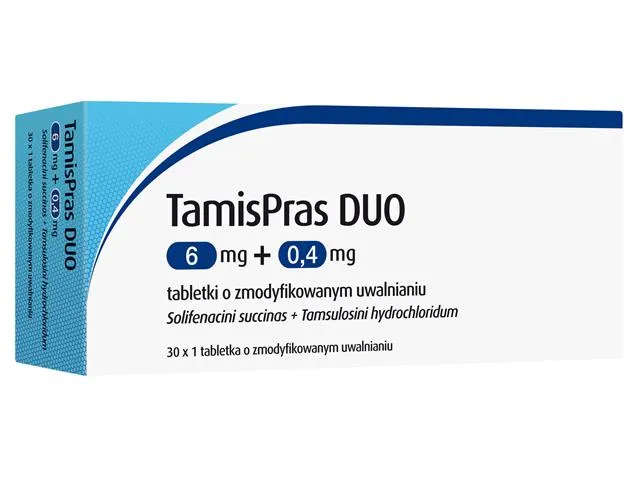
TAMISPRAS DUO
PolandIt is used in men to treat moderate to severe bladder and prostate enlargement (benign prostatic hyperplasia) symptoms. It helps, among other things, with problems starting urination, a weak urine stream, frequent urination, and sudden urgency to urinate.
Frequently asked questions
How should TamisPras DUO be taken?
The maximum dose is one tablet daily, taken orally. It can be taken with or without food. It is important not to crush or chew the tablet.
When should you not use this medicine?
You should not take it if you have an allergy to any of the ingredients, severe liver or kidney disease, kidney dialysis, severe stomach or intestinal disease, myasthenia gravis, glaucoma with progressive vision loss, or orthostatic hypotension (dizziness when changing body position).
What are the possible side effects of TamisPras DUO?
Common side effects may include: dizziness, blurred vision, dry mouth, constipation, nausea, fatigue, and ejaculation disorders. Other possible symptoms include headache, drowsiness, palpitations, or urinary tract infections. In rare cases, acute urinary retention or allergic reactions may occur.
Does the medicine interact with other agents?
Yes, you must inform your doctor about all medications you are taking. Particular caution should be exercised when using medicines such as ketoconazole, erythromycin, ritonavir, nelfinavir, itraconazole, verapamil, diltiazem, paroxetine, anticholinergic drugs, cholinergic drugs, alpha-blockers, and bisphosphonates.
Does the medicine affect driving?
The medicine may cause dizziness, blurred vision, fatigue, or drowsiness; therefore, if these symptoms occur, you should not drive vehicles or operate machinery.
Instructions for use
Package leaflet: Information for the user
TamisPras DUO, 6 mg + 0.4 mg, modified release tablets
Solifenacini succinas + Tamsulosini hydrochloridum
Please read all of this leaflet carefully before taking this medicine, because it contains
important information for you.
Keep this leaflet, as you may need to read it again.
If you have any further questions, please ask your doctor or pharmacist.
This medicine has been prescribed for a specific individual. Do not pass it on to others. It may harm
other people, even if their symptoms are the same.
If you experience any adverse reactions, including any not listed in this leaflet, inform your doctor or
pharmacist immediately. See section 4.
Contents of the leaflet:
- What TamisPras DUO is and what it is used for
- What you need to know before taking TamisPras DUO
- How to take TamisPras DUO
- Possible side effects
- How to store TamisPras DUO
- Contents of the pack and other information
1. What TamisPras DUO is and what it is used for
TamisPras DUO is a combination of two different medicines, called solifenacin and tamsulosin, in one tablet. Solifenacin belongs to a group of medicines known as anticholinergics, and tamsulosin belongs to a group of medicines known as alpha-blockers (alpha-adrenolytics).
TamisPras DUO is used in men for the treatment of moderate to severe lower urinary tract symptoms related to both bladder filling and bladder emptying phases, caused by bladder disorders and enlargement of the prostate gland (benign prostatic hyperplasia). TamisPras DUO is used when previous treatment with a single-component medicine for the same condition has not provided the expected improvement.
Enlargement of the prostate gland may lead to problems with urination (symptoms related to the emptying phase), such as difficulty starting urination, difficulty in passing urine (a weak urine stream), dribbling after urination, or a feeling of incomplete bladder emptying. At the same time, the urinary bladder becomes irritated and contracts spontaneously, even when the patient does not intend to empty it. This results in symptoms related to the bladder filling phase, such as changes in the sensation of bladder filling, urgency (a sudden and strong need to pass urine without prior warning), and the need to urinate more frequently.
Solifenacin reduces unwanted contractions of the urinary bladder and increases the volume of urine that can be stored in the bladder. As a result, the patient may need to use the toilet less often. Tamsulosin improves urine flow through the urethra and facilitates urination.
2. Important information before using TamisPras DUO
When not to use TamisPras DUO:
if the patient is allergic to solifenacin or tamsulosin or any of the other
ingredients of this medicine (listed in section 6).
if the patient is undergoing renal dialysis.
if the patient has severe liver disease.
if the patient has severe kidney disease AND at the same time is taking
medicines that may slow down the elimination of TamisPras DUO from the body (for example,
ketoconazole, ritonavir, nelfinavir, itraconazole). The doctor or pharmacist will inform the patient whether this applies.
if the patient has moderate liver disease AND at the same time is taking
medicines that may slow down the elimination of TamisPras DUO from the body (for
example, ketoconazole, ritonavir, nelfinavir, itraconazole). The doctor or pharmacist will inform
the patient whether this applies.
if the patient has severe stomach or intestinal disease (including toxic megacolon, a complication of ulcerative colitis).
if the patient has a muscle disorder called myasthenia gravis, which may cause extreme
weakness of certain muscles.
if the patient has increased intraocular pressure (glaucoma), with progressive loss of
vision.
if the patient experiences fainting due to a sudden drop in blood pressure upon changing body position (when sitting or standing up); this is known as orthostatic hypotension.
Inform the doctor if the patient has any of the conditions listed above.
Warnings and precautions
Before starting treatment with TamisPras DUO, discuss the following with the doctor or pharmacist:
if the patient is unable to urinate (urinary retention).
if the patient has any gastrointestinal obstruction.
if the patient is at risk of reduced gastrointestinal motility (peristalsis of the stomach and intestines). The doctor will inform the patient whether this applies.
if the patient has a displacement of part of the stomach (hiatal hernia), has heartburn, and/or is taking medicines that may cause or worsen oesophagitis.
if the patient has a certain type of nervous system disorder (autonomic neuropathy).
if the patient has severe kidney disease.
if the patient has moderately severe liver disease.
Regular follow-up examinations are necessary to monitor the patient's condition for which treatment was initiated.
TamisPras DUO may affect blood pressure, resulting in dizziness, lightheadedness, or rarely fainting (orthostatic hypotension). If the patient experiences any of these symptoms, they should sit or lie down and wait until the symptoms subside.
If the patient is undergoing or scheduled for eye surgery due to cataracts (clouding of the eye lens) or elevated intraocular pressure (glaucoma), inform the ophthalmologist that TamisPras DUO has been used in the past, is currently being used, or is planned for use. This will allow the specialist to take appropriate precautions during treatment and surgical procedures. Consult the doctor whether, in connection with eye surgery due to cataracts or increased intraocular pressure (glaucoma), starting treatment with TamisPras DUO should be postponed or its use temporarily discontinued.
Children and adolescents
This medicine must not be used in children and adolescents.
TamisPras DUO and other medicines
Inform the doctor or pharmacist about all medicines the patient is currently taking or has recently taken, as well as any medicines the patient plans to take.
It is especially important to inform the doctor if the patient is taking:
medicines such as ketoconazole, erythromycin, ritonavir, nelfinavir, itraconazole, verapamil, diltiazem, and paroxetine, which slow down the elimination of TamisPras DUO from the body.
other anticholinergic medicines, as the effects of both medicines and their adverse reactions could be intensified when medicines from the same group are used concomitantly.
cholinergic medicines, as they may reduce the effect of TamisPras DUO.
medicines such as metoclopramide and cisapride, which accelerate gastrointestinal motility. TamisPras DUO may reduce their effectiveness.
other alpha-receptor blockers, as this could lead to an undesirable sudden drop in blood pressure.
medicines such as bisphosphonates, as they may cause or worsen oesophagitis.
TamisPras DUO with food and drink
TamisPras DUO can be taken with or without food, according to the patient's preference.
Pregnancy, breastfeeding and fertility
TamisPras DUO is not indicated for use in women.
Cases of abnormal ejaculation (ejaculation disorders) have been reported in men. This means that semen does not exit externally through the urethra but enters the urinary bladder (retrograde ejaculation), or the volume of semen is reduced, or there is no ejaculation (anejaculation). These symptoms are not harmful.
Driving and operating machinery
TamisPras DUO may cause dizziness, blurred vision, fatigue, and, less frequently, somnolence. If the patient experiences any of these adverse effects, they should not drive or operate machinery.
TamisPras DUO contains sodium
This medicine contains less than 1 mmol (23 mg) of sodium per tablet, meaning the medicine is considered "sodium-free".
3. How to use TamisPras DUO
This medicine should always be taken according to the instructions given by your doctor or pharmacist. If you are unsure,
you should consult your doctor or pharmacist.
The maximum daily dose is one tablet containing 6 mg of solifenacin and 0.4 mg of tamsulosin,
taken orally. The tablet may be taken with or without food, according to patient preference.
Do not crush or chew the tablet.
Taking more TamisPras DUO than recommended
If you take more tablets than prescribed, or if someone accidentally ingests the tablets,
you should immediately contact a doctor, pharmacist, or go to a hospital.
In case of overdose, the doctor may administer activated charcoal; gastric lavage may be helpful
if performed within 1 hour after the overdose. Do not induce vomiting.
Symptoms of overdose may include: dry mouth, dizziness, blurred vision,
perceiving things that are not actually present (hallucinations), excessive excitement,
seizures, difficulty breathing, rapid heartbeat (tachycardia), inability to completely or partially empty the bladder or pass urine (urinary retention), and (or) undesirable lowering of blood pressure.
Missing a dose of TamisPras DUO
Take the next dose of TamisPras DUO at the usual time. Do not take a double dose to make up for a missed tablet.
Stopping treatment with TamisPras DUO
If the patient stops taking TamisPras DUO, symptoms may return or worsen.
Always consult your doctor if you are considering stopping treatment.
If you have any further questions about the use of this medicine, consult your doctor or pharmacist.
4. Possible adverse effects
Like all medicines, this medicine can cause adverse effects, although not everyone will experience them.
The most serious adverse effect observed not commonly (may affect up to 1 in
100 men) during treatment with solifenacin succinate in combination with tamsulosin
hydrochloride in clinical trials is acute urinary retention, meaning sudden
inability to pass urine. If a patient suspects this condition, they should immediately
consult a doctor. It may be necessary to discontinue treatment with TamisPras DUO.
Allergic reactions may occur during treatment with solifenacin succinate and tamsulosin hydrochloride:
- Not commonly occurring symptoms of allergic reactions may include skin rash (which may be itchy) or urticaria.
- Rarely occurring symptoms may include swelling of the face, lips, mouth, tongue or throat, which may cause difficulty in swallowing or breathing (angioedema). Angioedema has been reported rarely with tamsulosin and very rarely with solifenacin. If angioedema occurs, treatment with TamisPras DUO must be immediately discontinued and the medicine must not be taken again.
If a patient experiences sudden allergic symptoms or a severe skin reaction (e.g. blistering of the skin or skin peeling), a doctor must be informed immediately and treatment with solifenacin succinate and tamsulosin hydrochloride must be discontinued. Appropriate treatment and (or) other necessary measures should be initiated.
Common adverse effects (may affect more than 1 in 10 men)
dizziness
blurred vision
dry mouth, indigestion, constipation, nausea, abdominal pain
abnormal ejaculation (ejaculation disorders). This means that semen does not exit through the urethra but enters the bladder (retrograde ejaculation), or the volume of semen is reduced or ejaculation does not occur at all. These symptoms are not harmful.
fatigue (tiredness)
Uncommon adverse effects (may affect up to 1 in 100 men)
urinary tract infection, bladder infection (cystitis)
drowsiness (somnolence), taste disturbances (dysgeusia), headache
dry eyes
fast or irregular heartbeat (palpitations)
dizziness or weakness, especially when standing up (orthostatic hypotension)
catarrh or stuffy nose (nasal mucosal inflammation), dry nose
gastroesophageal reflux disease (gastroesophageal reflux), diarrhoea, dry throat,
nausea (vomiting)
itching (pruritus)
difficulty passing urine
fluid accumulation in the lower limbs (oedema), fatigue (asthenia)
Rare adverse effects (may affect up to 1 in 1,000 men)
feeling faint (fainting)
accumulation of hard stool in the large intestine (faecal impaction)
skin allergy leading to swelling in the tissue just beneath the skin surface (angioedema)
Very rare adverse effects (may affect up to 1 in 10,000 men)
hallucinations, disorientation
rash, inflammation and blistering of the skin and (or) mucous membranes of the lips, eyes, mouth, nasal passages or genital organs (Stevens-Johnson syndrome), allergic skin reactions (erythema multiforme)
prolonged and painful erection (usually not associated with sexual activity) (priapism)
Frequency not known (frequency cannot be estimated from available data)
severe allergic reaction causing difficulty in breathing or dizziness (anaphylactic reaction)
decreased appetite, high blood potassium levels (hyperkalemia), which may cause heart rhythm disturbances
rapid decline in consciousness and general mental functioning (delirium)
during eye surgery due to cataract or elevated intraocular pressure (glaucoma), the pupil (black area in the center of the eye) may not dilate properly. Also, the iris (colored part of the eye) may become floppy during surgery.
increased eye pressure (glaucoma), vision disturbances
irregular or unusual heartbeat (QT interval prolongation, torsade de pointes ventricular tachycardia, atrial fibrillation, arrhythmia), rapid heartbeat (tachycardia)
shortness of breath, voice disturbances, nosebleeds (epistaxis)
intestinal obstruction (ileus), abdominal discomfort
liver function abnormalities
skin inflammation causing redness and peeling of the skin over large areas of the body (exfoliative dermatitis)
muscle weakness
kidney function disorders
Reporting of adverse effects
If any adverse effects occur, including any adverse effects not listed
in this leaflet, inform your doctor or pharmacist. Adverse effects can be reported
directly to the Department of Monitoring Adverse Drug Reactions of the Office for Registration of Medicinal Products, Medical Devices and Biocidal Products, Al. Jerozolimskie 181C, 02-222 Warsaw, tel.: +48 22 49 21 301, fax: +48 22 49 21 309, website:
https://smz.ezdrowie.gov.pl
Adverse effects can also be reported to the marketing authorization holder.
Reporting adverse effects helps to provide more information on the safety of the medicine.
5. How to store TamisPras DUO
Keep this medicine out of sight and reach of children.
Do not use this medicine after the expiry date stated on the carton and blister after: EXP.
The expiry date refers to the last day of the specified month.
Store blisters at a temperature not exceeding 25°C.
Store bottles at a temperature not exceeding 30°C.
Medicines must not be disposed of via wastewater or household waste. Ask your pharmacist how to dispose of medicines no longer required. These measures help protect the environment.
6. Contents of the pack and other information
What TamisPras DUO contains
- The active substances are: solifenacin succinate and tamsulosin hydrochloride. Each modified-release tablet contains 6 mg of solifenacin succinate and 0.4 mg of tamsulosin hydrochloride.
- The other ingredients are: calcium hydrogen phosphate, microcrystalline cellulose (E 460), sodium croscarmellose (E 468), hypromellose (E 464), iron oxide red (E 172), magnesium stearate (E 470b), high molecular weight polyethylene glycol, polyethylene glycol, colloidal anhydrous silica, titanium dioxide (E 171).
What TamisPras DUO looks like and contents of the pack
TamisPras DUO 6 mg + 0.4 mg, modified-release tablets, are red, round, biconvex, film-coated tablets with the imprint "T7S" on one side.
TamisPras DUO is available in blisters containing 10, 14, 20, 28, 30, 50, 56, 60, 90, 100 or 200 modified-release tablets in a cardboard box, or in perforated unit dose blisters containing 10 x 1, 14 x 1, 20 x 1, 28 x 1, 30 x 1, 50 x 1, 56 x 1, 60 x 1, 90 x 1, 100 x 1 or 200 x 1 modified-release tablet, and in HDPE bottles containing 200 modified-release tablets closed with a child-resistant polypropylene cap, with 2 g of desiccant, packed in a cardboard box.
Not all pack sizes may be marketed.
Marketing Authorisation Holder
Aurovitas Pharma Polska Sp. z o.o.
ul. Sokratesa 13D lokal 27
01-909 Warsaw
e-mail: [email protected]
Manufacturer
Synthon Hispania S.L.
C/ Castelló 1
08830 Sant Boi de Llobregat, Barcelona
Spain
Synthon B.V.
Microweg 22
6545 CM Nijmegen
The Netherlands
Synthon s.r.o.
Brněnská 32/čp. 597
678 01 Blansko
Czech Republic
This medicinal product is authorised in the European Economic Area under the following names:
Netherlands: Solifenacinesuccinaat/Tamsulosine HCl Aurobindo 6mg/0.4mg, tabletten met gereguleerde afgifte
Belgium: Solifenacine/Tamsulosine AB 6 mg/0.4 mg tabletten met gereguleerde afgifte/ comprimés à libération modifiée/ Tabletten mit veränderter Wirkstofffreisetzung
Spain: Solifenacina/Tamsulosina 6 mg/0.4 mg comprimidos de liberacion modificada EFG
Poland: TamisPras DUO
Portugal: Solifenacina + Tansulosina Generis
Similar drugs
| Brand name | Dosage form | Active substance / Dosage | Manufacturer |
|---|---|---|---|
| BEPLASOT | tablets, modified release |
|
Genericon Pharma Gesellschaft m.b.H., Synthon B.V., Synthon Hispania S.L., Synthon s.r.o. |
| MINGERLAN | tablets, modified release |
|
Synthon B.V. Synthon Hispania S.L. Synfon s.r.o. |
| RANLOSIN DUO | tablets, modified release |
|
Adamed Pharma S.A. |
| SOLIFENACIN SUCCINATE + TAMSULOSIN HYDROCHLORIDE ADAMED | tablets, modified release |
|
Adamed Pharma S.A. |
| SOLITOMBO | tablets, modified release |
|
Adamed Pharma S.A. |
| TAMSUNORM COMBI | tablets, modified release |
|
Adamed Pharma S.A. |
The original data is available in the language of the country of manufacture.
Data source: Register of Medicinal Products of Poland (URPL)
Data last verified: September 01, 2026