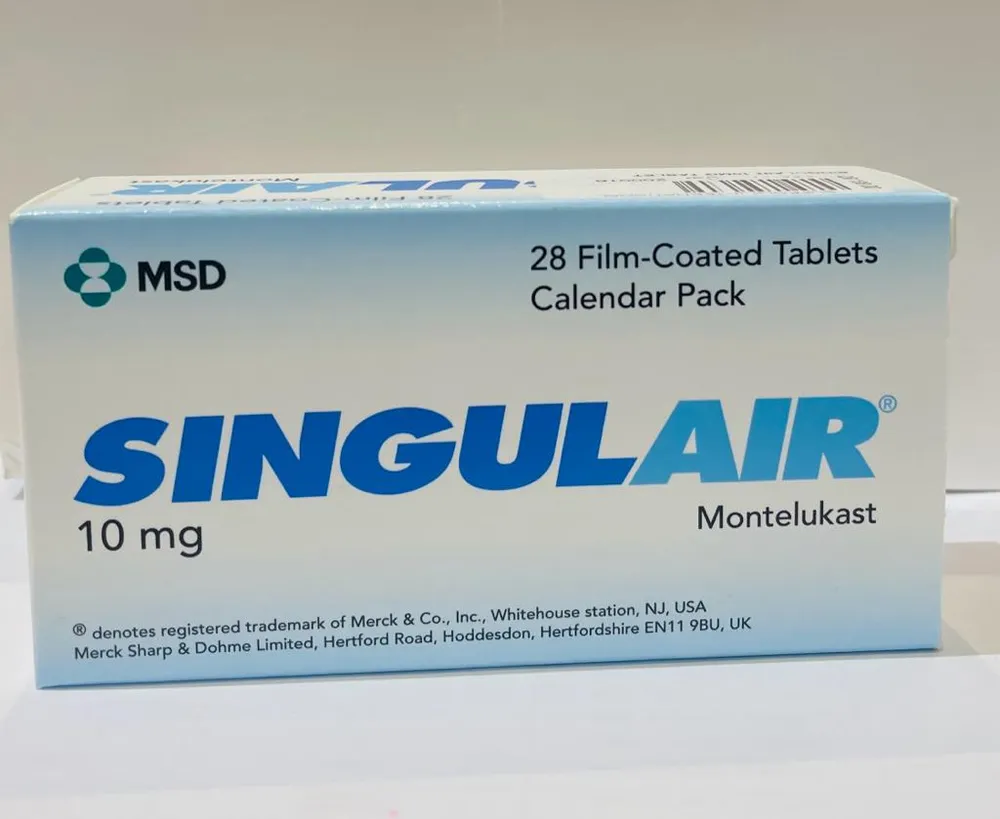
SINGULAIR 10
PolandThe medicine is used to prevent the occurrence of asthma symptoms during the day and at night and helps to prevent exercise-induced bronchoconstriction. It may also relieve symptoms of seasonal allergies (hay fever).
Frequently asked questions
How should Singulair 10 be taken?
Adults and adolescents over 15 years of age should take one 10 mg tablet once daily, in the evening. The tablets can be taken with or without food.
When should you not use this medicine?
Do not use the medicine if you are allergic to montelukast or any of the other ingredients. It should also not be used in children under 15 years of age.
Can Singulair 10 cause side effects?
The most commonly reported symptoms are abdominal pain and headache. Allergic reactions (e.g., swelling of the face or throat), mood changes (e.g., depression, aggression), seizures, and in very rare cases, suicidal thoughts or liver problems may also occur. If serious symptoms occur, contact a doctor immediately.
Can other medicines be taken with Singulair 10?
Inform your doctor about all medicines you are taking. Before starting treatment, you should report the use of, among others, phenobarbital, phenytoin, rifampicin, or gemfibrozil. This medicine should not be used instead of other asthma medicines prescribed by a doctor.
Does Singulair 10 help in a sudden asthma attack?
No, this medicine is not intended for the treatment of sudden asthma attacks. In the event of an attack, follow your doctor's instructions and use your reliever inhaler.
Instructions for use
Package leaflet: Information for the user
Warning! Keep this leaflet! The information on the immediate packaging is in a foreign language.
Singulair 10, 10 mg, film-coated tablets
Montelukastum
Please read the entire leaflet carefully before taking this medicine, as it contains
important information for the patient.
- Keep this leaflet, as you may need to read it again.
- If you have any questions, ask your doctor or pharmacist.
- This medicine has been prescribed for a specific individual. Do not pass it on to others. It may harm other people, even if their symptoms are the same.
- If you experience any adverse reactions, including any not listed in this leaflet, inform your doctor or pharmacist. See section 4.
Table of contents of the leaflet
- What Singulair 10 is and what it is used for
- What you need to know before taking Singulair 10
- How to take Singulair 10
- Possible side effects
- How to store Singulair 10
- Contents of the pack and other information
1. What Singulair 10 is and what it is used for
What Singulair 10 is
Singulair 10 is a leukotriene receptor antagonist that blocks the action of substances called leukotrienes.
How Singulair 10 works
Leukotrienes cause narrowing and swelling of the airways and also trigger allergic symptoms.
By blocking the action of leukotrienes, Singulair 10 relieves asthma symptoms, helps control asthma, and also alleviates symptoms of seasonal allergies (also known as hay fever or seasonal allergic rhinitis).
When Singulair 10 should be used
Your doctor has prescribed Singulair 10 for the treatment of asthma to prevent daytime and nighttime asthma symptoms.
- Singulair 10 is used in the treatment of adult patients and adolescents aged 15 years and older whose asthma has not been adequately controlled with previously used medications and who require additional therapy.
- Singulair 10 also helps prevent airway narrowing caused by physical exercise.
- In patients with asthma, Singulair 10 may also relieve symptoms of seasonal allergic rhinitis.
Your doctor will determine how to use Singulair 10 based on your symptoms and the severity of your asthma.
What is asthma?
Asthma is a chronic disease.
In asthma, the following occur:
- Breathing difficulties caused by narrowing of the airways. This narrowing varies in intensity in response to various triggers;
- Airway hyperresponsiveness, in which the airways react to many factors such as cigarette smoke, pollen, cold air, or physical exertion;
- Swelling (inflammation) of the mucous lining of the airways. Asthma symptoms include coughing, wheezing, and chest tightness.
What are seasonal allergies?
Seasonal allergies (also known as hay fever or seasonal allergic rhinitis) are allergic reactions commonly triggered by airborne pollen from trees, grasses, and weeds. Typical symptoms of seasonal allergies may include: nasal congestion, runny nose, itchy nose; sneezing; watery, swollen, red, and itchy eyes.
2. Important information before taking Singulair 10
Inform your doctor about any medical conditions or allergies you currently have or have had in the past.
When not to take Singulair 10
- If you are allergic to montelukast or any of the other ingredients of this medicine (listed in section 6).
Warnings and precautions
Before starting Singulair 10, discuss this with your doctor or pharmacist.
- If your asthma symptoms worsen or you experience difficulty breathing, contact your doctor immediately.
- Singulair 10 tablets for oral use are not intended for the treatment of acute asthma attacks. If an asthma attack occurs, follow your doctor's instructions. Always keep a rescue inhaler available for immediate use in case of an asthma attack.
- It is important that you continue taking all asthma medications prescribed by your doctor. Do not use Singulair 10 instead of other asthma medications prescribed by your doctor.
- Be aware that if you experience symptoms such as flu-like illness, tingling or numbness in the hands or feet, worsening respiratory symptoms and/or rash while taking asthma medications, you should contact your doctor.
- You should not take acetylsalicylic acid (aspirin) or non-steroidal anti-inflammatory drugs (also known as NSAIDs) if they worsen your asthma symptoms.
Various neuropsychiatric events (for example, behavioral and mood changes, depression, and suicidal thoughts) have been reported in patients of all ages treated with montelukast (see section 4). If you experience such symptoms while taking montelukast, consult your doctor.
Children and adolescents
Do not use this medicine in children under 15 years of age.
Other formulations of this medicine are available for children and adolescents under 18 years of age, appropriate for the patient's age.
Singulair 10 and other medicines
Tell your doctor or pharmacist about all medicines you are currently taking, have recently taken, or plan to take, including over-the-counter medicines.
Some medicines may affect the action of Singulair 10, or Singulair 10 may affect the action of other medicines you are taking.
Before starting Singulair 10, inform your doctor if you are taking any of the following medicines:
- phenobarbital (used to treat epilepsy)
- phenytoin (used to treat epilepsy)
- rifampicin (used to treat tuberculosis and certain other infections)
- gemfibrozil (used to treat high levels of lipids in plasma)
Singulair 10 with food and drink
Singulair 10 mg coated tablets can be taken with or without food.
Pregnancy and breastfeeding
If you are pregnant or breastfeeding, think you may be pregnant, or are planning to have a baby, consult your doctor or pharmacist before taking Singulair 10.
Pregnancy
Your doctor will assess whether you can take Singulair 10 during this period.
Breastfeeding
It is not known whether Singulair 10 passes into human milk. If you are breastfeeding or intend to breastfeed, you should consult your doctor before taking Singulair 10.
Driving and using machines
Singulair 10 is not expected to affect your ability to drive or operate machinery. However, individual responses to the medicine may vary.
Some adverse effects (such as dizziness and drowsiness) reported during treatment with Singulair 10 may affect your ability to drive or operate machinery.
Singulair 10 10 mg coated tablets contain lactose and sodium
If you have been previously diagnosed with an intolerance to certain sugars, consult your doctor before taking this medicine.
This medicine contains less than 1 mmol (23 mg) of sodium per tablet; therefore, it is considered "sodium-free".
3. How to take Singulair 10
This medicine should always be taken exactly as directed by the doctor or pharmacist. If you have any doubts,
you should consult your doctor or pharmacist.
- Take only one Singulair 10 tablet once daily, as prescribed by your doctor.
- The medicine should be taken even when the patient does not have asthma symptoms, and also during an acute asthma attack.
Use in adults and adolescents aged 15 years and older
The recommended dose is one 10 mg coated tablet once daily in the evening.
Ensure that the patient taking Singulair 10 is not also taking other medicines containing the same active substance, montelukast.
This medicine is intended for oral use.
Singulair 10 may be taken with or without food.
Taking more Singulair 10 than recommended
Contact your doctor immediately.
In most cases of overdose, no adverse effects have been observed.
In cases of overdose in children and adults, the most commonly observed symptoms have been: abdominal pain, drowsiness, excessive thirst, headache, vomiting, and increased motor activity.
If you forget to take Singulair 10
Singulair 10 should be taken as prescribed by your doctor. However, if a dose is missed, resume the usual dosing schedule—one tablet once daily.
Do not take a double dose to make up for the missed dose.
Stopping Singulair 10
Singulair 10 is effective in treating asthma only when taken regularly.
It is important to continue taking Singulair 10 for as long as your doctor has instructed.
This will help keep the patient's asthma under control.
If you have any further questions about the use of this medicine, consult your doctor or pharmacist.
4. Possible adverse effects
Like all medicines, this medicine can cause adverse effects, although not everyone will experience them.
During clinical trials with Singulair 10 tablets, 10 mg, the most commonly reported adverse effects (may occur in less than 1 in 10 people), considered to be related to treatment with Singulair 10, were:
- abdominal pain
- headache
These symptoms were usually mild in intensity and occurred more frequently in patients taking Singulair 10 than in patients receiving placebo (a tablet containing no active substance).
Serious adverse effects
You should contact your doctor immediately if any of the following adverse effects occur, as they may be serious and the patient may require immediate medical attention.
Uncommon: may occur in less than 1 in 100 people
- allergic reactions, including swelling of the face, lips, tongue, and (or) throat, which may cause difficulty in breathing or swallowing
- changes in behaviour and mood: agitation, including aggressive behaviour or hostile attitude, depression
- seizures
Rare: may occur in less than 1 in 1 000 people
- increased tendency to bleeding
- tremor
- palpitations
Very rare: may occur in less than 1 in 10 000 people
- a group of symptoms such as flu-like symptoms, sensation of pricking and tingling or numbness of hands and feet, worsening of respiratory symptoms and (or) rash (Churg-Strauss syndrome) (see section 2)
- low platelet count
- changes in behaviour and mood: hallucinations, disorientation, suicidal thoughts and attempts
- swelling (inflammation) of the lungs
- severe skin reactions (e.g. erythema multiforme), which may occur without prior symptoms
- hepatitis (inflammation of the liver)
Other adverse effects reported after marketing of the medicine
Very common: may affect more than 1 in 10 people
- upper respiratory tract infections
Common: may affect less than 1 in 10 people
- diarrhoea, nausea, vomiting
- rash
- fever
- increased liver enzyme levels
Uncommon: may affect less than 1 in 100 people
- changes in behaviour and mood: unusual dreams, including nightmares, difficulty sleeping, sleepwalking, irritability, feeling anxious, psychomotor agitation
- dizziness, drowsiness, sensation of pricking and tingling or numbness
- nosebleeds
- dry mouth, dyspepsia
- bruising, itching, urticaria
- muscle or joint pain, muscle cramps
- nocturnal enuresis in children
- weakness and (or) fatigue, malaise, oedema
Rare: may affect less than 1 in 1 000 people
- changes in behaviour and mood: attention disorders, memory disturbances, uncontrolled muscle movements
Very rare: may affect less than 1 in 10 000 people
- tender, red nodules under the skin, usually appearing on the shins (erythema nodosum)
- changes in behaviour and mood: obsessive-compulsive symptoms, stuttering
Reporting of adverse effects
If you experience any adverse effects, including any not listed in this leaflet, tell your doctor or pharmacist. Adverse effects can be reported directly to the Department of Monitoring Adverse Drug Reactions of the Office for Registration of Medicinal Products, Medical Devices and Biocidal Products, Al. Jerozolimskie 181C, 02-222 Warsaw, phone: +48 22 4921301, fax: +48 22 4921309, website: https://smz.ezdrowie.gov.pl.
Reporting adverse effects helps to provide more information on the safety of the medicine.
5. How to store Singulair 10
- Store below 30°C.
- Keep in the original packaging to protect from light and moisture.
- Keep the medicine out of sight and reach of children.
- Do not use this medicine after the expiry date stated on the packaging. The expiry date refers to the last day of the stated month.
- Medicines must not be disposed of via wastewater or household waste. Ask your pharmacist how to dispose of medicines no longer required. This will help protect the environment.
6. Contents of the pack and other information
What Singulair 10 contains
- The active substance is montelukast. Each tablet contains 10 mg of montelukast in the form of montelukast sodium.
- Other ingredients are: microcrystalline cellulose, lactose monohydrate (89.3 mg), sodium croscarmellose, hydroxypropylcellulose (E 463), and magnesium stearate. Film-coating ingredients: hypromellose, hydroxypropylcellulose (E 463), titanium dioxide (E 171), iron oxide red (E 172), iron oxide yellow (E 172), and carnauba wax.
What Singulair 10 looks like and contents of the pack
Singulair 10 mg tablets are beige, square-shaped, film-coated tablets with rounded edges, embossed with the word SINGULAIR on one side and MSD 117 on the other.
Blister packs containing 14 or 28 tablets.
For more detailed information, please contact the responsible party or parallel importer.
Marketing Authorisation Holder in the Czech Republic, country of export:
N.V. Organon, Kloosterstraat 6, 5349 AB Oss, The Netherlands
Manufacturer:
Merck S.L., Polígono Merck, Mollet del Vallés, 08100 Barcelona, Spain
Merck Healthcare KGaA, Frankfurter Strasse 250, 64293 Darmstadt, Germany
Parallel Importer:
InPharm Sp. z o.o.
ul. Strumykowa 28/11, 03-138 Warsaw, Poland
Repackaged by:
InPharm Sp. z o.o. Services sp. k.
ul. Chełmżyńska 249, 04-458 Warsaw, Poland
Marketing Authorisation Number in the Czech Republic, country of export: 14/351/99-C
Parallel Import Licence Number: 184/23
Similar drugs
The original data is available in the language of the country of manufacture.
Data source: Register of Medicinal Products of Poland (URPL)
Data last verified: September 01, 2026