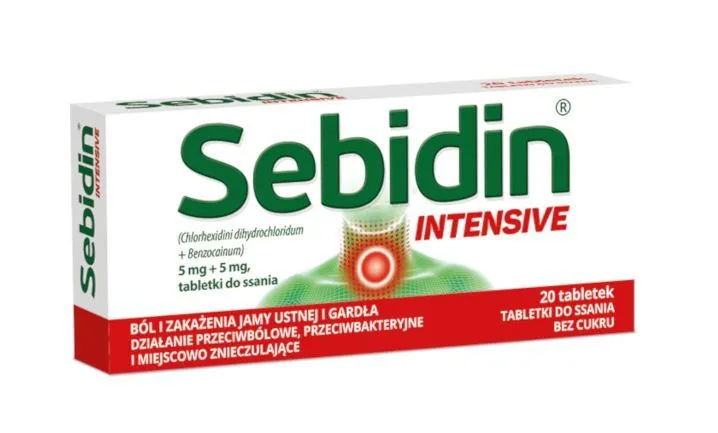
SEBIDIN INTENSIVE
PolandThe medicine is used to relieve sore throat, throat irritation, and hoarseness during oral and throat infections without fever. It may also help in treating mucosal inflammations, such as aphthous ulcers.
Frequently asked questions
How to use Sebidin Intensive?
Adults and children over 12 years of age should slowly suck one tablet every 2 hours. The tablet must not be chewed or swallowed. The maximum daily dose is 8 tablets.
When should you not use this medicine?
Do not take this medicine if you are allergic to any of its ingredients, suffer from methemoglobinemia (or have suffered from it in the past), or if you are a child under 12 years of age.
Can Sebidin Intensive be taken with other medicines?
This medicine should not be used together with other medicines containing bactericidal substances (e.g., sulfonamides) or with cholinesterase inhibitors (used in the treatment of cognitive disorders).
What may side effects be?
Side effects may include, among others, tongue irritation, loss of appetite, taste disturbances, breathing problems, rash, nausea, diarrhea, and brown discoloration of the teeth, tongue, or dental fillings.
When should you contact a doctor?
You should do so if there is no improvement after 5 days of use, if symptoms worsen, or if high fever, headache, nausea, or vomiting occurs.
Instructions for use
Package leaflet: Information for the patient
Sebidin Intensive, 5 mg + 5 mg, lozenges
Chlorhexidini dihydrochloridum + Benzocainum
Please read this leaflet carefully before taking the medicine, as it contains information important for the patient.
This medicine should always be taken exactly as described in this patient leaflet or as directed by a doctor or pharmacist.
- Keep this leaflet, as you may need to read it again.
- If you need advice or further information, please consult your pharmacist.
- If you experience any adverse reactions, including any adverse reactions not listed in this leaflet, inform your doctor or pharmacist. See section 4.
- If there is no improvement after 5 days, or if your condition worsens, consult a doctor.
Leaflet contents
- What Sebidin Intensive is and what it is used for
- Important information before taking Sebidin Intensive
- How to take Sebidin Intensive
- Possible side effects
- How to store Sebidin Intensive
- Contents of the pack and other information
1. What Sebidin Intensive is and what it is used for
Sebidin Intensive is a medicine intended for the treatment of symptoms such as sore throat and throat irritation, hoarseness, associated with infections of the mouth and throat occurring without fever.
It may also be used in the treatment of inflammatory conditions of the mucous membrane characterized by small mucosal ulcers (aphthae).
If there is no improvement after 5 days, or if you feel worse, consult a doctor.
2. Information to know before using Sebidin Intensive
When not to take Sebidin Intensive:
- if the patient is allergic to the active substances or to any of the other ingredients of this medicine (listed in section 6);
- in children under 12 years of age;
- in patients suffering from methemoglobinemia (a blood disorder characterized by the presence of abnormal hemoglobin unable to bind and transport oxygen. The most common symptom is cyanosis, resulting from tissue hypoxia) or with a history of methemoglobinemia.
Warnings and precautions
Before starting to use Sebidin Intensive, consult your doctor, pharmacist, or nurse.
Special caution is required in patients:
- with hypersensitivity to ester-type local anesthetics (especially para-aminobenzoic acid derivatives, PABA), parabens, or p-phenylenediamine, as they may exhibit hypersensitivity to benzocaine.
- with breathing problems such as asthma, bronchitis, or emphysema.
- with heart disease.
- who smoke, as they are at higher risk of complications related to methemoglobinemia.
- with certain enzymatic deficiencies, such as glucose-6-phosphate dehydrogenase deficiency, hemoglobin-M disease, NADH-methemoglobin reductase deficiency (diaphorase 1), or pyruvate kinase deficiency, who may also be more susceptible to developing methemoglobinemia.
- who are elderly, seriously ill, or debilitated, due to increased risk of systemic adverse effects of benzocaine.
- with severe trauma to the oral mucosa, due to increased absorption of the anesthetic agent.
- with periodontitis, due to increased supragingival calculus formation.
- with rough or uneven dental fillings, due to the possibility of discoloration.
Children and adolescents
Do not use in children under 12 years of age.
Sebidin Intensive with other medicines
Inform your doctor or pharmacist about all medicines currently used, recently taken, or planned to be taken.
Do not use Sebidin Intensive together with:
- other medicines containing bactericidal substances (e.g., sulfonamides);
- cholinesterase inhibitors (medicines used in the treatment of cognitive disorders).
Pregnancy, breastfeeding, and fertility
If the patient is pregnant or breastfeeding, suspects she may be pregnant, or is planning to become pregnant, she should consult a doctor or pharmacist before using this medicine.
Due to limited safety data on use in pregnant and breastfeeding women, the use of Sebidin Intensive is not recommended in these patient groups.
Driving and operating machinery
This medicine has no effect or negligible effect on the ability to drive and operate machinery.
Sebidin Intensive contains sodium
The medicine contains less than 1 mmol (23 mg) of sodium per tablet, meaning the medicine is considered "sodium-free".
3. How to take Sebidin Intensive
This medicine should always be taken exactly as described in this patient leaflet or as directed by a doctor or pharmacist. If in doubt, consult your doctor or pharmacist.
Recommended dose for adults and children over 12 years of age:
1 tablet every 2 hours. A maximum of 8 tablets may be taken in 24 hours.
Method of administration
Administer to the oral mucosa. The tablet should be slowly sucked in the oral cavity.
Do not chew or swallow the lozenges.
If symptoms worsen or persist for more than five days, or if they are accompanied by high fever, headache, nausea or vomiting, the patient should contact a doctor.
Use in children and adolescents
Do not use in children under 12 years of age.
Overdose of Sebidin Intensive
Due to the low content of active substances in a single dose, the risk of overdose is small.
If any signs of poisoning occur, discontinue use of the product immediately.
In case of overdose, consult a doctor, as treatment may be necessary.
Missed dose of Sebidin Intensive
Do not take a double dose to make up for a missed dose.
If you have any further questions about the use of this medicine, consult your doctor, pharmacist or nurse.
4. Possible adverse reactions
Like all medicines, this medicine can cause adverse reactions, although not everybody will experience them.
Adverse reactions occurring rarely (in 1 to 10 out of 10,000 patients):
- irritation of the tip of the tongue and oral mucosa.
Adverse reaction for which frequency cannot be determined based on available data:
- methemoglobinemia (a blood disorder associated with presence of abnormal hemoglobin);
- hypersensitivity, allergic reactions affecting the skin and mucous membranes;
- loss of appetite;
- taste disturbances (rarely persistent);
- breathing difficulties, nasal mucosa congestion, throat irritation;
- brown discoloration of teeth, tongue, nausea, dyspepsia, abdominal pain, diarrhea, dry mouth, burning sensation of the tongue, tingling of the tongue, increased dental calculus formation;
- rash, urticaria, contact dermatitis, allergic dermatitis;
- brown discoloration of dental fillings, dentures, and other oral appliances.
Brown discolorations may be more pronounced in patients with dental calculus and usually appear within a week after starting treatment. Discoloration of the tongue is not harmful and usually resolves spontaneously. Tooth discoloration is not permanent and can be removed during routine oral hygiene. Discoloration of dental fillings may be permanent.
Reporting of adverse reactions
If any adverse reactions occur, including those not listed in this leaflet, inform your doctor, pharmacist, or nurse. Adverse reactions can be reported directly to the Department of Monitoring Adverse Drug Reactions of the Office for Registration of Medicinal Products, Medical Devices and Biocidal Products:
Al. Jerozolimskie 181C, 02-222 Warsaw, tel.: + 48 22 49 21 301, fax: + 48 22 49 21 309,
Website: https://smz.ezdrowie.gov.pl
Adverse reactions can also be reported to the marketing authorization holder.
Reporting adverse reactions helps to provide more information on the safe use of the medicine.
5. How to store Sebidin Intensive
Keep this medicine out of sight and reach of children.
Do not use this medicine after the expiry date stated on the packaging after "EXP". The expiry date refers to the last day of the stated month.
Do not store above 25°C.
Medicines must not be disposed of via wastewater or household waste. Ask your pharmacist how to dispose of medicines no longer in use. This will help protect the environment.
6. Contents of the pack and other information
What Sebidin Intensive contains
- The active substances in this medicine are chlorhexidine dihydrochloride and benzocaine. Each tablet contains 5 mg of chlorhexidine dihydrochloride and 5 mg of benzocaine.
- Other ingredients are: mannitol, microcrystalline cellulose (PH 101), povidone K29/32, magnesium stearate, sodium cyclamate (E 952), sodium saccharin (E 954), menthol flavour 611072E, orange flavour 90103-71.
What Sebidin Intensive looks like and contents of the pack
Sebidin Intensive lozenges are round, with a score line on one side, and white-yellow in colour.
Packaged in blisters made of PVC/PE/PVDC/Aluminium, contained in a cardboard box.
The pack contains 20 lozenges.
Marketing Authorisation Holder and Manufacturer
Marketing Authorisation Holder:
Perrigo Poland Sp. z o.o.[+logo]
ul. Domaniewska 48
02-672 Warsaw
tel.: +48 (22) 852 55 51
Manufacturer:
LABORATORIOS ALCALÁ FARMA, S.L.
Avenida de Madrid, 82
28802 Alcalá de Henares (Madrid)
Spain
Similar drugs
| Brand name | Dosage form | Active substance / Dosage | Manufacturer |
|---|---|---|---|
| DOPPELSEPT THROAT | tablets, for sucking |
|
Laboratorios Alcala Farma, S.L. |
The original data is available in the language of the country of manufacture.
Data source: Register of Medicinal Products of Poland (URPL)
Data last verified: September 01, 2026