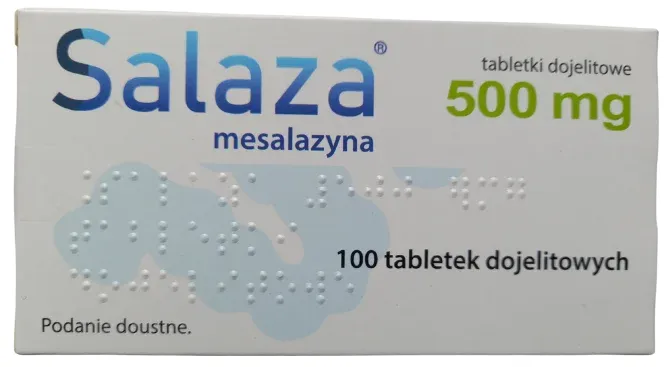
SALAZA
PolandThe medicine is used in the treatment of ulcerative colitis (inflammatory bowel disease).
Frequently asked questions
How should Salaza be taken?
Tablets should be swallowed whole with liquid before a meal. They must not be divided, chewed, or crushed. The dosage depends on the purpose of treatment (acute episode or prevention of recurrence) and must be strictly determined by a doctor.
When should you not use this medicine?
You should not take it if you are allergic to mesalazine or salicylates, if the patient suffers from conditions that increase susceptibility to bleeding, or if they have severe renal or hepatic impairment.
Does Salaza interact with other medicines?
Yes, the medicine may interact, among others, with antidiabetic drugs, blood pressure-lowering drugs, anticoagulants, anti-inflammatory drugs, gout medications, lactulose, and immunosuppressants.
What are the possible side effects of Salaza?
Possible side effects include, among others, abdominal pain, diarrhea, nausea, headache, dizziness, and skin photosensitivity. You should contact a doctor immediately if a severe rash, fever, breathing problems, severe headache, vision disturbances, or tinnitus occurs.
Can the medicine be used during pregnancy or breastfeeding?
You should not take the medicine during pregnancy or while breastfeeding, unless explicitly advised by a doctor.
Is the medicine safe for children?
The medicine should not be used in children under 5 years of age. Due to a lack of sufficient safety data, its use is also not recommended in adolescents under 18 years of age.
Instructions for use
Package leaflet: Information for the patient
Salaza, 1000 mg, enteric-coated tablets
mesalazine
Please read all of this leaflet carefully before taking this medicine because it contains important information for you.
- Keep this leaflet as you may need to read it again.
- If you have any further questions, please ask your doctor, pharmacist, or nurse.
- This medicine has been prescribed for a specific individual. Do not pass it on to others. It may harm someone else, even if their symptoms are the same.
- If you experience any adverse effects, including any not listed in this leaflet, tell your doctor, pharmacist, or nurse. See section 4.
Contents of the leaflet
- What Salaza is and what it is used for
- What you need to know before taking Salaza
- How to take Salaza
- Possible side effects
- How to store Salaza
- Contents of the pack and other information
1. What Salaza is and what it is used for
Salaza enteric-coated tablets contain 1000 mg of the active substance mesalazine (also known as 5-acetylsalicylic acid), which belongs to a group of medicines called intestinal anti-inflammatory drugs.
Salaza is indicated for the treatment of ulcerative colitis (an inflammatory bowel disease).
2. Important information before taking Salaza
When not to take Salaza:
- if the patient is allergic to mesalazine or to any of the other ingredients of this medicine (listed in section 6),
- if the patient is allergic to acetylsalicylic acid or any other salicylate,
- if the patient suffers from a disease which increases their susceptibility to bleeding,
- if the patient has severe impairment of kidney and (or) liver function.
Warnings and precautions
Before starting treatment with Salaza, discuss this with your doctor or pharmacist.
Before starting treatment with Salaza, inform your doctor:
- if the patient is pregnant or planning to become pregnant,
- if the patient is breastfeeding,
- if the patient has liver or kidney disease,
- if the patient suffers from any lung disease, e.g. asthma,
- if the patient was previously allergic to sulfasalazine,
- if the patient has active peptic ulcer disease of the stomach or duodenum,
- if the patient has previously had inflammation of the heart (which may have been caused by infection in the heart),
- if the patient has ever experienced severe skin rash or skin peeling, blisters or oral ulcers after taking mesalazine.
If the patient experiences severe or recurring headache, vision disturbances, or ringing or
buzzing in the ears, they should contact their doctor immediately.
If any allergic symptoms (e.g. rash, itching) or bronchospasm, abdominal pain, severe headache, or fever occur during treatment, the patient should not take any more tablets and should contact their doctor without delay.
Before and during treatment, the doctor may wish to perform regular blood and urine tests to monitor liver, kidney, blood and lung function.
The use of mesalazine may lead to the formation of kidney stones. Symptoms may include flank pain and haematuria. During treatment with mesalazine, an adequate fluid intake should be maintained.
Serious skin reactions, including drug reaction with eosinophilia and systemic symptoms (DRESS), Stevens-Johnson syndrome (SJS), and toxic epidermal necrolysis (TEN), have been reported with mesalazine treatment. Mesalazine should be discontinued and immediate medical help sought if any of the symptoms of these serious skin reactions, listed in section 4, occur.
Mesalazine may cause a reddish-brown discoloration of urine when it comes into contact with sodium hypochlorite bleach present in toilet water. This results from a chemical reaction between mesalazine and the bleach and is harmless.
Children and adolescents
Information on the safety of this medicine in children and adolescents is limited.
Do not use this medicine in children under 5 years of age.
Salaza with other medicines
In general, the patient may continue treatment with other medicines while taking Salaza.
However, the patient should inform their doctor or pharmacist about all medicines currently used, recently used, or planned to be used, including those available without a prescription.
Salaza may interact with certain medicines when administered concomitantly, particularly with:
- blood glucose-lowering medicines (antidiabetic agents),
- blood pressure-lowering medicines (antihypertensive and (or) diuretic agents),
- medicines used to treat or prevent gout attacks,
- medicines used to promote bowel movements (laxatives containing lactulose),
- medicines that prevent blood clotting (anticoagulants),
- medicines used to reduce immune system activity (e.g. azathioprine, 6-mercaptopurine or thioguanine),
- medicines used to treat pain and inflammation (anti-inflammatory medicines).
Pregnancy and breastfeeding
If the patient is pregnant or breastfeeding, suspects she may be pregnant, or is planning to become pregnant, she should consult her doctor or pharmacist before using this medicine.
Experience with the use of mesalazine during pregnancy and breastfeeding is limited.
Allergic reactions may occur in the newborn during breastfeeding, e.g. diarrhoea. If diarrhoea occurs in the newborn, breastfeeding should be discontinued.
Do not take Salaza during pregnancy or breastfeeding unless advised by a doctor.
Driving and operating machinery
Salaza has no effect or a negligible effect on the ability to drive and operate machinery.
Salaza contains sodium
This medicine contains 4.26 mmol (98 mg) of sodium (the main component of table salt) in each enteric-coated tablet. This corresponds to 5% of the maximum recommended daily dietary sodium intake for adults.
If taking 4 enteric-coated tablets per day for a prolonged period, patients, especially those monitoring their dietary sodium intake, should contact their doctor or pharmacist.
3. How to use Salaza
This medicine should always be used according to the instructions given by your doctor or pharmacist. If you have any doubts,
you should consult your doctor or pharmacist.
The decision regarding the duration of treatment with this medicine is made by the doctor. Do not discontinue treatment
earlier, even if you feel better, because symptoms may recur due to premature discontinuation of
treatment.
You must strictly follow your doctor's instructions regarding treatment, both during acute flare-ups of
colitis and during maintenance therapy.
The recommended dose in adults is:
For the treatment of acute episodes of inflammation of the large intestine, your doctor will usually prescribe a dose
ranging from 1.5 (one 1000 mg tablet and one 500 mg tablet) to 4 grams (four 1000 mg tablets) of mesalazine per
day, which may be administered once daily or in divided doses.
For preventing further episodes, your doctor may prescribe a dose ranging from 1.5
(one 1000 mg tablet and one 500 mg tablet) to 3 grams (three 1000 mg tablets) of mesalazine
per day, which may be administered once daily or in divided doses.
Salaza, enteric-coated tablets, should be taken orally.
The tablets should be swallowed whole with liquid, before a meal. Do not split, chew,
or crush the tablets.
In both cases, your doctor may prescribe Salaza 500 mg, enteric-coated tablets, to
adjust the dose.
Use in children and adolescents
Salaza is not recommended for use in children and adolescents under 18 years of age due to lack of
data on safety and efficacy. This medicine should not be used in children under 5 years of age.
Use in elderly patients
In elderly patients, Salaza should be used with caution and only in patients with normal kidney function.
Taking more Salaza than recommended
If you take more Salaza than recommended, contact your doctor, pharmacist, or hospital emergency department
immediately. Take the medicine pack with you.
Missing a dose of Salaza
Do not take a double dose to make up for a missed dose.
Stopping Salaza treatment
It is important to take Salaza tablets every day, even if you do not have symptoms
of ulcerative colitis. Always complete the prescribed course of treatment.
If you have any further doubts about using this medicine, consult your doctor, pharmacist, or nurse.
4. Possible adverse effects
Like all medicines, this medicine can cause adverse effects, although they do not occur in everyone.
All medicines may cause allergic reactions, but severe allergic reactions are very rare. If any of the following symptoms occur after taking this medicine, you should stop taking these tablets and contact your doctor immediately:
- allergic skin rash,
- fever,
- breathing difficulties.
If the patient develops fever or irritation of the throat or oral cavity, you should stop taking these tablets and contact your doctor immediately. These symptoms, in very rare cases, may be caused by a decrease in the number of white blood cells in the blood (a condition called agranulocytosis).
Serious adverse effects:
You should stop taking mesalazine and seek immediate medical help if the patient experiences any of the following symptoms:
- red, flat, disc-shaped or circular spots on the trunk, often with blisters in their center, skin peeling, mouth, throat, nose, genital or eye ulcers, widespread rash, fever and swollen lymph nodes. Such life-threatening skin rashes may be preceded by fever and flu-like symptoms;
- if the patient experiences severe or recurring headache, visual disturbances, or ringing or buzzing in the ears. These may be symptoms of increased intracranial pressure (idiopathic intracranial hypertension).
The following adverse effects have been reported in patients taking mesalazine:
Rare adverse effects (may affect up to 1 in 1,000 people):
- abdominal pain, diarrhoea, flatulence, nausea and vomiting;
- headache, dizziness;
- chest pain, shortness of breath or swelling of the limbs due to the medicine's effect on the heart;
- increased sensitivity of the skin to sunlight and ultraviolet radiation (photosensitivity).
Very rare adverse effects (may affect up to 1 in 10,000 people):
- kidney function disorders, sometimes accompanied by swelling of the limbs or pain in the sides of the body;
- severe abdominal pain due to acute pancreatitis;
- worsening of symptoms of colitis;
- fever, sore throat or nausea due to changes in blood cell counts;
- shortness of breath, cough, wheezing, spotted changes on lung X-ray due to allergic and/or inflammatory lung diseases;
- diarrhoea and severe abdominal pain due to an allergic reaction to the medicine at the intestinal level;
- skin rash or skin inflammation;
- muscle and joint pain;
- jaundice or abdominal pain due to liver function disorders or impaired bile flow;
- hair loss leading to baldness;
- erythema multiforme;
- numbness and tingling in the fingers of the hands and feet (peripheral neuropathy);
- transient decrease in semen production;
- blood cell count disorders.
Adverse effects with unknown frequency (frequency cannot be estimated from the available data):
- kidney stones and associated kidney pain (see also section 2);
- severe skin adverse effects: drug reaction with eosinophilia and systemic symptoms (DRESS), Stevens-Johnson syndrome (SJS), and toxic epidermal necrolysis (TEN).
Photosensitivity
More severe reactions have been reported in patients with pre-existing skin disorders such as atopic dermatitis and allergic eczema.
If these symptoms persist or worsen, consult your doctor.
Reporting of adverse effects
If any adverse effects occur, including any not listed in this leaflet, inform your doctor or pharmacist. Adverse effects can be reported directly to the Department of Monitoring Adverse Drug Reactions at the Office for Registration of Medicinal Products, Medical Devices and Biocidal Products, Al. Jerozolimskie 181C, 02-222 Warsaw,
tel.: +48 22 49 21 301
fax: +48 22 49 21 309
website: https://smz.ezdrowie.gov.pl .
Adverse effects can also be reported to the marketing authorization holder.
Reporting adverse effects helps provide more information on the safety of this medicine.
5. How to store Salaza
Keep this medicine out of the sight and reach of children.
No special storage conditions are required for this medicine.
Do not use this medicine after the expiry date stated on the cardboard box following {EXP}. The expiry date refers to the last day of the month indicated.
Medicines must not be disposed of via wastewater or household waste. Ask your pharmacist how to dispose of medicines you no longer use. This will help protect the environment.
6. Contents of the pack and other information
What Salaza contains
- Each enteric-coated tablet contains 1000 mg of mesalazine.
- Other ingredients are: sodium carbonate anhydrous, glycine, povidone K-30, microcrystalline cellulose, sodium croscarmellose, colloidal anhydrous silica, calcium stearate, methacrylic acid and ethyl acrylate copolymer (1:1), 30% solution, methacrylic acid and methyl methacrylate copolymer (1:1), methacrylic acid and methyl methacrylate copolymer (1:2), dibutyl sebacate, talc, titanium dioxide (E 171), macrogol 6000, yellow iron oxide (E 172), red iron oxide (E 172).
What Salaza looks like and contents of the pack
This medicinal product is supplied in PVC/PVDC/Aluminium blisters packed in a cardboard box containing 60 or 100 enteric-coated tablets.
The enteric-coated tablets are elongated, with a uniform orange coating.
Marketing Authorisation Holder
Faes Farma S.A.
Autonomia Etorbidea, 10
48940 Leioa (Bizkaia)
Spain
Manufacturer
Faes Farma, S.A.
Maximo Agirre Kalea, 14
48940 Leioa (Bizkaia)
Spain
Faes Farma, S.A.
Parque Científico y Tecnológico de Bizkaia
Ibaizabal Bidea, Edificio 901
48160 Derio (Bizkaia)
Spain
For further information, please contact the local representative of the Marketing Authorisation Holder:
Recordati Polska sp. z o.o.
al. Armii Ludowej 26
00-609 Warsaw
tel.: + 48 22 206 84 50
This medicine is authorised in the European Economic Area countries under the following names:
Austria: Azzavix 1000 mg magensaftresistente tablette
Poland: Salaza
Czech Republic: Salcrozine
Ireland: Galtasa 1000 mg gastro-resistant tablets
Slovakia: Salcrozine 1000 mg gastrorezistentná tableta
Greece: Mecolzin 1000 mg γαστροανθεκτικό δισκίο
Spain: Mecolvix 1000 mg comprimidos gastroresistentes
Similar drugs
| Brand name | Dosage form | Active substance / Dosage | Manufacturer |
|---|---|---|---|
| ASAMAX 250 | tablets, enteric-coated |
|
Sever Pharma Solutions AB |
| ASAMAX 500 | tablets, enteric-coated |
|
Sever Pharma Solutions AB |
| SALAZA | tablets, enteric-coated |
|
Faes Farma S.A. |
| SALOFALK 500 | tablets, enteric-coated |
|
Dr. Falk Pharma GmbH |
The original data is available in the language of the country of manufacture.
Data source: Register of Medicinal Products of Poland (URPL)
Data last verified: September 01, 2026