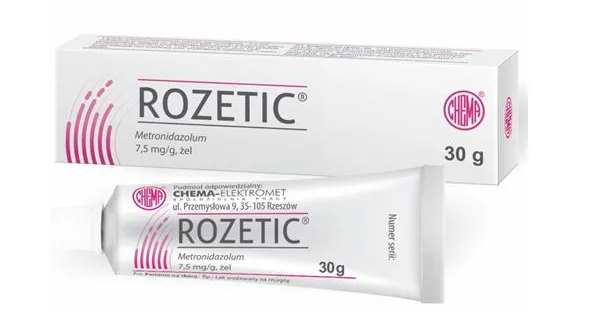
ROZETIC
PolandIt is used for the topical treatment of inflammatory lesions (papules and pustules) in rosacea and for the topical treatment of skin infections.
Frequently asked questions
How to use Rozetic?
Apply a thin layer of gel to the affected areas of the skin twice daily (morning and evening). Before use, wash the treated areas with a gentle facial skin emulsion. Treatment usually lasts from 3 to 4 months.
When should you not use this medicine?
Do not use it if you are allergic to the active substance or any of the other ingredients. The medicine must not be used around the eyes or on mucous membranes.
What are the possible side effects of Rozetic?
Common side effects may include: dry skin, erythema, itching, burning, pain or stinging of the skin, irritation, and worsening of acne symptoms. Uncommon side effects may include: tingling, numbness of the limbs, a metallic taste in the mouth, or nausea. Cases of facial swelling or skin peeling are unknown.
Can alcohol be consumed during treatment?
Alcohol must not be consumed during treatment and for at least 48 hours after its completion, as it may trigger a reaction involving hot flashes, vomiting, and rapid heartbeat.
Can the medicine be used during pregnancy or breastfeeding?
During pregnancy, the medicine may only be used if a doctor deems it necessary. It should not be used during breastfeeding – in such a case, the doctor will decide whether to continue treatment or discontinue breastfeeding.
What should be remembered when using the gel?
During treatment, avoid sun exposure and tanning beds (UV radiation). After applying the preparation, use cosmetics that do not clog pores (are non-comedogenic) and do not have an astringent effect.
Instructions for use
Package leaflet: information for the patient
Rozetic, 7.5 mg/g, gel
Metronidazolum
Please read the entire leaflet carefully before using the medicine, as it contains
important information for the patient.
- Keep this leaflet, as you may need to read it again.
- If you have any doubts, consult your doctor or pharmacist.
- This medicine has been prescribed for a specific individual. Do not share it with others. The medicine may harm another person, even if their symptoms are the same.
- If the patient experiences any adverse reactions, including any not listed in this leaflet, inform the doctor or pharmacist. See section 4.
Table of contents
- What Rozetic is and what it is used for
- Important information before using Rozetic
- How to use Rozetic
- Possible side effects
- How to store Rozetic
- Contents of the package and other information
1. What Rozetic is and what it is used for
Rozetic is a topical gel containing the active substance metronidazole.
Metronidazole is a nitroimidazole derivative with antibacterial activity.
Indications:
Topical treatment of inflammatory lesions characterized by papules and pustules in rosacea.
Topical treatment of skin infections.
2. Important information before using Rozetic
When not to use Rozetic
- if the patient is allergic to the active substance and its derivatives, or to any of the other ingredients of this medicine (listed in section 6).
Warnings and precautions
Before starting treatment with Rozetic, please discuss with your doctor or pharmacist.
Rozetic is intended for topical use only. It must not be used near the eyes or on mucous membranes. If the product comes into contact with the eyes, rinse thoroughly with plenty of water.
If skin irritation symptoms occur, consult your doctor, who may recommend less frequent application or temporary discontinuation of therapy.
During treatment, avoid exposure to sunlight and artificial sources of ultraviolet radiation (e.g., sunbeds).
Metronidazole is a nitroimidazole derivative and should be used with caution in patients with blood disorders. If the patient has any blood disease or is taking anticoagulant medicines, this should be reported to the doctor.
Do not use the medicine for longer than recommended by the doctor.
Rozetic and other medicines
Inform your doctor or pharmacist about all medicines the patient is currently using or has recently used, as well as any medicines planned for future use.
After topical application, Rozetic is minimally absorbed through the skin, so interactions with systemically acting medicines are unlikely.
The patient should not consume alcohol during treatment and for at least 48 hours after completion of metronidazole therapy, as a disulfiram-like reaction may occur (flushing, nausea, vomiting, tachycardia).
Orally administered metronidazole may potentiate the anticoagulant effect of warfarin and coumarin derivatives, leading to prolonged prothrombin time. It is unknown whether topically applied metronidazole affects prothrombin time.
Pregnancy, breastfeeding, and fertility
If the patient is pregnant or breastfeeding, suspects she may be pregnant, or is planning to have a child, she should consult her doctor or pharmacist before using this medicine.
Pregnancy
Rozetic may be used during pregnancy only if considered necessary by the doctor.
Breastfeeding
Rozetic should not be used during breastfeeding. The doctor will decide whether to discontinue Rozetic treatment or to stop breastfeeding.
Fertility
No data are available.
Driving and operating machinery
Rozetic has no effect or negligible effect on the ability to drive and operate machinery.
Rozetic contains methyl parahydroxybenzoate (E 218), propyl parahydroxybenzoate (E 216), and propylene glycol.
Due to the presence of methyl parahydroxybenzoate and propyl parahydroxybenzoate, this medicine may cause allergic reactions (including delayed-type reactions).
Rozetic contains 30 mg of propylene glycol in 1 g of gel. Due to the presence of propylene glycol, the medicine may cause skin irritation.
3. How to use Rozetic
This medicine should always be used exactly as directed by the physician or pharmacist. In case of doubt,
consult your doctor or pharmacist.
Rozetic is intended for topical application to the skin.
Before use, wash the affected areas with an emulsion for special care of sensitive and delicate facial skin.
Apply a thin layer of the medicine to the affected skin areas twice daily (morning and evening).
After applying Rozetic, patients should use only cosmetics that do not cause comedones and do not have a drying effect.
The treatment period usually lasts from 3 to 4 months. The duration of use should not be prolonged. However, if a clear improvement occurs, the treating physician may recommend continuing therapy for another 3 or 4 months, depending on the severity of the lesions.
Elderly patients
Dosage adjustment is not required in elderly patients.
Use in children
Rozetic should not be used in children due to lack of data on safety and efficacy.
Use of more than the recommended dose of Rozetic
There are no data available on overdose in humans.
If you forget to use Rozetic
Apply the medicine as soon as possible. If it is almost time for the next dose, do not use a double dose to make up for the missed dose.
In case of accidental ingestion
Seek immediate medical advice from a doctor.
If you have any further questions about the use of this medicine, consult your doctor or pharmacist.
4. Possible adverse reactions
Like all medicines, this medicinal product may cause adverse reactions, although not everyone experiences them.
The adverse reactions listed below are categorized according to frequency of occurrence:
Common (occurring in fewer than 1 in 10 treated patients):
dry skin, erythema, itching, skin discomfort (burning, skin pain/stinging),
skin irritation, worsening of acne symptoms.
Uncommon (occurring in fewer than 1 in 100 treated patients):
hypogeusia, paraesthesia and limb numbness, metallic taste in the mouth, nausea.
Not known (frequency cannot be estimated from available data):
contact dermatitis, skin desquamation, facial swelling.
Reporting of adverse reactions
If any adverse reactions occur, including any adverse reactions not listed in this leaflet, inform a doctor, pharmacist, or nurse. Adverse reactions can be reported directly to the Department of Monitoring Adverse Drug Reactions of the Office for Registration of Medicinal Products, Medical Devices and Biocidal Products
Al. Jerozolimskie 181 C
02-222 Warsaw
Phone: +48 22 4921301
Fax: +48 22 4921309
Website: https://smz.ezdrowie.gov.pl
Adverse reactions can also be reported to the marketing authorization holder.
Reporting adverse reactions enables better assessment of the medicine's safety profile.
5. How to store Rozetic
Store below 25°C. Do not store in the refrigerator. Do not freeze.
Keep the tube tightly closed.
The medicine should be stored out of sight and reach of children.
Pay attention to the expiry date of the medicine.
Period of use after first opening of the tube: 28 days.
Do not use this medicine after the expiry date stated on the packaging. The expiry date refers to the last day of the stated month.
Medicines must not be disposed of via wastewater or household waste. Ask your pharmacist how to dispose of medicines no longer required. Such practices help protect the environment.
6. Contents of the packaging and other information
What Rozetic contains
The active substance is metronidazole.
7.5 mg of metronidazole is contained in 1 g of gel.
Other components: carbomer 980, edetate disodium, propylene glycol, methyl parahydroxybenzoate (E 218), propyl parahydroxybenzoate (E 216), purified water, sodium hydroxide (for pH adjustment).
What Rozetic looks like and contents of the packaging
Rozetic is a gel of uniform consistency, ranging in colour from light yellow to yellow.
The medicinal product is packed in an aluminium tube with a sealing membrane, internally coated with epoxy-phenolic varnish, fitted with a HDPE cap with a piercing device, containing 30 g of gel. The tube, together with the patient leaflet, is placed in a cardboard box.
Marketing Authorisation Holder and Manufacturer
CHEMA-ELEKTROMET
Labour Cooperative
Przemysłowa 9 Street
35-105 Rzeszów
tel. 17 862 05 90
e-mail: [email protected]
Similar drugs
| Brand name | Dosage form | Active substance / Dosage | Manufacturer |
|---|---|---|---|
| METRONIDAZOLE JELFA | gel |
|
Jelfa Pharmaceutical Enterprise S.A. |
| METRONIDAZOLE ZIAJA | gel |
|
ZIAJA Ltd Drug Manufacturing Plant Sp. z o.o. |
| ROZEX | gel |
|
Laboratoires Galderma S.A. |
The original data is available in the language of the country of manufacture.
Data source: Register of Medicinal Products of Poland (URPL)
Data last verified: September 01, 2026