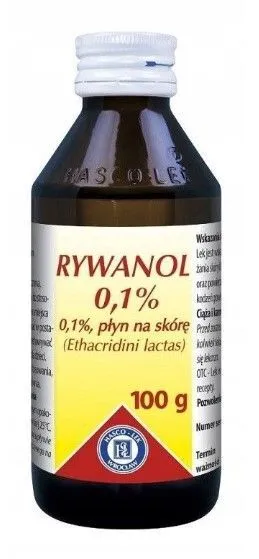
RIVANOL 0.1%
PolandThe medicinal product is used for the disinfection of the skin and superficial skin damage, such as epidermal abrasions.
Frequently asked questions
How to use Rivanol 0.1%?
The solution should be applied topically to the skin. Unless otherwise directed by a doctor, it is usually applied several times a day in the form of compresses, dressings, or rinses.
When should you not use this medicine?
Do not use it if you are allergic to the active substance or acridine dyes. The medicine must not be used in the eyes or taken orally. It should also not be applied to large areas of damaged skin.
What are the possible side effects?
Long-term use of Rivanol 0.1% may cause allergic reactions. If any adverse effects occur, contact a doctor or pharmacist.
Can this medicine be used with other preparations?
It should not be used simultaneously with oxidizing agents (e.g., hydrogen peroxide, potassium permanganate), tannins, anionic substances (polyethylene glycol), or with sodium borate solution, salicylic acid, or sodium chloride, as this may inactivate the medicine.
What precautions should be taken during use?
Avoid contact of the solution with clothing. Before starting use, it is advisable to consult a doctor or pharmacist, especially if you are pregnant or breastfeeding.
How should the medicine be stored?
It should be stored at a temperature below 25°C, in a closed package, protected from light, and out of reach of children. After opening the package, the medicine should be used within 30 days.
Instructions for use
Package leaflet: Information for the user
RIVANOL 0,1%, 1 mg/g, skin liquid
(Ethacridini lactas monohydricus)
Please read all of this leaflet carefully before you start using this medicine, because it
contains important information for you.
This medicine should always be used exactly as described in this patient leaflet or as
instructed by your doctor or pharmacist.
- Keep this leaflet so that you can read it again if necessary.
- If you need advice or further information, please consult your pharmacist.
- If you experience any adverse reactions, including any possible side effects not listed in this leaflet, inform your doctor or pharmacist. See section 4.
- If there is no improvement or if you feel worse, you should consult your doctor.
Contents of the leaflet
- What Rivanol 0.1% is and what it is used for
- Important information before using Rivanol 0.1%
- How to use Rivanol 0.1%
- Possible side effects
- How to store Rivanol 0.1%
- Contents of the pack and other information
1. What Rivanol 0.1% is and what it is used for
Rivanol 0.1% is a liquid for topical application to the skin. Rivanol 0.1% contains the active substance ethacridine lactate monohydrate, which belongs to the group of acridine dyes with antibacterial properties. Ethacridine lactate monohydrate acts against streptococci, staphylococci, and other Gram-positive bacteria.
Indications
Skin disinfection and superficial skin injuries (e.g. abrasions).
2. Important information before using Rivanol 0.1%
When not to use Rivanol 0.1%:
- if the patient is allergic to the active substance or acridine dyes,
- orally,
- in the eyes.
Warnings and precautions
Before starting to use Rivanol 0.1%, discuss this with a doctor or pharmacist.
Do not use the medicine for prolonged periods, as it may cause allergic reactions.
Do not apply to large areas of damaged skin.
Avoid contact of the medicine with clothing.
Discontinue use if symptoms of hypersensitivity occur.
Rivanol 0.1% and other medicines
Inform the doctor or pharmacist about all medicines currently used or recently used, as well as any medicines the patient plans to take.
Due to the risk of inactivation, do not use simultaneously with oxidizing agents (potassium permanganate, hydrogen peroxide), astringents (tannin), anionic substances (polyethylene glycol), or sodium borate solution, salicylic acid, sodium chloride.
Pregnancy, breastfeeding and fertility
If the patient is pregnant, breastfeeding, suspects she may be pregnant, or plans to have a child, she should consult a doctor before using this medicine.
There is lack of data regarding use during pregnancy and breastfeeding.
Driving and operating machinery
When used correctly, no influence on the ability to drive or operate machinery has been observed.
3. How to use Rivanol 0.1%
This medicine should always be used exactly as described in the patient leaflet or as advised by a doctor or pharmacist. If in doubt, consult a doctor or pharmacist.
This medicine is intended for topical application on the skin.
Unless otherwise advised by a doctor, the medicine is usually applied several times a day as compresses, dressings, or rinses.
Use in children
There is no data available on use in children.
If you feel that the effect of Rivanol 0.1% is too strong or too weak, consult a doctor.
Use of a higher than recommended dose of Rivanol 0.1%
There is no available data on overdose when used according to the indications and recommended method of administration.
Missed application of Rivanol 0.1%
If a dose of Rivanol 0.1% is missed, continue treatment as usual according to the recommendations.
If the medicine has been accidentally ingested, seek medical advice immediately.
4. Possible adverse reactions
Like all medicines, this medicine can cause adverse reactions, although not everyone will experience them.
Prolonged use of the medicine may cause allergic reactions.
If any of the adverse reactions worsen or if any adverse reactions not listed in the leaflet occur, a doctor or pharmacist should be consulted immediately.
Reporting adverse reactions
If any adverse reactions occur, including those not listed in this leaflet, inform your doctor, pharmacist, or nurse. Adverse reactions can be reported directly to the Department of Monitoring Adverse Drug Reactions of the Office for Registration of Medicinal Products, Medical Devices and Biocidal Products:
Al. Jerozolimskie 181 C, 02-222 Warsaw, tel.: +48 22 49-21-301, fax: +48 22 49-21-309,
website: https://smz.ezdrowie.gov.pl
Adverse reactions can also be reported to the marketing authorization holder.
Reporting adverse reactions helps to provide more information on the safety of the medicine.
5. How to store Rivanol 0.1%
Keep this medicine out of sight and reach of children.
Store below 25°C in the closed original container. Protect from light.
Do not use after the expiry date stated on the container. The expiry date refers to the last day of the specified month.
Use within 30 days after first opening the container.
Medicines must not be disposed of via wastewater or household waste. Ask your pharmacist how to dispose of medicines no longer required. These measures help protect the environment.
6. Other information
What Rivanol 0.1% contains
- The active substance is ethacridine lactate monohydrate. 1 g of the skin solution contains 1 mg of ethacridine lactate monohydrate.
- The other ingredient is: purified water.
What Rivanol 0.1% looks like and contents of the pack
The medicine is a yellow skin solution.
Available pack sizes
Orange glass bottles with a screw cap containing 50 g, 90 g, 100 g, 140 g, 150 g,
200 g, 250 g, 500 g, 1000 g of the medicine.
Not all pack sizes may be marketed.
Marketing Authorization Holder
Poland
Poznańskie Zakłady Zielarskie „Herbapol” S.A.
ul. Towarowa 47-51, 61-896 Poznań
tel. + 48 61 886 18 00, fax +48 61 853 60 58
Manufacturer
Poznańskie Zakłady Zielarskie „Herbapol” S.A.
Paterek, ul. Przemysłowa 3, 89-100 Nakło nad Notecią
tel. 52 386 73 10, fax 52 386 73 23
The original data is available in the language of the country of manufacture.
Data source: Register of Medicinal Products of Poland (URPL)
Data last verified: September 01, 2026