POLIBIOTIC
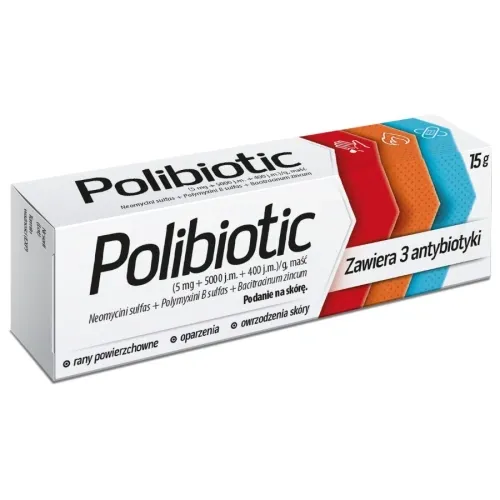
PolandIt is used for minor wounds, such as abrasions, scratches, or bites, as well as for burns and skin ulcers.
Frequently asked questions
How to use Polibiotic?
After cleaning the wound area, apply a small amount of ointment 2 to 5 times daily. The area may be covered with gauze or left uncovered. The medicine should not be used for longer than 7 days.
When should you not use this medicine?
Do not use it if you are allergic to any of the ingredients, have hearing or kidney disorders, if the medicine is being used in children under 12 years of age, or if the wounds are deep, puncture wounds, severe burns, or if the lesions are oozing. It must also not be used on the eyes or mucous membranes.
Can Polibiotic cause side effects?
Skin reactions (itching, rash, redness, swelling), hearing or kidney damage, and infection with bacteria or fungi to which the medicine is ineffective may occur.
Can this medicine be combined with other medicines?
Caution should be exercised, and the doctor should be informed about all medicines being taken. It must not be used simultaneously with potent diuretics (e.g., furosemide), as this may increase the risk of hearing damage.
What to do if there is no improvement after 7 days?
If the skin condition does not improve after 7 days or if the patient feels worse, a doctor should be contacted.
Instructions for use
Package leaflet: Information for the patient
Polibiotic, (5 mg + 5000 IU + 400 IU)/g, ointment
Neomycini sulfas + Polymyxini B sulfas + Bacitracinum zincum
Please read this leaflet carefully before using the medicine, as it contains
important information for the patient.
This medicine should always be used exactly as described in this patient leaflet or according to
the instructions given by the doctor or pharmacist.
- Keep this leaflet, so that you can read it again if necessary.
- If you need advice or further information, please consult your pharmacist.
- If you experience any adverse reactions, including any adverse reactions not listed in this leaflet, inform your doctor or pharmacist. See section 4.
- If there is no improvement after 7 days of treatment, or if you feel worse, consult your doctor.
Table of contents
- What Polibiotic is and what it is used for
- Important information before using Polibiotic
- How to use Polibiotic
- Possible side effects
- How to store Polibiotic
- Contents of the pack and other information
1. What Polibiotic is and what it is used for
Polibiotic is an ointment for topical application to the skin.
Polibiotic contains three active antibiotic substances: neomycin, polymyxin B, and bacitracin,
which have complementary antibacterial spectra of activity against bacteria responsible for most skin infections.
Indications
Polibiotic is indicated for minor wounds (abrasions, scratches, bites), burns,
and skin ulcers.
If there is no improvement after 7 days of treatment, or if you feel worse, consult your doctor.
2. Information before using Polibiotic
When not to use Polibiotic
- if the patient is allergic to neomycin or polymyxin B, or bacitracin, or any of the other ingredients of this medicine (listed in section 6);
- if the patient has hearing disorders (the medicine may have ototoxic effects);
- on deep or puncture wounds, severe burns, or large areas of damaged skin, and on oozing lesions; due to the risk of active substances being absorbed into the bloodstream and causing systemic adverse effects (ototoxicity, nephrotoxicity);
- in the eyes or on mucous membranes;
- in children under 12 years of age.
Warnings and precautions
Before starting to use Polibiotic, discuss this with your doctor or pharmacist.
If an allergic reaction to Polibiotic occurs, discontinue use immediately and consult a doctor without delay.
Before using Polibiotic, inform your doctor:
- if the patient is allergic to any aminoglycoside antibiotics (e.g. streptomycin, gentamicin, tobramycin) or polymyxins, as the patient may also be allergic to Polibiotic;
- if the patient has impaired kidney function, as this increases the risk of Polibiotic causing kidney and hearing damage.
Prolonged use of Polibiotic may lead to overgrowth of microorganisms resistant to the drug, including bacteria and fungi.
If adverse effects occur, especially irritation at the application site, or if there is no improvement, discontinue use of Polibiotic and consult a doctor.
Application of Polibiotic on large areas of damaged skin may result in hearing loss, kidney damage, and neurotoxic effects.
Children
Do not use in children under 12 years of age due to the risk of kidney and hearing damage.
Use in patients with impaired kidney function or hearing impairment
Patients with impaired kidney function, hearing impairment, or those concurrently using other medicines that may damage the kidneys or hearing, should consult a doctor before using Polibiotic.
Use in elderly patients
There are no specific recommendations for the use of Polibiotic in elderly patients. However, patients with impaired kidney function should consult a doctor before using Polibiotic.
Polibiotic with other medicines
Inform your doctor or pharmacist about all medicines the patient is currently using or has recently used, as well as any medicines the patient plans to use.
Following application of Polibiotic on large skin areas or damaged skin, systemic absorption may occur, potentially leading to interactions with other concurrently administered medicines.
Inform your doctor if the patient is taking oral neomycin, as this may increase the risk of allergic reactions.
Do not use Polibiotic simultaneously with medicines that may damage the kidneys or hearing, such as potent diuretics (e.g. furosemide, ethacrynic acid). When such drugs are administered together with aminoglycoside antibiotics (e.g. neomycin contained in Polibiotic), they increase their blood concentration, thereby increasing the risk of hearing disorders, including deafness, which may occur even after discontinuation of Polibiotic.
Concurrent use of Polibiotic with medicines that may damage the kidneys or nervous system may result in additive adverse effects.
Pregnancy and breastfeeding
If the patient is pregnant or breastfeeding, suspects she may be pregnant, or is planning to become pregnant, she should consult a doctor or pharmacist before using this medicine.
Due to lack of adequate studies, Polibiotic should not be used during pregnancy and breastfeeding.
Driving and operating machinery
No effects of Polibiotic on the ability to drive or operate machinery have been observed.
3. How to use Polibiotic
This medicine should always be used exactly as described in this patient information leaflet or as directed by a doctor or pharmacist. If in doubt, consult a doctor or pharmacist.
Application to the skin.
Recommended dose
Clean the affected area and cover it with a small amount of the medicine.
Apply the ointment to the affected skin 2 to 5 times daily.
After application, the area may be covered with a gauze dressing or left uncovered.
Do not use for longer than 7 days.
After completing treatment, do not reapply Polibiotic for at least 3 months.
Use in children
Do not use in children under 12 years of age due to the risk of kidney and hearing damage.
Use of more than the recommended dose of Polibiotic
When the medicine is applied to mucous membranes or over large areas of skin (especially damaged skin), systemic adverse effects may occur. This particularly applies to patients with impaired kidney function. Symptoms may include kidney damage, hearing impairment, and neurotoxic effects of the drug.
If more than the recommended dose of Polibiotic has been used, stop using the medicine and contact a doctor.
Missed dose of Polibiotic
Do not use a double dose to make up for a missed dose.
If you have any further doubts about using this medicine, consult your doctor or pharmacist.
4. Possible adverse effects
Like all medicines, this medicine can cause adverse effects, although not everybody will experience them.
Possible adverse effects include:
- hypersensitivity symptoms, including skin reactions (itching, rash, redness, swelling and other signs of irritation);
- hearing damage;
- kidney damage;
- infection with resistant strains of bacteria or fungi.
Reporting of adverse effects
If any adverse effects occur, including any adverse effects not listed
in this leaflet, inform your doctor or pharmacist. Adverse effects can
be reported directly to the Department of Monitoring of Adverse Drug Reactions of the Office for Registration of Medicinal Products, Medical Devices and Biocidal Products,
Al. Jerozolimskie 181C, 02-222 Warsaw,
tel.: + 48 22 49 21 301,
fax: + 48 22 49 21 309,
website: https://smz.ezdrowie.gov.pl.
Adverse effects can also be reported to the marketing authorization holder.
Reporting adverse effects helps to provide more information on the safety of the medicine.
5. How to store Polibiotic
Keep this medicine out of sight and reach of children.
Do not use this medicine after the expiry date (EXP) stated on the packaging. The expiry date refers to the last day of the stated month.
Shelf-life after first opening of the tube:
- aluminium tube 3 g and 5 g: 7 days;
- aluminium tube 15 g: 3 years, but not beyond the expiry date stated on the packaging.
Aluminium tube:
No special storage precautions are required.
PET/PE/Aluminium/PE foil sachets:
Store below 25°C.
Medicines must not be disposed of via the sewage system or household waste. Ask your pharmacist how to dispose of medicines no longer required. Such practices help protect the environment.
6. Contents of the pack and other information
What Polibiotic contains
- The active substances are: neomycin sulfate, polymyxin B sulfate, and zinc bacitracin. Each 1 g of ointment contains 5 mg neomycin sulfate, 5,000 i.u. polymyxin B sulfate, and 400 i.u. zinc bacitracin.
- Other ingredient: white soft paraffin.
What Polibiotic looks like and contents of the pack
Polibiotic is an ointment.
The packaging contains:
- An internally lacquered aluminium tube with a membrane, closed with a cap made of HDPE, containing 3 g, 5 g or 15 g of ointment, placed in a cardboard box,
- 10 sachets made of PET/PE/Aluminium/PE laminate, each containing 1 g of ointment, placed in a cardboard box.
Marketing Authorisation Holder and Manufacturer
Aflofarm Farmacja Polska Sp. z o.o.
ul. Partyzancka 133/151,
95-200 Pabianice
Tel. (42) 22-53-100
Similar drugs
| Brand name | Dosage form | Active substance / Dosage | Manufacturer |
|---|---|---|---|
| MAXIBIOTIC | ointment | EMO-FARM Sp. z o.o. | |
| MULTIBIOTIC | ointment | Chema-Elektromet Cooperative of Work |
The original data is available in the language of the country of manufacture.
Data source: Register of Medicinal Products of Poland (URPL)
Data last verified: September 01, 2026