PACLITAXEL KABI
PolandThe medicinal product is used to treat cancers such as: ovarian cancer, breast cancer, advanced non-small cell lung cancer, and Kaposi's sarcoma in patients with AIDS.
Frequently asked questions
How should Paclitaxel Kabi be administered?
The medicinal product is administered intravenously only by infusion (drip) by specialized medical personnel. It is usually administered every 2 or 3 weeks, and the duration of the infusion is from 3 to 24 hours.
When should you not use this medicine?
You must not use it if you are allergic to any of the ingredients of the medicine (especially castor oil polyoxylated macrogol), while breastfeeding, if you have a low white blood cell count, or in the case of severe and uncontrolled infection (in patients with Kaposi's sarcoma). Use in children under 18 years of age is not recommended.
What are the possible side effects of Paclitaxel Kabi?
The most common symptoms are alopecia (hair loss), muscle and joint pain, nausea, vomiting, diarrhea, sore throat, and numbness or weakness of the arms and legs. Allergic reactions (e.g., shortness of breath, rash, swelling) and respiratory or urinary tract infections may also occur.
Does the medicine interact with other agents?
Yes, caution should be exercised and the use of the medicine should be discussed with a doctor if you are taking, among others, antibiotics (e.g., erythromycin), antifungals, antidepressants, anticonvulsants, heartburn medications, HIV medications, or clopidogrel.
Should contraception be used during treatment?
Yes. Women and men of reproductive age and their partners must use effective methods of contraception for at least 6 months after the completion of treatment. Men should consult a doctor regarding sperm storage due to the risk of infertility.
Instructions for use
Table of contents
- 1. What Paclitaxel Kabi is and what it is used for
- 2. Important information before using Paclitaxel Kabi
- 3. How to use Paclitaxel Kabi
- 4. Possible adverse effects
- 5. How to store Paclitaxel Kabi
- 6. Contents of the pack and other information
- Information intended exclusively for healthcare professionals:
Package leaflet: Information for the user
Paclitaxel Kabi, 6 mg/ml, concentrate for solution for infusion
Paclitaxelum
Please read all of this leaflet carefully before using this medicine, because it contains
important information for you.
Keep this leaflet, as you may need to read it again.
If you have any further questions, please ask your doctor or nurse.
If you experience any side effects, including any not listed in this leaflet, tell your doctor or nurse.
See section 4.
Contents of the leaflet
- What Paclitaxel Kabi is and what it is used for
- What you need to know before you use Paclitaxel Kabi
- How to use Paclitaxel Kabi
- Possible side effects
- How to store Paclitaxel Kabi
- Contents of the pack and other information
1. What Paclitaxel Kabi is and what it is used for
Paclitaxel Kabi belongs to a group of anticancer medicines known as "taxanes". These medicines inhibit the growth of cancer cells.
Paclitaxel Kabi is used in the treatment of the following cancers:
Ovarian cancer:
as first-line treatment (after initial surgery, in combination with a platinum-containing medicine, cisplatin);
when other treatments using conventional platinum-containing medicines have failed.
Breast cancer:
as first-line treatment for advanced disease or disease that has spread to other parts of the body (metastases). Paclitaxel Kabi is used in combination with an anthracycline (e.g. doxorubicin) or with trastuzumab (in patients who cannot be treated with anthracyclines and in whom the tumour cells express HER2 receptors);
as adjuvant therapy following treatment with an anthracycline and cyclophosphamide (AC);
as second-line treatment in patients in whom standard anthracycline-based therapy has failed or in whom anthracycline therapy is not appropriate.
Advanced non-small cell lung cancer:
in combination with cisplatin in patients who are not candidates for surgery and/or radiotherapy.
Kaposi’s sarcoma associated with AIDS:
in patients in whom other treatments (e.g. treatment with liposomal formulations of anthracyclines) have been ineffective.
2. Important information before using Paclitaxel Kabi
When not to use Paclitaxel Kabi:
if the patient is allergic to paclitaxel or any of the other ingredients of this medicine
(listed in section 6), especially to macrogolglycerol ricinoleate
(polyoxyethylated castor oil);
during breastfeeding;
in patients with reduced white blood cell count (baseline neutrophil count
<1.5 × 10⁹/l or <1.0 × 10⁹/l in patients with Kaposi’s sarcoma – medical advice should be sought);
the doctor will perform a blood test to check whether the patient has an adequate number of blood cells;
in the presence of severe and uncontrolled infection, exclusively
in patients receiving Paclitaxel Kabi for the treatment of Kaposi’s sarcoma.
If any of the above conditions apply to the patient, the doctor must be informed before starting
treatment with Paclitaxel Kabi.
Use of Paclitaxel Kabi is not recommended in children (under 18 years of age).
Warnings and precautions
Before starting treatment with Paclitaxel Kabi, discuss this with your doctor.
To minimize allergic reactions, the patient will be given other medications prior to receiving Paclitaxel Kabi.
If the patient experiences allergic reactions (such as difficulty breathing, feeling of suffocation, chest tightness, drop in blood pressure, dizziness, feeling of emptiness in the head, skin reactions such as rash or swelling).
If the patient develops fever, severe chills, sore throat, or mouth ulcers (signs of bone marrow suppression).
If the patient experiences numbness, tingling, pricking sensations, sensitivity to touch, or weakness in hands and feet (symptoms of peripheral neuropathy), a dose reduction of Paclitaxel Kabi may be necessary.
If the patient has severe liver function impairment, use of Paclitaxel Kabi is not recommended.
If the patient has heart conduction disorders.
If the patient develops severe or persistent diarrhoea with fever and abdominal pain during or shortly after treatment with Paclitaxel Kabi; this may be due to inflammation of the bowel (pseudomembranous colitis).
If the patient has previously undergone radiotherapy to the chest (as this may increase the risk of lung inflammation).
If the patient develops pain or redness in the mouth (symptoms of oral mucositis) and is being treated for Kaposi’s sarcoma, a lower dose may be required.
Due to the risk of extravasation, close monitoring of the infusion site for possible leakage during administration is recommended.
If any of the above events affect the patient, the doctor must be informed immediately.
Paclitaxel Kabi must be administered intravenously only. Intra-arterial administration of Paclitaxel Kabi may cause arterial inflammation, leading to pain, swelling, redness, and burning sensation.
Paclitaxel Kabi and other medicines
If the patient is taking paclitaxel together with any of the following medicines, this should be discussed with the doctor:
anticancer drugs (e.g. antibiotics such as erythromycin, rifampicin; if the patient is unsure whether a medicine is an antibiotic, they should consult their doctor, nurse, or pharmacist), including antifungal agents (e.g. ketoconazole);
medicines used to stabilize mood, sometimes called antidepressants (e.g. fluoxetine);
medicines used to treat seizures (epilepsy) (e.g. carbamazepine, phenytoin);
medicines used to lower blood lipid levels (e.g. gemfibrozil);
medicines used to treat heartburn or stomach ulcers (e.g. cimetidine);
medicines used in the treatment of HIV and AIDS (e.g. ritonavir, saquinavir, indinavir, nelfinavir, efavirenz, nevirapine);
a medicine called clopidogrel, used to prevent blood clots.
The alcohol content in this medicine may alter the effects of other medicines. If the patient is taking other medicines, they should consult their doctor or pharmacist.
Pregnancy, breastfeeding and effects on fertility
If the patient is pregnant or suspects she may be pregnant, the doctor must be informed before starting treatment with Paclitaxel Kabi. If there is a possibility of becoming pregnant during treatment, effective and safe contraceptive methods must be used. Use of Paclitaxel Kabi during pregnancy is not recommended unless absolutely necessary.
Men and women of reproductive age, as well as their partners, must use contraception for at least 6 months after completion of paclitaxel treatment. Men should seek advice before treatment regarding sperm storage due to the risk of irreversible infertility.
If the patient is breastfeeding, she must inform the doctor. It is not known whether paclitaxel passes into human milk. Due to the potential harmful effect of the medicine on the infant, breastfeeding must be discontinued during treatment with Paclitaxel Kabi. Breastfeeding should not be resumed until the doctor advises otherwise.
Driving and using machines
There is no reason why the patient cannot drive between treatment cycles. However, it should be noted that Paclitaxel Kabi contains a certain amount of alcohol, and driving immediately after receiving the medicine is not recommended due to possible effects on the central nervous system. As in any case, driving or operating machinery should be avoided if dizziness or a feeling of emptiness in the head occur.
The alcohol content in this medicine may affect the ability to drive and operate machinery, as it may impair judgment and reaction speed.
Paclitaxel Kabi contains macrogolglycerol ricinoleate and alcohol
The medicine contains macrogolglycerol ricinoleate, which may cause severe allergic reactions. The doctor should be informed if the patient is allergic to this ingredient of Paclitaxel Kabi.
This medicine contains 393 mg of alcohol (ethanol) per 1 ml, equivalent to 39.3% w/v. The amount of alcohol in a 52.5 ml dose of this medicine is equivalent to 515.8 ml of beer or 206.3 ml of wine.
If the patient has epilepsy or liver problems, they should consult their doctor or pharmacist before using this medicine.
If the patient is alcohol-dependent, they should consult their doctor or pharmacist before using this medicine.
3. How to use Paclitaxel Kabi
To minimize allergic reactions, patients will receive other medications before starting treatment with Paclitaxel Kabi.
These medications may be administered as tablets, intravenous infusions, or both.
Paclitaxel Kabi is given as an intravenous infusion through a dedicated venous line, using an in-line filter provided in the set. Paclitaxel Kabi is administered by trained medical personnel.
The medical staff will prepare the infusion solution prior to administration. The dose will depend on the patient's blood test results. Depending on the type and severity of the tumor, Paclitaxel Kabi may be used as monotherapy or in combination with another anticancer drug.
Paclitaxel Kabi must always be administered intravenously over 3 or 24 hours. The drug is usually given every 2 or 3 weeks, unless otherwise directed by the physician. The physician will inform the patient about the number of treatment cycles with Paclitaxel Kabi required.
If you have any further questions regarding the use of this medicine, consult your doctor or pharmacist.
4. Possible adverse effects
Like all medicines, this medicine can cause adverse effects, although not everyone will experience them.
You should inform your doctor immediately if any symptoms of an
allergic reaction occur, including one or more of the following:
hot flushes;
skin reactions;
itching;
chest tightness;
shortness of breath or difficulty breathing;
swelling.
All of these reactions may be signs of serious adverse effects.
You should contact your doctor immediately if the following occur:
fever, severe chills, sore throat or mouth ulcers (symptoms of bone marrow suppression);
numbness or weakness in hands and feet (symptoms of peripheral neuropathy);
severe or prolonged diarrhoea accompanied by fever and stomach pain.
Very common (may occur in more than 1 in 10 patients):
mild allergic reactions such as hot flushes, rash, itching;
infections: mainly upper respiratory tract and urinary tract infections;
sore throat or mouth ulcers, mouth pain or redness, diarrhoea, malaise (nausea, vomiting);
hair loss (in most cases, hair loss began within one month of starting paclitaxel treatment. In most of these patients, visible hair loss occurred (over 50%));
muscle pain, cramps, joint pain;
numbness, tingling or weakness in hands and feet (symptoms of peripheral neuropathy); these may persist for more than 6 months after completion of paclitaxel treatment;
laboratory tests may show: reduced platelet count, which may lead to bleeding and increased tendency to bruising, reduced white or red blood cell counts, and low blood pressure.
Common (may occur in less than 1 in 10 patients):
transient, mild nail changes and skin disorders, injection site reactions (local swelling, pain, skin redness);
laboratory tests may show: reduced heart rate, significant increase in liver enzyme activity (alkaline phosphatase and aspartate aminotransferase).
Uncommon (may occur in less than 1 in 100 patients):
infection-induced shock (known as "septic shock");
palpitations, heart dysfunction (atrioventricular block, cardiomyopathy), rapid heartbeat, heart attack, respiratory failure;
fatigue, sweating, fainting, severe allergic reactions, phlebitis, swelling of the face, lips, mouth, tongue or throat;
back pain, chest pain, pain in hands and feet, chills, abdominal pain;
laboratory tests may show: significant increase in bilirubin levels (jaundice), high blood pressure, blood clots.
Rare (may occur in less than 1 in 1000 patients):
decreased white blood cell count with fever and increased risk of infection (febrile neutropenia);
nerve disorders, including muscle weakness in arms and legs (motor neuropathy);
heart failure;
feeling short of breath, pulmonary embolism, pulmonary fibrosis, interstitial lung disease, dyspnoea, pleural effusion;
intestinal obstruction, intestinal perforation, ischaemic colitis, pancreatitis;
itching, rash, skin redness (erythema);
blood infection (septicaemia), peritonitis, pneumonia;
fever, dehydration, weakness, oedema and malaise;
severe, life-threatening allergic reactions (anaphylactic reactions);
laboratory tests may show: increased blood creatinine levels, indicating impaired kidney function.
Very rare (may occur in less than 1 in 10,000 patients):
irregular, rapid heart rhythm (atrial fibrillation, supraventricular tachycardia);
sudden disorders of blood-forming cells (acute myeloid leukaemia, myelodysplastic syndrome);
optic nerve and (or) vision disturbances (scintillating scotomata);
hearing loss or disturbances (ototoxicity), tinnitus, vertigo of labyrinthine origin;
cough;
blood clots in abdominal and intestinal blood vessels (mesenteric thrombosis), colitis, sometimes with persistent severe diarrhoea (pseudomembranous colitis, colitis during neutropenia), ascites, oesophagitis, constipation;
severe hypersensitivity reactions, including fever, skin redness, joint pain and (or) eye inflammation (Stevens-Johnson syndrome), localised skin peeling (necrolysis), erythema with irregular red patches (exudates) (erythema multiforme), blistering and peeling skin inflammation (exfoliative dermatitis), urticaria, nail separation from the nail bed (patients undergoing treatment should use sunscreen cream on hands and feet);
loss of appetite (anorexia);
severe, life-threatening hypersensitivity reactions with shock (anaphylactic shock);
liver function disorders (hepatic necrosis, hepatic encephalopathy (fatal cases reported));
confusion;
grand mal seizures, nerve damage in the brain (autonomic neuropathy affecting involuntary body functions, which may cause intestinal obstruction and low blood pressure), convulsions, brain dysfunction (encephalopathy), dizziness, headaches, coordination difficulties (ataxia).
Frequency not known (cannot be estimated from available data):
tumour lysis syndrome (also known as tumour lysis syndrome);
fluid accumulation in the macula (macular oedema), perception of light phenomena such as flashes (photopsia), deposits in the vitreous body (vitreous opacities);
phlebitis;
thickening and hardening of the skin, blood vessels and internal organs (scleroderma);
systemic lupus erythematosus (butterfly-shaped rash);
coagulation disorders; cases of disseminated intravascular coagulation (DIC) have been reported; this is a serious condition causing excessive bleeding, excessive clotting, or both simultaneously;
redness and swelling of the palms and soles, which may lead to skin peeling.
Reporting of adverse effects
If any adverse effects occur, including any adverse effects not listed in this leaflet, you should inform your doctor, pharmacist or nurse. Adverse effects can be reported directly to the Department of Monitoring of Adverse Drug Reactions of the Office for Registration of Medicinal Products, Medical Devices and Biocidal Products
Al. Jerozolimskie 181C
02-222 Warsaw
Phone: +48 22 49 21 301
Fax: +48 22 49 21 309
Website: https://smz.ezdrowie.gov.pl
Adverse effects can also be reported to the marketing authorisation holder.
Reporting adverse effects helps provide more information on the safety of the medicine.
5. How to store Paclitaxel Kabi
Keep the medicine out of sight and reach of children.
Do not store above 25°C.
Store the vials in the outer packaging to protect from light.
Do not use this medicine after the expiry date stated on the label and carton following: EXP.
The expiry date refers to the last day of the stated month.
Do not use this medicine if cloudiness or insoluble precipitate is observed.
Medicines must not be disposed of via wastewater or household waste. Ask your pharmacist how to dispose of medicines no longer required. Such measures will help protect the environment.
6. Contents of the pack and other information
What Paclitaxel Kabi contains
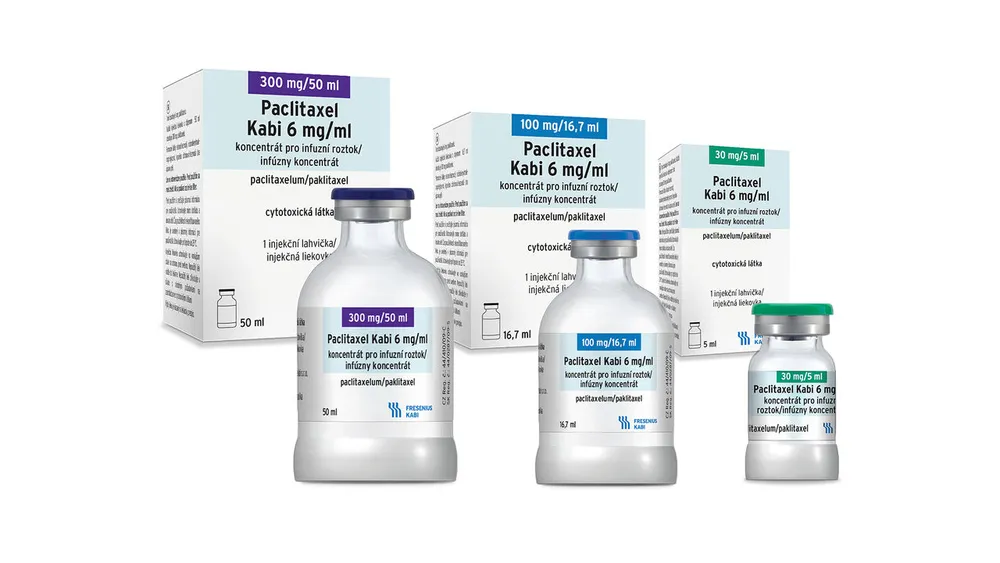
The active substance is paclitaxel. Each ml contains 6 mg of paclitaxel.
Each 5 ml vial contains 30 mg of paclitaxel.
Each 16.7 ml vial contains 100 mg of paclitaxel.
Each 25 ml vial contains 150 mg of paclitaxel.
Each 50 ml vial contains 300 mg of paclitaxel.
Each 100 ml vial contains 600 mg of paclitaxel.
Other ingredients: ethanol anhydrous, polyoxyethylated castor oil (macrogol glycerol hydroxystearate), and citric acid anhydrous (for pH adjustment).
What Paclitaxel Kabi looks like and contents of the pack
Concentrate for solution for infusion.
Paclitaxel Kabi is a clear, slightly yellowish solution.
The medicinal product is available in glass vials with a chlorobutyl rubber stopper coated with Teflon.
Pack sizes:
Packs contain 1 or 5 glass vials.
Not all pack sizes may be marketed.
Marketing Authorisation Holder and Manufacturer
Marketing Authorisation Holder:
Fresenius Kabi Polska Sp. z o.o.
Al. Jerozolimskie 134
02-305 Warsaw
Poland
Manufacturer:
Fresenius Kabi Deutschland GmbH
Pfingstweide 53
61169 Friedberg
Germany
Corden Pharma Latina S.p.A.
Via Murillo No. 7
04013 Sermoneta (LT)
Italy
For further information, please contact the Marketing Authorisation Holder:
Fresenius Kabi Polska Sp. z o.o.
Al. Jerozolimskie 134
02-305 Warsaw
Poland
Tel. +48 22 345 67 89
This medicinal product is authorised in the Member States of the European Economic Area under the following names:
| Austria | Paclitaxel Kabi 6 mg/ml concentrate for solution for infusion |
| Belgium | Paclitaxel Fresenius Kabi |
| Bulgaria | Paclitaxel Kabi 6 mg/ml concentrate for solution for infusion |
| Czech Republic | Paclitaxel Kabi |
| Denmark | Paclitaxel Fresenius Kabi 6 mg/ml concentrate for infusion solution, solution |
| Estonia | Paclitaxel Kabi 6 mg/ml concentrate for infusion solution |
| Finland | Paclitaxel Fresenius Kabi 6 mg/ml concentrate for infusion, solution for preparation |
| France | Paclitaxel Kabi 6 mg/ml solution to dilute for infusion |
| Spain | Paclitaxel Fresenius Kabi 6 mg/ml concentrate for perfusion solution |
| Netherlands | Paclitaxel Fresenius Kabi |
| Ireland | Paclitaxel 6 mg/ml concentrate for solution for infusion |
| Latvia | Paclitaxel Kabi 6 mg/ml concentrate for infusion solution |
| Lithuania | Paclitaxel Kabi 6 mg/ml concentrate for infusion solution |
| Luxembourg | Paclitaxel Kabi 6 mg/ml concentrate for solution for infusion |
| Germany | Paclitaxel Kabi 6 mg/ml concentrate for solution for infusion |
| Norway | Paclitaxel Fresenius Kabi 6 mg/ml concentrate for infusion solution |
| Poland | Paclitaxel Kabi |
| Portugal | Paclitaxel Kabi 6 mg/ml concentrate for perfusion solution |
| Romania | Paclitaxel Kabi 6 mg/ml concentrate for perfusion solution |
| Slovakia | Paclitaxel Kabi 6 mg/ml |
| Slovenia | Paclitaxel Kabi 6 mg/ml concentrate for infusion solution |
| Sweden | Paclitaxel Fresenius Kabi 6 mg/ml concentrate for infusion solution, solution |
| Hungary | Paclitaxel Kabi 6 mg/ml concentrate for infusion solution |
| United Kingdom | Paclitaxel 6 mg/ml concentrate for solution for infusion |
| Italy | Paclitaxel Kabi 6 mg/ml concentrate for infusion solution |
Information intended exclusively for healthcare professionals:
Preparation:
As with other antineoplastic agents, caution should be exercised when preparing paclitaxel for administration. Dilution must be performed by trained personnel in a specially designated area under aseptic conditions. Appropriate protective gloves should be used. Precautions should be taken to avoid contact with skin and mucous membranes. In case of skin contact, the affected area should be thoroughly washed with soap and water. Local reactions such as tingling, burning, and redness of the skin have been observed following skin contact. In the event of contact with mucous membranes, they should be immediately rinsed with water. Inhalation of solution vapors has been associated with bronchospasm, chest pain, burning sensation in the throat, and nausea.
During storage of unopened vials in the refrigerator, a precipitate may form, which will redissolve upon gentle shaking or without shaking once room temperature is reached. This does not affect the quality of the drug. If the solution remains cloudy or the precipitate does not dissolve, the vial should be discarded.
When multiple needle insertions and drug withdrawals are performed, vials maintain microbiological, chemical, and physical stability for 28 days at 25°C. The user is responsible for any other storage conditions and duration.
Do not use Chemo-Dispensing Pin-type devices or similar applicators with spikes to withdraw doses from the vial, as they may damage the stopper, thus compromising sterility.
Preparation of infusion solution for intravenous administration:
Prior to intravenous infusion, paclitaxel must be aseptically diluted in 5% glucose solution, 0.9% sodium chloride solution, 5% glucose in Ringer's solution, or 5% glucose with 0.9% sodium chloride solution to achieve a concentration between 0.3 and 1.2 mg/mL.
The prepared infusion solution maintains chemical and physical stability at 25°C for 24 hours when diluted in 5% glucose solution, 0.9% sodium chloride solution, 5% glucose in Ringer's solution, or 5% glucose/0.9% sodium chloride solution. From a microbiological standpoint, the product should be used immediately. If not administered immediately, the person administering the drug is responsible for the storage time and conditions prior to administration. In such cases, the solution should not be stored for longer than 24 hours at 2°C to 8°C, unless reconstitution and dilution were performed under controlled and validated aseptic conditions.
After dilution, the solution is intended for single use only.
After preparation, solutions may appear slightly cloudy due to the properties of the excipients; this cannot be removed by filtration. Paclitaxel should be administered intravenously using an infusion set equipped with an in-line filter containing a microporous membrane with a pore size of ≤0.22 μm. In testing studies, no significant loss of drug activity was observed when the solution was administered through an intravenous infusion set with an in-line filter.
Rare cases of precipitation have been reported during paclitaxel infusion, usually toward the end of a 24-hour infusion. Although the cause of precipitation has not been fully elucidated, it is likely related to supersaturation of the diluted solution. To reduce the risk of precipitation, paclitaxel should be administered as soon as possible after dilution, and vigorous shaking or agitation of the solution should be avoided. Infusion sets should be thoroughly flushed before use. The appearance of the solution should be checked regularly during intravenous infusion, and infusion should be discontinued if precipitation occurs.
To reduce the risk of patient exposure to DEHP (di-(2-ethylhexyl)phthalate), which may leach from PVC bags, infusion sets, and other medical equipment, the diluted paclitaxel solution should be stored in containers made of non-PVC materials (e.g., glass, polypropylene) or in plastic bags made of polypropylene or polyolefin, and administered via infusion sets lined with polyethylene. The use of infusion sets with filters (e.g., IVEX-2) that have short inlet or outlet tubing made of PVC does not result in significant leaching of DEHP.
Safety instructions for preparation of infusion solution
- All procedures must be performed in a dedicated room or containment unit. Protective gloves and gowns must be worn. If a separate room or containment unit is not available, a mask and protective goggles must be used.
- Pregnant women or women of childbearing potential should not prepare this drug.
- Opened containers such as vials and bottles, and used cannulas, syringes, catheters, tubing, and cytostatic waste should be considered hazardous waste and disposed of in accordance with local regulations for handling HAZARDOUS WASTE.
- In case of spillage of the solution, follow these instructions:
- Put on protective clothing
- Collect broken glass and place it in a container for HAZARDOUS WASTE
- Contaminated surfaces should be thoroughly rinsed using generous amounts of cold water
- After rinsing, dry the surfaces with absorbent material, and dispose of all cleaning materials according to recommendations for handling HAZARDOUS WASTE.
- In case of skin contact with paclitaxel, the affected area should be flushed thoroughly with water and then washed with soap and water. In case of contact with mucous membranes, immediately rinse thoroughly with water. If any discomfort occurs, seek medical advice.
- If paclitaxel gets into the eyes, rinse thoroughly with a large amount of cold water. Seek immediate consultation with an ophthalmologist.
Disposal of waste
All unused remnants of the medicinal product and its waste materials must be disposed of in accordance with local regulations regarding cytotoxic drugs.
Similar drugs
| Brand name | Dosage form | Active substance / Dosage | Manufacturer |
|---|---|---|---|
| PACLITAXEL ACCORD | solution for infusion, concentrate |
|
Accord Healthcare Polska Sp. z o.o. |
| PACLITAXEL-EBEWE | solution for infusion, concentrate |
|
Ebewe Arzneimittel Ges.m.b.H. |
The original data is available in the language of the country of manufacture.
Data source: Register of Medicinal Products of Poland (URPL)
Data last verified: September 01, 2026