OVIXAN
PolandThe drug has anti-inflammatory properties and reduces itching. It is used to relieve the symptoms of inflammatory skin diseases, such as psoriasis or certain types of dermatitis.
Frequently asked questions
How to use Ovixan?
Once daily, carefully apply a thin layer of cream to the skin lesions. Use only a small amount of the product, in accordance with the doctor's recommendations.
When should you not use this cream?
Do not use it if you are allergic to any of the ingredients of the drug, if you have acne, rosacea, viral infections (e.g., herpes), bacterial or fungal infections, or if you have skin wounds or ulcers. It must also not be applied to the eyelids.
What are the possible side effects?
Side effects may include, among others, burning, itching, irritation, dry skin, skin discoloration, blurred vision, or pain at the application site. In children, long-term use may lead to growth inhibition or the development of Cushing's syndrome.
Can the medication be stopped suddenly?
Do not stop use suddenly if the cream has been used for a long time, as this may cause a recurrence of the disease (redness, burning, and stinging of the skin). The dosage should be reduced gradually under medical supervision.
Can the drug be used during pregnancy or breastfeeding?
Use in these cases may only be initiated on a doctor's prescription. In such cases, avoid using large amounts of the cream and use it for a short period. During breastfeeding, do not apply the drug to the breasts.
Can the cream be used on the face?
The cream must not be applied to the facial skin without an explicit recommendation from a doctor.
Instructions for use
Package leaflet: Information for the user
Ovixan, 1 mg/g, cream
mometasone furoate
Please read carefully the entire leaflet before using the medicine, as it contains
important information for the patient.
- Keep this leaflet, so that you can read it again if necessary.
- If you have any questions, please consult your doctor or pharmacist.
- This medicine has been prescribed for a specific individual. Do not pass it on to others. The medicine may harm another person, even if their symptoms are the same.
- If you experience any adverse reactions, including any not listed in this leaflet, inform your doctor or pharmacist. See section 4.
Table of contents:
- What Ovixan is and what it is used for
- Important information before using Ovixan
- How to use Ovixan
- Possible side effects
- How to store Ovixan
- Contents of the pack and other information
1. What Ovixan is and what it is used for
Ovixan contains the active substance mometasone furoate and is a corticosteroid for topical use on the skin. Topical corticosteroids are divided into four classes according to their potency and effect: mild, moderate, potent, and very potent. Mometasone furoate belongs to the class "potent corticosteroids".
Adults and children aged 2 years and older:
Ovixan has anti-inflammatory properties and reduces itching. Ovixan is used to reduce symptoms associated with inflammatory skin diseases that should be treated with glucocorticosteroids, e.g. psoriasis (except extensive plaque psoriasis) and certain types of dermatitis. The medicine does not cure the skin disease, but relieves the symptoms.
2. Important information before using Ovixan
When not to use Ovixan
- if the patient is allergic to mometasone furoate, other corticosteroids, or any of the other ingredients of this medicine (listed in section 6).
- in case of other skin diseases which may worsen, particularly rosacea (a skin condition of the face), acne, perioral dermatitis (inflammation of the skin), skin atrophy, genital and anal itching, diaper dermatitis, bacterial infections such as impetigo, tuberculosis (lung disease), syphilis (sexually transmitted disease), viral infections such as cold sores, shingles, chickenpox, athlete's foot (red, itchy and peeling skin on the feet), or Candida genital infection which may cause discharge and itching, or other skin conditions.
- if the patient has recently experienced adverse reactions following vaccination (e.g. against influenza).
- on wounds and skin ulcers.
Warnings and precautions
Before starting to use Ovixan, discuss this with your doctor, pharmacist, or nurse.
- Tell your doctor if you are pregnant, think you may be pregnant, or are breastfeeding.
- Inform your doctor immediately if you experience irritation or hypersensitivity during treatment with Ovixan.
- As with all potent topical corticosteroids, treatment should not be stopped abruptly. If long-term treatment is discontinued, the disease may flare up in the form of dermatitis with intense redness, stinging, and burning. This can be prevented by gradually reducing treatment, for example by applying the cream less frequently before stopping treatment.
- Treatment of psoriasis with this medicine may cause worsening of skin symptoms (e.g. pustular form of the disease with numerous small skin ulcers). The doctor must monitor the patient regularly, as this type of treatment requires close observation.
- Ovixan should not be used on damaged skin.
- Do not apply the cream to the eyelids. Take care to avoid contact of the cream with the eyes.
- If the patient experiences blurred vision or other visual disturbances, contact a doctor.
Ovixan and other medicines
Tell your doctor or pharmacist about all medicines you are currently taking or have recently taken, as well as any medicines you plan to take.
Pregnancy, breastfeeding and fertility
If you are pregnant or breastfeeding, think you may be pregnant, or are planning to have a baby, you should consult your doctor or pharmacist before using this medicine.
Treatment with Ovixan during pregnancy or breastfeeding should only be started on the advice of a doctor.
If your doctor recommends using the cream during pregnancy or breastfeeding, avoid using large amounts and use the cream only for a short period. Do not use Ovixan on the breasts or adjacent skin areas while breastfeeding.
Ovixan contains propylene glycol (E1520) and cetearyl alcohol
This medicine contains 250 mg of propylene glycol (E1520) per 1 gram of cream. Propylene glycol may cause skin irritation. This medicine contains cetearyl alcohol, which may cause local skin reactions (e.g. contact dermatitis).
3. How to use Ovixan
Ovixan should only be applied to the skin.
This medicine should always be used exactly as prescribed by the doctor. If in doubt, consult
your doctor or pharmacist.
The doctor should monitor treatment regularly.
Do not apply the cream to the facial skin without medical advice.
Avoid contact of the cream with the eyes.
Unless otherwise advised by the doctor, do not cover treated skin areas with compresses or
bandages. This is intended to minimize the risk of adverse effects.
Dosage:
Apply a thin layer of the cream once daily to the affected skin areas. Use only a small amount of cream.
The amount of cream sufficient for application to an area equivalent to two adult palms fits on the fingertip (from the tip of the finger to the first joint of an adult's finger). Never use larger amounts or apply the cream more frequently than prescribed by the doctor.
Adults, including elderly patients:
- Do not apply the cream over large areas of skin (more than 20% of body surface area) or for prolonged periods.
Use in children (aged 2 years and older):
- Do not use the cream in children aged 2 years and older without medical advice.
- Do not apply the cream to areas exceeding 10% of the child's body surface area.
Children under 2 years of age:
Ovixan is not recommended for use in children under 2 years of age.
Accidental overdose of Ovixan
If the medicine is accidentally swallowed, this is unlikely to cause adverse effects.
If the patient has not followed the doctor's instructions and has used the cream too frequently and/or for too long, consult a doctor or pharmacist.
Missed dose of Ovixan
If the patient forgets to apply the cream at the scheduled time, apply it as soon as possible, then continue with the prescribed dosing schedule. Do not apply a double dose or use the cream twice a day to make up for a missed dose.
Stopping Ovixan treatment
If the cream has been used for a prolonged period, do not stop treatment abruptly, as this may be harmful to the patient. The dose should be gradually reduced according to the doctor's instructions.
If you have any further questions about the use of this medicine, consult your doctor or pharmacist.
4. Possible adverse effects
Like all medicines, this medicine can cause adverse effects, although not everyone experiences them.
Adverse effects reported in children and adults during topical application of corticosteroids include:
Very rare (may affect up to 1 in 10,000 people):
- Folliculitis
- Itching
- Dilation of superficial blood vessels or "spider veins"
- Burning sensation
Unknown frequency (cannot be estimated from available data):
- Pain or other reactions at the application site
- Secondary infections (infections occurring during or after treatment for another infection or illness)
- Paresthesia (abnormal sensations of the skin or numbness)
- Blurred vision
- Changes in skin pigmentation
- Maceration of the skin (softening and whitening of the skin)
- Prurigo (itching eruptions causing intense itching)
- Perioral dermatitis
- Recurrent, deep folliculitis (furunculosis)
- Allergic contact dermatitis
- Skin irritation and dryness
- Rosacea-like dermatitis of the face with redness, swelling, and vesicles on the cheeks and nose
- Non-elevated blue or purple spots on the skin (purpura)
Increased use, treatment of large skin areas, prolonged use, and use under occlusive dressings may increase the risk of adverse effects.
Corticosteroids may affect the normal secretion of hormones in the body. This is more likely when high doses are used for a prolonged period.
Additional adverse effects in children and adolescents
Particularly in children treated with creams and ointments containing corticosteroids, the medicine may be absorbed through the skin, leading to a condition called Cushing's syndrome, which includes various symptoms such as facial rounding and muscle weakness.
During long-term treatment in children, growth suppression may occur. The doctor will help avoid this risk by prescribing the lowest effective dose of corticosteroid necessary to control the patient's symptoms.
Reporting of adverse effects
If any adverse effects occur, including any not listed in this leaflet, inform your doctor, pharmacist, or nurse. Adverse effects can be reported directly to the Department of Monitoring Adverse Drug Reactions at the Office for Registration of Medicinal Products, Medical Devices and Biocidal Products, Al. Jerozolimskie 181C, 02-222 Warsaw, phone: 22 49-21-301, fax: 22 49-21-309, website: https://smz.ezdrowie.gov.pl.
Adverse effects can also be reported to the marketing authorization holder.
Reporting adverse effects helps to provide more information on the safety of the medicine.
5. How to store Ovixan
Keep this medicine out of sight and reach of children.
Do not use this medicine after the expiry date stated on the tube and the carton after "Expiry date". The expiry date refers to the last day of the stated month.
There are no special storage requirements for this medicinal product.
Medicines must not be disposed of via the sewage system or household waste. Ask your pharmacist how to dispose of medicines no longer required. Such measures will help protect the environment.
6. Contents of the package and other information
What Ovixan contains
- The active substance is mometasone furoate.
- The other ingredients are: propylene glycol (E1520), cetostearyl alcohol, purified coconut oil, stearic acid, polyoxyethylene stearate, glycerol monostearate 40-55, sodium citrate, anhydrous citric acid and purified water.
See also section 2 "Ovixan contains propylene glycol (E1520) and cetostearyl alcohol".
What Ovixan looks like and contents of the pack
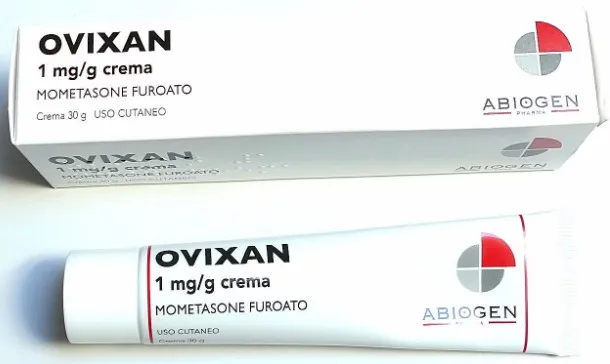
Ovixan 1 mg/g cream is a white, odourless cream in a laminated aluminium polyethylene tube with a polypropylene cap.
Pack sizes:
Tubes containing 15 g, 30 g, 35 g, 70 g, 90 g or 100 g of cream, packed in a cardboard box.
Not all pack sizes may be marketed.
Marketing Authorisation Holder and Manufacturer
Marketing Authorisation Holder
Reig Jofre Sp. z o.o.
Ostródzka Street 74N
03-289 Warsaw
Poland
e-mail: [email protected]
Manufacturer
Bioglan AB Lichtenheldt GmbH – Werk I
Borrgatan 31 Industriestraße 7 - 11
211 24 Malmö 23812 Wahlstedt
Sweden Germany
This medicinal product is authorised in the Member States of the European Economic Area under the following names:
| Country name | Medicinal product name |
| Denmark | Ovison 1mg/g cream |
| Finland | Ovixan 1 mg/g emulsion ointment |
| Germany | MomeGalen 1 mg/g cream |
| Iceland | Ovixan 1 mg/g cream |
| Italy | Ovixan 1 mg/g cream |
| Norway | Ovixan 1 mg/g cream |
| Poland | Ovixan |
| Sweden | Ovixan 1 mg/g cream |
Other sources of information
Detailed information about this medicinal product is available on the website of the Office for Registration of Medicinal Products, Medical Devices and Biocidal Products: www.urpl.gov.pl
Similar drugs
| Brand name | Dosage form | Active substance / Dosage | Manufacturer |
|---|---|---|---|
| EDELAN | cream |
|
Glenmark Pharmaceuticals s.r.o. |
| ELOCOM | cream |
|
Organon Salud, S.L. |
| ELOCOM | cream |
|
ORGANON BIOSCIENCES S.R.L. |
| ELOCOM | cream |
|
ORGANON BIOSCIENCES S.R.L. |
| ELOCOM | cream |
|
ORGANON BIOSCIENCES S.R.L. |
| ELOCOM | cream | — | N.V. Organon |
| ELOCOM | cream | — | Organon Salud, S.L. |
| ELOCOM | cream |
|
Organon Belgium |
| ELOSONE | cream |
|
EMO-FARM Sp. z o.o. |
| EZTOM | cream |
|
Glenmark Pharmaceuticals s.r.o. |
| IVOXEL | cream |
|
Almirall Hermal GmbH |
| MOMECUTAN FETTCREME | cream |
|
mibe GmbH Pharmaceuticals Sun-Farm Sp. z o.o. |
The original data is available in the language of the country of manufacture.
Data source: Register of Medicinal Products of Poland (URPL)
Data last verified: September 01, 2026