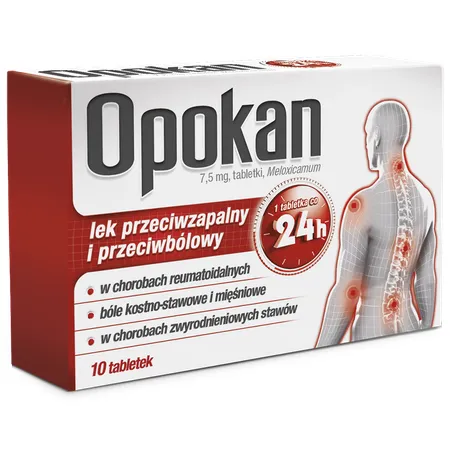
OPOKAN
PolandIt is used for the short-term treatment of exacerbations of rheumatoid diseases, such as rheumatoid arthritis, juvenile rheumatoid arthritis, and ankylosing spondylitis. It has anti-inflammatory, analgesic, and antipyretic properties.
Frequently asked questions
How to use Opokan?
The recommended dose is 1 tablet (7.5 mg) once daily. The tablet should be taken orally during a meal, with water.
When should you not take this medicine?
It must not be used if you are allergic to meloxicam, have severe hepatic or renal impairment, severe heart failure, active gastric or duodenal ulcer disease, have had a stroke, or other bleeding. The medicine must not be used in children under 16 years of age or in women in the third trimester of pregnancy.
Can you take other medicines together with Opokan?
It should not be combined with other non-steroidal anti-inflammatory drugs (NSAIDs) or aspirin. Particular caution should be exercised, and the doctor should be informed if you are taking diuretics, anticoagulants, antihypertensives, corticosteroids, or antidiabetic drugs.
What side effects may occur?
The most common side effects are gastrointestinal problems, such as nausea, vomiting, abdominal pain, constipation, or diarrhea. Headaches, dizziness, drowsiness, and increased blood pressure may also occur. Discontinue use immediately if allergic reactions occur (e.g., facial swelling, shortness of breath), gastrointestinal bleeding (e.g., tarry stools), or severe skin rashes.
What should you do if health problems occur during use of the medicine?
If there is no improvement after 7 days or if your health condition worsens, you should contact a doctor. In case of taking more than the recommended dose, seek medical attention immediately or go to an emergency department.
Does the medicine affect driving?
If dizziness, drowsiness, or visual disturbances occur after taking the medicine, you must not drive vehicles or operate machinery.
Instructions for use
Package leaflet: Information for the patient
Opokan, 7.5 mg, tablets
Meloxicamum
Please read all of this leaflet carefully before taking this medicine, as it contains
important information for the patient.
This medicine should always be taken exactly as described in this patient leaflet or as directed by
the doctor or pharmacist.
- Keep this leaflet, so that you can read it again if necessary.
- If you need advice or further information, please consult your pharmacist.
- If you experience any adverse reactions, including any adverse reactions not listed in this leaflet, inform your doctor or pharmacist. See section 4.
- If there is no improvement or if you feel worse after 7 days, you should contact your doctor.
Table of contents
- What Opokan is and what it is used for
- What you need to know before taking Opokan
- How to take Opokan
- Possible side effects
- How to store Opokan
- Contents of the pack and other information
1. What Opokan is and what it is used for
Opokan belongs to a group of medicines called non-steroidal anti-inflammatory drugs (NSAIDs).
It has anti-inflammatory, analgesic and antipyretic properties.
It is used in bone, joint and muscle pain (e.g. back pain, spinal pain, knee pain) associated with rheumatic and degenerative joint diseases.
Opokan is intended for adults and for children and adolescents aged 16 years and older.
Indications for use of Opokan:
- Short-term treatment of flare-ups of symptoms in rheumatic diseases, such as:
° rheumatoid arthritis,
° juvenile rheumatoid arthritis,
° ankylosing spondylitis.
If there is no improvement or if you feel worse after 7 days, you should contact your doctor.
2. Important information before taking Opokan
When not to take Opokan
- if the patient is allergic to meloxicam or any of the other ingredients of this medicine (listed in section 6);
- if asthma, wheezing, tightness of the chest, shortness of breath (asthma), skin rash (urticaria), nasal congestion due to swelling of the nasal mucosa (nasal polyps), sudden swelling of the skin or mucous membranes, such as around the eyes, face, lips, mouth or throat, possibly causing breathing difficulties (angioedema), occurred during treatment with other non-steroidal anti-inflammatory drugs (NSAIDs) or acetylsalicylic acid (aspirin);
- if the patient has severe liver function disorders;
- if the patient has severe renal insufficiency and is not undergoing dialysis;
- if gastrointestinal bleeding or perforation of the stomach or intestines occurred during treatment with anti-inflammatory drugs (NSAIDs);
- if the patient has active or recurrent peptic ulcer disease of the stomach and/or duodenum (with at least two episodes of confirmed ulceration or bleeding);
- if the patient has had a cerebral haemorrhage (stroke) or other bleeding, e.g. from the gastrointestinal tract;
- if the patient has severe heart failure;
- in women during the third trimester of pregnancy;
- in children and adolescents under 16 years of age.
If the patient is unsure whether any of the above points apply, they should contact their doctor.
Warnings and precautions
Before starting treatment with Opokan, discuss this with your doctor or pharmacist.
- if the patient has experienced a sudden allergic reaction (anaphylactic shock) occurring within 20 minutes of taking the medicine (see section 4: Possible side effects),
- if the patient has peptic ulcer disease of the stomach and/or duodenum or inflammation of the oesophageal or gastric mucosa. This medicine may be given to patients whose condition has been completely cured,
- if the patient has diabetes, high blood cholesterol levels, or hypertension; this increases the risk of heart attack or stroke,
- if the patient has mild or moderate heart failure (manifesting as oedema),
- if the patient has ischaemic heart disease, peripheral arterial disease, or cerebrovascular disease, as this increases the risk of arterial thrombosis,
- if the patient has inflammatory bowel diseases (ulcerative colitis or Crohn's disease), as this increases the risk of gastrointestinal bleeding. If gastrointestinal bleeding occurs, the medicine should be discontinued immediately,
- if the patient has impaired kidney function; kidney function should then be monitored regularly,
- if the patient has reduced circulating blood volume (hypovolaemia), which may occur due to significant blood loss, burns, surgery, or low fluid intake,
- if the patient has impaired liver function; the medicine may cause slight, transient increases in liver enzyme activity in the blood (AspAT and AlAT),
- if the patient is elderly, as the risk of kidney, liver, and heart dysfunction increases. The doctor will order regular tests,
- if the patient plans pregnancy or has difficulty conceiving, because the medicine adversely affects fertility. The medicine should then be discontinued,
- if the patient has previously diagnosed high potassium levels in the blood,
- if the patient has ever developed a persistent drug rash (erythema multiforme) after taking meloxicam or other oxicams (e.g. piroxicam) [circular or oval red and swollen skin patches, usually recurring in the same location(s), blisters, urticaria, and itching].
Taking medicines such as Opokan may be associated with a small increased risk of heart attack (myocardial infarction) or stroke. This risk increases with long-term use of high doses. Do not use higher doses or longer treatment duration than recommended (see section 3). If the patient has heart problems, has had a stroke, or suspects a risk of these conditions (e.g. high blood pressure, diabetes, high cholesterol, smoking), they should discuss the treatment approach with their doctor or pharmacist.
Treatment with Opokan should be stopped immediately if bleeding (causing tarry stools) or gastrointestinal ulceration (causing abdominal pain) is noticed.
Serious, potentially life-threatening skin reactions (Stevens-Johnson syndrome, toxic epidermal necrolysis) have been reported with the use of Opokan. These initially appear as red spots or circular lesions on the trunk, often with central blisters. Additional symptoms may include mouth, throat, nose, or genital ulcers and conjunctivitis (red, swollen eyes). These potentially life-threatening skin reactions are often accompanied by flu-like symptoms. The rash may progress to widespread blisters or skin detachment. The highest risk of severe skin reactions occurs during the first weeks of treatment. Patients who have experienced Stevens-Johnson syndrome or toxic epidermal necrolysis while taking Opokan must not restart treatment with meloxicam.
If a rash or any of the above symptoms occur, stop taking Opokan immediately and seek medical advice, informing the doctor about taking this medicine.
Opokan is not recommended for the treatment of acute pain attacks.
Opokan may mask signs of infection (e.g. fever). If the patient suspects an infection, they should contact their doctor.
Using the lowest effective dose for the shortest duration necessary to relieve symptoms reduces the risk of adverse effects.
Children and adolescents
Do not use in children and adolescents under 16 years of age.
Opokan and other medicines
Tell your doctor or pharmacist about all medicines the patient is currently taking or has recently taken, as well as any medicines they plan to take.
Do not take Opokan together with the following medicines:
- other non-steroidal anti-inflammatory drugs, including salicylates (e.g. acetylsalicylic acid at a single dose of 500 mg and daily dose of 3000 mg); concomitant use with Opokan may increase the risk of gastrointestinal ulcers and bleeding,
- diuretics (drugs that increase urine production, e.g. furosemide); concomitant use with Opokan may cause severe kidney failure in dehydrated patients. Patients receiving both Opokan and diuretics should receive adequate fluid intake (orally and/or intravenously via infusion). Before starting treatment, the doctor will assess kidney function,
- oral or parenteral anticoagulants (used to prevent blood clot formation); concomitant use with Opokan may increase bleeding,
- thrombolytic and antiplatelet drugs (medicines that dissolve blood clots),
- antihypertensive drugs: angiotensin-converting enzyme inhibitors (e.g. captopril, enalapril), angiotensin II receptor antagonists type AT (so-called sartans), beta-blockers.
Concomitant use of the above-mentioned medicines with Opokan may cause severe kidney dysfunction and reduce their therapeutic effect.
- cyclosporine, tacrolimus (medicines used in patients after organ transplantation or in severe skin diseases, rheumatoid arthritis, or nephrotic syndrome); the doctor will regularly monitor kidney function,
- trimethoprim (used to treat urinary tract infections);
- potassium salts (medicines used to treat low blood potassium levels);
- intrauterine contraceptive devices; Opokan may reduce their effectiveness. An additional method of contraception, e.g. using a condom, should be used,
- corticosteroids (e.g. used for anti-inflammatory purposes or treating allergic reactions); concomitant use with Opokan may increase the risk of gastrointestinal ulcers and bleeding,
- lithium (used to treat certain psychiatric disorders),
- selective serotonin reuptake inhibitors (SSRIs) (used to treat depression),
- methotrexate (a cytostatic medicine used to treat cancer or severe uncontrolled skin diseases and active rheumatoid arthritis),
- cholestyramine (a medicine that lowers blood cholesterol levels),
- deferasirox (used to treat chronic iron overload),
- pemetrexed (used to treat cancers);
- oral antidiabetic drugs (sulfonylurea derivatives, nateglinide) – used to treat diabetes. The doctor should ensure regular monitoring of the patient's blood glucose levels for hypoglycaemia.
Opokan with food and drink
Take the medicine during a meal, with water.
Pregnancy, breastfeeding, and effect on fertility
If the patient is pregnant, breastfeeding, suspects she may be pregnant, or is planning to have a child, she should consult her doctor or pharmacist before taking this medicine.
Pregnancy
Do not take Opokan if the patient is in the last three months of pregnancy, as it may harm the unborn child or cause complications during delivery. It may cause kidney and heart problems in the unborn child. It may increase the tendency to bleeding in both the patient and her child and may delay or prolong labour. During the first 6 months of pregnancy, Opokan should not be used unless the doctor considers it absolutely necessary. If treatment is required during this period or when trying to conceive, the lowest possible dose should be used for the shortest possible time. From the 20th week of pregnancy, Opokan may cause narrowing of a blood vessel (ductus arteriosus) in the child's heart or kidney problems, which may lead to low levels of amniotic fluid surrounding the child (oligohydramnios). If treatment is required for longer than a few days, the doctor may recommend additional monitoring.
Breastfeeding
Opokan is not recommended for breastfeeding women.
Before taking this medicine, consult a doctor or pharmacist.
Fertility
Opokan may adversely affect female fertility and make conception difficult. Do not use in women who have difficulty conceiving or who are undergoing fertility investigations.
Driving and operating machinery
If adverse effects such as dizziness, visual disturbances including blurred vision, drowsiness, or other central nervous system disorders occur, do not drive or operate machinery.
Opokan contains monohydrate lactose and sodium
Monohydrate lactose
If the patient has previously been diagnosed with intolerance to certain sugars, they should consult their doctor before taking the medicine.
Sodium
The medicine contains 2.35 mg of sodium per tablet.
The medicine contains less than 1 mmol (23 mg) of sodium per tablet, meaning the medicine is considered "sodium-free".
3. How to take Opokan
This medicine should always be taken exactly as described in this patient information leaflet or as directed by your doctor or pharmacist. If in doubt, consult your doctor or pharmacist.
Recommended dose
The recommended dose is 1 tablet (7.5 mg) per day.
Elderly patients: 1 tablet (7.5 mg) per day.
Patients at increased risk of adverse reactions, patients with renal impairment, patients with hepatic impairment: the dose should not exceed 7.5 mg per day.
Use in children and adolescents: Opokan must not be used in children and adolescents under 16 years of age.
Method of administration:
- The medicine should be taken orally during a meal, with water.
- Opokan should be taken once daily (as a single dose).
If symptoms worsen or do not improve within 7 days, contact your doctor.
Taking more Opokan than recommended
If you take more Opokan than recommended, or if you suspect an overdose, seek immediate medical advice from a doctor or go to the nearest hospital emergency department.
Symptoms of NSAID overdose are usually limited to:
- weakness (feeling of lack of energy);
- drowsiness;
- nausea and vomiting;
- stomach pain (epigastric pain). These symptoms usually resolve after discontinuation of Opokan. Gastrointestinal bleeding (bleeding from the gastrointestinal tract) may occur in the patient.
Severe poisoning may lead to serious adverse reactions of the drug (see section 4):
- increased blood pressure (arterial hypertension);
- acute renal failure;
- liver function disorders;
- shallow breathing or respiratory arrest (respiratory depression);
- loss of consciousness (coma);
- seizures (convulsions);
- circulatory collapse (cardiovascular collapse);
- cardiac arrest;
- immediate allergic (hypersensitivity) reactions, including:
- fainting;
- shortness of breath;
- skin reactions.
Missed dose of Opokan
Do not take a double dose to make up for a missed dose.
Take the next dose at the scheduled time.
If you have any further doubts about the use of this medicine, consult your doctor or pharmacist.
4. Possible adverse effects
Like all medicines, this medicine can cause adverse effects, although not everyone will experience them.
You must discontinue use of Opokan and consult a doctor or the nearest hospital immediately if any of the following occur:
Any allergic (hypersensitivity) reactions, which may manifest as:
- Skin reactions such as itching (pruritus), blistering and peeling of the skin, which may potentially be life-threatening (Stevens-Johnson syndrome, toxic epidermal necrolysis), damage to soft tissues (lesions of mucous membranes), or erythema multiforme (see section 2). Erythema multiforme is a severe allergic skin reaction causing spots, red or purple patches, or blisters on the skin. It may also appear on the lips, eyes, and other moist areas of the body;
- Swelling of the skin or mucous membranes, such as swelling around the eyes, face and lips, mouth or throat, which may make breathing difficult, swelling of the ankles and legs (peripheral edema);
- Shortness of breath or asthma attack;
- Hepatitis (liver inflammation). This may cause symptoms such as:
- Yellowing of the skin and whites of the eyes (jaundice);
- Abdominal pain, loss of appetite.
Any adverse gastrointestinal symptoms, and particularly:
- Bleeding (resulting in black, tarry stools);
- Gastrointestinal ulceration (causing abdominal pain).
Gastrointestinal bleeding, ulceration or perforation may occasionally be severe and potentially fatal, especially in elderly patients.
If the patient has previously experienced any gastrointestinal disorders due to long-term use of NSAIDs, medical advice should be sought immediately, especially if the patient is elderly. The doctor may monitor the progress of treatment.
If use of Opokan causes visual disturbances, do not drive or operate machinery.
General adverse effects associated with non-steroidal anti-inflammatory drugs (NSAIDs)
The use of certain non-steroidal anti-inflammatory drugs (NSAIDs) may be associated with a small increased risk of arterial thrombosis (arterial blockage), e.g. myocardial infarction or stroke, particularly when used at high doses or for prolonged periods.
Treatment with NSAIDs has been associated with reports of edema, hypertension and heart failure.
The most commonly observed adverse effects involve the gastrointestinal tract (stomach and intestinal disturbances):
- Peptic ulcer disease (ulcers of the stomach and duodenum);
- Perforation of the intestinal wall or gastrointestinal bleeding (sometimes fatal, especially in elderly patients).
The following adverse effects have been reported with NSAIDs:
- Nausea and vomiting;
- Loose stools (diarrhea);
- Flatulence (passing gas);
- Constipation;
- Indigestion (dyspepsia);
- Abdominal pain;
- Black stools due to gastrointestinal bleeding;
- Vomiting blood;
- Ulcerative stomatitis (mouth ulcers);
- Exacerbation of gastrointestinal inflammation (e.g. worsening of colitis or Crohn's disease).
Gastritis (inflammation of the stomach) has been observed less frequently.
Adverse effects of meloxicam – the active substance in Opokan
Very common: may affect more than 1 in 10 people
- Gastrointestinal disturbances such as indigestion (dyspepsia), nausea and vomiting, abdominal pain, constipation, flatulence, loose stools (diarrhea).
Common: may affect less than 1 in 10 people
- Headache.
Uncommon: may affect less than 1 in 100 people
- Dizziness (feeling of emptiness in the head);
- Dizziness or vertigo (vestibular origin);
- Somnolence (drowsiness);
- Anaemia (reduced concentration of the red blood pigment haemoglobin);
- Increased blood pressure (hypertension);
- Flushing (transient redness of the face and neck);
- Sodium and water retention;
- Increased potassium levels (hyperkalaemia). This may lead to symptoms such as:
- Heart rhythm disturbances;
- Palpitations (when the patient feels the heartbeat more than usual);
- Muscle weakness;
- Regurgitation (reflux of stomach contents into the oesophagus);
- Gastritis (inflammation of the stomach);
- Gastrointestinal bleeding;
- Inflammation of the oral mucosa;
- Immediate hypersensitivity reactions (allergy);
- Itching, skin rash;
- Fluid retention-related edema, including swelling of ankles/legs (peripheral edema);
- Sudden swelling of the skin or mucous membranes, such as around the eyes, face, lips, mouth or throat, which may make breathing difficult (angioedema);
- Transient abnormalities in liver function tests (e.g. increased activity of liver enzymes such as aminotransferases, or increased levels of the bile pigment bilirubin). These changes may be detected by the doctor through blood tests;
- Abnormalities in kidney function laboratory tests (e.g. increased creatinine or urea levels).
Rare: may affect less than 1 in 1,000 people
- Mood disturbances;
- Nightmares;
- Blood morphology disorders, including:
- Abnormal blood smear;
- Decreased white blood cell count (leukopenia);
- Decreased platelet count (thrombocytopenia). These adverse effects may increase the risk of infection and symptoms such as bruising or nosebleeds.
- Tinnitus (ringing in the ears);
- Palpitations (awareness of heartbeat);
- Gastric or duodenal ulcer disease;
- Oesophagitis (inflammation of the oesophagus);
- Asthma attacks (in patients hypersensitive to aspirin or other NSAIDs);
- Skin blistering or peeling (Stevens-Johnson syndrome and toxic epidermal necrolysis);
- Urticaria (hives);
- Visual disturbances, including: blurred vision, conjunctivitis (inflammation of the eyeball or eyelids);
- Colitis (inflammation of the large intestine).
Very rare: may affect less than 1 in 10,000 people
- Bullous skin reactions and erythema multiforme. Erythema multiforme is a severe allergic skin reaction causing spots, red or purple patches or blisters on the skin. It may also occur on the lips, eyes and other moist areas of the body;
- Hepatitis. This may cause symptoms such as:
- Yellowing of the skin and whites of the eyes (jaundice);
- Abdominal pain, loss of appetite;
- Acute renal failure, particularly in patients with risk factors such as heart disease, diabetes or kidney disease;
- Perforation of the intestinal wall.
Frequency not known: frequency cannot be estimated from the available data
- Confusion, disorientation;
- Shortness of breath and skin reactions (anaphylactic and/or anaphylactoid reactions), skin rashes caused by exposure to sunlight (photosensitivity reactions);
- Heart failure reported in association with NSAID treatment;
- Complete loss of certain types of white blood cells (agranulocytosis), especially in patients taking Opokan together with other medicines that potentially have bone marrow suppressive or destructive effects (myelotoxic drugs). This may cause:
- Sudden fever;
- Sore throat;
- Infections;
- Pancreatitis;
- Infertility in women, delayed ovulation;
- A characteristic allergic skin reaction known as fixed drug eruption, usually recurring in the same location(s) upon re-exposure to the drug, and may appear as itchy, round or oval, red and swollen skin patches or blisters (urticaria).
Adverse effects caused by non-steroidal anti-inflammatory drugs (NSAIDs), but not yet reported with the use of Opokan:
- Acute renal failure due to structural changes in the kidneys;
- Very rarely, cases of kidney inflammation (interstitial nephritis);
- Death of certain kidney cells (acute necrosis of glomeruli or renal papillae);
- Presence of protein in the urine (nephrotic syndrome with proteinuria).
Reporting of adverse effects
If any adverse effects occur, including any not listed in this leaflet, inform your doctor or pharmacist. Adverse effects can be reported directly to the Department of Monitoring of Adverse Drug Reactions of the Office for Registration of Medicinal Products, Medical Devices and Biocidal Products:
Al. Jerozolimskie 181C, 02-222 Warsaw
Tel.: +48 22 49 21 301
Fax: +48 22 49 21 309
Website: https://smz.ezdrowie.gov.pl
Adverse effects can also be reported to the marketing authorization holder.
Reporting adverse effects helps to provide more information on the safety of the medicine.
5. How to store the medicine Opokan
Keep the medicine out of the sight and reach of children.
Store in the tightly closed original packaging, at a temperature not exceeding 25°C, in a dry place.
Do not use this medicine after the expiry date stated on the packaging after: EXP.
The expiry date refers to the last day of the stated month.
Lot – indicates the batch number
Medicines must not be disposed of via wastewater or household waste. Ask your pharmacist
how to dispose of medicines no longer required. This will help protect the environment.
6. Contents of the packaging and other information
What Opokan contains
- The active substance is meloxicam. Each tablet contains 7.5 mg of meloxicam.
- The other ingredients are: microcrystalline cellulose, lactose monohydrate, pregelatinized starch, maize starch, sodium citrate, colloidal anhydrous silica, magnesium stearate.
What Opokan looks like and contents of the pack
Opokan is a tablet. The tablets are yellow, uncoated, round, flat, with a division line on one side. The line enables tablet splitting.
The pack contains 10 tablets (1 blister), 20 tablets (2 blisters), or 30 tablets (3 blisters), packed together with the patient leaflet in a cardboard box.
Marketing Authorisation Holder
Aflofarm Farmacja Polska Sp. z o.o.
ul. Partyzancka 133/151
95-200 Pabianice
Tel. (42) 22-53-100
Manufacturer
Aflofarm Farmacja Polska Sp. z o.o.
ul. Szkolna 31
95-054 Ksawerów
Similar drugs
| Brand name | Dosage form | Active substance / Dosage | Manufacturer |
|---|---|---|---|
| AGLAN 15 | tablets |
|
Zentiva, joint-stock company |
| ASPICAM | tablets |
|
Biofarm Sp. z o.o. |
| ASPICAM BIO | tablets |
|
Biofarm Sp. z o.o. |
| DIFORTAN TABS | tablets |
|
Niche Generics Limited |
| DIFORTAN TABS MAX | tablets |
|
Niche Generics Limited |
| MELOXICAM APTEO MED | tablets |
|
Synoptis Industrial Sp. z o.o. |
| MELOXICAM GENOPTIM | tablets |
|
Synoptis Industrial Sp. z o.o. |
| MELOXISTAD | tablets |
|
Chanelle Medical Unlimited Company STADA Arzneimittel AG |
| MOILEC | tablets |
|
Gedeon Richter Polska Sp. z o.o. |
| MOVALIS | tablets |
|
Rottendorf Pharma GmbH |
| MOVALIS | tablets |
|
Rottendorf Pharma GmbH |
| OPOKAN MAX | tablets |
|
Aflofarm Farmacja Polska Limited |
The original data is available in the language of the country of manufacture.
Data source: Register of Medicinal Products of Poland (URPL)
Data last verified: September 01, 2026