OKTEVA
PolandThe medicine is used to treat acromegaly (a disease caused by excess growth hormone), to relieve symptoms associated with neuroendocrine intestinal tumors, and to treat pituitary tumors that secrete excessive amounts of TSH hormone.
Frequently asked questions
How should Okteva be administered?
The medicine is administered exclusively via deep intramuscular injection into the buttock. During long-term use, the injection site should be rotated, alternating between the left and right buttock.
When should you not use the medicine?
Do not use the medicine if you are allergic to octreotide or any of the other ingredients of the product.
What are the possible side effects of Okteva?
The most common side effects are diarrhea, abdominal pain, nausea, constipation, headache, and pain at the injection site. Serious side effects may include gallstones, too high or too low blood sugar levels, thyroid problems, pancreatitis or hepatitis, and allergic reactions.
Does Okteva interact with other medicines?
The medicine may affect the action of substances such as cimetidine, cyclosporine, bromocriptine, quinidine, and terfenadine. It may also be necessary to adjust the dosage of blood pressure medications, insulin, or medications that maintain fluid and electrolyte balance.
What precautions should be taken before starting treatment?
You should inform your doctor about problems with gallstones, diabetes, and any history of vitamin B deficiencies. The medicine may affect blood sugar levels as well as thyroid, liver, and pancreatic functions, which requires periodic medical monitoring.
How should the medicine be stored?
The medicine should be stored in a refrigerator (at a temperature of 2°C – 8°C) in its original packaging to protect it from light. Do not freeze. The prepared suspension must be used immediately.
Instructions for use
Package leaflet: Information for the patient
Okteva, 10 mg, powder and solvent for preparation of suspension for injection with
prolonged release
Okteva, 20 mg, powder and solvent for preparation of suspension for injection with
prolonged release
Okteva, 30 mg, powder and solvent for preparation of suspension for injection with
prolonged release
octreotide
Please read carefully all the information in this leaflet before using this medicine, as it contains
important information for the patient.
- Keep this leaflet, as you may need to read it again.
- If you have any further questions, please consult your doctor, pharmacist or nurse.
- This medicine has been prescribed for a specific individual. Do not pass it on to others. It may harm someone else even if their symptoms are the same.
- If you experience any adverse reactions, including any not listed in this leaflet, inform your doctor, pharmacist or nurse. See section 4.
Table of contents
- What Okteva is and what it is used for
- Important information before using Okteva
- How to use Okteva
- Possible side effects
- How to store Okteva
- Contents of the pack and other information
1. What Okteva is and what it is used for
Okteva is a synthetic analogue of somatostatin, a substance naturally present in the human body that inhibits the action of certain hormones, such as growth hormone. Okteva acts more strongly than somatostatin and has a longer duration of action.
Okteva is used
- in the treatment of acromegaly. Acromegaly is a disease in which the body produces too much growth hormone. In healthy individuals, growth hormone affects the growth of tissues, organs and bones. Excess growth hormone causes enlargement of bones and tissues, especially in the hands and feet. Okteva significantly alleviates symptoms of acromegaly, such as headache, excessive sweating, numbness in hands and feet, fatigue and joint pain. In most cases, excessive production of growth hormone is caused by enlargement of the pituitary gland (pituitary adenoma); treatment with Okteva may reduce the size of the adenoma.
Okteva is used in the treatment of patients with acromegaly:
- when other treatments for acromegaly (surgical treatment or radiotherapy) are contraindicated or ineffective;
- after radiotherapy, during the transitional period before the full effect of radiotherapy is achieved;
- to alleviate symptoms associated with excessive production of certain specific hormones and related substances by the stomach, intestines and pancreas; Excessive production of hormones and other similar natural substances may be caused by certain rare diseases of the stomach, intestines or pancreas. This disrupts the body's natural hormonal balance and causes various symptoms such as facial flushing, diarrhea, low blood pressure, skin rash and weight loss. Treatment with Okteva helps to alleviate these symptoms;
- in the treatment of neuroendocrine tumors located in the intestine (e.g. in the appendix, small intestine or colon); Neuroendocrine tumors are rare tumors occurring in various parts of the body. Okteva is also used to inhibit the growth of such tumors when they are located in the intestine (e.g. in the appendix, small intestine or colon);
- in the treatment of pituitary tumors producing excessive amounts of thyroid-stimulating hormone (TSH); Excessive levels of thyroid-stimulating hormone (TSH) lead to hyperthyroidism. Okteva is used in patients with pituitary tumors producing excessive amounts of thyroid-stimulating hormone (TSH):
- when other treatments (surgical treatment or radiotherapy) are inappropriate or ineffective;
- after radiotherapy during the transitional period, before radiotherapy achieves full effectiveness.
2. Important information before using Okteva
Follow all your doctor's instructions carefully. These may differ from the information contained in this leaflet.
Please read the following information before using Okteva.
When not to use Okteva:
- if you are allergic to octreotide or any of the other ingredients of this medicine (listed in section 6).
Warnings and precautions
Before starting treatment with Okteva, discuss with your doctor:
- if you know you have or have previously had gallstones; or if you experience any complications such as fever, chills, abdominal pain or yellowing of the skin or eyes; inform your doctor, as long-term use of Okteva may lead to the formation of gallstones. Your doctor may recommend periodic monitoring of the gallbladder;
- if you have diabetes, because Okteva may affect blood glucose levels. If you have diabetes, your blood glucose levels should be monitored regularly;
- if you have previously had reduced vitamin B levels, your doctor may recommend periodic monitoring of vitamin B levels.
Examinations and follow-up visits
If you are receiving long-term treatment with Okteva, your doctor may recommend periodic monitoring of thyroid function.
Your doctor will monitor your liver function.
Your doctor may recommend checking pancreatic enzyme activity.
Children
Experience with the use of Okteva in children is limited.
Okteva with other medicines
Tell your doctor or pharmacist about all medicines you are currently taking, have recently taken or plan to take.
Treatment with other medicines can generally be continued during therapy with Okteva.
However, interactions have been reported between Okteva and certain drugs such as cimetidine, cyclosporine, bromocriptine, quinidine and terfenadine.
If you are taking a medicine that lowers blood pressure (e.g. a beta-blocker or calcium channel blocker) or a medicine affecting water and electrolyte balance, your doctor may adjust the dosage.
In patients with diabetes, adjustment of insulin dosage by the doctor may be necessary.
If you are to receive treatment with lutetium oxodotreotide (Lu), a radiopharmaceutical therapy, your doctor may temporarily interrupt and/or adjust treatment with Okteva.
Pregnancy, breastfeeding and fertility
If you are pregnant or breastfeeding, think you may be pregnant, or are planning to have a child, consult your doctor before using this medicine.
Okteva may be used during pregnancy only if clearly necessary.
Women of childbearing potential should use effective contraception during treatment.
Do not breastfeed while taking Okteva. It is not known whether Okteva passes into human milk.
Driving and operating machinery
Okteva has no effect or a negligible effect on the ability to drive and operate machinery. However, certain adverse reactions associated with the use of Okteva, such as headache and fatigue, may reduce your ability to safely drive or operate machinery.
Okteva contains sodium
Okteva contains less than 1 mmol (23 mg) of sodium per dose, i.e. is essentially "sodium-free".
3. How to use Okteva
Okteva must be administered exclusively as an intramuscular injection into the buttock.
During prolonged administration, injections should be alternated between the left and right buttock.
Use of a higher than recommended dose of Okteva
Following overdose of Okteva, no life-threatening reactions have been reported.
Symptoms of overdose include: hot flushes, frequent urination, fatigue, depression, anxiety, and lack of concentration.
If you suspect an overdose and the patient experiences any of these symptoms, inform your doctor immediately.
Missing a dose of Okteva
If an injection has not been administered on time, it should be given as soon as possible, and then treatment should continue as previously scheduled. Administering the dose several days later is not harmful, but may result in a temporary return of disease symptoms until the planned treatment schedule is resumed.
Stopping treatment with Okteva
After discontinuation of treatment with Okteva, disease symptoms may recur. Therefore, do not stop using Okteva without consulting your doctor.
If you have any further questions regarding the use of this medicine, please consult your doctor, nurse, or pharmacist.
4. Possible adverse reactions
Like all medicines, this medicine can cause adverse reactions, although not everyone will experience them.
Some adverse reactions may be serious. You must immediately inform the doctor
if the patient experiences any of the following symptoms:
Very common (may affect more than 1 in 10 people):
- Gallstones causing sudden back pain
- High blood sugar levels
Common (may affect up to 1 in 10 people):
- Hypothyroidism (underactive thyroid) affecting heart rhythm, appetite, or body weight changes; fatigue, feeling cold, or swelling in the front of the neck
- Changes in thyroid function test results
- Inflammation of the gallbladder; symptoms may include pain in the upper right part of the abdomen, fever, nausea, yellowing of the skin and eyes (jaundice)
- Low blood sugar levels
- Impaired glucose tolerance
- Slow heart rate
Uncommon (may affect up to 1 in 100 people):
- Thirst, reduced urine output, dark-coloured urine, dry and red skin
- Fast heart rate
Other serious adverse reactions
- Hypersensitivity reactions (allergic reactions), including skin rash
- A type of allergic reaction (anaphylaxis) which may cause difficulty swallowing or breathing, swelling and tingling, possibly with low blood pressure, dizziness or loss of consciousness
- Inflammation of the pancreas; symptoms may include sudden pain in the upper abdomen, nausea, vomiting, diarrhoea
- Inflammation of the liver; symptoms may include yellowing of the skin and eyes (jaundice), nausea, vomiting, loss of appetite, general malaise, itching, pale-coloured urine
- Irregular heart rate
- Low platelet count; this may cause increased bleeding or bruising
If the patient notices any of the symptoms listed above, they must immediately inform the doctor.
Other adverse reactions:
If the patient notices any of the following adverse reactions, they should inform the doctor, pharmacist, or nurse. These reactions are usually mild and tend to resolve as treatment continues.
Very common (may affect more than 1 in 10 people):
- Diarrhoea
- Abdominal pain
- Nausea
- Constipation
- Bloating with gas
- Headache
- Pain at the injection site
Common (may affect up to 1 in 10 people):
- Stomach discomfort after meals (dyspepsia)
- Vomiting
- Feeling of fullness in the stomach
- Fatty stools
- Loose stools
- Pale-coloured stools
- Dizziness
- Loss of appetite
- Changes in liver function test results
- Hair loss
- Shortness of breath
- Weakness
If any adverse reactions occur, inform the doctor, nurse, or pharmacist.
Reporting of adverse reactions
If any adverse reactions occur, including any adverse reactions not listed in this leaflet, inform the doctor, pharmacist, or nurse. Adverse reactions can be reported directly to the Department of Monitoring Adverse Reactions of Medicinal Products at the Office for Registration of Medicinal Products, Medical Devices and Biocidal Products:
Al. Jerozolimskie 181C
02-222 Warsaw
Phone: 22 49-21-301
Fax: 22 49-21-309
Website: https://smz.ezdrowie.gov.pl
Adverse reactions can also be reported to the marketing authorisation holder.
Reporting adverse reactions helps provide more information on the safety of this medicine.
5. How to store Okteva
Keep this medicine out of the sight and reach of children.
Store in the original packaging to protect from light.
Store in a refrigerator (2°C – 8°C). Do not freeze.
On the day of injection, Okteva may be stored at temperatures below 25°C.
Do not store Okteva after reconstitution. The prepared suspension must be used immediately.
Do not use this medicine after the expiry date stated on the label and packaging after "EXP" and "Expiry date (EXP)". The expiry date refers to the last day of the stated month.
Do not use this medicine if you notice any foreign particles or change in colour.
Medicines must not be disposed of via the sewage system or household waste. Ask your pharmacist how to dispose of medicines no longer required. Such measures help protect the environment.
6. Contents of the Package and Other Information
What the medicinal product Okteva contains
- The active substance is octreotide. One vial contains 10 mg, 20 mg, or 30 mg of octreotide (as octreotide acetate).
- Other ingredients are: in the powder (vial): D,L-lactide and glycolide copolymer (55:45) and mannitol (E 421); in the solvent (prefilled syringe): sodium carmellose, mannitol (E 421), poloxamer 188, and water for injections.
What Okteva looks like and contents of the pack
Okteva 10 mg
Each single pack contains: 1 glass vial containing 10 mg octreotide sealed with a rubber stopper and aluminium cap with a dark blue flip-off cap, 1 glass prefilled syringe containing 2 ml of solvent, 1 safety needle for injection, and 1 vial connector, or
3 glass vials each containing 10 mg octreotide, 3 prefilled syringes each containing 2 ml of solvent, 3 safety needles for injection, and 3 vial connectors.
Okteva 20 mg
Each single pack contains: 1 glass vial containing 20 mg octreotide sealed with a rubber stopper and aluminium cap with an orange flip-off cap, 1 glass prefilled syringe containing 2 ml of solvent, 1 safety needle for injection, and 1 vial connector, or
3 glass vials each containing 20 mg octreotide, 3 prefilled syringes each containing 2 ml of solvent, 3 safety needles for injection, and 3 vial connectors.
Okteva 30 mg
Each single pack contains: 1 glass vial containing 30 mg octreotide sealed with a rubber stopper and aluminium cap with a dark red flip-off cap, 1 glass prefilled syringe containing 2 ml of solvent, 1 safety needle for injection, and 1 vial connector, or
3 glass vials each containing 30 mg octreotide, 3 prefilled syringes each containing 2 ml of solvent, 3 safety needles for injection, and 3 vial connectors.
Not all pack sizes may be marketed.
Marketing Authorisation Holder and Manufacturer
Marketing Authorisation Holder
Teva B.V.
Swensweg 5
2031 GA Haarlem
The Netherlands
Manufacturer
PLIVA HRVATSKA d.o.o. (PLIVA CROATIA Ltd.)
Prilaz baruna Filipovića 25
Zagreb 10000
Croatia
Merckle GmbH,
Ludwig-Merckle-Str. 3
Blaubeuren
Germany
Pharmathen International S.A
Industrial Park Sapes
Rodopi Prefecture, Block No 5
Rodopi 69300
Greece
For further information about the medicinal product and its names in other European Economic Area countries, please contact the representative of the marketing authorisation holder:
Teva Pharmaceuticals Polska Sp. z o.o., ul. Emilii Plater 53, 00-113 Warsaw, tel. (22) 345 93 00.
Information intended exclusively for healthcare professionals:
What dose of Okteva should be administered
Acromegaly
Treatment should be initiated with Okteva at a dose of 20 mg administered every 4 weeks for 3 months. Patients previously receiving subcutaneous (sc.) octreotide may start treatment with Okteva the day after the last subcutaneous octreotide injection. The dose should then be adjusted based on serum growth hormone (GH) and insulin-like growth factor-1/somatomedin C (IGF-1) levels, as well as clinical symptoms.
In patients whose clinical symptoms and biochemical parameters (GH; IGF-1) are not fully controlled after 3 months (GH levels still >2.5 micrograms/l), the dose may be increased to 30 mg every 4 weeks. If after an additional 3 months GH, IGF-1, and/or other symptoms remain inadequately controlled while on the 30 mg dose, the dose may be increased to 40 mg every 4 weeks.
In patients with consistently serum GH levels below 1 microgram/l, normalized serum IGF-1 levels, and with objective and subjective signs and symptoms of acromegaly having resolved after 3 months of treatment with 20 mg, Okteva at a dose of 10 mg every 4 weeks may be considered. However, particularly in this patient group, close monitoring of treatment efficacy through measurement of serum GH and IGF-1 levels and assessment of clinical symptoms is recommended during treatment with this lower dose of Okteva.
In patients on a stable dose of Okteva, GH and IGF-1 levels should be monitored every 6 months.
Functioning gastroenteropancreatic neuroendocrine tumours
- Treatment of patients with symptoms related to functioning neuroendocrine tumours of the stomach, intestine, and pancreas
Initiate treatment with Okteva at a dose of 20 mg every 4 weeks.
Patients previously receiving subcutaneous octreotide should continue their prior effective dose for 2 weeks after the first injection of Okteva.
In patients who achieve satisfactory symptom relief and improvement in biological markers after 3 months of treatment, the dose of Okteva may be reduced to 10 mg every 4 weeks.
In patients with only partial symptom relief after 3 months of treatment, the dose of Okteva may be increased to 30 mg every 4 weeks.
On days when symptoms related to gastroenteropancreatic tumours are exacerbated despite treatment with Okteva, additional subcutaneous octreotide at the previously used dose is recommended. This may occur particularly during the first 2 months of treatment, before therapeutic octreotide concentrations are achieved.
- Treatment of patients with advanced neuroendocrine tumours originating from the midgut or of unknown primary site, when a primary site outside the midgut has been excluded
The recommended dose of Okteva is 30 mg administered every 4 weeks. Treatment with Okteva to control tumour progression should be continued in the absence of tumour progression.
- Treatment of TSH-secreting adenomas
Treatment with Okteva should be initiated at a dose of 20 mg every 4 weeks and continued for 3 months before any dose adjustment. The dose may then be adjusted based on TSH and thyroid hormone secretion.
Instructions for Preparation and Intramuscular Administration (Injection) of the Medicinal Product Okteva
FOR DEEP INTRAMUSCULAR INJECTION IN THE BUTTOCK ONLY – NEVER INTRAVENOUS
Kit:
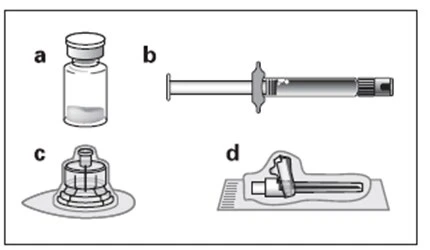
a One vial containing Okteva as a powder
b One prefilled syringe containing solvent for suspension preparation
c One vial connector for reconstitution of the medicinal product
d One safety needle for injection
Follow the instructions below carefully to properly reconstitute the medicinal product Okteva before deep intramuscular injection into the buttock.
Three requirements are critical for proper reconstitution of Okteva.
Failure to meet these requirements may result in improper administration of the medicinal product.
- The injection kit must reach room temperature. Remove the injection kit from the refrigerator and allow it to stand at room temperature for at least 30 minutes before reconstitution, but not longer than 24 hours.
- After adding the solvent, allow the vial to stand for 5 minutes to ensure complete wetting of the powder.
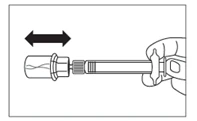
- After wetting, shake the vial with moderate force in a horizontal plane for at least 30 seconds until a uniform suspension is formed. The suspension of Okteva must be prepared immediately before administration.
The medicinal product Okteva must be administered only by trained medical personnel.
Step 1
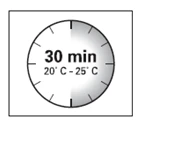
- Remove the injection kit containing Okteva from the refrigerator where it was stored. WARNING: It is essential to begin the reconstitution process only after the injection kit has reached room temperature. Allow the kit to stand at room temperature for at least 30 minutes before reconstitution, but not longer than 24 hours.
Note: The injection kit may be returned to the refrigerator if necessary.
Step 2
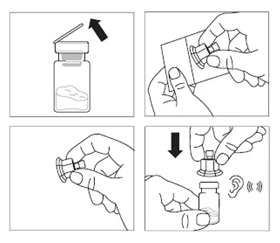
- Remove the plastic cap from the vial and wipe the rubber stopper with an alcohol-impregnated swab.
- Peel off the foil covering the vial connector package, remove the vial connector from its packaging by holding it between the white Luer connector and the collar. DO NOT TOUCH the tip of the connector at any point.
- Place the vial on a flat surface. Place the vial connector onto the vial and press firmly until it clicks into place with an audible "click".
- Wipe the tip of the vial connector with an alcohol-impregnated swab.
Step 3
- Remove the tip cap from the prefilled syringe
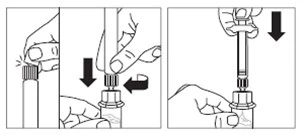
containing the solvent and screw the syringe onto the vial connector.
- Slowly push the plunger fully down so that all the solvent flows into the vial.
Step 4
WARNING: It is essential to allow the vial to stand for 5 minutes
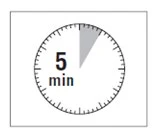
to ensure complete wetting of the powder with the solvent.
Note: The plunger may be pushed back upwards slightly due to minor overpressure in the vial, which is normal. At this stage, prepare the patient for injection.
Step 5
- After sufficient time for wetting the powder, check that the plunger is fully depressed to the bottom of the syringe.
WARNING: While keeping the plunger fully depressed, shake the vial moderately in a horizontal plane for at least 30 seconds to form a uniform suspension (a milky, homogeneous suspension). If part of the powder has not dissolved, repeat moderate shaking for another 30 seconds.
Step 6
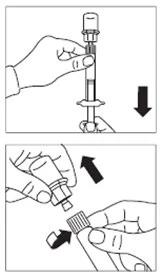
- Turn the syringe with the vial upside down and slowly withdraw the entire contents of the vial into the syringe by pulling back the plunger.
- Unscrew the syringe from the vial connector.
Step 7
- Prepare the injection site by wiping it with an alcohol-impregnated
swab.
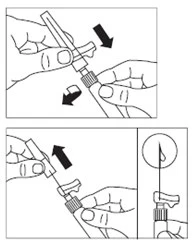
- Screw the safety needle onto the syringe.
- If immediate administration is not possible, gently shake the syringe again immediately before administration to obtain a milky, homogeneous suspension.
- Remove the protective needle cap with a straight upward motion.
- Gently tap the syringe with fingers to move any visible air bubbles to the top, then expel them from the syringe. Proceed immediately to Step 8. Any delay may cause sedimentation.
Step 8
- The medicinal product Okteva must be administered
only by deep intramuscular injection into the
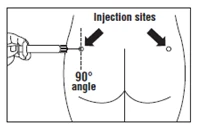
buttock, NEVER intravenously.
- Insert the entire needle into the left or right buttock at a 90° angle to the skin surface.
- Slowly pull back the plunger of the prefilled syringe to ensure the needle is not in a blood vessel (reposition the needle if it is within a blood vessel).
- Slowly and steadily push the plunger until the syringe is empty. Withdraw the needle from the injection site and activate the safety needle shield (as described in Step 9).
Step 9
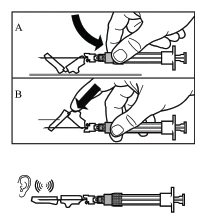
- Activate the needle safety shield using one of the following two methods:
- Press the hinged part of the shield firmly against a hard surface (Figure A)
- Or press the hinged part of the shield with a finger (Figure B).
- Proper activation will be confirmed by an audible click.
- Note: Record the injection site on the patient's chart, rotating the site monthly.
- Immediately dispose of the syringe in an appropriate sharps container.
Similar drugs
| Brand name | Dosage form | Active substance / Dosage | Manufacturer |
|---|---|---|---|
| OKTEVA | powder and solvent for preparation of suspension for injection with prolonged release |
|
Merckle GmbH Pharmathen International S.A. PLIVA Croatia Ltd. Teva Pharmaceuticals Europe B.V. |
| OKTEVA | powder and solvent for preparation of suspension for injection with prolonged release |
|
Merckle GmbH Pharmathen International S.A. PLIVA Croatia Ltd. Teva Pharmaceuticals Europe B.V. |
The original data is available in the language of the country of manufacture.
Data source: Register of Medicinal Products of Poland (URPL)
Data last verified: September 01, 2026