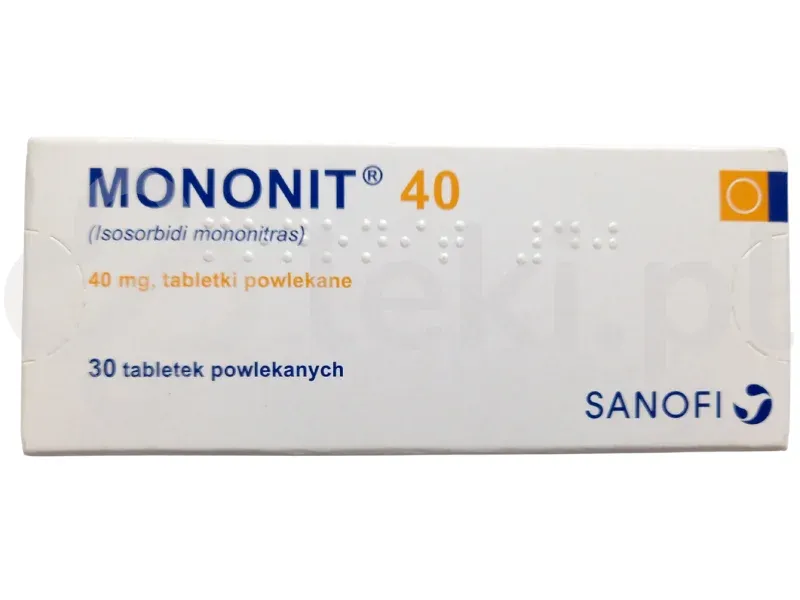
MONONIT 40
PolandThe medicinal product is used for the long-term treatment of angina pectoris (manifesting as chest pain and a feeling of pressure in the chest) and to prevent its attacks.
Frequently asked questions
How should Mononit 10, Mononit 20, Mononit 40 be taken?
The tablets should be taken after a meal, without chewing, and swallowed with a small amount of liquid. Usually, one tablet is taken two or three times daily. When dosing twice daily, the second tablet should be taken 8 hours after the first; when dosing three times daily, tablets should be taken every 6 hours.
When should you not use this medicine?
You must not take it if you are allergic to any of the ingredients of the medicine, if you have experienced anaphylactic shock or vascular collapse, serious heart rhythm disorders, severe myocardial or pericardial disease, very low blood pressure (below 90 mm Hg), severe hypovolemia, severe anemia, or if you are taking riociguat or medicines for erectile dysfunction (5-phosphodiesterase inhibitors).
Can Mononit 10, Mononit 20, Mononit 40 be taken with other medicines?
Caution should be exercised, as the simultaneous use of blood pressure-lowering drugs (e.g., beta-blockers, diuretics, calcium antagonists), neuroleptics, antidepressants, or medicines for erectile dysfunction may enhance the effect of the medicine. It must not be combined with riociguat or ergot alkaloids.
What are the possible side effects of Mononit 10, Mononit 20, Mononit 40?
Headache is the most common side effect. Low blood pressure, dizziness, drowsiness, weakness, and fainting upon standing up suddenly also occur frequently. Other possible symptoms include nausea, vomiting, flushing of the face and neck, and allergic reactions.
Can you drive after taking the medicine?
The medicine may significantly affect reaction time; therefore, you should not drive vehicles or operate machinery after taking it, especially at the start of treatment or when changing the dose.
What should you do in case of overdose?
In case of taking a dose greater than recommended, you should contact a doctor or go to the nearest hospital immediately.
Instructions for use
Patient Information Leaflet
MONONIT 10, 10 mg, film-coated tablets
MONONIT 20, 20 mg, film-coated tablets
MONONIT 40, 40 mg, film-coated tablets
Isosorbide mononitrate
Please read this leaflet carefully before using this medicine, as it contains important information for you.
- Keep this leaflet, as you may need to read it again.
- If you have any further questions, please consult your doctor or pharmacist.
- This medicine has been prescribed for a specific individual. Do not pass it on to others. It may harm them even if their symptoms are the same.
- If you experience any side effects, including any not listed in this leaflet, inform your doctor or pharmacist. See section 4.
Leaflet Contents:
- What Mononit 10, Mononit 20, Mononit 40 is and what it is used for
- What you need to know before taking Mononit 10, Mononit 20, Mononit 40
- How to take Mononit 10, Mononit 20, Mononit 40
- Possible side effects
- How to store Mononit 10, Mononit 20, Mononit 40
- Contents of the pack and other information
1. What Mononit 10, Mononit 20, Mononit 40 is and what it is used for
Mononit 10, Mononit 20, Mononit 40 is available as film-coated tablets and contains isosorbide mononitrate as the active substance.
Isosorbide mononitrate belongs to a group of medicines called organic nitrates. The medicine dilates blood vessels, increases blood flow through vessels, and reduces the heart muscle's oxygen demand.
Mononit 10, Mononit 20, Mononit 40 is used for the long-term treatment of angina pectoris (chest pain and tightness) and for preventing angina attacks.
2. Important information before taking Mononit 10, Mononit 20, Mononit 40
When not to take Mononit 10, Mononit 20, Mononit 40:
- if the patient is allergic (hypersensitive) to isosorbide mononitrate, other nitrates, or any of the other ingredients of this medicine (listed in section 6);
- if the patient has shock or circulatory collapse;
- if the patient has severe heart function disorders (cardiogenic shock);
- if the patient has severe heart muscle or pericardium diseases causing significant impairment of heart function (so-called hypertrophic cardiomyopathy, constrictive pericarditis, cardiac tamponade);
- if the patient is concurrently taking medicines used to treat erectile dysfunction (medicines from the phosphodiesterase-5 inhibitor group, e.g. sildenafil, vardenafil, tadalafil). Treatment with isosorbide mononitrate must not be discontinued in order to take a medicine containing a phosphodiesterase-5 inhibitor, as this may increase the risk of angina attacks (see "Mononit 10, Mononit 20, Mononit 40 and other medicines");
- if the patient has very low arterial blood pressure (hypotension) (systolic pressure below 90 mm Hg);
- if the patient has severe hypovolemia (reduced blood volume in vessels);
- if the patient is concurrently taking riociguat (a medicine used to treat pulmonary hypertension);
- if the patient has severe anaemia (reduced number of red blood cells, which may manifest as skin pallor, weakness, and shortness of breath).
Warnings and precautions
Before starting treatment with Mononit 10, Mononit 20, Mononit 40, discuss this with your doctor or pharmacist.
Exercise special caution when using Mononit 10, Mononit 20, Mononit 40:
- if the patient has low ventricular filling pressure, e.g. in acute myocardial infarction, impaired left ventricular function; avoid reducing systolic blood pressure below 90 mm Hg;
- if the patient has aortic and/or mitral valve stenosis;
- if the patient is prone to fainting associated with sudden body uprighting, e.g. upon waking in the morning (orthostatic circulatory disorders);
- if the patient has conditions associated with increased intracranial pressure;
- if the patient has liver function disorders;
- if the patient has a disease of the eye called glaucoma;
- if the patient has hyperthyroidism (overactivity of the thyroid gland, which may manifest as increased appetite, weight loss, and sweating);
- if the patient has reduced activity of the enzyme glucose-6-phosphate dehydrogenase (G6PD), which may manifest as haemolytic anaemia.
Mononit 10, Mononit 20, and Mononit 40 are not intended for the treatment of acute angina attacks or acute myocardial infarction.
Reduced efficacy and tolerance to the medicine have been reported with prior use of other nitrates. To avoid diminished or lost therapeutic effect, continuous administration of high doses should be avoided.
Caution is advised in patients with lung diseases or ischaemic heart disease, as the medicine may cause transient hypoxia (inadequate oxygen content in the blood). In patients with ischaemic heart disease, myocardial ischaemia may develop.
Children and adolescents
The safety and efficacy of Mononit 10, Mononit 20, Mononit 40 in children and adolescents have not been established.
Mononit 10, Mononit 20, Mononit 40 and other medicines
Inform your doctor or pharmacist about all medicines currently taken or recently taken, as well as any medicines you plan to take.
Concomitant use of the following medicines may enhance the blood pressure-lowering effect of Mononit 10, Mononit 20, Mononit 40:
- other vasodilating medicines (e.g. prazosin);
- beta-blockers (e.g. propranolol);
- diuretics;
- calcium channel antagonists (e.g. verapamil);
- angiotensin-converting enzyme inhibitors (e.g. captopril);
- neuroleptics (used to treat psychiatric disorders, e.g. chlorpromazine);
- tricyclic antidepressants (medicines used to treat depression, e.g. amitriptyline);
- medicines used to treat erectile dysfunction containing phosphodiesterase-5 inhibitors as active substances (e.g. sildenafil, vardenafil, tadalafil);
- riociguat (a medicine used to treat pulmonary hypertension).
Concomitant use with dihydroergotamine (a medicine used to treat migraine) may increase dihydroergotamine blood levels and thereby cause elevated arterial blood pressure.
Concomitant use of nitrates and ergot alkaloids should be avoided, as they may have opposing effects.
Caution is recommended when using medicines containing sapropterin (administered to patients with high blood levels of the amino acid phenylalanine) together with all medicines causing vasodilation via nitric oxide release, e.g. glyceryl trinitrate (NTG), isosorbide dinitrate (ISDN), isosorbide 5-mononitrate (5-ISMN), and others.
Mononit 10, Mononit 20, Mononit 40 with food, drink, and alcohol
Tablets should be taken after meals.
Concomitant alcohol consumption may intensify the blood pressure-lowering effect of the medicine.
Pregnancy, breastfeeding, and fertility
If the patient is pregnant, breastfeeding, suspects she may be pregnant, or is planning to have a child, she should consult her doctor or pharmacist before using this medicine.
Mononit 10, Mononit 20, Mononit 40 may be used during pregnancy only if, in the opinion of the doctor, the benefit to the mother outweighs the potential risk to the foetus.
It is unknown whether isosorbide mononitrate passes into human milk. Therefore, use of this medicine during breastfeeding is not recommended.
It is unknown whether isosorbide mononitrate affects human fertility.
Driving and operating machinery
The medicine may significantly affect the patient's reaction ability, even when used as directed. Therefore, the patient should not drive, operate machinery, or work without stable support. This is especially important during the initial treatment period, dose escalation, product change, and concomitant alcohol consumption.
Mononit 10, Mononit 20, and Mononit 40 contain sodium
The medicine contains less than 1 mmol (23 mg) of sodium per tablet, meaning the medicine is considered "sodium-free".
3. How to take Mononit 10, Mononit 20, and Mononit 40
This medicine should always be taken according to the doctor's or pharmacist's instructions. In case of doubt, consult your doctor or pharmacist.
The usual dose is 1 tablet of Mononit 10, Mononit 20, or Mononit 40 two or three times daily. The doctor may increase the dose if necessary.
The maximum daily dose is 120 mg of isosorbide mononitrate.
Tablets should be taken after meals, without chewing, with a small amount of liquid.
To avoid reduced efficacy, when dosing twice daily, the second tablet should be taken 8 hours after the first; when dosing three times daily, tablets should be taken every 6 hours.
Do not change the prescribed dose or the time intervals between doses, as this may lead to reduced or loss of therapeutic effect.
Elderly patients
Dose adjustment is not necessary in elderly patients.
Use in children and adolescents
This medicine should not be used in children.
Taking more than the recommended dose of Mononit 10, Mononit 20, Mononit 40
If more than the recommended dose of Mononit 10, Mononit 20, Mononit 40 is taken, seek immediate medical advice from a doctor or go to the nearest hospital.
Symptoms of overdose include: significant drop in blood pressure, orthostatic circulatory disorders (blood pressure drop associated with sudden body uprighting), skin pallor, excessive sweating, weakly palpable pulse, reflex tachycardia, headache, weakness, dizziness, skin flushing, nausea, vomiting, and diarrhoea. After severe overdose, methaemoglobinaemia with cyanosis, dyspnoea, increased respiratory rate, and elevated intracranial pressure may occur.
Missed dose of Mononit 10, Mononit 20, or Mononit 40
If a dose is missed, take it as soon as remembered. However, if it is almost time for the next dose, skip the missed dose and take the next dose at the usual time.
Do not take a double dose to make up for a missed dose.
Stopping treatment with Mononit 10, Mononit 20, or Mononit 40
Do not stop treatment without consulting your doctor.
If you have any further doubts regarding the use of this medicine, consult your doctor or pharmacist.
4. Possible adverse reactions
Like all medicines, this medicine can cause adverse reactions, although not everyone will experience them.
The following adverse reactions have been observed during treatment with this medicine:
Very common (may affect at least 1 in 10 people):
- headache (usually resolves after a few days of treatment).
Common (may affect up to 1 in 10 people):
- at the beginning of treatment or after increasing the dose, hypotension and (or) low arterial blood pressure, fainting due to a sudden drop in blood pressure when rapidly standing up or sitting up from a lying position (orthostatic hypotension), rapid heart rate, disorientation, dizziness, drowsiness, weakness.
Uncommon (may affect up to 1 in 100 people):
- nausea, vomiting, sudden skin flushing, especially of the face and neck (hot flushes), skin allergic reactions;
- significant decrease in arterial blood pressure with worsening of retrosternal pain (symptoms of angina pectoris);
- collapse, bradycardia, loss of consciousness.
Very rare (may affect up to 1 in 10,000 people):
- heartburn, exfoliative dermatitis.
Frequency not known (cannot be estimated from available data):
- methemoglobinemia (abnormal hemoglobin structure);
- hemolytic anemia in patients with reduced activity of glucose-6-phosphate dehydrogenase enzyme;
- angioedema (allergic reaction which may cause difficulty in swallowing or breathing);
- rash, erythema, pruritus, urticaria (allergic reactions);
- myocardial ischemia (angina pectoris);
- transient hypoxia (insufficient oxygen in the blood);
- development of drug tolerance, cross-tolerance with other nitrates (reduced effectiveness of the drug).
Reporting of adverse reactions
If any adverse reactions occur, including any not listed in this leaflet, inform your doctor or pharmacist. Adverse reactions can be reported directly to the Department of Monitoring Adverse Drug Reactions of the Office for Registration of Medicinal Products, Medical Devices and Biocidal Products,
Al. Jerozolimskie 181C, 02-222 Warsaw, phone: +48 22 4921301, fax: +48 22 4921309,
Website: https://smz.ezdrowie.gov.pl
Adverse reactions can also be reported to the marketing authorization holder.
Reporting adverse reactions helps to provide more information on the safety of the medicine.
5. How to store Mononit 10, Mononit 20, Mononit 40
No special storage instructions are required.
Keep the medicine in a place out of sight and reach of children.
Do not use the medicine after the expiry date stated on the carton and blister pack after "Expiry date". The expiry date refers to the last day of the stated month.
Medicines must not be disposed of via wastewater or household waste. Ask your pharmacist how to dispose of medicines no longer required. This will help protect the environment.
6. Contents of the packaging and other information
What Mononit 10, Mononit 20, Mononit 40 contains
- The active substance is isosorbide mononitrate. Each Mononit 10 coated tablet contains 10 mg of isosorbide mononitrate, each Mononit 20 coated tablet contains 20 mg of isosorbide mononitrate, each Mononit 40 coated tablet contains 40 mg of isosorbide mononitrate.
- Other ingredients: microcrystalline cellulose, sodium carboxymethyl starch, talc, magnesium stearate; coating: eudragit RL 30D, talc, titanium dioxide, macrogol 6000, methylsilicon oil.
What Mononit 10, Mononit 20, Mononit 40 looks like and contents of the pack
Mononit 10: white, round, biconvex coated tablets, engraved with the mark "M10" on both sides.
Mononit 20: white, round, biconvex coated tablets, engraved with the mark "M20" on both sides.
Mononit 40: white, round, biconvex coated tablets, engraved with the mark "M40" on both sides.
Pack sizes:
Mononit 10: 60 coated tablets.
Mononit 20: 30 or 60 coated tablets.
Mononit 40: 30 coated tablets.
Marketing Authorisation Holder
Sanofi Sp. z o.o.
ul. Marcina Kasprzaka 6
01-211 Warsaw
Manufacturer
Opella Healthcare Poland Sp. z o.o.
Rzeszów Branch
ul. Lubelska 52
35-233 Rzeszów
For further information, please contact:
Sanofi Sp. z o.o.
ul. Marcina Kasprzaka 6
01-211 Warsaw
Tel.: +48 22 280 00 00
Similar drugs
| Brand name | Dosage form | Active substance / Dosage | Manufacturer |
|---|---|---|---|
| MONONIT 10 | tablets, film-coated |
|
Opella Healthcare Poland Sp. z o.o. Branch in Rzeszów |
| MONONIT 20 | tablets, film-coated |
|
Opella Healthcare Poland Sp. z o.o. Branch in Rzeszów |
The original data is available in the language of the country of manufacture.
Data source: Register of Medicinal Products of Poland (URPL)
Data last verified: September 01, 2026