MIFLONIDE BREEZHALER
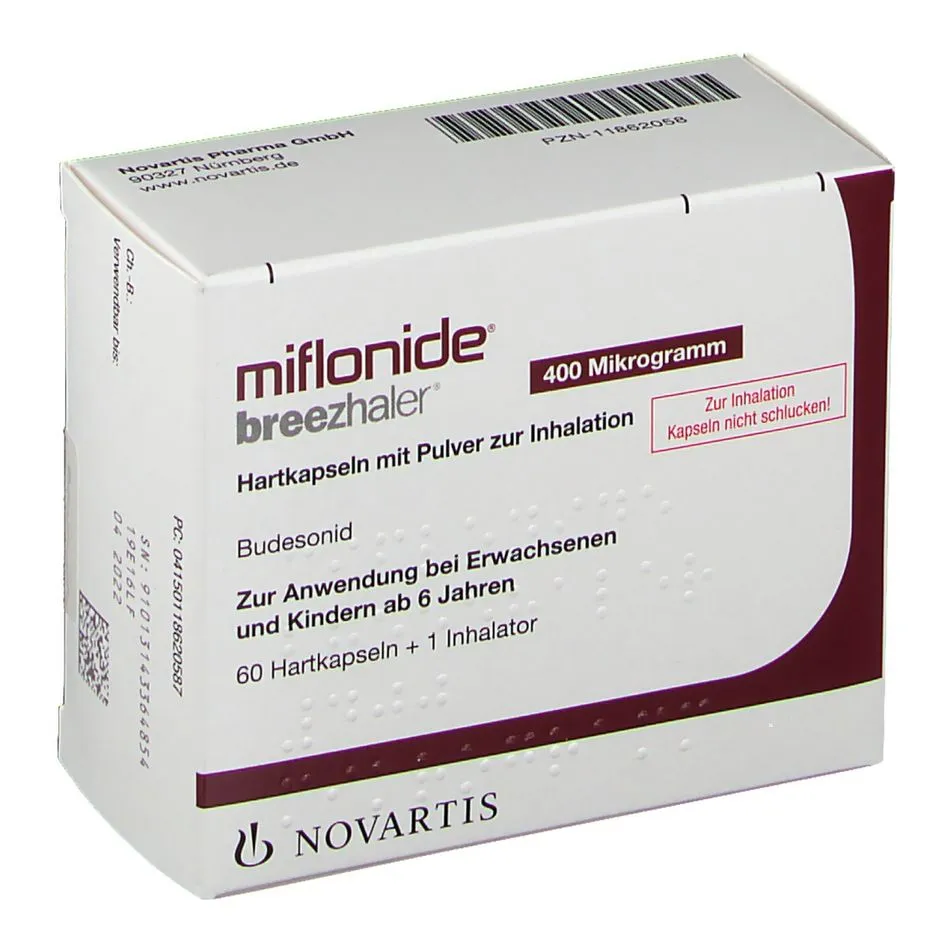
PolandThe medicine is used in the treatment of bronchial asthma in adults, children, and adolescents over 6 years of age, and in the treatment of chronic obstructive pulmonary disease (COPD). It helps to reduce inflammation in the lungs and makes breathing easier.
Frequently asked questions
How to use Miflonide Breezhaler?
The medicine should be taken according to the doctor's instructions, preferably at the same time every day. The capsules should be inserted into the special Breezhaler inhaler and the powder inhaled. After each inhalation, the mouth should be rinsed with water and spat out to prevent fungal infections.
When should you not use this medicine?
Do not use the medicine if you are allergic to budesonide or any other ingredients of the medicine, or in the case of confirmed pulmonary tuberculosis (current or past).
Can Miflonide Breezhaler cause side effects?
Possible side effects include, among others, oral fungal infections, cough, hoarseness, throat irritation, and less commonly, vision problems, muscle spasms, anxiety, or depression. In case of severe allergic reactions, difficulty breathing, or changes in body weight, contact a doctor immediately.
Does the medicine interact with other agents?
You should inform your doctor if you are taking any other medicines, especially those used to treat infections (e.g., itraconazole, clarithromycin), HIV infections (e.g., ritonavir), and medicines for heart rhythm disorders.
Can this medicine be used during pregnancy or breastfeeding?
During pregnancy, the medicine may be used only if the doctor considers that the benefit to the mother outweighs the risk to the fetus. Use of the medicine during breastfeeding is not recommended – in such cases, a doctor should be consulted.
What should you not do while using the medicine?
Miflonide Breezhaler is not intended for the treatment of sudden attacks of shortness of breath (in such situations, other rescue medicines should be used). Capsules must not be swallowed, and no inhalers other than the one included in the package should be used. You should also not suddenly stop using the medicine without consulting a doctor.
Instructions for use
Miflonide Breezhaler, 200 micrograms/inhalation dose,
inhalation powder in hard capsules
Miflonide Breezhaler, 400 micrograms/inhalation dose,
inhalation powder in hard capsules
Budesonide
Please read the entire leaflet before using this medicine, as it contains
important information for the patient.
- Keep this leaflet, so that you can read it again if necessary.
- If you have any questions, consult your doctor or pharmacist.
- This medicine has been prescribed for a specific individual. Do not pass it on to others. The medicine may harm someone else, even if their symptoms are the same.
- If you experience any adverse reactions, including any not listed in this leaflet, inform your doctor or pharmacist.
Table of contents of the leaflet
- What Miflonide Breezhaler is and what it is used for
- Important information before using Miflonide Breezhaler
- How to use Miflonide Breezhaler
- Possible side effects
- How to store Miflonide Breezhaler
- Contents of the pack and other information
1. What Miflonide Breezhaler is and what it is used for
Budesonide, the active substance in Miflonide Breezhaler, belongs to a group of medicines called corticosteroids and is used in the treatment of bronchial asthma in adults, children and adolescents aged over 6 years, as well as in the treatment of chronic obstructive pulmonary disease (COPD).
Miflonide Breezhaler is used to reduce inflammation in the lungs and helps maintain airway patency, thereby reducing asthma symptoms. Asthma is caused by inflammation of the small airways. Regular use of Miflonide Breezhaler helps prevent asthma attacks and facilitates breathing in chronic obstructive pulmonary disease.
Do not stop using Miflonide Breezhaler regularly, even if symptoms have improved.
If you have any questions about how Miflonide Breezhaler works or why it has been prescribed, consult your doctor.
2. Important information before using Miflonide Breezhaler
When not to use Miflonide Breezhaler
- if the patient is allergic (hypersensitive) to budesonide or to any of the other ingredients of the medicine listed in section 6 of this leaflet. If the patient thinks they may be allergic, they should contact their doctor,
- if the patient has tuberculosis of the lungs (current or past). If either of the above situations applies to the patient, the patient should not use Miflonide Breezhaler and should inform their doctor as soon as possible.
Warnings and precautions
Before starting treatment with Miflonide Breezhaler, discuss the following with your doctor:
- if the patient is also using another medicine from the corticosteroid group,
- if the patient has breathing difficulties due to respiratory diseases other than asthma or COPD,
- if the patient experiences blurred vision or other visual disturbances, they should contact their doctor.
Contact your doctor immediately if the patient experiences any of the following symptoms:
- respiratory tract infection during treatment with Miflonide Breezhaler (possible symptoms: worsening cough, fever, respiratory secretions),
- breathing difficulties with wheezing or cough (paradoxical bronchospasm) after inhalation of Miflonide Breezhaler,
- rash, itching, urticaria, breathing or swallowing difficulties, dizziness, swelling of the face or throat during treatment with Miflonide Breezhaler,
- change in body weight, weakness, abdominal obesity, nausea, persistent diarrhoea during treatment with Miflonide Breezhaler,
- visual disturbances, including blurred vision during treatment with Miflonide Breezhaler,
- sleep problems, depression or feeling anxious, motor restlessness, nervousness, excessive excitement or irritability during treatment with Miflonide Breezhaler.
Other special warnings
-
N M - .
-
Do not use another inhaler.
-
If symptoms worsen, such as wheezing or shortness of breath, inform your doctor.
-
Do not use Miflonide Breezhaler for the treatment of acute asthma attacks. In such cases, other medicines should be used. If the patient has not been prescribed another medicine for this purpose, they should speak to their doctor.
-
Do not suddenly stop using oral anti-inflammatory medicines (e.g. oral steroids). In patients previously treated long-term with oral anti-inflammatory medicines, the doctor will gradually reduce the dose of these medicines when starting treatment with Miflonide Breezhaler. The doctor may advise the patient to carry a warning card, because in case of an accident, surgery or severe infection, the patient may require higher doses of anti-inflammatory medicine.
-
Rinse the mouth with water after each use of Miflonide Breezhaler to reduce the likelihood of developing oral fungal infections. Do not swallow this water.
-
To relieve asthma symptoms, the patient should have access to a short-acting bronchodilator (e.g. albuterol or salbutamol).
-
Periodically, the doctor may perform adrenal function tests.
-
It is recommended that patients always carry a card stating that they have asthma.
-
If asthma symptoms worsen, the doctor may recommend increasing the dose of Miflonide Breezhaler, and may also recommend using oral corticosteroids and/or an antibiotic if there is an infection.
-
In stressful situations, such as injury or surgery, the doctor may recommend additional corticosteroids.
-
Replacing systemic corticosteroids with inhaled corticosteroids may reveal previously suppressed allergic reactions, such as allergic rhinitis or rash. Patients may experience lethargy, muscle and joint pain, nausea or vomiting. Allergic reactions can be treated with antihistamines or locally applied corticosteroids.
-
If the patient has liver disease, they should inform their doctor before using Miflonide Breezhaler. The doctor will recommend an appropriate dose.
Children and adolescents (over 6 years of age)
Miflonide Breezhaler should not be used in children under 6 years of age.
If a child uses inhaled steroids at high doses for a prolonged period, the doctor will regularly monitor the child's growth.
Miflonide Breezhaler and other medicines
Tell your doctor about all medicines the patient is currently taking or has recently taken, including medicines obtained without a prescription. This particularly includes the following medicines:
- certain medicines used to treat infections (e.g. itraconazole, ketoconazole, clarithromycin, rifampicin),
- certain medicines used to treat HIV infection (e.g. ritonavir, nelfinavir, atazanavir, cobicistat),
- certain medicines used to treat heart rhythm disorders. If the patient is taking any of the above medicines, a dose adjustment or additional precautions may be necessary.
Pregnancy and breastfeeding
This medicine may be used during pregnancy only if, in the opinion of the doctor, the benefit to the mother outweighs the potential risk to the foetus. If the patient is pregnant, suspects she may be pregnant, or is planning to become pregnant, she should consult her doctor before using this medicine. The risks of using the medicine during pregnancy should be discussed with the doctor. The lowest effective dose of budesonide necessary to maintain adequate asthma control should be used.
Use of Miflonide Breezhaler is not recommended during breastfeeding. If a woman is breastfeeding, she should consult her doctor before using this medicine. The doctor will discuss the risks of using the medicine during breastfeeding with the patient.
Driving and operating machinery
The effect of Miflonide Breezhaler on the ability to drive and operate machinery is considered unlikely.
Important information about certain ingredients of Miflonide Breezhaler
Miflonide Breezhaler contains lactose (milk sugar). If the patient has been diagnosed with intolerance to certain sugars, such as lactose, the patient should contact their doctor before using Miflonide Breezhaler.
3. How to use Miflonide Breezhaler
Miflonide Breezhaler should always be used exactly as directed by your doctor. If in
doubt, consult your doctor. Do not exceed the recommended dose.
Miflonide Breezhaler is available in two strengths in capsule form. Your doctor has prescribed
the optimal dose for you.
Dosage
Asthma
Adults: The dose is 200 to 400 micrograms of budesonide once or twice daily.
In case of worsening asthma symptoms, when switching from oral corticosteroids to inhaled
budesonide treatment, or when reducing the dose of oral corticosteroids, the budesonide dose may be increased to 1600 micrograms
daily, administered in 2 to 4 inhalations.
Children over 6 years of age: The dose is 200 micrograms of budesonide once or twice daily. If necessary, your doctor may increase the budesonide dose to 800 micrograms per day.
Children must use Miflonide Breezhaler under adult supervision.
Chronic obstructive pulmonary disease (COPD)
Adults: The dose is 200 to 400 micrograms of budesonide twice daily. If necessary,
your doctor may increase the dose to 1600 micrograms per day.
If you have any doubts about using the medicine, consult your doctor or pharmacist.
Depending on your response to treatment, your doctor may recommend a higher or lower dose.
When to use Miflonide Breezhaler
It is best to use Miflonide Breezhaler at the same time each day.
If you feel that the effect of Miflonide Breezhaler is too strong or too weak, consult your doctor.
Instructions for use
Please read the following instructions carefully to learn how to use Miflonide Breezhaler capsules with the Breezhaler inhaler.
Use Miflonide Breezhaler capsules only with the Breezhaler inhaler provided in the package.
- Do not use other inhalers.
- Do not swallow the capsules. The powder inside the capsules is intended for inhalation only.
- Remember that Miflonide Breezhaler is used only to prevent asthma attacks. To treat an asthma attack, you will need to use a rescue inhaler, which is usually already prescribed for you.
Miflonide Breezhaler product package:
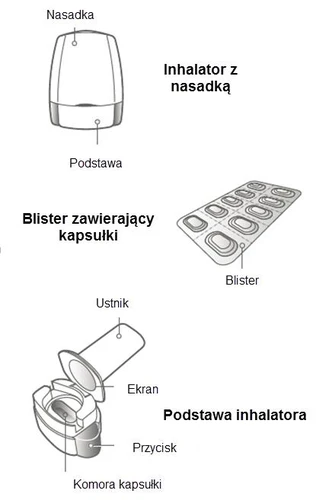
Each Miflonide Breezhaler package contains:
- 1 Breezhaler inhaler
- 6 or 10 blisters containing Miflonide Breezhaler capsules for use with the inhaler. The Breezhaler inhaler is used to inhale the medication contained in Miflonide Breezhaler capsules. How to use the Breezhaler inhaler
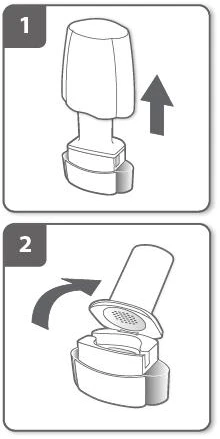
Remove the cap.
Open the inhaler:
Firmly hold the base of the inhaler and tilt the mouthpiece upwards. This opens the inhaler.
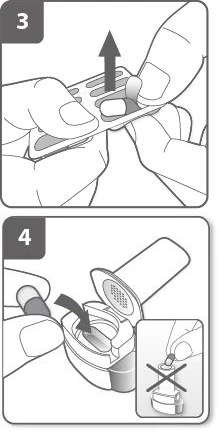
Prepare the capsule:
Remove the capsule from the blister with dry hands immediately before use.
Do not swallow the capsule.
Insert the capsule:
Place the capsule into the capsule chamber.
Never place the capsule directly into the mouthpiece.
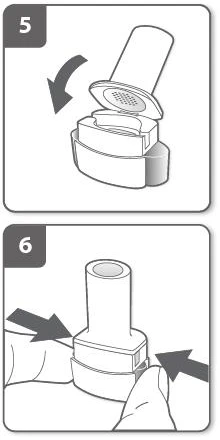
Close the inhaler:
Close the inhaler until you hear a “click”.
Pierce the capsule:
- Hold the inhaler upright with the mouthpiece facing upwards.
- Pierce the capsule by firmly pressing both side buttons simultaneously. This action should be performed only once.
- You should hear a “click” when the capsule is pierced.
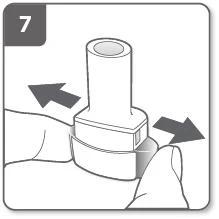
Completely release the side buttons.
Exhale:
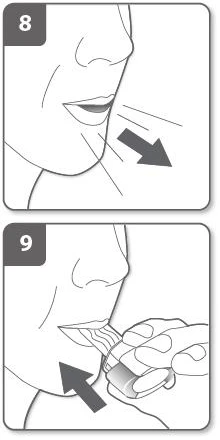
Before placing the mouthpiece in your mouth, breathe out fully.
Do not blow into the mouthpiece.
Inhale the medication:
To inhale the medication deeply into the lungs:
- Hold the inhaler as shown in the picture. The side buttons should be on the left and right sides. Do not press the side buttons.
- Place the mouthpiece in your mouth. Seal your lips tightly around it.
- Take a fast, but smooth and deep breath in, as deeply as possible.
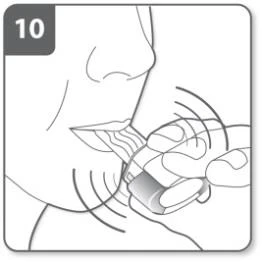
Note:
While breathing through the inhaler, the capsule will spin in the chamber and you may hear a whirring sound. You may notice a sweet taste as the medication moves into your lungs.
Additional information
Occasionally, very small fragments of the capsule may pass through the filter and reach your mouth. If this happens, these fragments may be felt on the tongue. Swallowing or inhaling these fragments is not harmful.
The likelihood of capsule breakage increases if the capsule has been pierced more than once (see step 6).
If you do not hear a whirring sound:
The capsule may be stuck in the chamber. In this case:
- Open the inhaler and gently loosen the capsule by tapping the base of the inhaler. Do not press the side buttons.
- Repeat steps 8 and 9 to inhale the medication again.
Hold your breath:
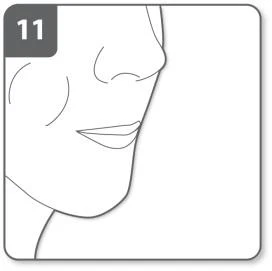
After inhaling the medication:
- Hold your breath for at least 5–10 seconds, or as long as comfortable, while removing the inhaler from your mouth.
- Then breathe out slowly.
- Open the inhaler to check whether any powder remains in the capsule.
If powder remains in the capsule:
- Close the inhaler.
- Repeat steps 8, 9, 10, and 11. Most people are able to empty the capsule within one or two inhalations.
Additional information
If the capsule is empty, this means that a sufficient amount of medication has reached the lungs.
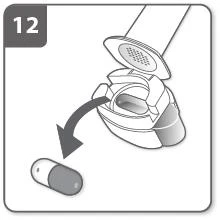
- Open the mouthpiece again and remove the empty capsule by tilting the inhaler so that the capsule falls out of the chamber. Dispose of the empty capsule in the trash. If your doctor has instructed you to take more than one capsule, repeat steps 3–12.
After completing inhalation
- Close the inhaler and replace the cap. After inhaling the medication, thoroughly rinse your mouth with water and spit out the water. This helps reduce the risk of developing a fungal infection (e.g. oral thrush) in the mouth. Do not store the capsules inside the Breezhaler inhaler.
How to clean the inhaler
Never wash the inhaler with water. If cleaning is needed, wipe the inner and outer surfaces of the mouthpiece with a clean, dry, lint-free cloth to remove any powder residue. The inhaler must remain dry.
Remember
- Do not swallow Miflonide Breezhaler capsules.
- Use only the Breezhaler inhaler provided in this package.
- Always store capsules in their blisters and remove them immediately before use.
- Never place a Miflonide Breezhaler capsule directly into the mouthpiece of the Breezhaler inhaler.
- Do not press the side buttons more than once.
- Never blow air into the mouthpiece of the Breezhaler inhaler.
- Always release the side buttons before inhaling.
- Never wash the Breezhaler inhaler with water. The inhaler must remain dry. See section “How to clean the inhaler”.
- Never disassemble the Breezhaler inhaler into parts.
- Always use a new Breezhaler inhaler provided with a new package of Miflonide Breezhaler. After finishing a package, always discard the inhaler.
- Do not store capsules in the Breezhaler inhaler.
- Always store the Breezhaler inhaler and Miflonide Breezhaler capsules in a dry place.
How long to use Miflonide Breezhaler
It is important to use Miflonide Breezhaler regularly as directed by your doctor. Continue using
Miflonide Breezhaler even if you do not have asthma symptoms, as it helps prevent asthma attacks. If you are unsure how long to continue using Miflonide Breezhaler, consult your doctor.
Taking more than the recommended dose of Miflonide Breezhaler
If you take more medicine than recommended, or if someone else accidentally takes the medicine,
contact your doctor or go to a hospital immediately. Bring the medicine packaging with you.
Appropriate treatment may be necessary.
It is important to take the medicine exactly as prescribed by your doctor. Do not increase or decrease the dose without consulting your doctor.
Missing a dose of Miflonide Breezhaler
If you miss a dose, take the next dose at your usual time. DO NOT take a double dose to make up for a missed dose.
Stopping Miflonide Breezhaler treatment
Stopping Miflonide Breezhaler may cause worsening of asthma symptoms. DO NOT suddenly stop using Miflonide Breezhaler unless your doctor tells you to do so.
If you have any further questions about using this medicine, consult your doctor or pharmacist.
4. Possible adverse reactions
Like any medicine, Miflonide Breezhaler can cause adverse reactions, although not everyone experiences them.
Some rare adverse reactions may be serious
- Difficulty breathing with wheezing, cough. The medicine should be stopped immediately and a doctor contacted.
- Severe allergic skin reactions with rash, itching, hives, difficulty breathing or swallowing, dizziness and (or) swelling of the face and throat; these may be symptoms of a severe allergic reaction.
- Extreme weakness, weight loss, nausea, persistent diarrhoea; these may be symptoms of adrenal insufficiency.
- Weight gain, moon-shaped face, muscle weakness and (or) abdominal obesity; these may be symptoms of a hormonal disorder (Cushing's syndrome associated with adrenal overactivity).
- Increased intraocular pressure (glaucoma). If any of the above symptoms occur, contact a doctor immediately.
Other adverse reactions
Frequently occurring adverse reactions
Adverse reactions that may occur in up to 1 in 10 patients
- Fungal infections (candidiasis) of the mouth and throat. Rinse the mouth with water after each dose to reduce the risk of developing oral and throat candidiasis.
- Cough. If this symptom is severe, inform the doctor.
- Hoarseness
- Throat irritation
- Dysphonia (voice function disorder, voice weakness or change in voice quality to a lower pitch)
- Pneumonia (lung infection) in patients with COPD. Inform the doctor if any of the following symptoms occur during budesonide treatment; these may be symptoms of a lung infection:
- fever or chills
- increased mucus production, change in mucus colour
- worsening cough or increased breathing difficulties
Uncommon adverse reactions
Adverse reactions that may occur in up to 1 in 100 patients
- Blurred vision, cataract
- Muscle spasms
- Muscle tremors
- Depression
- Anxiety
Rare adverse reactions
Adverse reactions that may occur in up to 1 in 1000 patients
- Growth retardation in children and adolescents
- Weakening of bone structure
- Nervousness, behavioural changes (mainly in children)
- Immediate and delayed hypersensitivity reactions, including rash, contact dermatitis, urticaria, angioedema, itching and severe allergic reactions
- Easy bruising (bruises)
If any of the listed reactions occur to a significant extent in a patient, the doctor should be informed.
Other adverse reactions may also occur, but their frequency cannot be determined
from the available data
- Sleep disturbances, excessive psychomotor activity, aggression. These reactions are more likely to occur in children. If any of the listed reactions occur in a patient, inform the doctor.
If any adverse reaction worsens or if any adverse reactions not listed in this leaflet occur, inform the doctor or pharmacist.
Reporting adverse reactions
If any adverse reactions occur, including any adverse reactions not listed in this leaflet, inform the doctor or pharmacist. Adverse reactions can be reported directly to the Department of Monitoring Adverse Reactions of Medicinal Products, Office for Registration of Medicinal Products, Medical Devices and Biocidal Products, Al. Jerozolimskie 181C, 02-222 Warsaw, tel. +48 22 49 21 301, fax: +48 22 49 21 309, e-mail: [email protected]. Reporting adverse reactions helps to provide more information on the safety of the medicine.
Adverse reactions can also be reported to the marketing authorisation holder.
5. How to store Miflonide Breezhaler
- Store the medicine below 25°C, in a dry place.
- Keep the medicine out of the sight and reach of children.
- Do not use Miflonide Breezhaler if the packaging is damaged.
- Do not use Miflonide Breezhaler after the expiry date stated on the carton. The expiry date refers to the last day of the stated month.
- Medicines must not be disposed of via wastewater or household waste. Ask your pharmacist how to dispose of medicines no longer in use. This will help protect the environment.
6. Contents of the packaging and other information
What Miflonide Breezhaler contains
- The active substance in Miflonide Breezhaler is budesonide. One capsule (i.e. one inhalation dose) of Miflonide Breezhaler contains either 200 or 400 micrograms of budesonide.
- The other ingredients are: lactose monohydrate. Capsule shell composition: gelatin, purified water, iron oxide red (E 172), titanium dioxide (E 171), and iron oxide black (E 172) (only for the 400 microgram dose) and carmine red (E 124) (only for the 400 microgram dose). Ink composition used for printing on capsules: shellac (E 904), propylene glycol (E 1520), concentrated ammonium hydroxide (E 527), iron oxide black (E 172), potassium hydroxide (E 525).
What Miflonide Breezhaler looks like and contents of the pack
Miflonide Breezhaler is a powder for inhalation contained in pink-transparent capsules. The powder inside the capsule is intended for inhalation into the lungs using a device called the Breezhaler.
The pack contains 60 or 100 capsules in blisters and an inhaler.
Marketing Authorisation Holder
Novartis Poland Sp. z o.o.
ul. Marynarska 15
02-674 Warsaw
Tel. + 48 22 375 48 88
Manufacturer/Importer:
Novartis Poland Sp. z o.o.
ul. Marynarska 15
02-674 Warsaw
Novartis Pharma GmbH
Roonstrasse 25,
90429 Nürnberg
Germany
Novartis Farmacéutica S.A.
Gran Vía de les Corts Catalanes, 764,
08013 Barcelona
Spain
Similar drugs
| Brand name | Dosage form | Active substance / Dosage | Manufacturer |
|---|---|---|---|
| BUDESONIDE LEK-AM | powder for inhalation in hard capsules |
|
Pharmaceutical Enterprise LEK-AM Ltd. |
| BUDESONIDE LEK-AM | powder for inhalation in hard capsules |
|
Pharmaceutical Enterprise LEK-AM Ltd. |
| MIFLONIDE BREEZHALER | powder for inhalation in hard capsules |
|
Novartis Farmacéutica, S.A. Novartis Pharma GmbH Novartis Poland Sp. z o.o. |
The original data is available in the language of the country of manufacture.
Data source: Register of Medicinal Products of Poland (URPL)
Data last verified: September 01, 2026