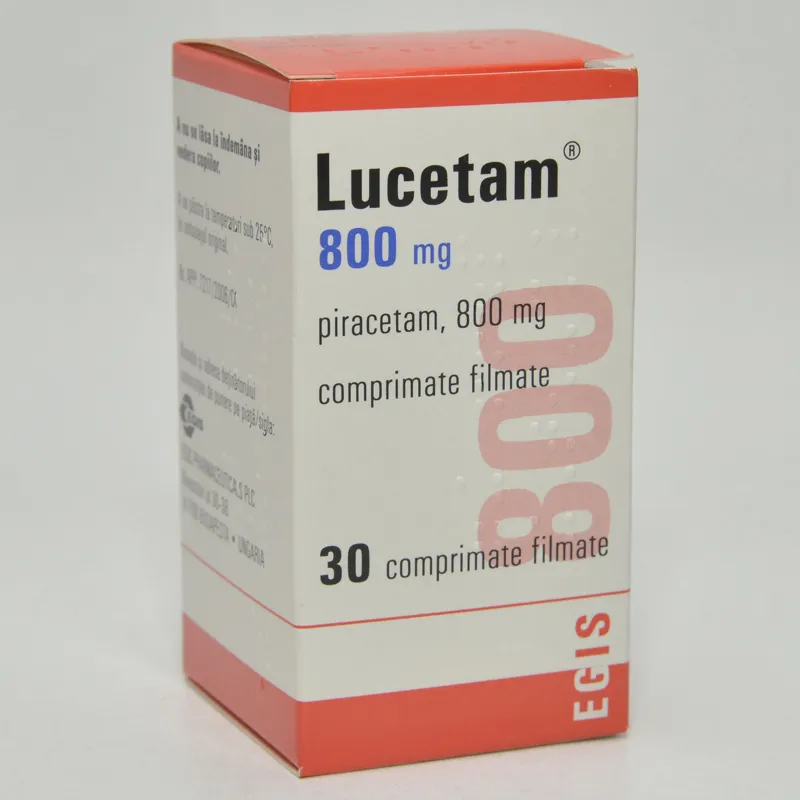
LUCETAM
PolandIt is used in the treatment of cortical myoclonus (sudden muscle spasms), dizziness of various origins, and dyslexic disorders in children (in combination with speech therapy).
Frequently asked questions
How should Lucetam be taken?
The tablets should be taken according to the doctor's instructions, with or without food, swallowing with 100-200 ml of fluid. It is recommended to divide the daily dose into 2 to 4 equal parts.
When should you not use this medicine?
You must not use it if you are allergic to piracetam or any other ingredients, if the patient has cerebral hemorrhage (hemorrhagic stroke), end-stage renal disease, or suffers from Huntington's chorea.
Can Lucetam interact with other medicines?
Yes. You must inform your doctor if you are taking thyroid hormones or anticoagulants, as their simultaneous use requires special supervision or a change in dosage. Caution is also required when using medicines that affect blood clotting.
What are the possible side effects of Lucetam?
Involuntary muscle movements, weight gain, or nervousness may occur frequently. Less commonly, weakness, drowsiness, or depression may occur. Other side effects may include headache, insomnia, dizziness, nausea, or coordination problems. Seek medical help immediately if swelling of the lips or throat, difficulty breathing, fainting, or urticaria (hives) occurs.
Can the medicine be used during pregnancy or breastfeeding?
During pregnancy, the medicine may only be used if the doctor considers that the benefits outweigh the risks. It should not be used during breastfeeding – in such a case, breastfeeding should be discontinued.
What should I do if I forget to take a dose?
Take the forgotten dose as soon as possible, unless it is almost time for the next dose. Do not take a double dose to make up for a missed dose.
Instructions for use
Patient Information Leaflet
Warning! Keep this leaflet. The information on the immediate packaging is in a foreign language.
Lucetam, 1200 mg
coated tablets
Piracetamum
Please read this leaflet carefully before taking this medicine, as it contains
important information for the patient.
- Keep this leaflet, so that you may read it again if necessary.
- If you have any questions, please consult your doctor, pharmacist, or nurse.
- This medicine has been prescribed for a specific individual. Do not pass it on to others. This medicine may harm others, even if their symptoms are the same.
- If you experience any adverse effects, including any not listed in this leaflet, inform your doctor, pharmacist, or nurse. See section 4.
Table of Contents:
- What Lucetam is and what it is used for
- Important information before taking Lucetam
- How to take Lucetam
- Possible side effects
- How to store Lucetam
- Contents of the pack and other information
1. What Lucetam is and what it is used for
Piracetam, the active substance in Lucetam, is a nootropic agent, i.e. it enhances brain metabolism. It reduces blood viscosity, increases blood flow in cerebral vessels without vasodilatory effects, and enhances oxygen utilization and glucose consumption in ischemic brain tissue.
Lucetam is indicated for the treatment of:
- cortical myoclonus (brief, sudden muscle jerks affecting one or more limbs or the trunk);
- vertigo of various origins;
- dyslexic disorders in children (in combination with speech therapy).
2. Important information before using Lucetam
When not to use Lucetam:
- if the patient is allergic to piracetam, other pyrrolidone derivatives, or any of the other ingredients of this medicine (listed in section 6);
- if the patient has bleeding in the brain (hemorrhagic stroke);
- if the patient has end-stage renal disease;
- if the patient suffers from Huntington's chorea.
Warnings and precautions
Before using Lucetam, inform your doctor or pharmacist:
- if the patient has impaired kidney function, as in such cases elimination of the active substance of Lucetam may be reduced, resulting in a stronger effect of the medicine. Dose adjustment may be necessary. In elderly patients, the doctor will regularly monitor kidney function during treatment;
- if the patient has coagulation disorders, severe bleeding, or is at risk of bleeding, for example due to gastric or intestinal ulcer; if the patient has previously experienced a hemorrhagic stroke; or if the patient has recently undergone major surgery, including dental surgery, or is taking anticoagulant medicines or platelet aggregation inhibitors (including low-dose acetylsalicylic acid), because the active substance of Lucetam may affect blood coagulation and its use in such cases requires special caution (and careful medical supervision);
- if the patient has muscle jerks originating from the central nervous system (cortical myoclonus), as abrupt discontinuation of Lucetam may lead to recurrence of myoclonus and withdrawal seizures.
Lucetam and other medicines
Tell your doctor about all medicines the patient is currently taking or has recently taken,
as well as any medicines the patient plans to take.
Be sure to inform the doctor about taking thyroid hormones or anticoagulant medicines.
Concomitant use of these medicines with Lucetam requires careful medical supervision or adjustment of the doses used.
Pregnancy and breastfeeding
If the patient is pregnant or breastfeeding, suspects she may be pregnant, or is planning to have a child, she should consult a doctor or pharmacist before using this medicine.
Pregnancy
Lucetam may be used during pregnancy only if clearly necessary. The doctor will prescribe this medicine only when the benefits of its use in an individual case outweigh the potential risk to the fetus.
Breastfeeding
Piracetam is excreted in breast milk. Therefore, Lucetam should not be used during breastfeeding, or breastfeeding should be discontinued for the duration of treatment with Lucetam.
Driving and operating machinery
Given the adverse events observed during treatment with Lucetam, the medicine may affect the ability to drive and operate machinery, which should be taken into account. The doctor will determine appropriate restrictions accordingly.
3. How to use Lucetam
This medicine should always be taken according to the instructions provided by your doctor or pharmacist. If you have any doubts,
you should consult your doctor or pharmacist.
Recommended dose
The dose and duration of treatment should be individually determined by a doctor depending on
the type and severity of the disease, age, and other medical conditions.
Tablets should be taken with food or independently of meals, and swallowed with 100–200 ml of liquid.
It is recommended to divide the daily dose into 2–4 equal parts.
Recommended daily doses depending on the indication:
Treatment of muscle jerks originating from the central nervous system (cortical myoclonus):
The recommended initial dose is 7.2 g per day. If necessary, this dose may be increased by 4.8 g every
3–4 days, up to a maximum dose of 24 g, administered in 2 or 3 divided doses.
Treatment of dizziness:
The recommended daily dose ranges from 2.4 g to 4.8 g, in 2 or 3 divided doses.
In case of renal impairment, dosage adjustment may be necessary.
Use in children and adolescents
To improve learning outcomes in children with learning difficulties and dyslexic disorders (in
combination with other methods):
For adolescents and children from the age of 8, the recommended daily dose is approximately 3.2 g, in 2 divided doses.
It should be used in combination with speech therapy.
Taking a higher than recommended dose of Lucetam
If you take more than the recommended dose of Lucetam, you should immediately contact your doctor.
Missing a dose of Lucetam
Do not take a double dose to make up for a missed dose. If you miss a dose at the scheduled time, take the missed dose as soon as possible before the next dose. If it is already time for the next dose, skip the missed dose. Otherwise, there is a risk of overdose from taking two doses at once.
Stopping Lucetam treatment
Do not stop taking this medicine without first consulting your doctor. If you have any further doubts regarding the use of this medicine, consult your doctor or pharmacist.
4. Possible adverse reactions
Like all medicines, this medicine can cause adverse reactions, although not everybody gets them.
If any of the following symptoms occur, stop taking Lucetam and seek urgent medical help:
- swelling of the hands, feet, lips or throat, causing difficulty in breathing or swallowing;
- fainting or feeling faint;
- hives. A severe allergic (hypersensitivity) reaction to Lucetam may have occurred.
The following adverse reactions have been reported:
Frequent adverse reactions (may occur in 1 out of 10 patients):
Hyperkinesia (involuntary and excessive movement, usually of skeletal muscles), weight gain, nervousness.
Uncommon adverse reactions (may occur in 1 out of 100 patients):
Weakness, somnolence, depression.
Adverse reactions with unknown frequency (frequency cannot be estimated from the available data):
Bleeding disorders, agitation, anxiety, confusion, hallucinations, ataxia (impaired coordination of movement), balance disorders, exacerbation of epilepsy, headache, insomnia, dizziness, abdominal pain, epigastric pain, diarrhoea, nausea and vomiting, skin inflammation, skin itching.
Reporting of adverse reactions
If any adverse reactions occur, including any adverse reactions not listed in this leaflet, inform your doctor, pharmacist or nurse.
Adverse reactions can also be reported directly to the Department of Monitoring of Adverse Drug Reactions at the Office for Registration of Medicinal Products, Medical Devices and Biocidal Products
Al. Jerozolimskie 181C
02-222 Warsaw
Phone: +48 (22) 49 21 301
Fax: +48 (22) 49 21 309
Website: https://smz.ezdrowie.gov.pl
Reporting adverse reactions helps to provide more information on the safety of this medicine.
5. How to store Lucetam
Do not store at temperatures above 30°C.
Keep the medicine in a place invisible and out of reach of children.
Do not use the medicine after the expiry date stated on the packaging.
The expiry date refers to the last day of the stated month.
Medicines should not be disposed of via sewage systems or household waste. Ask your
pharmacist how to dispose of medicines no longer in use. This will help protect the
environment.
6. Contents of the packaging and other information
What Lucetam contains
The active substance is piracetam.
Each coated tablet contains 1200 mg of piracetam.
The other ingredients are: magnesium stearate, povidone K 30, coating (polyethylene glycol 6000, dibutyl sebacate, titanium dioxide (E 171), talc, ethylcellulose, hypromellose).
What Lucetam looks like and contents of the pack
White or almost white, oval, biconvex coated tablets with an embossed marking on one side:
"E 243".
Brown glass bottle with a plastic closure and tamper-evident ring, in a cardboard box, with an enclosed patient information leaflet, containing 60 coated tablets.
For further detailed information, please contact the Marketing Authorisation Holder or the Parallel Importer.
Marketing Authorisation Holder in Hungary, the country of export:
Egis Gyógyszergyár Zrt., H-1106 Budapest, Keresztúri út 30-38., Hungary
Manufacturer:
Egis Gyógyszergyár Zrt., H-9900 Körmend, Mátyás király utca 65., Hungary
Parallel Importer:
Delfarma Sp. z o.o., ul. Św. Teresy od Dzieciątka Jezus 111, 91-222 Łódź, Poland
Repackaged in:
Delfarma Sp. z o.o., ul. Św. Teresy od Dzieciątka Jezus 111, 91-222 Łódź, Poland
Hungarian Marketing Authorisation Number, country of export: OGYI-T-7153/09
Parallel Import Authorisation Number: 269/24
Similar drugs
| Brand name | Dosage form | Active substance / Dosage | Manufacturer |
|---|---|---|---|
| LUCETAM | tablets, film-coated | — | Egis Pharmaceuticals PLC |
| LUCETAM | tablets, film-coated |
|
Egis Pharmaceuticals PLC |
| LUCETAM | tablets, film-coated |
|
Egis Pharmaceuticals Ltd. |
| LUCETAM | tablets, film-coated |
|
Egis Pharmaceuticals Ltd. |
| MEMONIQ | tablets, film-coated |
|
HASCO-LEK S.A. Pharmaceutical Production Enterprise |
| MEMOTROPIL | tablets, film-coated |
|
Polpharma Pharmaceutical Works S.A. |
| MEMOTROPIL | tablets, film-coated |
|
Polpharma Pharmaceutical Works S.A. |
| NOOTROPIL | tablets, film-coated | — | UCB A.E. |
| NOOTROPIL | tablets, film-coated |
|
Advanz Pharma Limited |
| NOOTROPIL | tablets, film-coated |
|
UCB Hungary Ltd. |
| NOOTROPIL | tablets, film-coated |
|
UCB A.E. |
| PIRACETAM ESPEFA | tablets, film-coated |
|
Chemiczno-Farmaceutyczna ESPEFA Workers' Cooperative |
The original data is available in the language of the country of manufacture.
Data source: Register of Medicinal Products of Poland (URPL)
Data last verified: September 01, 2026