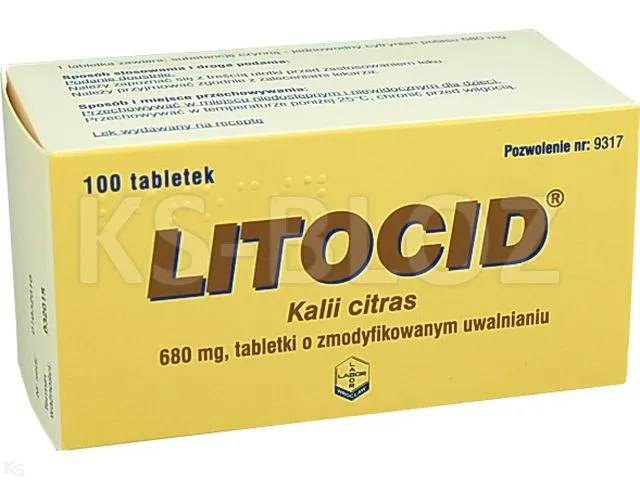
LITOCID
PolandIt is used in the treatment of calcium kidney stones in individuals with low urinary citrate excretion. It also helps in the treatment of renal tubular acidosis, metabolic acidosis in chronic renal failure, and is used to supplement potassium deficiency in the body. It may also be used in other conditions requiring long-term alkalization of the urine.
Frequently asked questions
How should Litocid be taken?
Tablets should be swallowed whole with plenty of fluid. They must not be broken or chewed, as this may irritate the stomach. For adults of average body weight, the standard dosage is 2 tablets 3 times a day (on average every 8 hours) at regular intervals. For treatment efficacy, it is most important to take the medication in the morning (after waking up) and in the evening (before bedtime).
When should this medicine not be used?
The medicine should not be used in cases of elevated blood potassium levels (hyperkalemia), urinary tract infections, blood clotting disorders, alkalosis, chronic renal failure (in advanced stages), and gastric or duodenal ulcer diseases. Contraindications also include conditions that slow the passage of the tablet through the gastrointestinal tract and planned surgical procedures within the next 2 days.
Can Litocid be taken with food?
Taking the medicine immediately after a meal may help relieve potential stomach irritation. However, alcohol should not be consumed during the course of treatment.
What side effects may Litocid cause?
Very rarely, symptoms of stomach irritation may occur, such as nausea, vomiting, heartburn, or a feeling of fullness. An exacerbation of lower limb venous insufficiency or symptoms of hemorrhagic diathesis is also possible. In individuals prone to hyperventilation, dizziness or vision disturbances (blackouts) may occur.
Does the medicine interact with other preparations?
Yes. Particular caution should be exercised when using it with ACE inhibitors and angiotensin II receptor antagonists. It should not be combined with aluminum and magnesium hydroxide, eplerenone, or methenamine. Consultation with a doctor is necessary when simultaneously taking potassium-sparing diuretics, opioids, certain antibiotics, antidepressants, and medications that affect blood clotting or urinary pH.
Instructions for use
LITOCID ®
(Kalii citras)
680 mg, modified-release tablets
Please read the entire package leaflet carefully before using the medicine, as it contains important information for the patient.
- Keep this leaflet for future reference.
- If you have any further questions, please consult your doctor or pharmacist.
- This medicine has been prescribed for a specific individual. Do not share it with others. This medicine may harm others, even if their symptoms are the same.
- If you experience any adverse reactions, including any not listed in this leaflet, inform your doctor or pharmacist. See section 4.
Table of contents
- What Litocid is and what it is used for
- Important information before taking Litocid
- How to take Litocid
- Possible side effects
- How to store Litocid
- Contents of the pack and other information
1. What Litocid is and what it is used for
The active substance in Litocid is potassium citrate. The formulation ensures slow release of the active substance. Citrates are known as a group of chemical compounds that act as inhibitors of calcium-containing kidney stone formation. This effect is achieved by reducing urinary saturation with calcium stone-forming salts. Citrates inhibit the growth of calcium oxalate and calcium phosphate crystals and alkalize urine. Approximately 90% of the administered dose is absorbed from the gastrointestinal tract. Administration before or after meals does not significantly affect the bioavailability of the drug. Orally administered citrates are largely metabolized, primarily in the intestinal wall. A small portion (from 1 to 10%) of the citrate administered at standard therapeutic doses reaches the systemic circulation and is subsequently excreted in urine. Bicarbonates formed from metabolized citrate act as an alkalizing agent, reducing the rate of endogenous citrate consumption in the tricarboxylic acid cycle and increasing renal citrate excretion. A single dose of potassium citrate in a slow-release formulation increases urinary citrate excretion over a period of 1 to 10 hours after ingestion (however, there is considerable individual variability).
Indications for use of Litocid include:
- Calcium-containing kidney stones in patients with low urinary citrate excretion,
- Distal renal tubular acidosis, metabolic acidosis in chronic renal failure (without significant reduction in daily urine volume and without hyperkalemia),
- Potassium deficiency supplementation,
- Other pathological conditions requiring chronic urinary alkalization.
2. Important information before using Litocid
When not to use Litocid
Litocid should not be used in the following cases:
- Hyperkalaemia (elevated potassium levels in the blood),
- Local and generalized disorders of haemostasis (e.g. blood coagulation disorders, vascular purpura),
- Urinary tract infection,
- Alkalosis, especially metabolic alkalosis,
- Ammonium-magnesium phosphate and mixed forms of kidney stones with predominance of ammonium-magnesium phosphate, particularly when associated with urinary tract infection,
- Chronic renal failure (glomerular filtration rate less than 0.7 ml/kg/min), especially in moderate to terminal stages,
- Inflammatory conditions of the stomach and duodenum, active peptic ulcer disease, gastrointestinal bleeding,
- Conditions causing delayed passage of tablets through the gastrointestinal tract, such as delayed gastric emptying, esophageal compression, intestinal obstruction or narrowing, as well as during anticholinergic therapy,
- Anticipated surgical procedures within the next 2 days, especially those involving risk of significant blood loss.
Warnings and precautions
Exercise particular caution when using Litocid, as breaking or chewing the tablet
accelerates drug release and may intensify its potential irritant effect on the gastric wall. For this
reason, it is recommended to swallow the tablets whole and drink plenty of fluid.
During treatment, monitoring urine acidity is advisable. Measurements should be
performed in freshly voided urine 3–4 times daily (morning urine measurement is most important). It is recommended to maintain urine pH within the range of 6.5–7.0. Based on the results obtained, the dose should be adjusted in consultation with a physician.
The presence of urinary tract infection, which may interfere with correct assessment of citrate's effect on urine pH, should be ruled out. One of the methods for monitoring drug requirement may also be measurement of daily urinary citrate excretion, with a recommended excretion level above 500 mg/day (or urine concentration exceeding 350 mg/l – particularly relevant when urine output is less than 1.5 l/day). Doses causing urinary citrate excretion exceeding 1200 mg/day do not provide significant additional benefits. For effective treatment and prevention of kidney stones, administration of the drug in the evening (before bedtime) and in the morning (after waking up) is most important.
Litocid should be one component of a treatment regimen developed by a physician, including adequate urine output, dietary recommendations, and periodic urine and blood tests. It should be noted that in most indicated conditions, the drug should be used long-term, even for many years. Unsupervised interruption of treatment, even for a short period (1–2 days), without consulting a physician, may negate the positive effects of long-term therapy and lead to recurrence or worsening of kidney stone symptoms.
Doses higher than recommended should not be used.
Consult a physician also if the above symptoms occurred in the past.
Litocid with food, drink, and alcohol
Taking the medication shortly after a meal may reduce potential gastrointestinal irritation.
Alcoholic beverages should not be consumed during treatment.
Litocid in patients with impaired kidney or liver function
In patients with mild impairment of kidney function or tendency towards elevated serum potassium levels, treatment should be supervised by a nephrologist. Serum creatinine and potassium levels should be monitored, and intake of potassium-rich foods (tomatoes, oranges, fruit compotes) may need to be limited.
Pregnancy, breastfeeding, and fertility
If the patient is pregnant, breastfeeding, suspects she might be pregnant, or is planning to have a child, she should consult a physician or pharmacist before using this medication.
The safety of using this drug during pregnancy and breastfeeding has not been sufficiently documented. Treatment may be continued only under supervision of a gynaecologist and nephrologist. The daily dose should be re-evaluated based on test results.
Driving and operating machinery
When used according to recommendations, the drug does not affect the ability to drive or operate machinery.
Litocid with other medicines
Inform your physician or pharmacist about all medications currently or recently taken, as well as any medications you plan to take.
Potassium citrate should not be administered with aluminium and magnesium hydroxide, eplerenone (selective aldosterone blocker), or methenamine. Consult a physician when using Litocid concomitantly with potassium-sparing diuretics, opioids, ephedrine (a component of cough syrups), pseudoephedrine (a component of cold tablets and antitussive syrups), anticoagulants, macrolide antibiotics, tricyclic antidepressants, or drugs that alkalinize or acidify urine (e.g. Phytolysin, Citropepsin, Alugastrin).
Furthermore, due to increased risk of hyperkalaemia, particular caution is required when using Litocid concomitantly with ACE inhibitors and angiotensin II receptor antagonists.
3. How to use Litocid
This medicine should always be taken as directed by a physician or pharmacist. If in doubt,
consult a physician or pharmacist.
In adults of average body weight, treatment should be initiated by taking orally 2 tablets (50 mg/kg body weight) three times daily at regular intervals (approximately every 8 hours). The maximum dose, individually determined for each patient, is based on urine pH and/or daily urinary citrate excretion.
Use in children
There is no appropriate indication for the use of Litocid in children.
Ingestion of more than the recommended dose of Litocid
The minimum toxic dose has not been established. Potassium salts administered to patients with normally functioning kidneys usually show minimal toxicity. Symptoms may include nausea, vomiting, weakness, limb paresthesia, pallor, hypotension, muscle cramps, and arrhythmias (cardiac rhythm disturbances). Low doses of potassium salts may be toxic in patients with renal insufficiency. In these patients, metabolic alkalosis (alkalosis) may also occur. Overdose of potassium citrate may lead to hyperkalemia.
Symptomatic management is recommended, depending on the disturbances identified by the physician, along with increased fluid intake over the next 12–24 hours. If less than half an hour has passed since ingestion of the medicine, an attempt should be made to induce vomiting. In case of signs of hemorrhagic diathesis, administration of vessel-sealing agents and vitamin K is helpful. Gastrointestinal irritation symptoms should be alleviated by using agents that form a protective coating on the gastric mucosa (e.g. preparations containing sucralfate) or alternatively H-receptor blockers (e.g. preparations containing ranitidine). Extreme caution should be exercised when considering the use of other drugs that alkalinize gastric contents. Mild alkalosis can be managed (in outpatient settings) with vitamin C and/or cranberry juice, following consultation with a nephrologist.
In case of ingestion of more than the recommended dose, seek immediate medical advice from a physician or pharmacist.
Missed dose of Litocid
Take the missed dose as soon as possible, unless it is almost time for the next dose. Do not take a double dose to make up for a missed dose.
4. Possible adverse reactions
Like all medicines, this medicine can cause adverse reactions, although not everyone will experience them.
The frequency of the possible adverse reactions listed below is defined as follows:
- very common: (occurs in more than 1 in 10 people);
- common: (occurs in 1 to 10 in 100 people);
- uncommon: (occurs in 1 to 10 in 1,000 people);
- rare: (occurs in 1 to 10 in 10,000 people);
- very rare: (occurs in less than 1 in 10,000 people);
- unknown: (frequency cannot be estimated from the available data).
General disorders and administration site conditions
Very rare: irritation of the upper gastrointestinal tract (especially when taken on an empty stomach and without water) – vomiting, nausea, heartburn, feeling of fullness in the right hypochondrium.
Vascular disorders
Exacerbation of venous insufficiency of the lower limbs, occurrence or worsening of haemorrhagic diathesis symptoms.
Respiratory, thoracic and mediastinal disorders
In individuals prone to hyperventilation (usually manifested by rapid and deep breathing), worsening of associated clinical symptoms (e.g. dizziness, visual disturbances) may occur.
If any of the described symptoms occur during treatment with this medicine, discontinue use immediately and consult a doctor without delay.
In some individuals, other adverse reactions may occur during treatment with Litocid.
Reporting of adverse reactions
If any adverse reactions occur, including any adverse reactions not listed in this leaflet, inform your doctor, pharmacist, or nurse. Adverse reactions can be reported directly to the Department of Monitoring Adverse Drug Reactions of the Office for Registration of Medicinal Products, Medical Devices and Biocidal Products:
Al. Jerozolimskie 181C, 02-222 Warsaw
tel.: +48 22 49-21-301; fax: +48 22 49-21-309
e-mail: [email protected]
Adverse reactions can also be reported to the marketing authorization holder.
Reporting adverse reactions helps to provide more information on the safety of the medicine.
5. How to store the medicine Litocid
Keep the medicine out of sight and reach of children.
Store below 25°C.
Keep in the original packaging to protect from moisture.
Do not use this medicine after the expiry date stated on the carton and container. The expiry date refers to the last day of the stated month.
Medicines must not be disposed of via the sewage system or in household waste. Ask your pharmacist how to dispose of medicines no longer required. This will help protect the environment.
6. Contents of the packaging and other information
What Litocid contains
The active substance is potassium citrate.
The other ingredients are carbomer 974 P, carbomer 971 P, magnesium stearate, povidone, talc.
What Litocid looks like and contents of the pack
White, round, biconvex tablet.
Available pack: HDPE or LDPE container closed with a PE cap containing a desiccant, in a cardboard box, containing 100 tablets and patient leaflet.
Marketing Authorisation Holder and Manufacturer
LABOR Pharmaceutical-Chemical Company Ltd.
ul. Długosza 49, 51-162 Wrocław
tel.: +48 71 325 30 85
fax: +48 71 326 14 57
e-mail: [email protected]
The original data is available in the language of the country of manufacture.
Data source: Register of Medicinal Products of Poland (URPL)
Data last verified: September 01, 2026