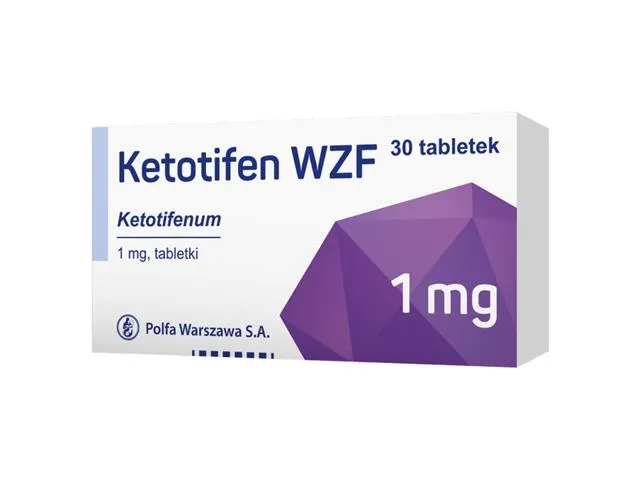
KETOTIFEN WZF
PolandThe medicine is used in adults and children over 3 years of age to prevent shortness of breath in asthma patients and to treat the symptoms of allergic rhinitis and conjunctivitis (such as runny nose, itching, sneezing, redness, or watery eyes).
Frequently asked questions
How to use Ketotifen WZF?
Tablets should be taken orally during a meal. The standard dose for adults and children over 3 years of age is 1 tablet twice daily (every 12 hours, morning and evening). The full effect of the medicine appears after several weeks of systematic use.
When should you not take this medicine?
Do not use the medicine if you are allergic to its ingredients, have epilepsy, are taking oral antidiabetic drugs, or if the patient is breastfeeding.
Does Ketotifen WZF cause side effects?
Possible side effects include, among others, drowsiness, headache, nausea, dizziness, dry mouth, as well as less commonly weight gain or liver problems. Some skin reactions may be very serious and require immediate contact with a doctor.
Can alcohol be consumed during treatment?
Alcohol should not be consumed while using the medicine, as it may enhance its effects.
Does the medicine affect driving?
In the first days of use, the medicine may impair the ability to drive vehicles and operate machinery; therefore, caution should be exercised and one should wait until their individual reaction to the body is known.
How to discontinue the medicine?
The medicine should be discontinued gradually over a period of 2 to 4 weeks to avoid a possible recurrence of asthma symptoms. The decision to discontinue treatment should always be made by a doctor.
Instructions for use
Patient Information Leaflet
KETOTIFEN WZF, 1 mg, tablets
Ketotifenum
Please read the entire leaflet carefully before using this medicine, as it contains
important information for the patient.
- Keep this leaflet for future reference.
- If you have any questions, please consult your doctor, pharmacist, or nurse.
- This medicine has been prescribed for a specific individual. Do not pass it on to others. It may harm someone else, even if their symptoms are similar.
- If any side effects occur, including any not listed in this leaflet, inform your doctor, pharmacist, or nurse. See section 4.
Table of Contents
- What Ketotifen WZF is and what it is used for
- Important information before taking Ketotifen WZF
- How to take Ketotifen WZF
- Possible side effects
- How to store Ketotifen WZF
- Contents of the pack and other information
1. What Ketotifen WZF is and what it is used for
Ketotifen WZF is an antiallergic medicine containing ketotifen, used in adults and children
aged over 3 years:
- for the prevention of asthma attacks in patients suffering from bronchial asthma;
- for the treatment of nasal and ocular symptoms associated with allergic rhinitis and allergic conjunctivitis (such as nasal congestion, profuse watery nasal discharge, nasal itching, frequent sneezing, redness of the eyes, tearing, eye itching).
2. Important information before using Ketotifen WZF
When not to use Ketotifen WZF:
- If the patient is allergic to ketotifen or any of the other ingredients of this medicine (listed in section 6).
- If the patient has epilepsy.
- If the patient is taking oral antidiabetic medicines.
- If the patient is breastfeeding.
Warnings and precautions
Before starting treatment with Ketotifen WZF, discuss it with a doctor or pharmacist.
Warning: Ketotifen WZF is not effective in treating acute allergic reactions or in stopping asthma attacks.
- If the patient suffers from epilepsy or has had seizures, they should consult a doctor before using this medicine.
- If allergy testing is planned, the medicine should be discontinued 10–14 days before the tests.
- During the initial phase of treatment with ketotifen, previously used anti-asthmatic medicines, especially corticosteroids, should not be abruptly discontinued, as adrenal insufficiency may occur. Therefore, corticosteroids should be gradually withdrawn over a prolonged period while using ketotifen.
- If the patient is taking antidiabetic medicines, this should be reported to the doctor. In rare cases, transient reduction in platelet count has been observed in patients taking Ketotifen WZF together with oral antidiabetic medicines. Therefore, concomitant use of antidiabetic medicines and Ketotifen WZF is not recommended (see section "When not to use Ketotifen WZF").
Ketotifen WZF may enhance the effects of alcohol. Therefore, alcohol should not be consumed during treatment with Ketotifen WZF.
If the patient experiences slowed reactions, possibly due to the sedative effect of the medicine, they should consult a doctor, who may reduce the dose.
Ketotifen WZF and other medicines
Inform the doctor or pharmacist about all medicines currently used or recently taken, as well as any medicines the patient plans to use. It is particularly important to inform the doctor about the use of:
- Other medicines used in asthma treatment, including bronchodilators;
- Sedatives, sleeping pills, or other medicines causing drowsiness;
- Strong opioid analgesics;
- Oral antidiabetic medicines (see section "When not to use Ketotifen WZF");
- Antihistamines (e.g. certain medicines used to treat allergies, colds, and flu);
- Anticoagulants.
Taking Ketotifen WZF with food and drink
This medicine should be taken during meals.
Pregnancy and breastfeeding
If the patient is pregnant or breastfeeding, suspects she may be pregnant, or is planning to have a child, she should consult a doctor or pharmacist before using this medicine.
The doctor will decide whether Ketotifen WZF can be used during pregnancy.
Breastfeeding must not be continued during treatment with Ketotifen WZF.
Driving and operating machinery
During the first few days of treatment, this medicine may impair the ability to drive and operate machinery. Therefore, driving or operating machinery should be avoided until the patient's individual response to the medicine is known.
3. How to use Ketotifen WZF
This medicine should always be used as directed by the physician. If in doubt, consult your
doctor or pharmacist.
Ketotifen WZF is taken orally.
Ketotifen WZF should be taken regularly – the full therapeutic effect occurs after several weeks of
treatment.
The usual doses are given below.
Children over 3 years of age:
1 tablet (1 mg) twice daily, every 12 hours, in the morning and evening, during meals.
In children, ketotifen syrup is recommended.
Adults:
1 tablet (1 mg) twice daily, every 12 hours, in the morning and evening, during meals.
In patients sensitive to the sedative effect of ketotifen, the physician may recommend gradually
increasing the dose during the first week of treatment, starting with half a tablet (0.5 mg ketotifen)
twice daily, then increasing the dose until the full therapeutic dose is reached. If necessary, the
physician may recommend increasing the daily dose up to 4 mg, i.e. 2 mg ketotifen twice daily.
Dosage adjustment is not required in elderly patients.
If you feel that the effect of Ketotifen WZF is too strong or too weak, consult your doctor.
Duration of treatment
The duration of treatment is determined by the physician.
Use of a higher than recommended dose of Ketotifen WZF
Main symptoms of overdose include: drowsiness progressing to excessive sedation; dizziness,
confusion and disorientation; increased heart rate and hypotension; hyperexcitability or seizures
(particularly in children); transient coma.
In case of ingestion of a higher than recommended dose, seek immediate medical advice. The
physician will decide on further management. Within the first few hours after ingestion of an
excessive dose, vomiting should be induced in the patient.
Missed dose of Ketotifen WZF
If a dose of Ketotifen WZF is missed, take it as soon as possible. Do not take the medicine if less
than 4 hours remain before the next scheduled dose. In this case, take the next dose at the usual
time. Do not take a double dose to make up for a missed dose.
Stopping Ketotifen WZF
If it becomes necessary to discontinue Ketotifen WZF, consult your doctor. The medicine should
be withdrawn gradually over a period of 2 to 4 weeks due to the risk of recurrence of asthma symptoms.
If you have any further questions regarding the use of this medicine, consult your doctor or
pharmacist.
4. Possible adverse reactions
Like all medicines, this medicine can cause adverse reactions, although not everyone will experience them.
The adverse reactions listed below are categorized according to their frequency of occurrence.
Some very rare adverse reactions may be serious (occurring in fewer than 1 in
10,000 people):
- rash, skin redness, formation of blister-like lesions (mainly on the lips, eyelids, and inside the mouth), accompanied by fever, chills, headache, cough, and body aches (Stevens-Johnson syndrome),
- yellowing of the skin and whites of the eyes, dark urine (symptoms of jaundice, liver function disorders, hepatitis).
If any of the above symptoms occur in a patient, a doctor should be informed immediately.
Common (occurring in fewer than 1 in 10 people):
- psychomotor agitation;
- irritability;
- insomnia;
- nervousness. These symptoms have been observed especially in children.
Uncommon (occurring in fewer than 1 in 100 people):
- cystitis (burning sensation or pain when urinating, frequent urination);
- dizziness;
- dryness of the oral mucosa.
Rare (occurring in fewer than 1 in 1,000 people):
- weight gain;
- sedation.
Very rare (occurring in fewer than 1 in 10,000 people):
- erythema multiforme;
- Stevens-Johnson syndrome – see information provided at the beginning of section 4 of this leaflet;
- severe skin reactions;
- seizures;
- hepatitis;
- increased liver enzyme activity.
Frequency not known (frequency cannot be estimated from available data):
- drowsiness;
- headache;
- nausea, vomiting, diarrhoea;
- rash, urticaria.
At the beginning of treatment, sedation, dryness of the oral mucosa, and dizziness may occur; these usually resolve spontaneously during continued use.
Reporting of adverse reactions
If any adverse reactions occur, including any adverse reactions not listed in this leaflet, inform a doctor, pharmacist, or nurse. Adverse reactions can be reported directly to the Department of Monitoring Adverse Drug Reactions of the Office for Registration of Medicinal Products, Medical Devices and Biocidal Products
Al. Jerozolimskie 181C
02-222 Warsaw,
Tel.: + 48 22 49 21 301
Fax: + 48 22 49 21 309
Website: https://smz.ezdrowie.gov.pl
Adverse reactions can also be reported to the marketing authorization holder.
Reporting adverse reactions helps to provide more information on the safety of this medicine.
5. How to store Ketotifen WZF
Keep this medicine out of sight and reach of children.
Store below 25°C.
Do not use this medicine after the expiry date stated on the carton and on the blister. The expiry date refers to the last day of the specified month.
The marking on the packaging: EXP indicates the expiry date, and Lot/LOT indicates the batch number.
Medicines must not be disposed of via wastewater or household waste. Ask your pharmacist how to dispose of medicines no longer required. Proper disposal helps protect the environment.
6. Contents of the packaging and other information
What Ketotifen WZF contains
- The active substance is ketotifen. Each tablet contains 1 mg of ketotifen (in the form of ketotifen hydrogen fumarate).
- The other ingredients are: magnesium stearate, maize starch, calcium hydrogen phosphate.
What Ketotifen WZF looks like and contents of the pack
Ketotifen WZF is a white or slightly cream-coloured tablet, with bevelled edges, round,
flat, with a dividing score on one side.
Each pack contains 30 tablets in blisters made of Aluminium/PVC, packed in a cardboard box.
Marketing Authorisation Holder
Zakłady Farmaceutyczne POLPHARMA S.A.
ul. Pelplińska 19, 83-200 Starogard Gdański
tel. + 48 22 364 61 01
Manufacturer
Zakłady Farmaceutyczne POLPHARMA S.A.
Production Site in Nowa Dęba
ul. Metalowca 2, 39-460 Nowa Dęba
The original data is available in the language of the country of manufacture.
Data source: Register of Medicinal Products of Poland (URPL)
Data last verified: September 01, 2026