INFLADROP
PolandIt is used to reduce ocular inflammation in adults following cataract surgery.
Frequently asked questions
How to use Infladrop?
One drop should be applied to the treated eye(s) twice daily (morning and evening). Treatment should last for 2 weeks after surgery and must not be extended.
When should you not use the medicine?
Do not use it if you are allergic to bromfenac or any other ingredients, or if you have experienced asthma, skin allergy, or severe nasal inflammation while using other anti-inflammatory drugs (e.g., ibuprofen). The medicine must not be used in children and adolescents.
Can contact lenses be worn during treatment?
The use of contact lenses is not recommended after cataract surgery; therefore, they should not be used during the course of treatment.
What side effects may Infladrop cause?
Side effects may include, among others, a foreign body sensation in the eye, redness, itching, pain or irritation of the eye, swelling of the eyelids, blurred vision, and more rarely, damage to the ocular surface or asthma.
Does the medicine affect driving?
Blurred vision may occur for a short time after instillation. Do not drive vehicles or operate machinery until this symptom has resolved.
What interactions should be taken into account?
You must inform your doctor if you are using steroid medications, drugs that affect blood clotting (e.g., warfarin, clopidogrel, acetylsalicylic acid), or if you have conditions such as diabetes, rheumatoid arthritis, or dry eye syndrome.
Instructions for use
Patient Information Leaflet
Infladrop, 0.9 mg/mL, eye drops, solution in a single-dose container
Bromfenac
Please read this leaflet carefully before using this medicine, as it contains important information for you.
- Keep this leaflet, as you may need to read it again.
- If you have any further questions, please consult your doctor or pharmacist.
- This medicine has been prescribed for a specific individual. Do not pass it on to others. It may harm someone else even if their symptoms are the same as yours.
- If you experience any side effects, including any not listed in this leaflet, tell your doctor or pharmacist. See section 4.
Table of contents:
- What Infladrop is and what it is used for
- Important information before using Infladrop
- How to use Infladrop
- Possible side effects
- How to store Infladrop
- Contents of the pack and other information
1. What Infladrop is and what it is used for
Infladrop contains bromfenac, which belongs to a group of medicines called non-steroidal anti-inflammatory drugs (NSAIDs). It works by blocking certain substances that cause inflammation.
Infladrop is used to reduce ocular inflammation following cataract surgery in adults.
2. Important information before using Infladrop
When not to use Infladrop
- if you are allergic to bromfenac or any of the other ingredients of this medicine (listed in section 6),
- if you have experienced asthma, skin allergy, or severe nasal inflammation while taking other NSAIDs. Examples of NSAIDs include: acetylsalicylic acid, ibuprofen, ketoprofen, diclofenac.
Warnings and precautions
Talk to your doctor or pharmacist before using Infladrop:
- if you are using topical corticosteroids (e.g. cortisone), as this may lead to adverse effects,
- if you have blood clotting disorders (e.g. haemophilia) or a history of such disorders, or if you are taking other medicines that may prolong bleeding time (e.g. warfarin, clopidogrel, acetylsalicylic acid),
- if you have eye diseases (e.g. dry eye syndrome, corneal disease),
- if you have diabetes,
- if you have rheumatoid arthritis,
- if you have undergone repeated eye surgery within a short period.
The use of contact lenses after cataract surgery is not recommended. Therefore, do not use contact lenses during treatment with Infladrop.
Children and adolescents
Infladrop should not be used in children and adolescents.
Infladrop and other medicines
Tell your doctor or pharmacist about all medicines you are currently taking or have recently taken, as well as any medicines you plan to take.
Pregnancy, breastfeeding and fertility
If you are pregnant, breastfeeding, think you may be pregnant, or are planning to become pregnant, consult your doctor before using this medicine.
Infladrop should not be used during the last three months of pregnancy.
Your doctor may prescribe this medicine during pregnancy if the expected benefit to the mother outweighs the potential risk to the fetus.
Infladrop may be prescribed to breastfeeding women and has no significant effect on fertility.
Driving and operating machinery
For a short time after instillation, blurred vision may occur. Patients experiencing reduced visual acuity after using this medicine should not drive or operate machinery until these symptoms have resolved.
3. How to use Infladrop
This medicine should always be used exactly as directed by a doctor or pharmacist. If in doubt,
consult a doctor or pharmacist.
Dosage
The recommended dose is one drop of Infladrop into the affected eye(s) twice daily (morning and
evening). Do not use more than one drop per affected eye twice daily.
Treatment with Infladrop should begin the day after cataract surgery.
Method of administration
Infladrop is for ophthalmic use only.
- Wash your hands before using the eye drops.
- Assume a comfortable and stable position.
- Open the aluminium sachet containing the single-dose containers.
- Detach one single-dose container from the strip.
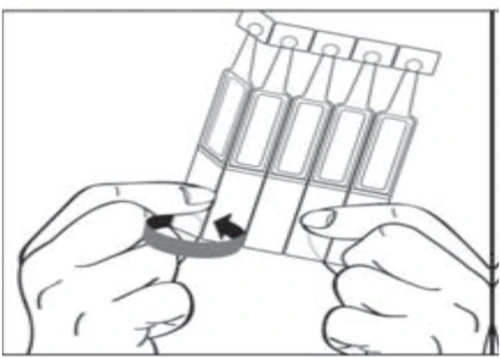
- Place the strip with the remaining single-dose containers back into the sachet and fold the edge
to close it. - To open the single-dose container, twist the top part.
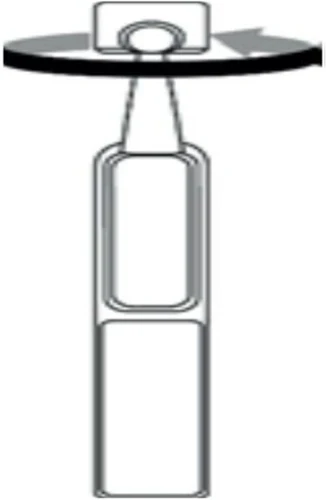
- Hold the container between your thumb and index finger.
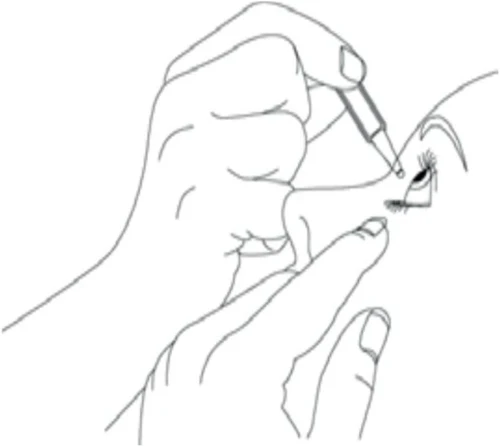
- Tilt your head backward or lie down. Look upward and, using a clean finger of the other hand, gently pull down the lower eyelid. Ensure that no part of the container touches the eye or surrounding areas. Gently squeeze the container to instil one drop into the space between the eyelid and the eyeball.
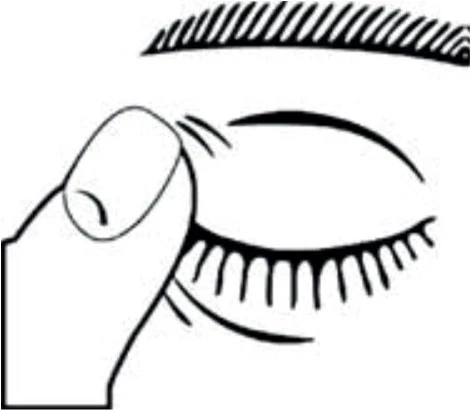
- Close the eye and press with a finger on the inner corner of the eye for about two minutes. This helps prevent the medicine from draining into the rest of the body.
- Wipe away any excess solution from the skin around the eye.
If your doctor has advised using the medicine in both eyes, repeat steps 7 to 9 for the second eye. After use, discard the single-dose container with any remaining medicine.
If you are using other eye drops, wait at least 5 minutes between applying Infladrop and the other drops.
Duration of treatment
Use the medicine for 2 weeks after surgery. Do not use Infladrop for longer than 2 weeks.
If you use more Infladrop than recommended
Rinse the eye with warm water. Do not use any additional drops until the next regularly scheduled dose. In case of accidental ingestion of Infladrop, drink a glass of water or another liquid to dilute the medicine.
If you forget to use Infladrop
Apply a single dose as soon as you remember. If it is almost time for the next dose, skip the missed dose. Continue with your regular dosing schedule. Do not use a double dose to make up for a forgotten dose.
Stopping Infladrop
Do not stop using Infladrop without consulting your doctor.
In rare cases, after discontinuation of eye drops containing bromfenac, an increase in inflammatory reaction has been observed, such as macular edema following cataract surgery.
If you have any further questions about the use of this medicine, consult your doctor or pharmacist.
4. Possible adverse reactions
Like all medicines, this medicine can cause adverse reactions, although not everyone experiences them.
If there is a worsening of vision or reduced visual acuity one week after discontinuation of treatment, you should contact your doctor immediately.
If any of the following adverse reactions occur during use of the drops, you should contact your doctor immediately:
Uncommon adverse reactions (may occur in up to 1 in 100 patients)
Foreign body sensation in the eye, eye redness and inflammation, eye surface damage and inflammation, eye discharge, itching, irritation or eye pain, eyelid swelling or bleeding, impaired vision caused by inflammation, floaters or moving spots in front of the eyes, or worsening of vision, which may indicate bleeding or damage to the back of the eye (retina), ocular discomfort, light sensitivity, blurred or reduced vision, facial swelling, cough, nosebleed or nasal congestion.
Rare adverse reactions (may occur in up to 1 in 1000 patients)
Eye surface damage, eye redness, asthma.
Reporting of adverse reactions
If any adverse effects occur, including any adverse effects not listed in this leaflet, inform your doctor or pharmacist. Adverse reactions can be reported directly to the Department of Monitoring Adverse Drug Reactions of the Office for Registration of Medicinal Products, Medical Devices and Biocidal Products:
Al. Jerozolimskie 181C, 02-222 Warsaw,
tel.: + 48 22 49 21 301,
fax: + 48 22 49 21 309,
website: https://smz.ezdrowie.gov.pl
Adverse reactions can also be reported to the Marketing Authorisation Holder.
Reporting adverse reactions helps to provide more information on the safety of the medicine.
5. How to store Infladrop
Keep the medicine out of the sight and reach of children.
Do not use this medicine after the expiry date stated on the bottle after "EXP". The expiry date refers to the last day of the stated month.
Store below 25°C.
Single-dose containers should be stored in the aluminum sachet.
After first opening the aluminum sachet, the shelf life of the single-dose containers is 7 days; after this period, any unused containers remaining in the sachet must be discarded.
The medicine contains no preservatives: after opening a single-dose container, the medicine should be used immediately.
After instilling the medicinal product into the eye(s), the single-dose container must be discarded, even if some solution remains.
Medicines must not be disposed of via wastewater or household waste. Ask your pharmacist how to dispose of medicines no longer required. Such measures help protect the environment.
6. Contents of the pack and other information
What Infladrop contains
- The active substance is bromfenac. One mL of solution contains 0.9 mg of bromfenac (as bromfenac sodium sesquihydrate). One drop contains approximately 33 micrograms of bromfenac.
- The other ingredients are: boric acid, borax, sodium sulfite (E 221), tyloxapol, povidone (K30), disodium edetate, water for injections, sodium hydroxide (to adjust pH).
What Infladrop looks like and contents of the pack
Infladrop is a clear greenish-yellow liquid (solution) available in single-dose containers made of LDPE with a capacity of 0.25 mL. The pack contains 4 sachets made of PET/Aluminium/PE, each containing 5 single-dose containers connected in strips – 20 single-dose containers in total.
Marketing Authorisation Holder
Adamed Pharma S.A.
Pieńków, ul. Mariana Adamkiewicza 6A,
05–152 Czosnów
tel.: +48 22 732 77 00
Manufacturer
Adamed Pharma S.A.
ul. Marszałka J. Piłsudskiego 5
95-200 Pabianice
Genetic S.p.A.
Nucleo Industriale
Contrada Canfora
84084 Fisciano (SA)
Italy
Similar drugs
| Brand name | Dosage form | Active substance / Dosage | Manufacturer |
|---|---|---|---|
| BROFESTILL | drops, ophthalmic solution in single-dose container |
|
Genetic S.p.A |
The original data is available in the language of the country of manufacture.
Data source: Register of Medicinal Products of Poland (URPL)
Data last verified: September 01, 2026