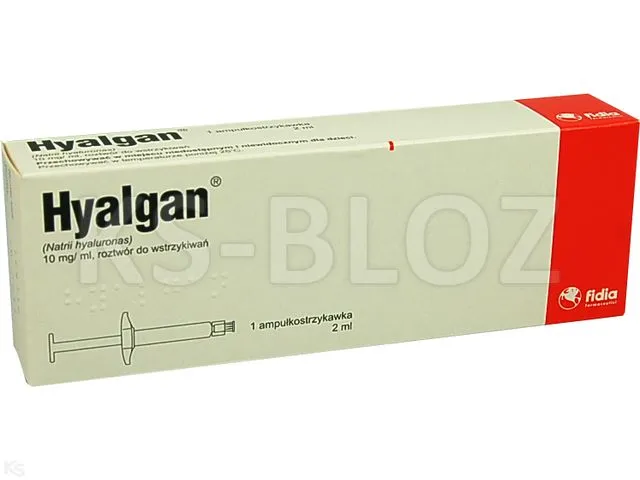
HYALGAN
PolandThe medicine is used in cases of mild to moderate knee osteoarthritis. It helps restore the properties of synovial fluid, such as viscosity and elasticity, and supports cartilage repair processes, while also acting anti-inflammatorily and analgesically.
Frequently asked questions
How should Hyalgan be used?
The medicine is administered via injections directly into the joint. The procedure is performed by a physician once a week for 5 weeks. After administration, it is recommended to avoid overstraining the joint for several hours.
When should you not use this medicine?
It should not be used if there is a hypersensitivity to hyaluronic acid or other ingredients of the medicine, if the patient has ever been allergic to poultry protein, or if the patient suffers from severe liver failure.
What are the possible side effects of Hyalgan?
Rarely, the following may occur: pain, swelling, redness, effusion, increased heat at the injection site, arthritis, or other complications following puncture. Very rarely, the following may occur: hypersensitivity reactions, rash, urticaria, pruritus, as well as synovitis or infectious arthritis.
Can the medicine be used with other preparations?
You must inform your doctor about all medications you are taking. Hyaluronic acid used simultaneously with certain local anesthetics may prolong their duration of action. Disinfectants containing quaternary ammonium salts should be avoided, as they may cause the active substance to precipitate.
Can the medicine be used during pregnancy?
During pregnancy and breastfeeding, the medicine is recommended only in absolutely necessary cases, and the decision must be made by a physician after assessing the benefits and risks.
Instructions for use
Patient Information Leaflet
Warning! Keep this leaflet! The packaging contains information in a foreign language.
Hyalgan
10 mg/ml (20 mg/2 ml), solution for injection
Natrii hyaluronas
Please read the entire leaflet before using the medicine, as it contains important information for the patient.
- Keep this leaflet for future reference.
- Consult your doctor or pharmacist if you have any further questions.
- This medicine has been prescribed for a specific individual. Do not give it to others.
- This medicine may harm another person, even if their symptoms are the same.
- If any of the side effects worsen or if any side effects not listed in this leaflet occur, inform your doctor or pharmacist immediately. See section 4.
Table of contents:
- What is Hyalgan and what is it used for
- What you need to know before using Hyalgan
- How to use Hyalgan
- Possible side effects
- How to store Hyalgan
- Contents of the pack and other information
1. What is Hyalgan and what is it used for
Hyalgan contains the active substance hyaluronic acid, a highly purified compound of high molecular weight belonging to the group of glycosaminoglycans (polysaccharide acids), which is an important component of extracellular structures. This substance occurs naturally in high concentrations, among others, in cartilage and synovial fluid. Intra-articular administration of Hyalgan in joint degenerative disease leads to normalization of synovial fluid properties such as viscosity and elasticity, and stimulates cartilage repair processes. Studies have shown that hyaluronic acid exerts anti-inflammatory and analgesic effects, resulting in improved joint mobility.
For intra-articular use.
Hyalgan is indicated for the treatment of mild to moderate osteoarthritis of the knee joints.
2. Important information before using Hyalgan
When not to use Hyalgan
- if the patient is allergic (hypersensitive) to hyaluronic acid or to any of the other ingredients of the medicine (listed in section 6);
- if the patient has ever had an allergy to avian protein;
- if the patient has severe liver insufficiency.
Warnings and precautions
- Disinfectants containing quaternary ammonium salts should not be used, as hyaluronic acid may precipitate in their presence.
- Intra-articular injection should be performed by a properly trained physician, using appropriate technique and under aseptic conditions required for this route of administration.
- The physician must exercise particular caution when administering the medicine to patients with an infection localized near the injection site, to avoid potential development of bacterial arthritis.
- Before performing the intra-articular injection, the physician must thoroughly examine the patient to exclude acute joint inflammation. If such a diagnosis is established, the physician should consider whether administration of the medicine is justified.
- If joint effusion is present, the physician should perform joint aspiration prior to injecting the medicine.
- Before injecting the medicine, the physician must ensure that the needle has not been inserted into a blood vessel (do not aspirate into the syringe containing the medicine).
- It is recommended to avoid overloading the joint for several hours after administration of the medicine.
Other medicines and Hyalgan
Inform your physician about all medicines currently used or recently used, as well as any medicines
the patient intends to use.
Hyaluronic acid, when used concomitantly with certain locally acting anesthetics, prolongs the duration of anesthesia.
Disinfectants containing quaternary ammonium salts may cause precipitation of hyaluronic acid.
No physico-chemical incompatibilities have been observed with drugs such as corticosteroids, when administered via intra-articular injections.
Pregnancy and breastfeeding
During pregnancy and breastfeeding, or if there is suspicion that a woman may be pregnant, or when planning pregnancy, consult a physician or pharmacist before using this medicine.
Animal studies have not shown embryotoxic or teratogenic effects of hyaluronic acid. However, in pregnant and breastfeeding women, Hyalgan should be used only when absolutely necessary. The decision to use the medicine should be made by the physician based on an assessment of the benefit-risk ratio.
Driving and operating machinery
Hyalgan has no influence on the ability to drive vehicles or operate machinery.
3. How to use Hyalgan
This medicine should always be used as directed by the physician. In case of doubt, consult
your doctor or pharmacist.
Hyalgan is administered as intra-articular injections once a week at a dose of 20 mg (2 ml)
for 5 weeks, under aseptic conditions.
Instructions for preparing the medicine for use and disposal of any residue
Cartridge-syringe: remove the elastomeric cap and carefully screw the needle onto the syringe, taking care not
to push the plunger. Check that the needle is securely attached to the threaded connector. Do
not overtighten the needle, as this may cause the connector to twist.
Any unused product and waste material must be disposed of in accordance with applicable regulations.
Overdose of Hyalgan
Due to the specific mode of administration (intra-articular injections are performed exclusively by a physician),
overdose by the patient is not possible.
Missed dose of Hyalgan
If a dose is missed, contact your doctor to schedule the next injection. Do not administer a double
dose to make up for the missed dose.
4. Possible adverse reactions
Like all medicines, this medicinal product may cause adverse reactions, although not everyone experiences them.
The adverse reactions listed below originate from controlled and open clinical trials as well as from spontaneous reports following marketing authorization.
Uncommon adverse reactions (occur in 1 to 10 people per 10,000):
pain, effusion, swelling, increased local warmth, redness, joint inflammation, post-administration local reactions, i.e. any other complications following joint puncture.
Very rare adverse reactions (occur in fewer than 1 person per 10,000) and frequency unknown (cannot be estimated from available data):
synovitis, septic arthritis, hypersensitivity reactions, anaphylaxis, rash, urticaria, pruritus.
Symptoms at the injection site were transient and resolved spontaneously within a few days, especially with concomitant use of cold compresses and joint unloading (recommended rest).
The above-mentioned adverse reactions very rarely had a more severe course and persisted for longer periods.
Administration of hyaluronic acid injections in cases of symptoms indicating an exacerbation of chronic inflammatory processes rarely led to worsening of the disease.
Hypersensitivity and anaphylactic reactions (reported spontaneously) resolved without permanent consequences.
Reporting of adverse reactions
If any adverse reactions occur, including any adverse reactions not listed in this leaflet, inform your doctor or pharmacist. Adverse reactions can be reported directly to the Department of Monitoring Adverse Drug Reactions, Office for Registration of Medicinal Products, Medical Devices and Biocidal Products, Al. Jerozolimskie 181C, 02-222 Warsaw, Tel.: +48 22 49 21 301, Fax: +48 22 49 21 309, website: https://smz.ezdrowie.gov.pl
Reporting adverse reactions helps to provide more information on the safety of this medicinal product.
5. How to store Hyalgan
Keep this medicine out of sight and reach of children.
Do not store above 25°C. Do not freeze.
Do not use this medicine after the expiry date stated on the packaging. The expiry date refers to the last day of the stated month.
Medicines must not be disposed of via wastewater or household waste. Ask your pharmacist how to dispose of medicines no longer in use. This will help protect the environment.
6. Contents of the package and other information
What Hyalgan contains
The active substance is sodium hyaluronate.
1 ml of injection solution contains the active substance: 10 mg of sodium hyaluronate.
2 ml of solution (1 pre-filled syringe) contains 20 mg of sodium hyaluronate.
Other ingredients include: sodium chloride, sodium dihydrogen phosphate dihydrate, disodium phosphate dodecahydrate, water for injections.
What Hyalgan looks like and contents of the pack
Hyalgan is a solution for injection supplied in a pre-filled syringe made of colourless type I glass, packed in a blister.
The pre-filled syringe contains 2 ml of solution and is sealed with a sterile elastomeric stopper (non-latex) and a needle attachment adapter, placed in a cardboard carton.
For further information, please contact the Marketing Authorisation Holder or the Parallel Importer.
Marketing Authorisation Holder in Italy, country of export:
Fidia Farmaceutici S.p.A.
Via Ponte della Fabbrica, 3/A
35031 Abano Terme (PD)
Italy
Manufacturer:
Fidia Farmaceutici S.p.A.
Via Ponte della Fabbrica, 3/A
35031 Abano Terme (PD)
Italy
Parallel Importer:
InPharm Sp. z o.o.
ul. Strumykowa 28/11
03-138 Warsaw
Poland
Repackaged by:
InPharm Sp. z o.o. Services sp. k.
ul. Chełmżyńska 249
04-458 Warsaw
Poland
Marketing Authorisation Number in Italy, country of export: 026354035
Parallel Import Licence Number: 301/23
Similar drugs
| Brand name | Dosage form | Active substance / Dosage | Manufacturer |
|---|---|---|---|
| HYALGAN | solution for injection |
|
Fidia Farmaceutici S.p.A. |
| HYALGAN | solution for injection |
|
Faran A.B.E.E. |
| HYALUROPROL | solution for injection |
|
Faran A.B.E.E. |
| SODIUM HYALURONATE MEDEZIN | solution for injection |
|
Faran A.B.E.E. |
The original data is available in the language of the country of manufacture.
Data source: Register of Medicinal Products of Poland (URPL)
Data last verified: September 01, 2026