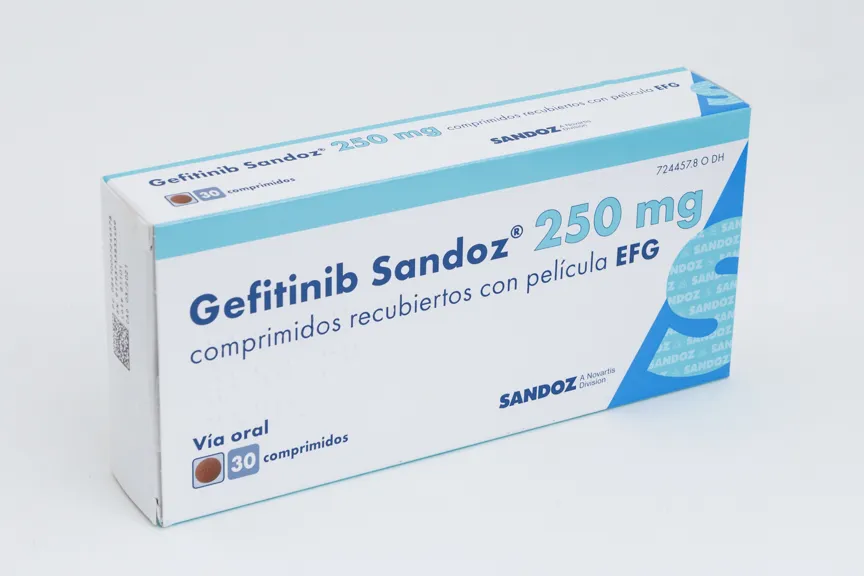
GEFITINIB SANDOZ
PolandThe medicine is used in adult patients for the treatment of non-small cell lung cancer.
Frequently asked questions
How should Gefitinib Sandoz be taken?
The recommended dose is one 250 mg tablet daily, taken every day at the same time. The tablet can be taken with or without food. If you have difficulty swallowing, you may mix the tablet (without crushing it!) with non-carbonated water and drink the entire mixture immediately after preparation.
When should you not use this medicine?
It must not be used if you are allergic to gefitinib or any of the excipients, or if the patient is breastfeeding. The medicine should not be administered to children and adolescents under 18 years of age.
Can this medicine be used with other preparations?
You must inform your doctor about all medicines you are taking, especially anticonvulsants, anti-tuberculosis drugs, antifungals, barbiturates, St. John's wort, medicines for heartburn and ulcers, and warfarin. Some of these may affect how the medicine works.
What are the possible side effects of Gefitinib Sandoz?
Common side effects may include: diarrhea, vomiting, nausea, skin rash, loss of appetite, weakness, and pain or redness in the mouth. Serious symptoms include allergic reactions (facial swelling, difficulty breathing), shortness of breath, severe skin reactions, and eye problems.
What should you do if you miss a dose?
If there are 12 or more hours left until the next dose, take the missed tablet immediately upon remembering. If there are less than 12 hours left, skip the missed dose and take the next one at the usual time. Do not take a double dose.
Instructions for use
Patient Information Leaflet
Gefitinib Sandoz, 250 mg, film-coated tablets
Gefitinibum
Please read all of this leaflet carefully before taking this medicine because it contains
important information for you.
- Keep this leaflet. You may need to read it again.
- If you have any further questions, ask your doctor, pharmacist, or nurse.
- This medicine has been prescribed for you personally. Do not pass it on to others. It may harm them even if their symptoms are the same as yours.
- If you experience any side effects, including any not listed in this leaflet, tell your doctor, pharmacist, or nurse. See section 4.
Contents of the leaflet
- What Gefitinib Sandoz is and what it is used for
- What you need to know before taking Gefitinib Sandoz
- How to take Gefitinib Sandoz
- Possible side effects
- How to store Gefitinib Sandoz
- Contents of the pack and other information
1. What Gefitinib Sandoz is and what it is used for
Gefitinib Sandoz contains the active substance gefitinib, which inhibits the activity of a protein called the epidermal growth factor receptor (EGFR). This protein is involved in the growth and spread of cancer cells. Gefitinib Sandoz is used to treat adult patients with non-small cell lung cancer. This type of cancer develops in lung tissue.
2. Important information before using Gefitinib Sandoz
When not to use Gefitinib Sandoz
- if the patient is allergic to gefitinib or to any of the excipients of this medicine (listed in section 6);
- if the patient is breastfeeding.
Warnings and precautions
Before taking Gefitinib Sandoz, discuss with your doctor or pharmacist if:
- the patient has ever had lung disease, as certain lung problems may worsen during treatment with Gefitinib Sandoz;
- the patient has ever had liver function disorders.
Children and adolescents
Gefitinib Sandoz must not be used in children and adolescents under 18 years of age.
Gefitinib Sandoz and other medicines
Tell your doctor or pharmacist about all medicines the patient is currently taking, has recently taken, or plans to take.
Especially inform your doctor or pharmacist if the patient is taking any of the following medicines:
- phenytoin or carbamazepine (antiepileptic medicines);
- rifampicin (a medicine used to treat tuberculosis);
- itraconazole (a medicine used to treat fungal infections);
- barbiturates (a type of medicine used to treat sleep disorders);
- herbal products containing St John's wort (Hypericum perforatum), used to treat depression and anxiety;
- proton pump inhibitors, H-_2 receptor antagonists, and antacids (medicines used to treat peptic ulcer, dyspepsia, heartburn, and to reduce gastric hydrochloric acid secretion);
The above medicines may affect the way Gefitinib Sandoz works. - warfarin (an oral anticoagulant medicine used to prevent blood clots). If the patient is taking a medicine containing this active substance, the doctor may recommend more frequent blood tests.
Pregnancy, breastfeeding and fertility
If the patient is pregnant, may become pregnant, or is breastfeeding, she should inform the doctor before taking this medicine.
Pregnancy should be avoided during treatment with Gefitinib Sandoz, as it may harm the unborn child.
For the safety of the infant, breastfeeding women must not take Gefitinib Sandoz.
Driving and operating machinery
If the patient experiences fatigue while taking this medicine, caution should be exercised when driving, operating tools or machinery.
Gefitinib Sandoz contains sodium and lactose
This medicine contains less than 1 mmol (23 mg) of sodium per coated tablet, i.e. it is considered "sodium-free".
If the patient has been diagnosed with an intolerance to certain sugars, he or she should consult a doctor before using this medicine.
3. How to use Gefitinib Sandoz
This medicine should always be taken exactly as prescribed by your doctor. If in doubt, consult your
doctor or pharmacist.
- The recommended dose is one 250 mg tablet per day.
- The tablet should be taken at the same time each day.
- The tablet may be taken with or without food.
- Antacids (medicines that reduce stomach acid) may be taken at least 2 hours after or 1 hour before taking Gefitinib Sandoz.
If a patient has difficulty swallowing the tablet, it may be mixed with non-carbonated water. Do not
use any other liquids. Do not crush the tablet. Mix the contents until the tablet dissolves (this may
take up to 20 minutes), and then drink the mixture immediately after preparation. To ensure the
entire dose has been taken, refill the glass halfway with water and drink it.
Taking more Gefitinib Sandoz than prescribed
If a patient has taken more tablets than prescribed, contact a doctor or pharmacist immediately.
Missing a dose of Gefitinib Sandoz
The action to take when a dose is missed depends on how much time remains until the next dose.
- If 12 hours or more remain before the next dose, the missed tablet should be taken as soon as remembered, and the next dose should be taken at the usual time.
- If less than 12 hours remain before the next dose, the missed tablet should not be taken; instead, take the next tablet at the usual time.
Do not take a double dose to make up for a missed dose.
If you have any further questions about the use of this medicine, consult your doctor or pharmacist.
4. Possible adverse reactions
Like all medicines, this medicine can cause adverse reactions, although not everyone will experience them.
If any of the following adverse reactions occur, contact your doctor immediately,
as urgent treatment may be necessary.
- Allergic reaction (common), especially with symptoms such as facial, lip, tongue or throat swelling, difficulty swallowing, hives and breathing difficulties;
- Severe shortness of breath or sudden worsening of breathlessness, which may be accompanied by cough or fever. These may be symptoms of a lung disease called "interstitial lung disease". These may occur in approximately 1 in 100 patients taking Gefitinib Sandoz and may be life-threatening.
- Severe skin reactions (rare) affecting large areas of the body. Symptoms may include redness, pain, ulceration, blistering and peeling of the skin. The changes may involve the lips, nose, eyes and genital organs.
- Dehydration (common) caused by prolonged or severe diarrhoea, vomiting, nausea or loss of appetite.
- Eye disorders (uncommon), such as pain, redness, tearing, light sensitivity, visual disturbances or ingrown eyelashes. These symptoms may indicate corneal erosion (surface of the eye).
If any of the following adverse reactions occur, consult your doctor as
quickly as possible:
Very common (may affect more than 1 in 10 people):
- diarrhoea
- vomiting
- nausea
- skin reactions such as acneiform rash, sometimes itchy, with dryness and/or cracking of the skin
- loss of appetite
- weakness
- redness or pain in the mouth
- increased activity of a liver enzyme called "alanine aminotransferase" seen in blood tests (if this activity is too high, your doctor may advise you to stop taking Gefitinib Sandoz).
Common (may affect less than 1 in 10 people):
- dry mouth
- dryness, redness or itching of the eyes
- redness and pain of the eyelids
- nail disorders
- hair loss
- fever
- bleeding (e.g. nosebleeds or blood in the urine)
- presence of protein in the urine (detected in urine tests)
- increased bilirubin levels and increased activity of a liver enzyme called "aspartate aminotransferase" seen in blood tests (if this activity is too high, your doctor may advise you to stop taking Gefitinib Sandoz)
- increased creatinine levels seen in blood tests (assessing kidney function)
- cystitis (burning sensation when passing urine and frequent, urgent need to pass urine).
Uncommon (may affect less than 1 in 100 people):
- pancreatitis (symptoms may include severe upper abdominal pain and severe nausea and vomiting)
- hepatitis (with symptoms such as general malaise with jaundice [yellowing of the skin and eyes] or without jaundice); this reaction is uncommon, but in some individuals has led to death
- gastrointestinal perforation
- skin reaction on the palms of the hands and soles of the feet, including tingling, numbness, pain, swelling or redness (known as hand-foot syndrome or palmar-plantar erythrodysesthesia).
Rare (may affect less than 1 in 1000 people):
- vasculitis (inflammation of the skin blood vessels, which may cause bruises or non-blanching rash on the skin)
- haemorrhagic cystitis (burning sensation when passing urine and frequent, urgent need to pass urine with blood in the urine).
Reporting of adverse reactions
If any adverse reactions occur, including any adverse reactions not listed
in this leaflet, inform your doctor, pharmacist or nurse. Adverse reactions
can be reported directly to the Department of Monitoring Adverse Reactions of Medicinal Products at the Office for Registration of Medicinal Products, Medical Devices and Biocidal Products: Al. Jerozolimskie 181C, 02-222 Warsaw
tel.: +48 22 49 21 301, fax: +48 22 49 21 309, website: https://smz.ezdrowie.gov.pl
Adverse reactions can also be reported to the marketing authorization holder.
Reporting adverse reactions helps provide more information on the safety of this medicine.
5. How to store Gefitinib Sandoz
Keep this medicine out of the sight and reach of children.
Do not use this medicine after the expiry date stated on the cardboard box and blister pack following EXP. The expiry date refers to the last day of the specified month.
There are no special storage temperature requirements. Store in the original packaging to protect from moisture.
Medicines must not be disposed of via wastewater or household waste. Ask your pharmacist how to dispose of medicines no longer required. Such measures help protect the environment.
6. Contents of the pack and other information
What Gefitinib Sandoz contains
- The active substance is gefitinib. One coated tablet contains 250 mg of gefitinib.
- The other ingredients are: lactose monohydrate, microcrystalline cellulose, sodium croscarmellose, povidone K30, magnesium stearate, sodium lauryl sulphate, polyvinyl alcohol, macrogol 3350, talc, titanium dioxide (E 171), purified water, red iron oxide (E 172), yellow iron oxide (E 172).
What Gefitinib Sandoz looks like and contents of the pack
Gefitinib Sandoz is a brown, round, biconvex coated tablet with a diameter of 11.1 mm, embossed with the number "250" on one side and smooth on the other.
The coated tablets are packed in non-perforated blisters made of Aluminium/OPA/Aluminium/PVC foil, placed in a cardboard box.
Pack sizes: 30 coated tablets.
Marketing Authorisation Holder
Sandoz GmbH
Biochemiestrasse 10
6250 Kundl, Austria
Manufacturer
Remedica Ltd
Aharnon Street, Limassol Industrial Estate
3056 Limassol, Cyprus
Lek Pharmaceuticals d.d.
Verovškova 57
1526 Ljubljana, Slovenia
For further information about this medicinal product and its brand names in the European Economic Area countries, please contact:
Sandoz Polska Sp. z o.o.
ul. Domaniewska 50 C
02-672 Warsaw
tel. 22 209 70 00
Similar drugs
| Brand name | Dosage form | Active substance / Dosage | Manufacturer |
|---|---|---|---|
| GEFITINIB ACCORD | tablets, film-coated |
|
Laboratori FUNDACIO DAU Pharmadox Healthcare Ltd. Wessling Hungary Ltd. |
| GEFITINIB GENOPTIM | tablets, film-coated |
|
Synthon B.V., Synthon Hispania S.L. |
| GEFITINIB ZENTIVA | tablets, film-coated |
|
Pharmadox Healthcare Ltd. S.C. Labormed-Pharma S.A. |
| SORAFENIB SANDOZ | tablets, film-coated |
|
Lek Pharmaceuticals d.d. PharOS Mt Ltd Remedica Ltd |
The original data is available in the language of the country of manufacture.
Data source: Register of Medicinal Products of Poland (URPL)
Data last verified: September 01, 2026