FUROCORT
PolandThe medicine is used to treat the symptoms of allergic rhinitis. It helps to relieve symptoms such as nasal congestion, discharge, itching or sneezing, as well as watery and red eyes.
Frequently asked questions
How to use Furocort?
The medicine should be used once daily, at the same time each day. Adults, adolescents, and children over 12 years of age usually start with 2 doses into each nostril once daily, and after symptoms are controlled, the dose may be reduced to 1 dose. Children aged 6–11 years usually take 1 dose into each nostril once daily (a doctor may recommend increasing the dose to 2 doses in case of severe symptoms).
When should you not use this medicine?
Do not use the medicine if you are allergic to furoate fluticasone or any of the ingredients. It must not be used in children under 6 years of age. Pregnant and breastfeeding women should not use the medicine unless expressly advised by a doctor or pharmacist.
Can Furocort be used with other medicines?
Inform your doctor if you are taking any other medicines, especially steroids (in tablets, injections, or creams), asthma medicines, HIV medicines (ritonavir, cobicistat), and antifungal medicines (ketoconazole). This medicine must not be used simultaneously with other nasal aerosols containing steroids.
What are the possible side effects?
Nosebleeds, headache, shortness of breath, or nasal mucosal ulceration may occur frequently. Pain, burning, or dryness in the nose may occur uncommonly. Very rarely, small holes may develop in the nasal septum. Contact a doctor immediately if allergic reactions occur, such as difficulty breathing, facial swelling, rash, or sudden weakness.
What should be monitored during long-term use in children?
Long-term use may cause slowed growth in children. A doctor should regularly monitor the child's growth and use the lowest effective dose.
How to prepare the aerosol for first use?
Before the first use, shake the bottle vigorously with the cap on for about 10 seconds. Then, remove the cap and prime the pump at least 6 times until a fine mist is released into the air.
Instructions for use
Package leaflet: Information for the user
Furocort, 27.5 micrograms/dose, nasal aerosol, suspension
Fluticasone furoate
Please read all of this leaflet carefully before using this medicine, because it contains
important information for you.
- Keep this leaflet so that you can read it again if necessary.
- If you have any questions, please consult your doctor, pharmacist, or nurse.
- This medicine has been prescribed for a specific individual. Do not pass it on to others. This medicine may harm someone else, even if their symptoms are the same.
- If you experience any adverse effects, including any not listed in this leaflet, tell your doctor, pharmacist, or nurse. See section 4.
Contents of the leaflet
- What Furocort is and what it is used for
- Important information before using Furocort
- How to use Furocort
- Possible side effects
- How to store Furocort
- Contents of the pack and other information
Detailed instructions for using the nasal aerosol
1. What Furocort is and what it is used for
Furocort (fluticasone furoate) belongs to a group of medicines called glucocorticosteroids.
Furocort reduces inflammation caused by allergy (inflammation of the nasal mucosa) and therefore
relieves allergy symptoms.
Furocort nasal aerosol is used to treat the symptoms of allergic rhinitis, including nasal congestion, runny nose, itchy nose, sneezing, watery, itchy or red eyes in adults, adolescents, and children aged 6 years and older.
Allergy symptoms may occur at specific times of the year and may be caused by allergy to grass or tree pollen (hay fever), or they may occur throughout the year and are most commonly caused by allergy to animals, house dust mites, or moulds.
2. Important information before using Furocort
When not to use Furocort
- If the patient is allergic to fluticasone furoate or to any of the other ingredients of this medicine (listed in section 6).
Warnings and precautions
Children and adolescents
Do not use in children under 6 years of age.
Use of Furocort:
- may cause slowed growth in children when used for prolonged periods. The doctor will regularly monitor the child's growth and ensure that the child uses the lowest effective dose possible.
- may cause eye disorders such as glaucoma (increased pressure in the eye) or cataract (clouding of the eye lens). Inform your doctor if such conditions have occurred previously or if blurred vision or other visual disturbances occur during treatment with Furocort.
Furocort with other medicines
Tell your doctor or pharmacist about all medicines the patient is currently taking or has recently taken, including medicines obtained without a prescription, as well as any medicines the patient plans to take. It is especially important to inform your doctor if you are currently taking or have recently taken any of the following medicines:
- steroids in tablet form or by injection
- steroid creams
- medicines used in the treatment of asthma
- ritonavir or cobicistat used in the treatment of HIV
- ketoconazole used in the treatment of fungal infections.
Your doctor will assess whether it is safe to use Furocort together with these medicines. Some of these medicines may increase the risk of adverse effects of Furocort, and your doctor may wish to monitor your condition closely.
Furocort should not be used at the same time as other intranasal steroid aerosols.
Pregnancy and breastfeeding
If the patient is pregnant or breastfeeding, suspects she may be pregnant, or is planning to have a baby, she should consult her doctor before using this medicine.
Do not use Furocort if the patient is pregnant, unless advised by a doctor or pharmacist.
Do not use Furocort if the patient is breastfeeding, unless advised by a doctor or pharmacist.
Driving and operating machinery
It is unlikely that Furocort will affect the ability to drive or operate machinery.
Furocort contains benzalkonium chloride
This medicine contains 8.25 micrograms of benzalkonium chloride per dose (27.5 micrograms).
Benzalkonium chloride may cause irritation or swelling inside the nose, especially if used for prolonged periods. Inform your doctor or pharmacist if discomfort occurs during use of the aerosol.
3. How to use Furocort
This medicine should always be used exactly as directed by your doctor or pharmacist. Do not use more than the recommended dose. If you are unsure, consult your doctor or pharmacist.
When to use Furocort
- Use once daily.
- Use at the same time each day.
The medicine treats symptoms both during the day and at night.
How long Furocort takes to work
Some people may not notice improvement for several days after first using Furocort. Usually, the effect of the medicine is observed within 8 to 24 hours after administration.
What dose to use
Adults, adolescents, and children aged 12 years and older
- The usual starting dose is 2 sprays into each nostril once daily.
- Once symptoms are under control, the dose may be reduced to 1 spray into each nostril once daily.
Children aged 6 to 11 years
- The usual starting dose is 1 spray into each nostril once daily.
- If symptoms are severe, your doctor may recommend increasing the dose to 2 sprays into each nostril once daily until symptoms are controlled. After that, the dose should be reduced to 1 spray into each nostril once daily.
How to use the nasal spray
Furocort has no taste or smell. It is delivered into the nose as a fine mist. Be careful not to get the spray into your eyes. If this occurs, rinse your eyes thoroughly with water.
Detailed instructions on how to use the nasal spray can be found in this leaflet after section 6. You must follow these instructions exactly to get the maximum benefit from using Furocort.
- See: Detailed instructions for using the nasal spray , after section 6.
If you use more Furocort than you should
Contact your doctor or pharmacist immediately.
If you forget to use Furocort
If you miss a dose, use it as soon as you remember. However, if it is almost time for your next dose, wait and use the next dose at the correct time. Do not use a double dose to make up for a forgotten dose.
If you have any further questions about the use of this medicine, or if you experience any discomfort while using the nasal spray, consult your doctor, pharmacist, or nurse.
4. Possible adverse reactions
Like all medicines, this medicine can cause adverse reactions, although not everyone will experience them.
Allergic reactions: seek medical help immediately
Allergic reactions to Furocort are rare and affect fewer than 1 in 1,000 people.
In a small number of patients, allergic reactions may develop into a serious condition, even life-threatening, if not treated. Symptoms include:
- wheezing, coughing, or difficulty breathing
- sudden weakness or dizziness (which may lead to collapse or loss of consciousness)
- swelling of the face
- skin rash or redness of the skin.
In many cases, these symptoms may indicate less severe adverse reactions. However,
it should be borne in mind that they could potentially be serious – therefore, if any of these
symptoms occur:
Contact your doctor as soon as possible.
Very common adverse reactions (occur in more than 1 in 10 people):
- Nosebleeds (usually mild), especially if Furocort has been used continuously for longer than 6 weeks.
Common adverse reactions (occur in fewer than 1 in 10 people):
- Nasal mucosal ulceration – which may cause irritation or a feeling of discomfort inside the nose. Blood streaks may also be visible when clearing the nose.
- Headache
- Shortness of breath.
Uncommon adverse reactions (occur in fewer than 1 in 100 people):
- Pain, burning, irritation, tenderness, or dryness inside the nose.
Rare adverse reactions (occur in fewer than 1 in 10,000 people):
- Small holes (perforations) in the nasal septum separating the nostrils.
Adverse reactions with unknown frequency (frequency cannot be estimated from available data):
- Slowed growth in children.
- Blurred vision or transient visual disturbances during long-term use.
- Chest tightness causing difficulty in breathing.
- Voice disorders, loss of voice
- Taste disturbances, loss of taste, loss of smell
Intranasal corticosteroids may affect hormone production in the body, especially if high doses are used for a prolonged period. This adverse reaction may result in slowed growth in children.
Reporting of adverse reactions
If any adverse reactions occur, including any not listed in this leaflet, inform your doctor or pharmacist. Adverse reactions can be reported directly to the Department of Monitoring Adverse Drug Reactions of the Office for Registration of Medicinal Products, Medical Devices and Biocidal Products:
Al. Jerozolimskie 181C, 02-222 Warsaw
Tel.: +48 22 49 21 301
Fax: +48 22 49 21 309
Website: https://smz.ezdrowie.gov.pl
Adverse reactions can also be reported to the marketing authorization holder.
Reporting adverse reactions helps to provide more information on the safety of the medicine.
5. How to store Furocort medicine
Keep this medicine out of sight and reach of children.
The protective cap should always be replaced after use.
Do not use this medicine after the expiry date stated on the packaging after EXP.
The expiry date refers to the last day of the stated month. The shelf life of Furocort nasal aerosol after first opening is 2 months.
Do not store in a refrigerator or freeze.
Medicines should not be disposed of via wastewater or household waste. Ask your pharmacist how to dispose of medicines no longer in use. This will help protect the environment.
6. Contents of the pack and other information
What Furocort contains
- The active substance is fluticasone furoate. Each spray delivers 27.5 micrograms of fluticasone furoate.
- Other ingredients are: glucose, microcrystalline cellulose (E460), sodium carboxymethylcellulose (E466), polysorbate 80 (E433), benzalkonium chloride, disodium edetate, water for injections (see section 2).
What Furocort looks like and contents of the pack
Furocort is a white nasal suspension contained in an amber glass bottle (type III),
fitted with a metering pump (polypropylene/aluminium), a nasal applicator made of polypropylene, and a protective cap made of polypropylene, all contained in a cardboard box. Furocort is available in a pack size of 120 doses.
Marketing Authorisation Holder and Manufacturer
Marketing Authorisation Holder
Teva B.V.
Swensweg 5, 2031 GA Haarlem
The Netherlands
Manufacturer
Teva Czech Industries s.r.o.
Ostravska 305/29
747 70 Opava – Komarov, Czech Republic
For further information about this medicine, please contact the representative of the Marketing Authorisation Holder:
Teva Pharmaceuticals Polska Sp. z o.o., ul. Emilii Plater 53, 00-113 Warsaw, Poland, tel. (22) 345 93 00.
This medicine is authorised for marketing in the European Economic Area countries under the following names:
Netherlands: Fluticasonfuroaat ratiopharm 27.5 microgram/dosis, neusspray suspensie
Bulgaria: Фурокорт 27,5 микрограма на впръскване спрей за нос, суспензия
Spain: Fluticasona Teva 27.5 microgramos/pulverización, suspensión para pulverización nasal
Poland: Furocort
DETAILED INSTRUCTIONS FOR USE OF THE NASAL AEROSOL
What the nasal aerosol looks like
The nasal aerosol is contained in a glass bottle made of amber glass (type III) with a metering pump, nasal applicator, and protective cap. It contains 120 doses.
Five important points about using the nasal aerosol
- Furocort is contained in an amber glass bottle. To check how much medicine remains, hold the bottle against a bright light source. This will make the liquid level visible.
- When using the nasal aerosol for the first time, you must shake the bottle vigorously for about 10 seconds with the protective cap in place. This is important because Furocort is a thick suspension that becomes liquid only after vigorous shaking. The medicine will spray only when it is in liquid form.
- Press the pump firmly, all the way down, to release the spray through the nozzle.
- Always replace the protective cap on the nozzle when the nasal aerosol is not in use. The protective cap prevents dust from entering, maintains pressure in the spray pump, and helps prevent blockage of the nozzle.
- Never use a pin or any other sharp object to clean the nozzle. This may damage the pump mechanism.
Preparing the nasal aerosol for use
You should prepare the nasal aerosol:
- Before first use
- After leaving the pump without the protective cap for 5 days or more
- If the device has not been used for 30 days or longer
Preparing the nasal aerosol ensures that you always receive the full dose of medicine.
Follow these steps:
- Shake the bottle vigorously for about 10 seconds with the protective cap on the pump.
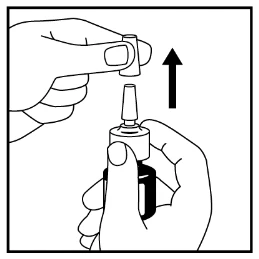
- Gently remove the protective cap – see Figure 1.
Figure 1
- Hold the nasal aerosol upright and tilt it slightly, then point the nozzle away from yourself.
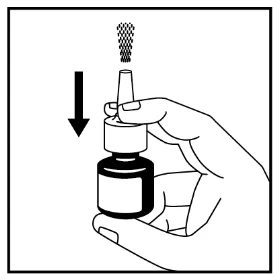
- Prime the pump by placing two fingers on each side of the spray pump and your thumb under the bottle. Press and release the pump. Repeat at least 6 times until a fine mist is released into the air – see Figure 2.
Figure 2
- The nasal aerosol is now ready for use.
Using the nasal aerosol
-
Shake the nasal aerosol vigorously.
-
Remove the protective cap.
-
Blow your nose to clear the nasal passages, then tilt your head slightly forward.
-
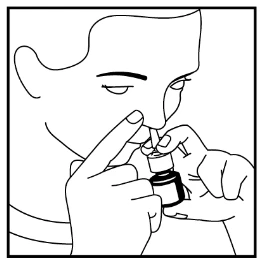
Insert the nozzle into one nostril and close the other nostril with a finger – see Figure 3. Point the nozzle slightly towards the outer side of the nose, away from the nasal septum. This helps deliver the medicine to the correct area of the nose.
-
While inhaling through your nose, press the spray pump firmly and completely.
Figure 3
- Remove the nozzle from the nostril and breathe out through your mouth.
- If your doctor has prescribed 2 sprays into each nostril, repeat steps 4 to 6.
- To administer the medicine into the other nostril, repeat steps 4 to 7.
- Replace the protective cap on the nasal aerosol.
Cleaning the nasal aerosol
After each use:
- Wipe the nozzle and the inside of the protective cap with a dry, clean tissue.
- Do not use water to clean the nozzle.
- Never use a pin or any other sharp object to unblock the nozzle.
- Always replace the protective cap on the nasal aerosol after use.
If the nasal aerosol does not work:
- Check whether there is still medicine left. Look at the liquid level in the bottle. If the level is very low, the nasal aerosol may not work properly.
- Check whether the nasal aerosol container is damaged.
- If you suspect the nozzle is blocked, never use a pin or any other sharp object to unblock it.
- Try to prime it again by following the instructions under "Preparing the nasal aerosol for use".
- If the nasal aerosol still does not work, or if liquid leaks from it, take the nasal aerosol to a pharmacy for advice.
Similar drugs
The original data is available in the language of the country of manufacture.
Data source: Register of Medicinal Products of Poland (URPL)
Data last verified: September 01, 2026