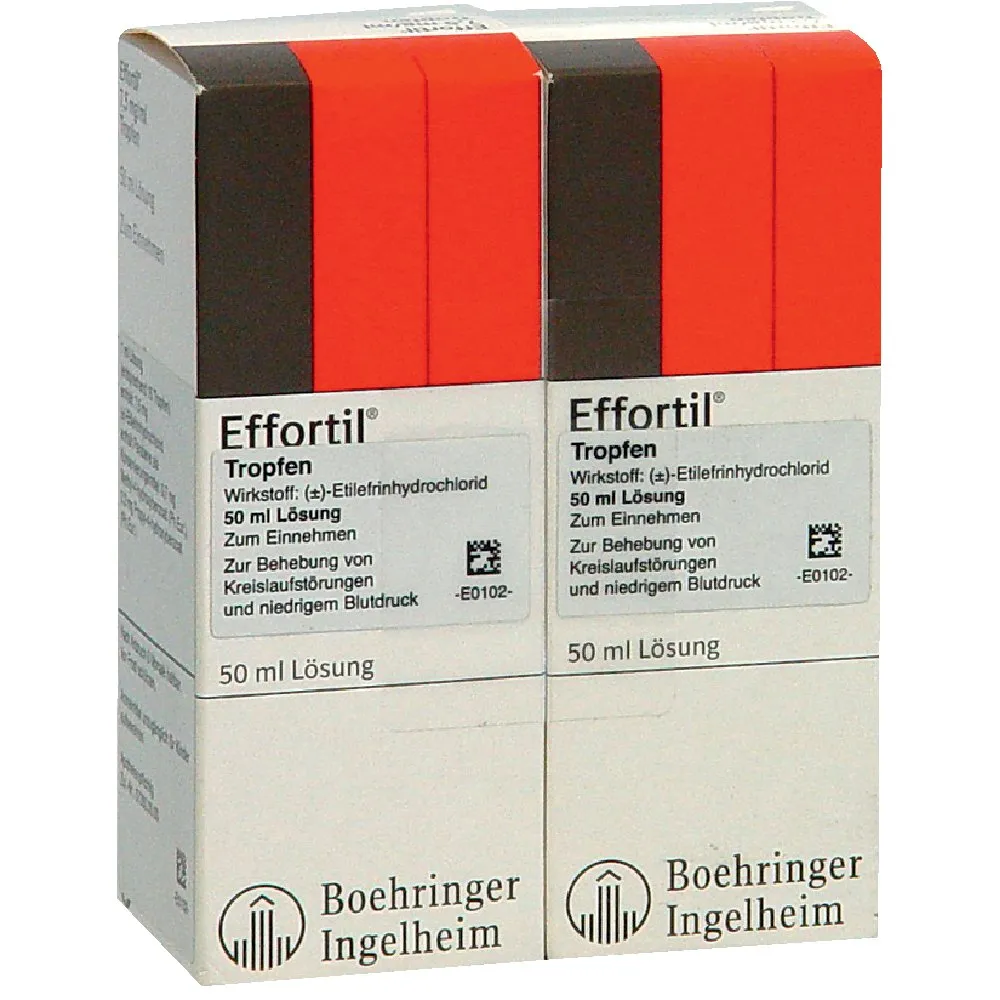
EFFORTIL
PolandThe medicine is used to treat arterial hypotension (symptomatic or orthostatic), which manifests, among other things, as dizziness, a feeling of fatigue, weakness, or vision problems.
Frequently asked questions
How should Effortil be dosed?
Dosage depends on age: adults and children over 6 years of age should take 10-20 drops three times a day; children aged 2-6 years – 5-10 drops three times a day; and children under 2 years of age – 2-5 drops three times a day. The drops should be taken with liquid, preferably before a meal.
When should this medicine not be used?
The medicine should not be used if hypertension, hyperthyroidism, coronary artery disease, glaucoma, heart problems (e.g., heart failure), or an adrenal tumor are present. Use during the first trimester of pregnancy and during breastfeeding is also contraindicated.
What side effects may occur with Effortil?
Possible side effects include, among others, allergic reactions (rash, facial swelling, difficulty breathing), palpitations, rapid heartbeat, increased blood pressure, chest pain, dizziness, headache, nausea, anxiety, insomnia, and excessive sweating.
Does the medicine interact with other drugs?
Yes, some drugs may enhance the effect of the preparation (e.g., thyroid hormones, certain antidepressants, atropine) or weaken its effect (e.g., hypertension medications, so-called beta-blockers). You should inform your doctor about all medications you are currently taking.
What should be done in case of overdose?
In case of taking a dose greater than the recommended amount, contact a doctor or pharmacist immediately. In young children, an overdose may lead to breathing problems and coma.
Instructions for use
Patient Information Leaflet
Warning! Keep this leaflet! The information on the immediate packaging is in a foreign language.
EFFORTIL
7.5 mg/g (7.5 mg/mL), oral drops
Etilefrini hydrochloridum
Please read this leaflet carefully before using the medicine, as it contains
important information for the patient.
- Keep this leaflet for future reference.
- If you have any questions, consult your doctor, pharmacist, or nurse.
- This medicine has been prescribed for a specific individual. Do not give it to others. The medicine may harm other people, even if their symptoms are the same.
- If the patient experiences any adverse reactions, including those not listed in this leaflet, inform a doctor, pharmacist, or nurse immediately. See section 4.
Table of Contents
- What Effortil is and what it is used for
- Important information before taking Effortil
- How to take Effortil
- Possible side effects
- How to store Effortil
- Contents of the pack and other information
1. What Effortil is and what it is used for
Ethylephrine, the active substance in Effortil, is an adrenergic agent with high affinity for both
alpha-1, beta-1, and beta-2 receptors.
Effortil is indicated for the treatment of symptomatic or orthostatic hypotension
(position-dependent), generally associated with symptoms such as dizziness,
unexplained fatigue, blurred or loss of vision, and feelings of weakness.
2. Important information before using Effortil
When not to use Effortil:
- if the patient is allergic to the active substance or to any of the other ingredients of this medicine (listed in section 6),
- if the patient has arterial hypertension,
- if the patient has hyperthyroidism,
- if the patient has a pheochromocytoma,
- if the patient has narrow-angle glaucoma,
- if the patient has benign prostatic hyperplasia with urinary retention,
- if the patient has coronary artery disease,
- if the patient has decompensated heart failure,
- if the patient has hypertrophic cardiomyopathy with left ventricular outflow tract obstruction,
- if the patient has valvular stenosis or stenosis of major arteries,
- if the patient is in the first trimester of pregnancy or during breastfeeding (see "Pregnancy, breastfeeding and fertility").
Warnings and precautions
Caution is required when using Effortil in patients with:
- tachycardia,
- cardiac arrhythmias,
- severe cardiovascular disorders,
- diabetes (see "Effortil with other medicines"),
- hyperthyroidism.
Inform the doctor if the patient has any of the above-mentioned conditions.
The use of etilefrine during sports competitions may lead to a positive result in doping tests.
Effortil with other medicines
Tell your doctor or pharmacist about all medicines the patient is currently taking or has recently taken, as well as any medicines the patient plans to take.
Concomitant use of guanethidine, mineralocorticoids, reserpine (an antihypertensive agent), thyroid hormones, adrenomimetics (medicines used e.g. in the treatment of bronchial asthma and chronic obstructive pulmonary disease, upper respiratory tract infections, circulatory disorders including hypotension), or medicines exhibiting sympathomimetic activity [such as tricyclic antidepressants (antidepressant drugs), monoamine oxidase inhibitors (MAO inhibitors) (antidepressant drugs and drugs increasing arterial blood pressure)] may enhance the effect of the medicine.
Halogenated aliphatic hydrocarbon derivatives (inhalational general anesthetics) and cardiac glycosides at higher doses may increase the effect of Effortil on the heart, leading to cardiac arrhythmias.
Dihydroergotamine (a migraine treatment) increases intestinal absorption of Effortil, thereby enhancing its effect.
Atropine [a medicine used in gastrointestinal and urinary tract spasms, bronchial asthma, treatment of bradycardia (slow heart rate), and as a pupil-dilating agent] may enhance the effect of Effortil and increase heart rate.
Adrenergic receptor-blocking agents (alpha- and beta-adrenolytic drugs used e.g. in the treatment of hypertension, central nervous system vascular disorders, and certain heart conditions) may completely or partially counteract the effect of Effortil. Treatment with beta-adrenolytic drugs may induce reflex bradycardia (excessively slow heart rate).
The blood glucose-lowering effect of antidiabetic medicines may be reduced.
Pregnancy, breastfeeding and fertility
If the patient is pregnant or breastfeeding, suspects she may be pregnant, or is planning to become pregnant, she should consult a doctor or pharmacist before using this medicine.
Due to insufficient human data and teratogenic effects observed in animal studies, the medicine must not be used during the first trimester of pregnancy (see "When not to use Effortil").
During the second and third trimesters of pregnancy, the medicine may be used only after careful consideration of the risk-benefit balance.
The medicine may disturb uterine and placental blood flow and may cause uterine muscle relaxation.
The medicine should not be used during breastfeeding, as passage into breast milk cannot be excluded.
Non-clinical and human studies on the effect of etilefrine on fertility have not been conducted.
Driving and using machines
Studies on the effect of the medicine on the ability to drive and operate machinery have not been performed. Undesirable effects such as dizziness may occur during treatment with Effortil. Therefore, caution should be exercised when driving or operating machinery.
Effortil contains sodium metabisulfite, methyl parahydroxybenzoate, and propyl parahydroxybenzoate.
Sodium metabisulfite may rarely cause severe hypersensitivity reactions and bronchospasm.
Methyl parahydroxybenzoate and propyl parahydroxybenzoate may cause allergic reactions (including delayed-type reactions).
1 ml of the product solution (approximately 15 drops) contains 0.24 mg of sodium.
Thus, the medicine contains less than 1 mmol (23 mg) of sodium per dose, meaning the medicine is considered "sodium-free".
3. How to use Effortil
This medicine should always be used as directed by a physician. If in doubt, consult your doctor.
Recommended dosage:
Adults and children over 6 years of age: 10–20 drops three times daily.
Children between 2 and 6 years of age: 5–10 drops three times daily.
Children under 2 years of age: 2–5 drops three times daily (see "Warnings and precautions").
10 drops correspond to approximately 5 mg of ethylephrine hydrochloride.
Effortil oral drops should be taken with liquid. Particularly rapid action may be achieved if the medicine is administered before meals.
Hold the inverted bottle in an upright position. To initiate drop release, tap lightly at the bottom of the bottle.
Tap here at the bottom of the bottle

Use of Effortil in doses higher than recommended
If a dose higher than recommended is taken, seek immediate advice from a doctor or pharmacist.
Symptoms of overdose
Acute overdose intensifies the adverse reactions described below. In infants and young children, overdose may lead to respiratory centre depression and coma.
4. Possible adverse reactions
Like all medicines, this medicine can cause adverse reactions, although not everyone will experience them:
- Hypersensitivity (allergic reactions), which may manifest as raised, itchy rash (urticaria) or swelling of the face, eyelids, lips, mouth, or difficulty breathing. If any of these symptoms occur in the patient, immediate medical attention must be sought.
- Angina (chest pain), heart rhythm disorders, tachycardia (fast heartbeat), increased blood pressure, palpitations
- Anxiety, insomnia
- Tremors, motor restlessness, headache
- Dizziness
- Nausea
- Excessive sweating
Reporting of adverse reactions
If any adverse symptoms occur, including any adverse effects not listed
in this leaflet, inform your doctor, pharmacist, or nurse. Adverse reactions
can also be reported directly to the Department of Monitoring Adverse Drug Reactions of the Office for Registration of Medicinal Products, Medical Devices and Biocidal Products, Al. Jerozolimskie 181C, 02-222 Warsaw, phone: + 48 22 49 21 301,
fax: + 48 22 49 21 309, website: https://smz.ezdrowie.gov.pl.
Reporting adverse reactions helps to gather further information on the safety of the medicine.
5. How to store Effortil medicine
Keep this medicine out of sight and reach of children.
Do not use this medicine after the expiry date stated on the packaging. The expiry date refers to the last day of the specified month.
Store in the original container to protect from light.
After first opening the bottle, use within 6 months.
Medicines must not be disposed of via wastewater or household waste. Ask your pharmacist how to dispose of medicines no longer required. This will help protect the environment.
6. Contents of the package and other information
What Effortil contains
- The active substance is etilefrine hydrochloride. 1 g of solution (approximately 15 drops) contains 7.5 mg of etilefrine hydrochloride.
- Other ingredients are: methyl parahydroxybenzoate (E 218), propyl parahydroxybenzoate (E 216), sodium metabisulfite (E 223), purified water.
What Effortil looks like and contents of the pack
Effortil is an oral solution in drops.
Pack size: one bottle containing 15 g.
For more detailed information, please contact the marketing authorisation holder or the parallel importer.
Marketing authorisation holder in Austria, country of export:
SERB SA
Avenue Louise 480
1050 Brussels
Belgium
Manufacturer:
Istituto De Angeli S.R.L.
Località Prulli
Reggello (Florence)
Italy
Parallel importer:
InPharm Sp. z o.o.
ul. Strumykowa 28/11
03-138 Warsaw
Repackaged by:
InPharm Sp. z o.o. Services sp. k.
ul. Chełmżyńska 249
04-458 Warsaw
Marketing authorisation number in Austria, country of export: 9106
Parallel import authorisation number: 241/14
Similar drugs
The original data is available in the language of the country of manufacture.
Data source: Register of Medicinal Products of Poland (URPL)
Data last verified: September 01, 2026