DOLOFEST
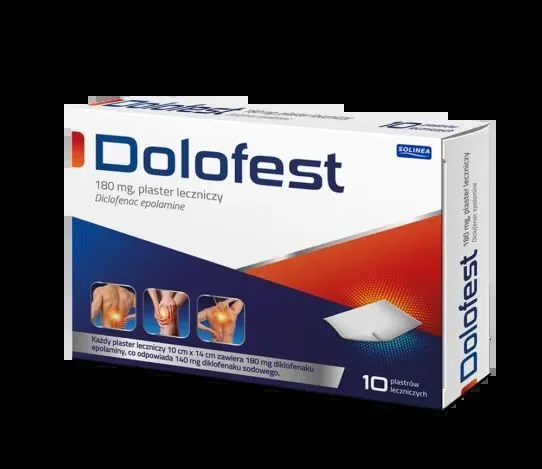
PolandThe medicine is used to relieve pain and inflammation of rheumatic or traumatic origin in the joints, muscles, tendons, and ligaments.
Frequently asked questions
How to use Dolofest?
Adults and adolescents over 16 years of age should apply one patch once or twice daily (every 12 or 24 hours) to the most painful area. It can be used for a maximum of 14 consecutive days.
When not to use this medicine?
Do not use the medicine if you are allergic to diclofenac or other non-steroidal anti-inflammatory drugs (NSAIDs), if you have asthma, breathing problems, active peptic ulcer disease, or skin damage. The medicine must not be used in children under 16 years of age or in women during the last three months of pregnancy.
What are the possible side effects of Dolofest?
The most common side effects may include redness, itching, rash, or skin inflammation at the site of patch application. Less commonly, petechiae, a sensation of heat, dry peeling skin, or allergic reactions such as facial swelling or difficulty breathing may occur.
Can this medicine be combined with other preparations?
The risk of interaction is very low, but you should inform your doctor if you are taking other medicines containing diclofenac or other non-steroidal anti-inflammatory drugs (NSAIDs). Avoid using patches in combination with other medicines containing diclofenac, as this increases the risk of skin reactions.
What should you remember when using the patches?
The patch should be applied only to healthy, intact skin. For at least one day after removing the patch, avoid direct contact with sunlight or tanning lamps to prevent skin photosensitivity.
Instructions for use
Patient Information Leaflet
Dolofest, 180 mg, medicated patch
Diclofenac epolamine
Please read all of this leaflet carefully before using the medicine, as it contains important information for you.
This medicine should always be used exactly as described in this patient leaflet or as directed by your doctor or pharmacist.
- Keep this leaflet, as you may need to read it again.
- If you need advice or further information, please consult your pharmacist.
- If you experience any adverse reactions, including any possible side effects not listed in this leaflet, inform your doctor or pharmacist. See section 4.
- If there is no improvement after a short period of treatment, or if you feel worse, you should consult your doctor.
Contents of the leaflet
- What Dolofest is and what it is used for
- Important information before using Dolofest
- How to use Dolofest
- Possible side effects
- How to store Dolofest
- Contents of the pack and other information
1. What Dolofest is and what it is used for
Dolofest belongs to a group of medicines called non-steroidal anti-inflammatory drugs (NSAIDs). NSAIDs reduce pain and inflammation.
Dolofest is used to relieve pain and inflammation of rheumatic or traumatic origin in joints, muscles, tendons, or ligaments.
If there is no improvement after a short period of using Dolofest, or if you feel worse, you should consult your doctor.
2. Important information before using Dolofest
When not to use Dolofest:
- if the patient is allergic to diclofenac, acetylsalicylic acid, other painkillers, any of the NSAIDs (non-steroidal anti-inflammatory drugs), or any of the other ingredients of this medicine (listed in section 6);
- if the patient has asthma, breathing problems, skin rash, or rhinitis after taking acetylsalicylic acid or other NSAIDs;
- if the patient is in the last three months of pregnancy (see section "Pregnancy, breastfeeding and fertility");
- if the patient has active gastric ulcer disease (peptic ulcer);
- if the patient has any skin lesions, including exudative or infected skin conditions, eczema, burns, or wounds;
- in children and adolescents under 16 years of age.
If any of the above conditions apply to the patient, discuss this with a doctor or pharmacist.
Warnings and precautions
Before starting treatment with Dolofest, consult a doctor or pharmacist if:
- the patient has heart disease;
- the patient has kidney disease;
- the patient has liver disease;
- the patient has had peptic ulcer disease in the past;
- the patient has inflammatory bowel disease, such as Crohn's disease or ulcerative colitis, or a tendency to intestinal bleeding;
- the patient has asthma;
- the patient has breathing problems, skin rash, or rhinitis after taking acetylsalicylic acid or other NSAIDs;
- the patient is using diclofenac or other NSAIDs orally or topically;
- the patient regularly uses sunbeds or is exposed to sunlight (see also "Other important information");
- the patient is elderly, as they may be more susceptible to adverse effects.
Other important information
Always use the lowest effective dose of Dolofest for the shortest duration necessary to control symptoms.
Dolofest should be used with caution in elderly patients, who may be more susceptible to adverse effects.
The risk of adverse effects can be minimized by using the lowest effective dose for the shortest necessary period. Do not exceed the recommended dose of Dolofest, do not apply it to large areas of skin, or use it for prolonged periods.
Avoid direct exposure to sunlight or UV lamps (tanning beds) for at least one day after removing the patch; this will reduce the risk of an unwanted photosensitivity reaction (light sensitivity).
Like other topically applied medicines, especially during long-term treatment, Dolofest may cause redness and itching (sensitization). If skin reactions occur at the site of patch application, discontinue treatment and consult a doctor or pharmacist.
Children and adolescents
Do not use this medicine in children and adolescents under 16 years of age.
Dolofest and other medicines
When Dolofest is used as directed, the risk of interaction with other medicines is very low.
However, inform your doctor or pharmacist about all medicines you are currently taking or have recently taken. In particular, inform your doctor if you are taking any other medicines containing diclofenac or other NSAIDs.
Pregnancy, breastfeeding and fertility
If you are pregnant or breastfeeding, think you may be pregnant, or are planning to have a baby, consult your doctor or pharmacist before using this medicine.
Pregnancy
Do not use Dolofest during the last three months of pregnancy. During the first six months of pregnancy, do not use Dolofest unless necessary and recommended by a doctor.
If treatment is necessary, use the lowest possible dose for the shortest possible time.
After oral administration of diclofenac-containing medicines (e.g. tablets), adverse effects may occur in the unborn child. It is not known whether the same risk applies to Dolofest when applied to the skin.
Breastfeeding
During breastfeeding, Dolofest should only be used on medical advice, as diclofenac passes into human milk in small amounts. However, do not apply Dolofest to the breast area of breastfeeding women, or to other large skin areas, or for prolonged periods.
If you are pregnant or breastfeeding, consult your doctor or pharmacist before using Dolofest.
Fertility
If you have difficulty becoming pregnant and are using Dolofest, inform your doctor, as discontinuation of treatment may be indicated.
Driving and operating machinery
The use of a medicated patch containing diclofenac has no effect on the ability to drive or operate machinery.
Dolofest contains:
- preservatives known as parahydroxybenzoates (methyl parahydroxybenzoate and propyl parahydroxybenzoate), which may cause allergic reactions (delayed-type reactions possible);
- 420 mg of propylene glycol per patch;
- polysorbate 80; polysorbates may cause allergic reactions.
3. How to use Dolofest
This medicine should always be used as directed by a doctor or pharmacist. If in doubt, consult a doctor or pharmacist.
Adults or adolescents aged 16 years and older
Number of patches to use
The recommended dose of Dolofest is one (1) patch once or twice daily (one application every 12 or 24 hours), applied to the most painful area for up to 14 consecutive days. If the patient does not experience improvement within the recommended treatment period or if symptoms worsen, the doctor should be informed.
If there is no improvement after 14 days of treatment or if the patient feels worse, medical advice should be sought.
Use in children and adolescents under 16 years of age
Dolofest should not be used in children and adolescents under 16 years of age. There is insufficient data on efficacy and safety in children and adolescents under 16 years of age (see also section "When not to use Dolofest").
Adolescents aged 16 years – in case of worsening symptoms, patients and (or) parents of adolescents are advised to consult a doctor. If there is no improvement after seven days of treatment or if the patient feels worse, the doctor should be informed.
How to use Dolofest
Cut open the top of the resealable sachet and remove the patch.
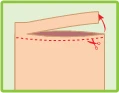
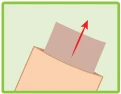
Carefully reseal the sachet.
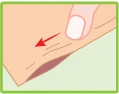
Remove the protective plastic film covering the adhesive layer of the patch.
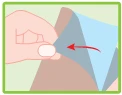
Apply the patch to the skin over the painful or swollen area.
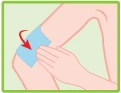
- If necessary, the patch may be additionally secured with a loose gauze bandage or adhesive tape, available from a pharmacy.
- Do not cover the patch with any other type of dressing.
- Do not cover the treated area with plastic material or with a bandage that prevents free access of air (occlusive dressing).
- The medicated patch should be applied only to intact, healthy skin. Do not apply to skin wounds or open injuries. The patch should not be left on the skin during bathing or showering.
- Avoid contact of the patch with eyes, nose, mouth, genital area, and anus. In case of contact with these areas, rinse thoroughly with water.
- Do not cut the patch.
Changing the patch
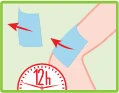
- Remove the patch after 12 or 24 hours and apply a new one.
Missed dose of Dolofest
Do not apply an additional patch to make up for a missed dose. Simply apply the next patch according to the regular schedule.
If there are any doubts regarding the use of this medicine, consult a doctor or pharmacist.
4. Possible adverse reactions
Like all medicines, this medicine can cause adverse reactions, although they do not occur in everyone.
Common adverse reactions (may occur in up to 1 in 10 people):
- Skin redness and skin eruptions (rash, eczema, erythema), inflammatory skin conditions (dermatitis, including allergic and contact dermatitis), itching or other reactions at the site of application of the patch.
Uncommon adverse reactions (may occur in up to 1 in 100 people):
- Small red or purple spots under the skin (petechiae);
- sensation of warmth.
Rare adverse reactions (may occur in up to 1 in 1,000 people):
- Skin inflammation with blister formation (bullous dermatitis);
- dry, flaking skin.
Very rare adverse reactions (may occur in up to 1 in 10,000 people):
- Pus-forming skin inflammation (pustular rash);
- symptoms of allergic reactions (hypersensitivity and anaphylactic reaction), including urticaria, facial swelling (angioedema), lips, eyes or tongue, and breathing difficulties;
- asthma;
- skin rash aggravated by sunlight (photosensitivity).
Adverse reactions with unknown frequency (frequency cannot be estimated from available data):
- Burning sensation at the application site.
Since Dolofest is applied to the skin over the affected area, there is a lower risk of adverse reactions such as gastrointestinal disorders, including pain, indigestion or any symptoms of bleeding from the stomach or intestines, which may occur with oral administration of diclofenac. However, if Dolofest is not used as recommended, such adverse reactions may occur.
Avoid using this medicine in combination with other medicines containing diclofenac, as using medicinal patches together with other diclofenac-containing medicines increases the likelihood of skin reactions, including after sun exposure, such as blistering, erythema and eczema. In rare cases, even severe reactions may occur, such as rash with redness, blistering and peeling (e.g. Stevens-Johnson syndrome, Lyell's syndrome).
Reporting of adverse reactions
If any adverse reactions occur, including any adverse reactions not listed in this leaflet, inform your doctor or pharmacist. Adverse reactions can be reported directly to the Department of Monitoring of Adverse Drug Reactions of the Office for Registration of Medicinal Products, Medical Devices and Biocidal Products:
Al. Jerozolimskie 181C
02-222 Warsaw
Tel.: +48 22 49 21 301
Fax: +48 22 49 21 309
Website: https://smz.ezdrowie.gov.pl
Adverse reactions can also be reported to the marketing authorization holder.
Reporting adverse reactions helps to provide more information on the safety of the medicine.
5. How to store Dolofest
Keep the medicine out of sight and reach of children.
Do not use this medicine after the expiry date stated on the sachet and the carton packaging following: EXP. The expiry date refers to the last day of the specified month.
No special temperature storage requirements for this medicine.
Do not use the medicine later than four months after first opening the sachet. After removing each patch, the sachet should be resealed tightly.
Medicines must not be disposed of via wastewater or household waste. Ask your pharmacist how to dispose of medicines no longer in use. This will help protect the environment.
6. Contents of the package and other information
What Dolofest contains
- The active substance is diclofenac epolamine. Each medicated patch contains 180 mg of diclofenac epolamine, equivalent to 140 mg of sodium diclofenac.
- The other ingredients are: gelatin, povidone (K90), liquid non-crystallizing sorbitol, heavy kaolin, titanium dioxide (E171), propylene glycol (E1520), methyl parahydroxybenzoate (E218), propyl parahydroxybenzoate (E216), disodium edetate (E385), tartaric acid, aluminium glycinate, sodium carboxymethylcellulose, sodium polyacrylate, 1,3-butyleneglycol, polysorbate 80 (E433), purified water. The backing layer is made of polyester fibre. The removable protective layer is made of polypropylene.
What Dolofest looks like and contents of the pack
Each medicated patch consists of a white to pale yellow paste evenly spread in a uniform layer on a fibrous backing, with a protective film covering the adhesive side. The resealable sachet contains 5 patches.
Pack sizes
Dolofest is available in packs of 5 or 10 patches in a box. Not all pack sizes may be marketed.
Marketing Authorisation Holder
Solinea Sp. z o.o.
Elizówka, ul.Szafranowa 6
21-003 Ciecierzyn, Poland
Tel. 81 463-48-82
(logo of the marketing authorisation holder)
Manufacturer
Miat S.p.A.
Piazza Giuseppe Pasolini 2
20159 Milan
Italy
This medicinal product is authorised in the European Economic Area countries under the following names:
Italy: Muscoridol
Greece: Miniflampatch 180 mg φαρμακoὔxo έμπλαστρο
Belgium: Diclofenac Patch AB 140 mg pleister
Diclofenac Patch AB 140 mg emplâtre médicamenteux
Diclofenac Patch AB 140 mg wirkstoffhaltiges Pflaster
Similar drugs
| Brand name | Dosage form | Active substance / Dosage | Manufacturer |
|---|---|---|---|
| DICLOFENAC VIATRIS | plaster, medicinal |
|
MIAT S.p.A. |
| FLECTOR PATCH | plaster, medicinal |
|
Altergon Italia SRL |
| ITAMI | plaster, medicinal |
|
Fidia Farmaceutici S.p.A. |
| OLFEN PATCH | plaster, medicinal |
|
Teva B.V. |
| OLFEN PATCH | plaster, medicinal |
|
Teva B.V. |
| OLFEN PATCH | plaster, medicinal |
|
Teva B.V. |
| OLFEN PATCH | plaster, medicinal |
|
Teva B.V. |
| OLFEN PATCH | plaster, medicinal |
|
Teva B.V. |
| VOLTAREN FORTE | plaster, medicinal |
|
Fidia Farmaceutici S.p.A. Haleon Germany GmbH |
| VOLTAREN FORTE | plaster, medicinal |
|
HALEON ROMÂNIA S.R.L. |
The original data is available in the language of the country of manufacture.
Data source: Register of Medicinal Products of Poland (URPL)
Data last verified: September 01, 2026