DESFLURANE PIRAMAL
PolandIt is a colorless liquid used for general anesthesia during surgical procedures. Inhaling it in vapor form induces deep sleep in the patient and allows this state to be maintained during surgery.
Frequently asked questions
How is Desfluran Piramal administered?
The medicine is administered exclusively by qualified medical personnel (anesthesiologist or under their supervision). It is most commonly administered through a special tube placed in the airways, and less frequently by inhaling vapor through a mask.
When should this medicine not be used?
It must not be used if the patient is allergic to desflurane or other anesthetic agents (e.g., isoflurane, sevoflurane), if the patient or a relative has experienced a rapid rise in body temperature during surgery (malignant hyperthermia), or if the patient has serious liver problems. In children, the medicine is used solely for the maintenance of anesthesia (provided they are intubated) and must not be used to induce sleep in a child.
What are the possible side effects of Desfluran Piramal?
Nausea and vomiting are the most common side effects. Headache, sore throat, conjunctivitis, changes in heart rhythm (e.g., tachycardia or bradycardia), and cough or laryngospasm also occur frequently. In rare cases, serious problems such as myocardial infarction, liver failure, or cardiac arrhythmias may occur.
Does the medicine interact with other agents?
Yes, the doctor must be informed about all medications being taken, especially muscle relaxants, opioids (strong painkillers), benzodiazepines (sedatives), nitrous oxide, and medications for hypertension or heart failure.
Can you drive after surgery?
No, due to the effect of the medicine on alertness and reaction time, you should not drive vehicles or operate machinery for 24 hours after surgery.
Instructions for use
Desfluran Piramal, 100% (v/v), solution for vapor inhalation
Desflurane
Please read this leaflet carefully before using the medicine, as it contains
important information for the patient.
- Keep this leaflet, as you may need to read it again.
- If you have any questions, please consult your doctor, pharmacist or nurse.
- This medicine has been prescribed for a specific individual. Do not give it to others. The medicine may harm another person, even if their symptoms are the same.
- If you experience any adverse reactions, including any not listed in this leaflet, inform your doctor, pharmacist or nurse. See section 4.
Contents of the leaflet
- What Desfluran Piramal is and what it is used for
- Important information before using Desfluran Piramal
- How to use Desfluran Piramal
- Possible side effects
- How to store Desfluran Piramal
- Contents of the pack and other information
1. What Desfluran Piramal is and what it is used for
Desfluran Piramal contains desflurane, which belongs to a group of halogenated hydrocarbons. Desfluran Piramal is a clear, colourless liquid used for general anaesthesia during surgical procedures. It is an inhalational anaesthetic agent (administered by inhalation as vapour). Inhalation of desflurane vapour causes the patient to fall into a deep sleep. Additionally, the medicine maintains this deep sleep (general anaesthesia), during which the patient can undergo surgery. In adults, Desfluran Piramal is used for induction and maintenance of anaesthesia. In infants and children, it is used exclusively for maintenance of anaesthesia.
2. Important information before using Desfluran Piramal
Desfluran Piramal must be administered only by qualified medical personnel trained in administering general anaesthesia under the supervision of an anaesthesiologist or by an anaesthesiologist.
When not to use Desfluran Piramal:
- if the patient has had or currently has contraindications to general anaesthetics;
- if the patient is allergic to desflurane or other halogenated anaesthetic agents, such as isoflurane or sevoflurane;
- if the patient or a family member has ever experienced a rapid and significant increase in body temperature during or immediately after surgery (a condition known as malignant hyperthermia);
- for induction of anaesthesia in children due to the significant risk of coughing, apnoea, vocal cord spasm (laryngospasm), and excessive secretion in the airways;
- for maintenance of anaesthesia in children under 6 years of age, unless the patient is intubated. Intubation is a procedure involving placement of a special tube in the airway to assist breathing;
- as the sole anaesthetic agent when there is an increased risk of tachycardia and elevated blood pressure;
- if the patient has previously experienced moderate to severe unexplained liver dysfunction or hepatitis (e.g., jaundice accompanied by unexplained fever and/or increased levels of certain white blood cells following inhalational anaesthesia with agents such as isoflurane or sevoflurane);
- for dental surgery procedures performed outside a hospital or day surgery unit.
If any of the above conditions apply, the patient must inform their treating doctor or anaesthesiologist before receiving this medicine.
Warnings and precautions
Before using Desfluran Piramal, discuss the following with your doctor or anaesthesiologist:
- if the patient has a risk of increased intracranial pressure, e.g., brain tumour;
- if the patient has a tendency towards bronchospasm (narrowing of the lungs and airways leading to coughing, wheezing or shortness of breath);
- if the patient is at risk of ischaemic heart disease (when blood vessels do not deliver sufficient blood and oxygen to the heart muscle);
- if the patient is pregnant or breastfeeding, or if the medicine is to be administered during childbirth (see also "Pregnancy and breastfeeding");
- if the patient has a muscle disease (neuromuscular disorder, e.g., Duchenne muscular dystrophy). In such cases, the patient may receive a skeletal muscle relaxant alongside Desfluran Piramal;
- if the patient has cardiac electrical conduction disorders, known as "QT prolongation";
- if the patient has previously undergone general anaesthesia, especially multiple times in short succession;
- if the patient is a child who has recently had a respiratory tract infection.
The doctor may administer a lower dose of Desfluran Piramal:
- in cases of low blood volume (hypovolaemia);
- in cases of low blood pressure (hypotension);
- in cases of debilitation.
The doctor may decide not to administer Desfluran Piramal and to use an alternative anaesthetic agent:
- if the patient has liver disease due to chronic alcohol abuse (liver cirrhosis);
- if the patient has viral hepatitis (liver disease caused by a virus);
- if the patient has another type of liver disease (e.g., unexplained liver dysfunction following anaesthesia, such as jaundice (yellowing of the skin and eyes), fever, or liver cell necrosis).
Desfluran Piramal may during surgery cause a rapid and significant increase in body temperature, possibly accompanied by muscle rigidity and other symptoms (malignant hyperthermia). In such a case, the anaesthesiologist (doctor) will discontinue Desfluran Piramal, the patient will receive a medicine used in the treatment of malignant hyperthermia (known as dantrolene), and other supportive therapies will be initiated.
The doctor must exercise particular caution if the patient has previously undergone inhalational anaesthesia, especially multiple times in short succession (repeated use).
After anaesthesia with Desfluran Piramal, the patient wakes up quickly. If postoperative pain is expected, the doctor will administer an analgesic. This may be given towards the end of the procedure or during emergence from anaesthesia.
- Desfluran Piramal may during anaesthesia cause a slight increase in blood glucose (sugar) levels.
Middle ear surgery
Desflurane, like other inhalational anaesthetic agents, may increase middle ear pressure, especially in children. Therefore, monitoring of middle ear pressure is recommended during desflurane anaesthesia.
Children and adolescents
- Desflurane should be used with caution in children with asthma or who have recently had an upper respiratory tract infection, as they have an increased risk of airway narrowing and increased airway resistance.
- Desfluran Piramal 100% must not be used for induction of anaesthesia in infants (see also section 2).
- Emergence from anaesthesia may cause a brief period of agitation in children, making them reluctant to cooperate.
- Desfluran Piramal may be used for maintenance of anaesthesia only if the patient has previously been intubated (a special breathing tube has been placed in the airway). In such cases, caution should be exercised when removing the laryngeal mask after deep anaesthesia to avoid adverse effects such as coughing or laryngospasm (spasm of the vocal cord muscles).
If any of the above conditions apply to the patient or their child, consult a doctor, nurse or pharmacist. Further evaluation and possible changes in treatment may be necessary.
Desfluran Piramal and other medicines
Inform your doctor or pharmacist about all medicines currently used or recently used, as well as any medicines planned for use, including those available without prescription.
Special caution is required if the patient is taking any of the following medicines:
- skeletal muscle relaxants (e.g. suxamethonium, pancuronium, atracurium, vecuronium). These medicines cause muscle relaxation. The anaesthesiologist may adjust the dosage accordingly;
- opioids (e.g. fentanyl, morphine, remifentanil). These are strong painkillers often used during general anaesthesia. Even if the patient uses these painkillers for other conditions, they should inform the doctor;
- benzodiazepines (e.g. midazolam, diazepam, nitrazepam). These are sedatives used to calm an anxious patient before surgery. Even if the patient uses these sedatives for other conditions, they should inform the doctor;
- nitrous oxide (commonly known as "laughing gas"). This agent may be used during general anaesthesia to facilitate induction and reduce pain;
- medicines used to treat hypertension or heart failure (such as beta-blockers).
Desfluran Piramal, food and drink
Desfluran Piramal is a medicine that induces sleep and maintains the patient in a sleeping state so that surgery can be performed. The patient should ask their doctor, surgeon or anaesthesiologist when and what they may eat or drink before surgery and after waking up.
Pregnancy and breastfeeding
If the patient is pregnant or breastfeeding, suspects she may be pregnant, or is planning to have a child, she should consult her doctor or pharmacist before using this medicine.
There are insufficient data on the use of desflurane in pregnant or breastfeeding women. Therefore, desflurane should be used in pregnant and breastfeeding women only if the doctor considers it absolutely necessary. Breastfeeding should be avoided for approximately 24 hours after desflurane anaesthesia.
Driving and operating machinery
Desfluran Piramal may affect alertness and reaction time for some time after administration. Therefore, the patient should not drive or operate machinery for 24 hours after surgery.
3. How to use Desfluran Piramal
Desfluran Piramal should be administered under continuous monitoring of respiratory and cardiovascular functions and in the presence of an anaesthesiologist with immediate access to equipment for anaesthesia and resuscitation. Desfluran Piramal will always be administered to the patient by an anaesthesiologist. The anaesthesiologist will determine the dose based on the patient's age and body weight, as well as the type of surgical procedure the patient is undergoing. During anaesthesia, the anaesthesiologist will monitor the patient's arterial blood pressure and heart rate. If necessary, the anaesthesiologist will adjust the administered dose of the medicinal product.
Desfluran Piramal is most commonly delivered through a special tube inserted into the patient's airway, after the patient has received an injection of another anaesthetic agent inducing sleep. Only in rare cases may the patient be asked to inhale Desfluran Piramal vapour through a mask to induce anaesthesia.
Desfluran Piramal is a liquid for vapour inhalation, administered via a vaporizer specifically calibrated for use with this product, allowing precise control of the delivered concentration.
Recovery from anaesthesia
At the end of the surgical procedure, the anaesthesiologist will discontinue administration of Desfluran Piramal. Within a few minutes, the patient will regain consciousness.
Overdose of Desfluran Piramal
If the patient receives a higher dose of Desfluran Piramal than recommended, administration of the medicinal product will be stopped immediately. The patient will be given pure oxygen. During recovery, arterial blood pressure and cardiac function will be closely monitored.
If you have any further questions regarding the use of this medicinal product, consult your doctor, pharmacist, or nurse.
4. Possible adverse reactions
Like all medicines, this medicine can cause adverse reactions, although not everyone will experience them.
Most adverse reactions are mild to moderate in intensity and resolve quickly. However, some adverse reactions may be serious (severe).
Serious adverse reactions (frequency unknown) such as:
- Rhabdomyolysis (breakdown of muscle fibres);
- Irregular heartbeat or abnormal heart rhythm (arrhythmia) in children;
- Rapid and marked increase in body temperature during surgery (malignant hyperthermia). Symptoms of the disease include excess carbon dioxide in the blood (hypercapnia), muscle rigidity, rapid heartbeat (tachycardia), rapid breathing (tachypnea), bluish discoloration of the skin (cyanosis), irregular heartbeat or abnormal heart rhythm (arrhythmia), low or high blood pressure, and fever.
Most of these serious adverse reactions may occur during anaesthesia and when the patient is under the care of trained medical personnel.
Desfluran Piramal may cause a slight increase in blood glucose concentration during anaesthesia. Possible adverse reactions include:
Very common (may affect more than 1 in 10 patients)
- Nausea.
- Vomiting. These occurred during induction and maintenance of anaesthesia with Desfluran Piramal.
Common (may affect up to 1 in 10 patients)
- Inflammation of the posterior pharyngeal wall (pharyngitis).
- Transient respiratory arrest. This occurred during induction and maintenance of anaesthesia with Desfluran Piramal.
- Headache.
- Inflammation of the outer layer of the eyeball and inner surface of the eyelids (conjunctivitis).
- Irregular heartbeat or abnormal heart rhythm.
- Slowing of the heartbeat (bradycardia).
- Acceleration of the heartbeat (tachycardia).
- Elevated arterial blood pressure (hypertension).
- Transient breathing pauses (apnoea), coughing, and excessive saliva production (hypersalivation). These occurred during induction and maintenance of anaesthesia with Desfluran Piramal.
- Sudden spasm of the vocal cords affecting breathing and speech (laryngospasm).
- Increased activity of the enzyme in the blood called creatine kinase.
- Abnormal electrocardiogram (abnormal ECG).
- Abnormal heart rhythm (prolongation of QTc interval, abnormal ECG).
Uncommon (may affect up to 1–10 in 1000 patients)
- Anxiety (agitation).
- Dizziness.
- Heart attack (myocardial infarction).
- Reduced blood flow to the heart muscle (myocardial ischaemia).
- Irregular heartbeat (arrhythmia).
- Blood vessel dilation (vasodilation).
- Inadequate oxygen supply to tissues (hypoxia). This occurred during induction and maintenance of anaesthesia with Desfluran Piramal.
- Muscle pain (myalgia).
Unknown frequency (frequency cannot be estimated from available data):
- Blood clotting disorders (coagulopathy).
- Increased or decreased potassium levels in the blood (hyperkalaemia or hypokalaemia).
- Excess of acids in body fluids (metabolic acidosis).
- Seizures (convulsions).
- Yellowing of the eyeball (yellowing of the whites of the eye).
- Heart failure (a condition in which the heart beats weakly) or cardiac arrest (a condition in which the heart stops beating).
- Severe heart rhythm disturbances with rapid and irregular pulse (torsade de pointes).
- Ventricular failure (a condition when two of the heart chambers are weakened or stop functioning).
- Reduced contractility of the heart muscle (hypokinesia of the heart chambers).
- Irregular heart rhythm (atrial fibrillation).
- Very high blood pressure (malignant hypertension).
- Bleeding (haemorrhage).
- Low blood pressure (hypotension).
- A condition in which insufficient blood reaches body tissues (shock).
- Difficulty breathing (respiratory failure) or respiratory arrest.
- Sudden spasm of muscles in the walls of the airways (bronchospasm).
- Coughing up blood from the lungs (haemoptysis).
- Sudden inflammatory condition of the pancreas (acute pancreatitis).
- Abdominal pain.
- Liver tissue necrosis (liver necrosis).
- Hepatitis.
- Blockage of bile drainage from the liver (cholestasis).
- Yellowing of the skin or eyeball (jaundice).
- Liver function disorders or liver disease.
- Urticaria.
- Redness of the skin (erythema).
- Weakness (asthenia).
- General discomfort.
- Changes in the electrocardiogram (ST-T segment changes or T-wave inversion on ECG).
- Increased activity of liver enzymes (increased alanine aminotransferase and aspartate aminotransferase activity).
- Blood clotting disorders (abnormal coagulation parameters).
- Increased ammonia levels.
- Increased bilirubin levels.
- Liver failure.
- Sensation of spinning and loss of balance (vestibular dizziness).
- Palpitations.
- Burning sensation in the eyes.
- Transient blindness.
- Brain disease (encephalopathy).
- Inflammation or infection of parts of the eye (corneal ulcerative keratitis).
- Eye congestion.
- Decreased visual acuity.
- Eye irritation.
- Eye pain.
- Fatigue.
- Burning sensation of the skin.
- Postoperative agitation.
Reporting of adverse reactions
If any adverse reactions occur, including any not listed in this leaflet, inform your doctor, pharmacist, or nurse.
Adverse reactions can be reported directly to the Department of Monitoring Adverse Drug Reactions of the Office for Registration of Medicinal Products, Medical Devices and Biocidal Products:
Al. Jerozolimskie 181C, 02-222 Warsaw, tel.: +48 22 49 21 301, fax: +48 22 49 21 309,
website: https://smz.ezdrowie.gov.pl
Adverse reactions can also be reported to the marketing authorisation holder.
Reporting adverse reactions helps provide more information on the safety of the medicine.
Inform your doctor, pharmacist, or nurse if you notice any changes in your health after receiving Desfluran Piramal. Some adverse reactions may require treatment.
5. How to store Desfluran Piramal
Keep the medicine out of sight and reach of children.
Do not use this medicine after the expiry date stated on the label after "EXP".
The expiry date refers to the last day of the stated month.
Store below 30°C.
Store the bottle in an upright position, tightly closed.
6. Contents of the package and other information
What Desfluran Piramal contains
- The active substance is desflurane 100% (v/v).
- The medicine does not contain any other ingredients.
This medicine contains fluorinated greenhouse gases.
Each container contains 360 g of desflurane, equivalent to 0.9324 tonnes of CO\
(global warming potential GWP = 2590).
What Desfluran Piramal looks like and contents of the pack
Desfluran Piramal is a liquid for the preparation of inhalation vapour.
Desfluran Piramal is a clear, colourless liquid.
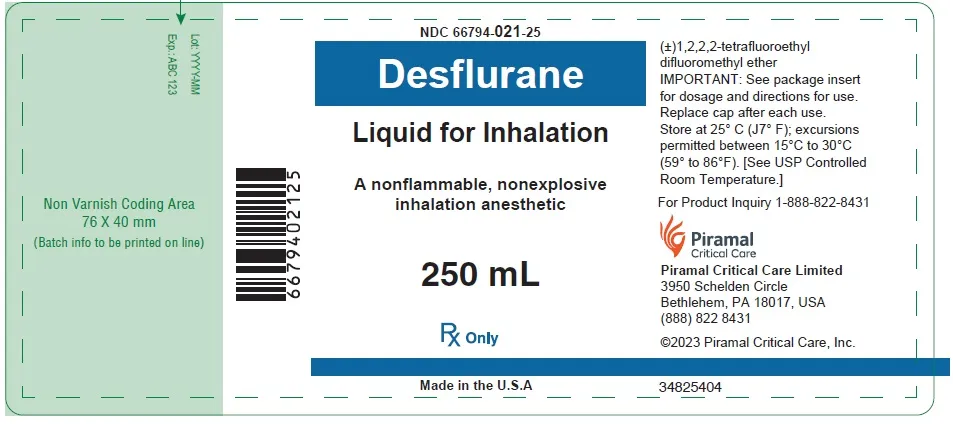
Bottle of 250 ml capacity made of amber glass type III, with a PVC coating on the outside
of the bottle, with a closure made of HDPE/ Ethylene Propylene Diene Monomer (EPDM) and an aluminium seal.
Pack sizes: 1 bottle or 6 bottles.
Not all pack sizes may be marketed.
Marketing Authorisation Holder and Manufacturer
Piramal Critical Care B.V.
Rouboslaan 32, 2252 TR
Voorschoten
The Netherlands
Email: [email protected]
This medicine is authorised in the European Economic Area countries under the following names:
| Austria | : | Desflurane Piramal 100% Liquid for Inhalation Vapor |
| Belgium | : | FR: Desflurane Piramal 100 % liquid for inhalation vapor NL: Desflurane Piramal 100 %, liquid for inhalation vapor DE: Desflurane Piramal 100 %, liquid for the production of an inhalation vapor |
| Denmark | : | Desflurane Piramal 100% Liquid for Inhalation Vapor |
| Finland | : | Desflurane Piramal |
| France | : | Desflurane Piramal 100% liquid for inhalation vapor |
| Spain | : | Desflurane Piramal 100% Liquid for Vapor Inhalation |
| Netherlands | : | Desflurane Piramal 100% liquid for inhalation vapor |
| Germany | : | Desflurane Piramal 100%, liquid for the production of an inhalation vapor |
| Norway | : | Desflurane Piramal |
| Poland | : | Desflurane Piramal |
| Portugal | : | Desflurane Piramal 100% liquid for vaporization inhalation |
| Sweden | : | Desflurane Piramal 100% inhalation vapor, liquid |
| Hungary | : | Desflurane Piramal 100% liquid for inhalation vapor |
| Italy | : | Desflurane Piramal |
| United Kingdom (Northern Ireland) | : | Desflurane 100% (v/v) Inhalation Vapour, liquid |
The original data is available in the language of the country of manufacture.
Data source: Register of Medicinal Products of Poland (URPL)
Data last verified: September 01, 2026