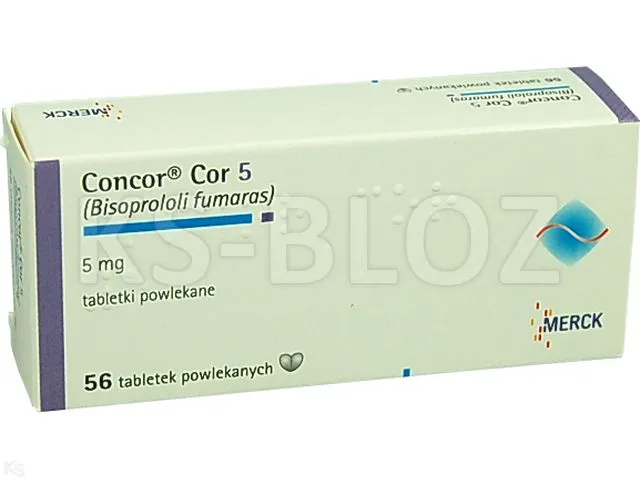
CONCOR COR 5
PolandThe medicine is used to treat arterial hypertension, angina pectoris, and stable, chronic heart failure.
Frequently asked questions
How should Concor Cor 5 be taken?
The tablets should be taken in the morning with or without food, swallowed with water. They must not be chewed. In the case of hypertension and angina pectoris, one 5 mg tablet is usually taken once daily, although the doctor may decide to increase the dose to two tablets.
When should you not use this medicine?
It must not be used in case of hypersensitivity to the ingredients of the medicine, severe asthma, serious circulatory disorders in the limbs (e.g., Raynaud's syndrome), untreated pheochromocytoma, metabolic acidosis, acute heart failure, symptoms of bradycardia, low blood pressure, or certain cardiac arrhythmias without a pacemaker.
Can Concor Cor 5 cause side effects?
Yes, side effects are possible, such as slow heart rate, fatigue, dizziness, headache, a feeling of coldness or numbness in the hands and feet, low blood pressure, and gastrointestinal problems (nausea, vomiting, diarrhea, constipation). Less commonly, sleep disturbances, depression, difficulty breathing, allergic reactions, or impotence may occur.
Can this medicine be used with other preparations?
You must inform your doctor about all medications you are taking. Concor Cor 5 must not be used together with certain antiarrhythmic drugs (e.g., quinidine, diltiazem), antihypertensive drugs (e.g., clonidine), or other medicines without explicit medical advice. A medical consultation is necessary before combining it with many other agents, such as certain drugs for hypertension, diabetes, or anti-inflammatory medications.
Should caution be exercised when driving?
The medicine may affect the ability to drive vehicles and operate machinery; therefore, special caution should be exercised, especially at the start of treatment, after a dose change, or when combined with alcohol.
Can the medicine be discontinued at any time?
You must not stop taking the medicine without consulting a doctor, as this may lead to an exacerbation of the disease. If treatment must be discontinued, the doctor will usually recommend a gradual reduction of the dose.
Instructions for use
Patient Information Leaflet
Warning! Please keep this leaflet. The information on the immediate packaging is in a foreign language.
Concor Cor 5 (Concor Cor 5 mg)
5 mg, film-coated tablets
Bisoprolol fumarate
Concor Cor 5 and Concor Cor 5 mg are different brand names for the same medicine.
Please read this leaflet carefully before using the medicine, as it contains
important information for the patient.
- Keep this leaflet so that you can read it again if necessary.
- If you have any questions, consult your doctor or pharmacist.
- This medicine has been prescribed for a specific individual. Do not pass it on to others. It may harm someone else, even if their symptoms are similar.
- If you experience any adverse reactions, including any not listed in this leaflet, inform your doctor, pharmacist, or nurse. See section 4.
Table of Contents
- What Concor Cor 5 is and what it is used for
- Important information before taking Concor Cor 5
- How to take Concor Cor 5
- Possible side effects
- How to store Concor Cor 5
- Contents of the pack and other information
1. What Concor Cor 5 is and what it is used for
The active substance in Concor Cor 5 is bisoprolol fumarate. Bisoprolol belongs to a group of medicines called beta-blockers. These medicines affect the body's response to certain nerve impulses, particularly in the heart. As a result, bisoprolol slows heart activity and thereby improves the heart's efficiency in pumping blood throughout the body. Bisoprolol at a dose of 5 mg lowers high blood pressure.
Heart failure occurs when the heart muscle is weak and unable to pump enough blood to meet the body's needs.
Concor Cor 5 is used in the treatment of stable chronic heart failure.
Concor Cor 5 is also used to treat hypertension or angina pectoris (chest pain caused by insufficient oxygen supply to the heart).
2. Important information before using Concor Cor 5
When not to use Concor Cor 5
Do not use Concor Cor 5 in the following cases:
- if the patient is allergic to bisoprolol or any of the other ingredients of this medicine (listed in section 6),
- if the patient has severe asthma,
- if the patient has serious circulatory disorders in the limbs (such as Raynaud's syndrome), which may cause tingling, paleness or blueness of fingers or toes,
- if the patient has untreated phaeochromocytoma, a rare tumour of the adrenal gland,
- if the patient has metabolic acidosis, a condition in which blood pH is abnormal,
- if the patient has acute heart failure,
- if the patient's heart failure worsens and intravenous administration of drugs increasing heart contractility becomes necessary,
- if the patient has symptoms of slow heart function,
- if the patient has symptoms of low blood pressure,
- if the patient has certain heart diseases causing very slow or irregular heartbeat (second- or third-degree atrioventricular block, sinoatrial block, sick sinus syndrome) in the absence of a pacemaker,
- if the patient has cardiogenic shock, an acute, life-threatening heart disorder leading to low blood pressure and circulatory failure.
Warnings and precautions
If any of the following conditions apply, consult a doctor before starting treatment with Concor Cor 5; the doctor may decide that special precautions are necessary (e.g. additional medications or more frequent monitoring):
- diabetes;
- strict fasting;
- certain heart diseases (such as heart rhythm disorders or severe chest pain at rest – Prinzmetal's angina);
- kidney or liver disorders;
- circulatory disorders in the limbs;
- mild bronchial asthma or chronic lung disease;
- presence of scaly skin lesions (psoriasis), even in medical history;
- thyroid dysfunction;
- phaeochromocytoma of the adrenal medulla.
Additionally, inform the doctor if the following are planned:
- allergen immunotherapy (e.g. to prevent hay fever), as Concor Cor 5 may increase the likelihood of allergic reactions or intensify such reactions;
- surgery under general anaesthesia, as Concor Cor 5 may alter the body's response to administered drugs.
Children and adolescents
Concor Cor 5 is not recommended for use in children and adolescents.
Concor Cor 5 and other medicines
Inform the doctor about all medicines currently taken or recently taken, as well as any medicines the patient plans to take.
Do not use the following medicines together with Concor Cor 5 without specific medical advice:
- certain medicines used to treat heart rhythm disorders (class I antiarrhythmics such as quinidine, disopyramide, lidocaine, phenytoin, flecainide, propafenone);
- certain medicines used to treat high blood pressure, coronary artery disease, or heart rhythm disorders (calcium antagonists such as verapamil and diltiazem);
- certain medicines used to treat high blood pressure, such as clonidine, methyldopa, moxonidine, rilmenidine. However, do not stop taking these medicines without consulting a doctor.
Before using any of the following medicines together with Concor Cor 5, consult a doctor; the doctor may recommend more frequent medical checks:
- certain medicines used to treat high blood pressure or coronary artery disease (dihydropyridine calcium antagonists such as felodipine and amlodipine);
- certain medicines used to treat heart rhythm disorders (class III antiarrhythmics such as amiodarone);
- locally administered beta-blockers (such as eye drops used to treat glaucoma);
- certain medicines used to treat, for example, Alzheimer's disease or glaucoma (parasympathomimetics);
- medicines used to treat acute heart disorders (adrenergic agonists such as isoprenaline and dobutamine);
- insulin and oral antidiabetic medicines;
- agents used in general anaesthesia (e.g. during surgery);
- cardiac glycosides used to treat heart failure;
- non-steroidal anti-inflammatory drugs (NSAIDs) used to treat joint inflammation, relieve pain and inflammation (e.g. ibuprofen and diclofenac);
- adrenaline, a medicine used to treat severe, life-threatening allergic reactions and cardiac arrest;
- all medicines that may lower blood pressure, either as a desired or adverse effect, such as antihypertensives, certain antidepressants (tricyclic antidepressants), certain antiepileptics or agents used in general anaesthesia (barbiturates), and certain medicines used in psychiatric disorders characterized by loss of contact with reality (phenothiazine derivatives);
- mefloquine, used for prevention and treatment of malaria;
- medicines used to treat depression, called monoamine oxidase inhibitors (except MAO-B inhibitors);
- rifampicin, an antibiotic used to treat infections;
- ergotamine derivatives, medicines used to treat dementia and migraine headaches.
Pregnancy and breastfeeding
There is a risk that using Concor Cor 5 during pregnancy may harm the unborn child.
If the patient is pregnant or breastfeeding, suspects she may be pregnant, or is planning to have a child, she should consult a doctor or pharmacist before using this medicine. The doctor will decide whether Concor Cor 5 can be taken during pregnancy.
It is not known whether bisoprolol passes into human milk; therefore, breastfeeding is not recommended during treatment with Concor Cor 5.
Driving and operating machinery
Depending on individual tolerance, this medicine may impair the ability to drive or operate machinery. Exercise particular caution at the beginning of treatment, after dose increases, or when switching medications, as well as when combining the medicine with alcohol.
3. How to use Concor Cor 5
This medicine should always be used as directed by the physician. In case of any doubts, consult
your doctor or pharmacist.
The following medicines are available on the market: Concor Cor 1.25 (1.25 mg), Concor Cor 2.5 (2.5 mg), Concor Cor
3.75 (3.75 mg), Concor Cor 5 (5 mg), Concor Cor 7.5 (7.5 mg), and Concor Cor 10 (10 mg).
Regular medical check-ups are necessary during treatment with Concor Cor 5. This is particularly
important at the beginning of treatment, during dose escalation, and when discontinuing therapy.
The tablet should be taken in the morning with food or independently of meals, with water. Tablets
must not be chewed. Tablets with a score line may be divided into two equal doses.
Adults
Treatment of stable chronic heart failure
Your doctor will start bisoprolol treatment at a low dose and gradually increase it – your doctor will
decide how to adjust the dose. The recommended initial dose is 1.25 mg once daily.
The dose should be increased every two weeks or longer to 2.5 mg, 3.75 mg, 5 mg,
7.5 mg, and 10 mg once daily. This is usually done as follows:
- 1.25 mg of bisoprolol once daily for 2 weeks;
- 2.5 mg of bisoprolol once daily for 2 weeks;
- 3.75 mg of bisoprolol once daily for 2 weeks;
- 5 mg of bisoprolol once daily for 2 weeks;
- 7.5 mg of bisoprolol once daily for 2 weeks;
- 10 mg of bisoprolol once daily for maintenance (chronic) treatment.
The maximum recommended daily dose is 10 mg of bisoprolol.
Depending on how well the medicine is tolerated, your doctor may decide to extend the interval before
the next dose increase. If the condition worsens or if the medicine is not well tolerated, it may be
necessary to reduce the dose again or discontinue treatment. In some patients, a maintenance dose
lower than 10 mg of bisoprolol may be sufficient.
Your doctor will determine the appropriate course of action.
Treatment of hypertension and angina pectoris
For both indications, the usual dose is one tablet of Concor Cor 5 (corresponding to 5 mg of
bisoprolol fumarate) once daily.
If necessary, your doctor may increase the dose to two tablets of Concor Cor 5 (corresponding to
10 mg of bisoprolol fumarate) once daily.
The maximum recommended dose is 20 mg once daily.
Impaired liver or kidney function
Treatment of hypertension and angina pectoris
In patients with mild to moderate impairment of liver or kidney function, dosage adjustment is
usually not required. In patients with severe renal impairment or severe hepatic impairment, doses
greater than 10 mg of bisoprolol per day should not be used.
Experience with bisoprolol in patients undergoing dialysis is limited; however, there is no evidence
requiring dosage adjustment.
Treatment of stable chronic heart failure
Particular caution is required during dose escalation.
Elderly patients
Dosage adjustment is not necessary.
Use in children and adolescents
Concor Cor 5 is not recommended for use in children and adolescents.
Duration of treatment
Treatment with Concor Cor 5 is usually long-term.
If discontinuation of treatment becomes necessary, your doctor will usually recommend gradually
reducing the dose. Otherwise, the condition may worsen.
Use of a higher than recommended dose of Concor Cor 5
If you take more Concor Cor 5 than prescribed, contact your doctor immediately. The doctor will
decide what actions should be taken.
Symptoms of overdose may include: slowed heart rate, difficulty breathing, significant drop in blood
pressure, dizziness, or seizures (caused by decreased blood sugar levels).
Missed dose of Concor Cor 5
Do not take a double dose to make up for a missed dose. Take the next dose as scheduled the
following morning.
Stopping Concor Cor 5
Never stop taking Concor Cor 5 unless instructed by your doctor. Otherwise, your condition may
worsen.
If you have any further questions about the use of this medicine, consult your doctor or pharmacist.
4. Possible adverse effects
Like all medicines, this medicine can cause adverse effects, although not everyone will experience them.
Very common (affects at least 1 in 10 patients):
- bradycardia (slow heart rate) (in patients with stable, chronic heart failure).
Common (affects less than 1 in 10 patients):
- worsening of existing heart failure (in patients with stable, chronic heart failure),
- fatigue*, asthenia (weakness) (in patients with stable, chronic heart failure), dizziness*, headache*,
- sensation of coldness or numbness in hands or feet,
- low blood pressure (especially in patients with heart failure),
- gastrointestinal disturbances such as nausea, vomiting, diarrhoea or constipation.
Applies only to patients with hypertension or angina pectoris:
* these symptoms occur mainly at the beginning of treatment. They are usually mild and resolve within 1–2 weeks.
Uncommon (affects less than 1 in 100 patients):
- atrioventricular conduction disturbances, worsening of existing heart failure (in patients with hypertension or angina pectoris); bradycardia (slow heart rate) (in patients with hypertension or angina pectoris),
- sleep disturbances,
- depression,
- asthenia (weakness) (in patients with hypertension or angina pectoris),
- bronchospasm (difficulty breathing) in patients with bronchial asthma or chronic obstructive pulmonary disease,
- muscle weakness or muscle cramps.
Rare (affects less than 1 in 1,000 patients):
-
hearing disturbances,
-
allergic rhinitis,
-
decreased tear production (should be considered if the patient wears contact lenses),
-
hepatitis, which may cause yellowing of the skin or eyes,
-
changes in the results of certain blood tests regarding liver function (increased AlAT and AspAT activity) or serum triglyceride levels,
-
allergic reactions such as itching, facial flushing, rash. Immediate medical advice should be sought if more severe allergic reactions occur, which may include: swelling of the face, neck, tongue, mouth or throat, or difficulty breathing,
-
erectile dysfunction,
-
nightmares, hallucinations,
-
fainting.
Very rare (affects less than 1 in 10,000 patients):
- conjunctivitis (eye irritation or redness),
- alopecia (hair loss),
- occurrence or exacerbation of scaly skin lesions (psoriasis), psoriasiform skin changes.
Reporting of adverse effects
If any adverse effects occur, including any adverse effects not listed in this leaflet, inform your doctor, pharmacist or nurse. Adverse effects can also be reported directly to the Department of Monitoring Adverse Drug Reactions at the Office for Registration of Medicinal Products, Medical Devices and Biocidal Products:
Al. Jerozolimskie 181C, 02-222 Warsaw
Tel.: +48 22 4921 301
Fax: +48 22 4921 309
Website: https://smz.ezdrowie.gov.pl
Reporting adverse effects helps to provide more information on the safety of the medicine.
5. How to store Concor Cor 5
Keep the medicine out of the sight and reach of children.
Do not use this medicine after the expiry date stated on the packaging. The expiry date refers to the last day of the stated month.
Do not store above 30°C.
Translation of some abbreviations appearing on the immediate packaging:
Ch.-B.:/Verw. bis: see imprint – Batch number:/expiry date: see embossing.
Medicines should not be disposed of via wastewater or household waste. Ask your pharmacist how to dispose of medicines no longer required. These measures will help protect the environment.
6. Contents of the pack and other information
What Concor Cor 5 contains
- The active substance is bisoprolol fumarate. Each coated tablet contains 5 mg of bisoprolol fumarate.
- Other ingredients are:
Tablet core: colloidal anhydrous silica, magnesium stearate, crospovidone, microcrystalline cellulose, maize starch, calcium hydrogen phosphate;
Tablet coating: yellow iron oxide (E 172), dimethicone, polyethylene glycol 400, titanium dioxide (E 171), hypromellose.
What Concor Cor 5 looks like and contents of the pack
Concor Cor 5 mg is a yellowish-white, coated tablet, heart-shaped, with a score line on both sides of the tablet.
The pack contains 30 or 60 coated tablets.
For more detailed information, please contact the responsible party or the parallel importer.
Marketing Authorisation Holder in Austria, country of export:
Merck GmbH
Zimbagasse 5, 1147 Vienna, Austria
Manufacturer:
Merck Healthcare KGaA
Frankfurter Strasse 250, 64293 Darmstadt, Germany
Parallel Importer:
Delfarma Sp. z o.o.
ul. Św. Teresy od Dzieciątka Jezus 111, 91-222 Łódź, Poland
Repackaged by:
Delfarma Sp. z o.o.
ul. Św. Teresy od Dzieciątka Jezus 111, 91-222 Łódź, Poland
Austrian Marketing Authorisation Number (country of export): 1-23305
Parallel Import Authorisation Number: 16/25
Similar drugs
| Brand name | Dosage form | Active substance / Dosage | Manufacturer |
|---|---|---|---|
| BIBLOC | tablets, film-coated |
|
Sandoz Limited |
| BIBLOC | tablets, film-coated |
|
Sandoz Hungária Ltd. |
| BIBLOC | tablets, film-coated |
|
Sandoz Hungária Ltd. |
| BIBLOC | tablets, film-coated |
|
Hexal AG |
| BIBLOC | tablets, film-coated |
|
Hexal AG |
| BIBLOC | tablets, film-coated |
|
Hexal AG |
| BIBLOC | tablets, film-coated |
|
Sandoz Limited |
| BIBLOC | tablets, film-coated |
|
Hexal AG |
| BIBLOC | tablets, film-coated |
|
Sandoz Limited |
| BIBLOC | tablets, film-coated |
|
Sandoz Limited |
| BIBLOC | tablets, film-coated |
|
HEXAL AG |
| BIBLOC | tablets, film-coated |
|
1 A Pharma GmbH |
The original data is available in the language of the country of manufacture.
Data source: Register of Medicinal Products of Poland (URPL)
Data last verified: September 01, 2026